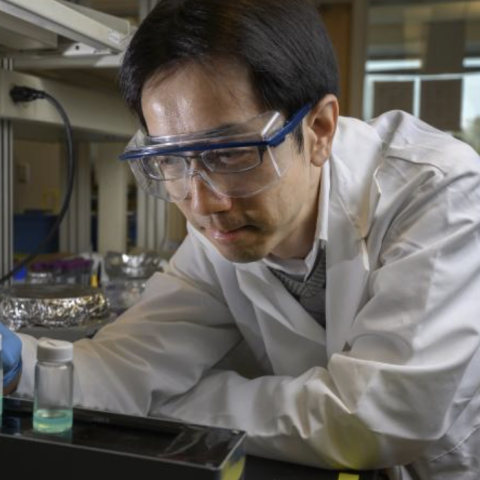
Faisal Alamgir
Energy Conversion, energy storage, nanomaterials, optical materials, photovoltaics, catalysis, electrical grid, energy storage
Dr. Deo came to Georgia Tech in August 2007 as an Assistant Professor of Nuclear and Radiological Engineering. Prior, he was a postdoctoral research associate in the Materials Science and Technology Division of the Los Alamos National Laboratory. He studied radiation effects in structural materials (iron and ferritic steels) and nuclear fuels (uranium dioxide). He also obtained research experience at Princeton University (Mechanical Engineering), Lawrence Livermore National Laboratory, and Sandia National Laboratories.
Nuclear; Thermal Systems; Materials In Extreme Environments; computational mechanics; Materials Failure and Reliability; Ferroelectronic Materials; Materials Data Sciences
Marilyn Brown is a Regents' and Brook Byers Professor of Sustainable Systems in the School of Public Policy. She joined Georgia Tech in 2006 after a distinguished career at the U.S. Department of Energy's Oak Ridge National Laboratory, where she led several national climate change mitigation studies and became a leader in the analysis and interpretation of energy futures in the United States.
Her research focuses on the design and impact of policies aimed at accelerating the development and deployment of sustainable energy technologies, with an emphasis on the electric utility industry, the integration of energy efficiency, demand response, and solar resources, and ways of improving resiliency to disruptions. Her books include Fact and Fiction in Global Energy Policy (Johns Hopkins University Press, 2016), Green Savings: How Policies and Markets Drive Energy Efficiency (Praeger, 2015), and Climate Change and Global Energy Security (MIT Press, 2011). She has authored more than 250 publications. Her work has had significant visibility in the policy arena as evidenced by her numerous briefings and testimonies before state legislative bodies and Committees of both the U.S. House of Representatives and Senate.
Dr. Brown co-founded the Southeast Energy Efficiency Alliance and chaired its Board of Directors for several years. She has served on the Boards of the American Council for an Energy-Efficient Economy and the Alliance to Save Energy, and was a commissioner with the Bipartisan Policy Center. She has served on eight National Academies committees and is an Editor of Energy Policy and an Editorial Board member of Energy Efficiency and Energy Research and Social Science. She served two terms (2010-2017) as a Presidential appointee and regulator on the Board of Directors of the Tennessee Valley Authority, the nation’s largest public power provider. From 2014-2018 she served on DOE’s Electricity Advisory Committee, where she led the Smart Grid Subcommittee.
Hydrogen Equity; ClIMaTe/Environment; Electrical Grid; Policy/Economics; Energy & Water
Fedorov's background is in thermal/fluid sciences, chemical reaction engineering as well as in applied mathematics. His laboratory works at the intersection between mechanical and chemical engineering and solid state physics and analytical chemistry with the focus on portable/ distributed power generation with synergetic CO2 capture; thermal management of high power dissipation devices and electronics cooling; special surfaces and nanostructured interfaces for catalysis, heat and moisture management; and development of novel bioanalytical instrumentation and chemical sensors. Fedorov joined Georgia Tech in 2000 as an assistant professor after finishing his postdoctoral work at Purdue University.
Heat Transfer; power generation; CO2 Capture; Catalysis; fuel cells; "Fedorov's research is at the interface of basic sciences and engineering. His research portfolio is diverse, covering the areas of portable/ distributed power generation with synergetic carbon dioxide management, including hydrogen/CO2 separation/capture and energy storage, novel approaches to nanomanufacturing (see Figure), microdevices (MEMS) and instrumentation for biomedical research, and thermal management of high performance electronics. Fedorov's research includes experimental and theoretical components, as he seeks to develop innovative design solutions for the engineering systems whose optimal operation and enhanced functionality require fundamental understanding of thermal/fluid sciences. Applications of Fedorov's research range from fuel reformation and hydrogen generation for fuel cells to cooling of computer chips, from lab-on-a-chip microarrays for high throughput biomedical analysis to mechanosensing and biochemical imaging of biological membranes on nanoscale. The graduate and undergraduate students working with Fedorov's lab have a unique opportunity to develop skills in a number of disciplines in addition to traditional thermal/fluid sciences because of the highly interdisciplinary nature of their thesis research. Most students take courses and perform experimental and theoretical research in chemical engineering and applied physics. Acquired knowledge and skills are essential to starting and developing a successful career in academia as well as in many industries ranging from automotive, petrochemical and manufacturing to electronics to bioanalytical instrumentation and MEMS."
Professor C. P. Wong is the Charles Smithgall Institute Endowed Chair and Regents’ Professor. After his doctoral study, he was awarded a two-year postdoctoral fellowship with Nobel Laureate Professor Henry Taube at Stanford University. Prior to joining Georgia Tech, he was with AT&T Bell Laboratories for many years and became an AT&T Bell Laboratories Fellow in 1992.
His research interests lie in the fields of polymeric materials, electronic packaging and interconnect, interfacial adhesions, nano-functional material syntheses and characterizations. nano-composites such as well-aligned carbon nanotubes, grahenes, lead-free alloys, flip chip underfill, ultra high k capacitor composites and novel lotus effect coating materials.
He received many awards, among those, the AT&T Bell Labs Fellow Award in 1992, the IEEE CPMT Society Outstanding Sustained Technical Contributions Award in 1995, the Georgia Tech Sigma Xi Faculty Best Research Paper Award in 1999, Best MS, PhD and undergraduate Thesis Awards in 2002 and 2004, respectively, the University Press (London) Award of Excellence, the IEEE Third Millennium Medal in 2000, the IEEE EAB Education Award in 2001, the IEEE CPMT Society Exceptional Technical Contributions Award in 2002, the Georgia Tech Class of 1934 Distinguished Professor Award in 2004, Outstanding Ph.D. Thesis Advisor Award in 2005, the IEEE Components, Packaging and Manufacturing Technology Field Award in 2006, the Sigma Xi’s Monie Ferst Award in 2007, the Society of Manufacturing Engineers (SME)’s TEEM Award in 2008, the 2009 IEEE -CPMT David Feldman Outstanding Contribution Award and the 2009 Penn State University Distinguished Alumni Award. The 2012 International Dresden Barkhausen Award (Germany).
He holds over 65 U.S. patents, numerous international patents, has published over 1000 technical papers, 12 books and a member of the National Academy of Engineering of the USA since 2000.
Materials for energy conversion and storage. Polymer sustainability, polymer degradation, polymer recycling & upcycling Polymer physics, solution processing of polymers, polymer architecture effects Polymer- and nanoparticle-based electrical & optical nanomaterials Liquid state theory, molecular simulations, and statistical mechanics Developing machine learning interaction potentials to predict the properties and phase behavior of fluids and materials
Martin Maldovan is an associate professor in the School of Chemical and Biomolecular Engineering and the School of Physics at the Georgia Institute of Technology. He received his Ph.D. at the Massachusetts Institute of Technology (MIT) in the Department of Materials Science and Engineering. He was also a postdoctoral associate and research scientist at MIT. Maldovan’s group is developing novel heat and mass transport processes as an enabling technology for energy converter materials and devices, micro and nanoelectronics, chemical and biological separations, and catalysis. His group focuses on designing, predicting, and controlling heat and mass transfer in rationally engineered systems with length scales ranging from macro to nano, to advance new paradigms for energy saving materials and devices.
Thermal Management; Energy Storage; Energy Conversion; Thermal Systems
Ajeet Rohatgi received the B.S. (E.E.) degree from Indian Institute of Technology in 1971, the M.S. (Materials Engineering) from Virginia Polytechnic Institute and State University in 1973, and the Ph.D. in Metallurgy and Materials Science from Lehigh University in 1977. He joined the Westinghouse Research and Development Center in Pittsburgh, Pennsylvania in 1977 and became a Westinghouse Fellow while working on the science and technology of photovoltaic and microelectronic devices. Rohatgi joined the ECE faculty at Georgia Tech in 1985 and started a program on photovoltaics, which has become one of the best in the country. He has become an internationally recognized leader in photovoltaics. He is the founding director of the first university-based DOE Center of Excellence in Photovoltaic Research and Education. He is the author of more than 300 publications and holds 10 U.S. patents. Rohatgi has received numerous awards and distinctions from professional societies and Georgia Tech. He is the founder and CTO for Suniva.
silicon devices; solar cells; dielectrics; Compund Semiconductors; solar energy
Gleb Yushin is a Professor at the School of Materials Science and Engineering at Georgia Institute of Technology and a Co-Founder of several companies, including Sila Nanotechnologies, Inc.. For his contributions to materials science, Yushin has received numerous awards and recognitions, including Kavli Fellow Award, R&D 100 Award (Y-Carbon's application), Honda Initiation Grant Award, National Science Foundation CAREER Award, Air Force Office of Scientific Research Young Investigator Award, and several distinctions from National Aeronautics and Space Administration (NASA), such as Nano 50 Award. Dr. Yushin has co-authored over 30 patents and patent applications, over 100 invited presentations and seminars and over 100 publications on nanostructured Electronic Materials related applications, including papers in Science, Nature Materials and other leading journals. His current research is focused on advancing energy storage materials and devices for electronics, transportation and grid applications.
CharacterizationMeasurementsPhotovoltaicsPolymersProcessing, Fabrication, & ManufacturingSynthesis
Zhiqun Lin is currently Professor of Materials Science and Engineering at the Georgia Institute of Technology. His research focuses on nanostructured functional materials (NanoFM). An extensive list of materials currently under investigation in his group includes polymer-based nanocomposites, block copolymers, polymer blends, conjugated polymers, quantum dots (rods, tetrapods, wires), magnetic nanocrystals, metallic nanocrystals, semiconductor metal oxide nanocrystals, ferroelectric nanocrystals, multiferroic nanocrystals, upconversion nanocrystals, thermoelectric nancrystals, core/shell nanoparticles (nanorods), hollow nanocrystals, Janus nanocrystals, nanopores, nanotubes, hierarchically structured and assembled materials, and semiconductor organic-inorganic nanohybrids.
The goal of his research is to understand the fundamentals of these nanostructured materials. His group intends to create these nanostructures in a precisely controllable manner and to exploit the structure-property relationships in the development of multifunctional materials for potential use in energy conversion (e.g., solar cells, photocatalysis, and hydrogen generation) and storage (e.g., batteries), electronics, optics, optoelectronics, magnetic materials and devices, nanotechnology, and biotechnology.
Nanocomposites; Polymeric Composites; Polymers; Nanocrystals; Self-Assembly; Solar Cells; Batteries; Composites; Nanostructures; Electronics; Energy Storage