
The State of Performance Art and Interactive Technology Workshop
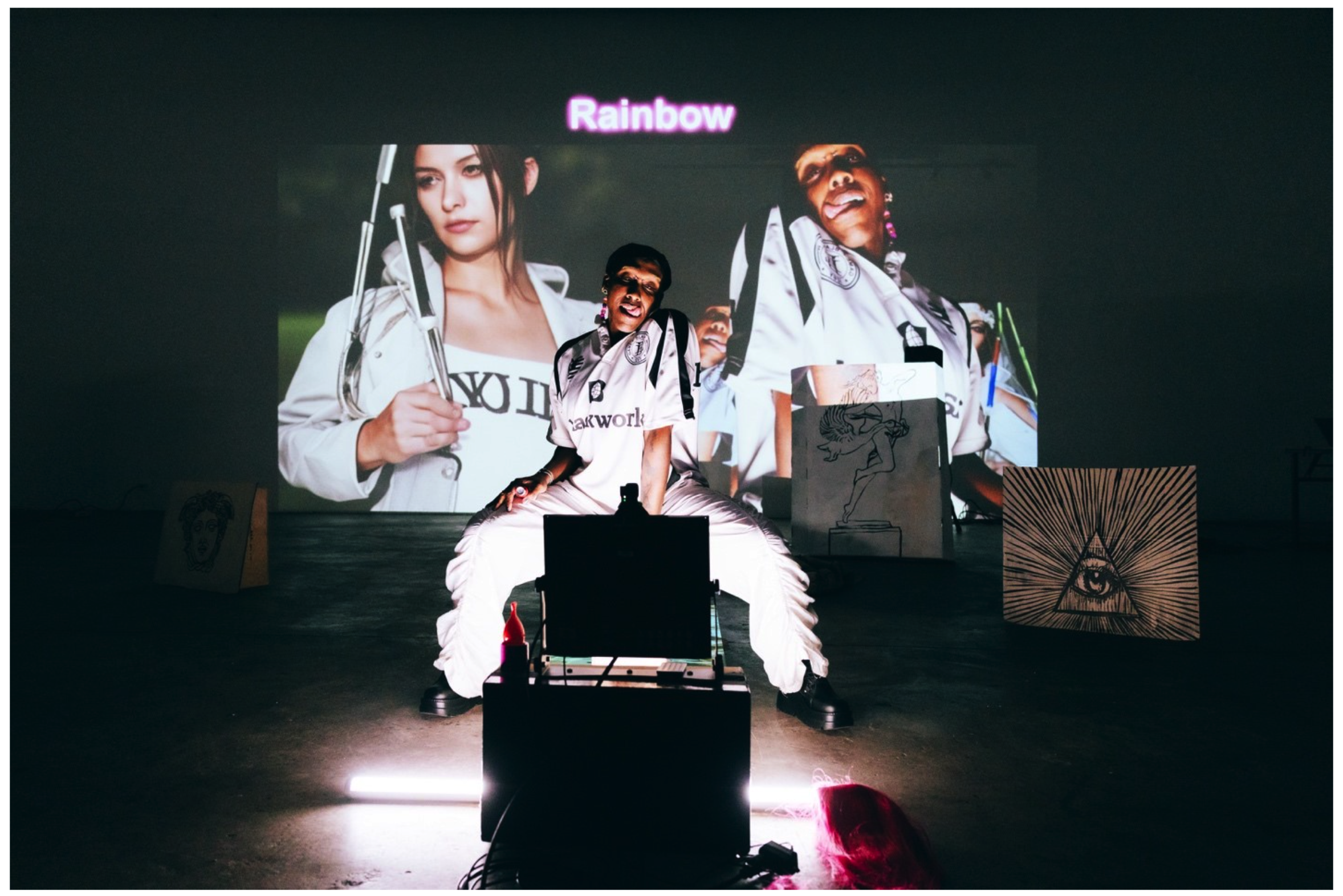
Still from Cyborg Mirror performance. Cyborg Mirror Director: Katherine Helen Fisher with Safety Third Performers: Jae Neal and Katherine Helen Fisher Creative Technologists: Mingyong Cheng and Shimmy Boyle Performer: Jae Neal Visual Décor: C. Finley Photographer: Anastasia Velicescu
UbiComp/ISWC 2025 features Workshops and Tutorials (at Undergraduate Centre, Otakaari 1, 02150 Espoo)
The State of Performance Art and Interactive Technology will be held in Room U9 271
Schedule
10AM-10:30AM - Coffee
10:30AM-12PM Paper Session
Artists’ Perspectives on an AI-Powered System for Enhancing Art Exhibitions
We present our preliminary findings from an ongoing study aimed at developing an Artificial Intelligence (AI )-powered system that incorporates artists’ input to facilitate meaningful, conversational interactions about artworks, going beyond traditional labels and fostering connections between exhibition visitors and artists. Findings from the formative evaluation of the proposed system with artists (N=5) who hold a neutral attitude toward AI suggests that the system has the potential to expand access to and expression of art, act as an agent on behalf of artists, and fit well within their current exhibition practices. These findings may also inform the integration of AI into other artistic practices, including performance art. Based on these findings we discuss the need for educational efforts to expand artists’ understanding of AI capabilities beyond generative tools and implications for the future design of the proposed system in terms of preserving artists’ authentic voice and supporting multilingual accessibility.
Interactivity as Embodied Engagement in Lamentation: Dancing the Archive
This paper describes the creative process for "Lamentation: Dancing the Archive," which transforms Martha Graham's iconic 1930 solo, "Lamentation," into an interactive installation that enables audiences to experience this historic work through embodied engagement. Using volumetric video capture and gesture-based interaction, the project allows viewers to control and explore the performance through their own movements, creating an intimate, physical relationship with archival choreographic material. This work demonstrates how interactive technology can unlock embodied connections with dance archives, proposing that engaging users' kinesthetic capacities alongside visual perception can yield meaningful experiences with historical works and expand traditional approaches to digital humanities and archival practice.
Dan-sco: Real-Time Dance-Music Composition Using Wearable Soft Sensors
Dan-sco is a live performance system that integrates wearable soft sensors with contemporary dance to enable real-time sound generation through body movement. The project features two custom designed garments—vibrant red and blue costumes—embedded with soft sensors fabricated via embroidery, knitting, and painting techniques. Each costume captures different forms of bodily gestures and maps them to algorithmically generated music, allowing performers to compose sound through motion. In this paper, we describe the iterative design and prototyping process, outline the system’s technical implementation, and share insights from its public deployment in both gallery and stage settings. We also reflecton the challenges of translating embodied movement into musical parameters, and offer practical recommendations for integrating wearable technologies into performative arts.
The Spirit of Kangie
The Spirit of Kangie case study leveraged volumetric capture to recontextualize dancing. The original project, Spirit of Obon, extends choreographer Nobuko Miyamoto’s original intent behind "Kangie" (meaning "gathering of joy") to bring people together after the COVID-19 pandemic. Bon Odori is a participatory circular dance performed communally during the Japanese and Japanese American Obon Festival commemorating ancestors. At annual pilgrimages to Japanese American incarceration sites Bon Odori is performed to remember Japanese Americans who were illegally incarcerated during World War II.
The vol-cap performances of Nobuko Miyamoto, Chie Saito, and Lani Yamanaka at Metastage Studio, a Microsoft Mixed Reality capture studio, transformed a traditional Obon dance into multiple projects. Multiple archives of the artists’ performances were created to optimize the original assets to evolve into a microfilm, a portable 3D holographic display and wearable AR dance. This case study examines how 3D assets have facilitated a transplanted dance pilgrimage when faced with considerable constraints - financial and environmental while considering accessibility. The authors of this paper alongside other creative collaborators created experiences highlighting the importance of Japanese American community dancing, digital cultural preservation and interactive dance education with motion capture, holographic, wearable and ubiquitous technologies.
Snakeskin in the Wild: A Multi-Sensor Framework for Performance Art
This paper presents a lightweight software framework for synchronizing heterogeneous, wearable biometric devices during live performance. Developed within the five year interdisciplinary project Neurolive, an interdisciplinary research collaboration that brings artists, scientists and audiences together to investigate “liveness,” the framework enables multiple EEG (Electroencephalogram) headsets, eye tracking glasses, and other sensors to stream in real time over a unified clock. The third version of the system was built for Neurolive’s third performance: “~ snakeskin in the wild ~” *created by Dog Kennel Hill Project (artists Ben Ash, Heni Hale and Rachel Lopez de la Nieta). Here are some creative interactions that emerged from this collaboration: (1) a stage adapted P300 routine, (2) a spatialized EEG sonification sound scape, and (3) audio cues to section the performance. We describe the concept, technical architecture, and artistic motivations, highlighting how the design prioritizes reliability, performer mobility, and network scalability inside a mid sized black box venue. Field observations reveal practical challenges—setting up the EEG to stream via LSL, calibration drift—and the tactics adopted to maintain a “seamless” aesthetic. We conclude with lessons learned and recommendations for creators seeking to incorporate large scale biosensing into immersive performance.
12PM-2PM Lunch
3:15PM-4:45PM Paper Session
Cyborg Mirror: a techno-feminist choreographic interface
This paper presents Cyborg Mirror: a techno-feminist choreographic interface, an interactive performance that uses real-time generative AI and audience participation to explore how identity and embodiment are co-constructed in technologically mediated environments. Drawing on cyborg feminism, posthuman theory, and feminist performance art traditions, the project disrupts binaries such as human/machine and physical/virtual to reimagine identity as fluid, hybrid, and relational. Through a dual-mirror system that transforms performers' bodies via AI-driven visuals and audience-submitted prompts, the work creates a dynamic feedback loop where embodiment, agency, and control are continuously negotiated. The paper outlines the theoretical frameworks, technical implementation, and audience engagement strategies that shape the project, while reflecting on public presentations and the emotional and critical responses they elicited. By positioning the femme body as both vulnerable and resistant within AI systems, Cyborg Mirror raises urgent questions about agency, transformation, and self-representation in the posthuman era.
BODY / NOT BODY - A Simulation of Self
This paper presents BODY / NOT BODY , a durational performance installation in which the artist engages in a two-hour unscripted conversation with a real-time, AI-driven simulation of himself. The work explores whether and how human identity can be simulated using AI in 2025. Audience members submit text prompts that the performer is required to speak aloud to the simulation, provoking responses that loop between human and digital self. While initially conceived as a technical challenge, the scope rather expanded as things developed into a larger exploration of philosophical questions surrounding the fluidity of identity, who we are to ourselves and others, the impossibility of being objective about oneself, technical gaps and the truths they expose, and how little might be needed in the space of an interaction to effectively evoke at least the gist of one’s identity. Through iterative prototyping combining voice cloning, fine-tuned large language models (LLMs), and a custom avatar, the project reveals that the gaps, failures, and uncanny moments in AI-driven self-simulation are
Workshopping Creative Interactive Experiences
Bringing people together with the goal of creating an interactive performance concept can be a daunting task. Even if everyone shows up with a collaborative spirit, differences in disciplines and openness to outside-the-box flow can stall the creative process. Finding inspiration from technical elements rather than limitations is key. We highlight a case study here in which we used an abstract art exercise to open up creative flow and level the field of discussion. We then give a brief description of the concept arising from the exercise currently in development.
Choosing the Right Equipment Balancing Equipment Cost and Project Sustainability for the Story Booth
In this workshop paper, we present the work choosing and implementing hardware for a techno-artistic project called “Story Booth”, which features a mobile recording booth outfitted with lighting and recording equipment. We describe a broad overview of the project and present our guiding themes behind hardware decisions of reuse, robustness and flexibility. For each theme we provide sample outcomes of our decision-making process. We conclude with a reflection on the benefits of our approach, which lead to higher initial investment in robust industrial equipment but has yielded an easy-to-use and easy-to-develop system with components that will continue providing value far beyond the initial project investment.
Show and Tell (30 min)
4:45PM – 5:15PM Coffee Break
5:15PM – 6:45PM Performance and Discussion
Reconfiguring Agency in the Age of Algorithmic Control: A Performance Lecture ("Sour Gummies Don't Cry")
Where is our agency in the age of algorithms? This paper investigates how algorithmic systems use the illusion of agency as a contemporary mechanism of control, framing human bodies as both working machines and sites for data extraction. Bodies are simultaneously reduced into data points and multiplied through digital identity labor, resulting in splintered selves and fragmented agency. With the rise of so-called "AI agents," human agency enters a deeper crisis. Drawing on Cyberfeminist theories, particularly Lucy Suchman’s work on feminist reconfigurations in technology design, this study and performance explore how agency is always in flux—relational, contextual, and reconfigurable.
To practice reconfigured agency, I present an experimental performance lecture ("Sour Gummies Don't Cry") using interactive technology. During the 20-minute performance, audience participants gain real-time control of a performer-lecturer (myself) via a custom web-based application, while the performer-lecturer recites a speech on human agency. This format demonstrates the tension between individual autonomy and systemic control while enacting a shared, fluid agency, emerging from the continuous, dynamic interactions.
Discussion (30min)


