
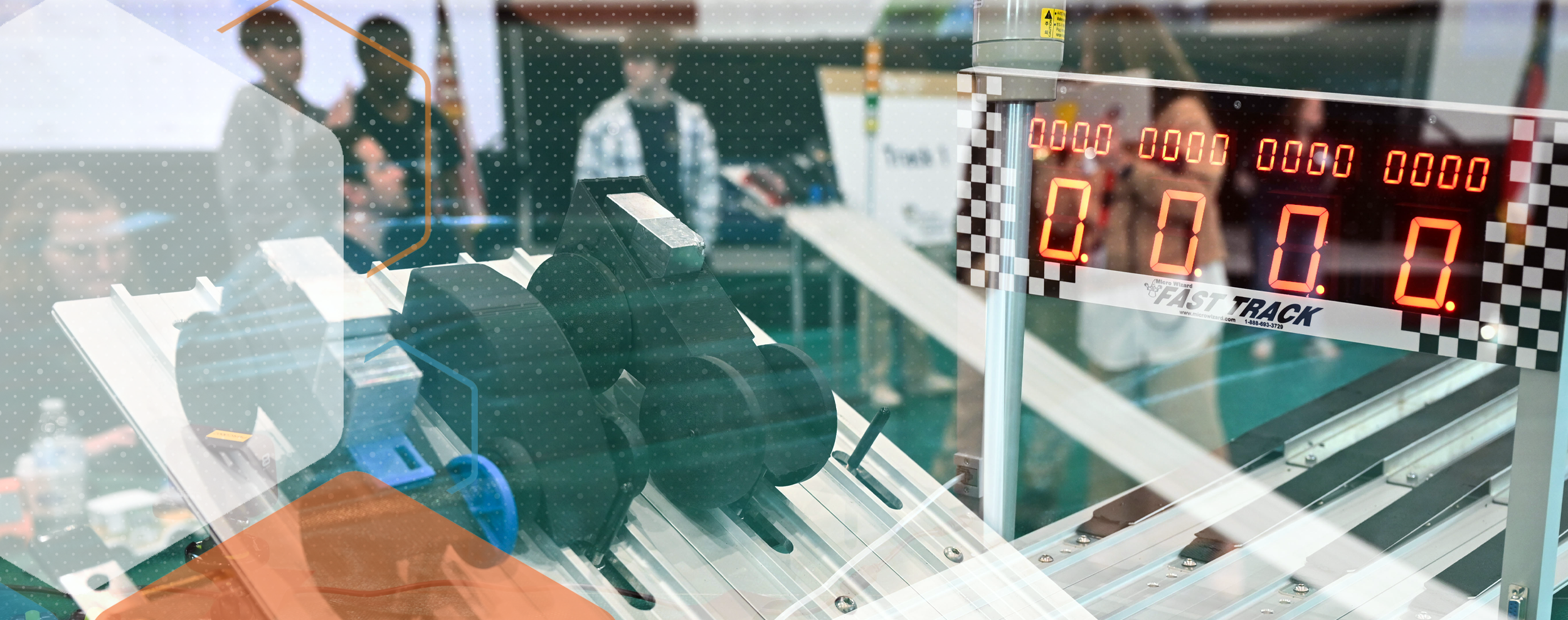
Southwest Georgia Students Put New Manufacturing Skills to the Test in Tri‑District Race
Georgia Tech’s Advanced Manufacturing Pathways program brought three school districts together for a hands‑on competition in Bainbridge, highlighting early progress in workforce development and the program’s expansion to six schools.
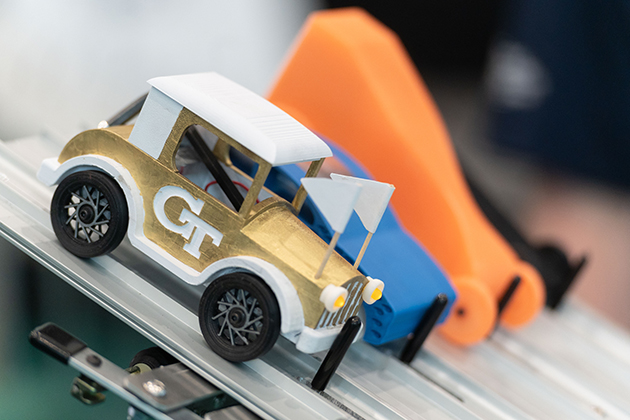
Custom 3D‑printed and machined cars wait at the starting line as students from three Southwest Georgia schools prepare to race.
Magic usually lives in storybooks and movie scenes. But in one Thomasville, Georgia, classroom, a 10th grader found a different kind of magic: the kind that hums from a 3D printer and turns an idea into something real.
“You can build something online and then make it in real life with the click of a button,” beamed Lauren Meehan, holding a pinewood derby-style car that she designed and manufactured herself. “It's almost like bringing cartoons to life.”
Lauren is one of more than 250 students who built a car of their own design as part of the first cohort of Georgia Tech’s Advanced Manufacturing Pathways (AMP) program. AMP connects local educators with Georgia Tech expertise to introduce high school students to advanced manufacturing. The course’s signature project challenges students to engineer the fastest possible car from the ground up, learning programming, digital design, data analysis, and machining along the way.
Students from the program’s inaugural high schools — Bainbridge, Thomas County Central, and Thomasville City — recently gathered in Bainbridge, Georgia, to race their creations head-to-head in AMP’s first tri-district competition.
“A year ago, this was just a crazy idea we had,” says Kyle Saleeby, a research engineer at the Georgia Tech Manufacturing Institute (GTMI) and one of the program’s key developers. “It’s truly amazing to see it all come together at an event like this and impact so many students.”
“You can build something online and then make it in real life with the click of a button. It's almost like bringing cartoons to life.” –Lauren Meehan, Thomasville City City High School
A Community Effort
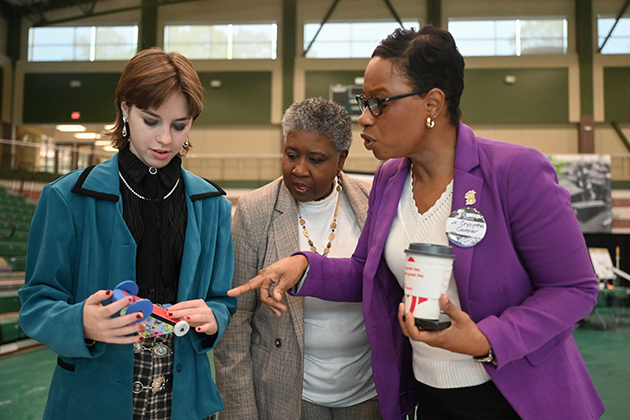
Thomasville City student Lauren Meehan shows her car to Sylvia Washington (center), the newly elected mayor of Bainbridge, and Crycynthia Gardner (right), a Decatur County Board of Education member, during the regional race event. Meehan’s car won Best in Show at her school’s competition.
The race was a true celebration of the collaborative effort it took to launch the program and guide its first cohort across the finish line. It also gave students a chance to show off their creations to the community that has cheered them on from day one.
Southern Regional Technical College played a central role by hosting the event, a commitment that came easily, according to Vice President for Academic Affairs Mason Miller. “Any time we get an opportunity to get students on campus to talk about the things that excite them, that's a positive for everybody,” he said. Flowers Foods Inc. added to the celebration by donating food for the day, helping transform the race into a full community gathering.
As the heats began, teachers, school superintendents, regional partners, and even the newly elected mayor of Bainbridge filled the room to cheer for the custom‑built cars on the track. The support reflected a shared commitment to growing talent in Southwest Georgia.
“Because we're from a rural area, we believe you have to fertilize not just your fields, but the fields around you,” says Amy Zock, director of Instructional and Innovative Technology at Decatur County Schools. “The more schools that get involved, the more that they do, the better our students will be.”
A Homegrown Future
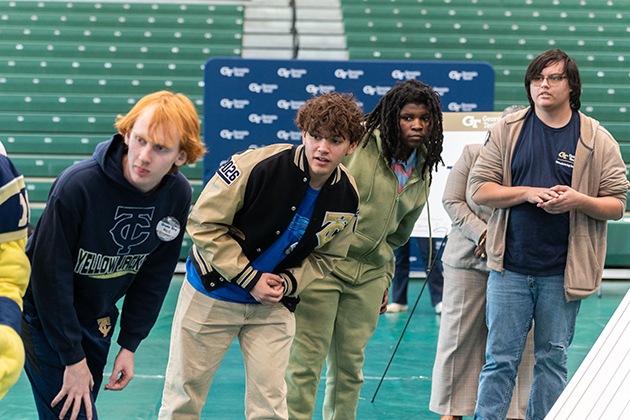
Months of work came down to less than three seconds as students watched their cars race through the final heats. While Jared Castillo (center left) ultimately posted the fastest time, the moment belonged to all the students who brought their designs to life.
That kind of excitement is crucial for people like Matthew Hilliard, a plant manager at Danimer Scientific in Bainbridge. Hilliard grew up in Southwest Georgia and always hoped to build his career close to home. But he also knows small‑town life isn’t for everyone. In his time at Danimer, several young engineers have left the area after just a year or two.
By exposing students to engineering pathways early, Hilliard hopes that programs like AMP will create the skilled workforce companies look for, ultimately bringing more industries to the area. “If a program like this is able to highlight the potential engineering pathways and really develop talent in Southwest Georgia, you’re more likely to want to come back to continue to develop your career here.”
One of those budding engineers is Jared Castillo from Thomas County Central High School. Castillo grew up watching his brother tinker with computers and robotics and jumped at the chance to dive into engineering firsthand.
“When I started modeling my cars on the CAD software, it all just clicked for me,” he says. “I just knew I wanted to go into that in the future.”
Castillo’s hard work paid off, earning him first runner‑up for Best Engineered Car and the fastest overall time at the tri‑district race. This fall, he will bring that same drive to Georgia Tech, where he plans to pursue computer engineering — drawn in part by the supportive, collaborative spirit he experienced during campus visits and through the AMP program.
Between free makerspaces and the culture of collaboration he saw among students, Castillo said, “It amazes me how much everybody else wants everybody to succeed” at Tech.
“Because we're from a rural area, we believe you have to fertilize not just your fields, but the fields around you. The more schools that get involved, the more that they do, the better our students will be.” –Amy Zock, Decatur County Schools
The Next Starting Line
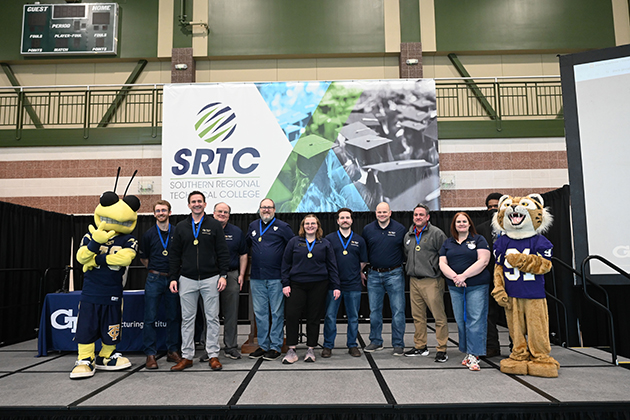
The instructional team behind the AMP program provided the structure, mentorship, and momentum that helped bring the pilot to life across three Southwest Georgia schools. From left to right: from left to right: Kyle Saleeby, Georgia Tech; Lukas Berg, Georgia Tech; Sean Mulvanity, GTRI; Mark Thompson, Thomas County Central High School; Maegan Lenertz, Georgia Tech; Matt Kosmala, Georgia Tech; Steven Ferguson, Georgia Tech; Matt Kirkley, Thomasville City High School; Beka Shiver, Southwest Georgia Regional Commission; and Mac Lewis, Bainbridge High School.
Classes for the second cohort are already underway. The program has now expanded to include three more Southwest Georgia schools, doubling its reach and giving even more students access to hands-on, advanced manufacturing education. Sean Mulvanity hopes to see that momentum build.
“In our first year of the Rural Computer Science Initiative, we were in eight districts. We’ve since ramped up to 50,” says Mulvanity, one of the leaders of the Center for Education Integrating Science, Mathematics, and Computing (CEISMC) and STEM@GTRI’s Rural Computer Science Initiative, which served as the blueprint for AMP. “We hope we can follow that same pathway of success with this program.”
Georgia Tech alumnus Paul Fryer, deputy district director for U.S. Rep. Sanford Bishop, attended the race to show support. As manufacturing technology advances, Fryer sees programs like AMP as “necessary for us to compete in a global economy” and hopes to see them grow in the region.
“We’re replacing old technology with better technology, and our students have to be equipped to compete and get those jobs.”

Writer: Audra Davidson
Media Contact: Jennifer Martin | jennifer.martin@research.gatech.edu
Photos: Allison Carter
Video: Christopher McKenney
Copy Editor: Stacy Braukman
About the Advanced Manufacturing Pathways Program
The Advanced Manufacturing Pathways (AMP) program is a Georgia Tech initiative that introduces high school students to modern manufacturing through hands‑on learning in programming, digital design, data analysis, 3D printing, and machining. Led by the Georgia Tech Manufacturing Institute in partnership with STEM@GTRI, AMP builds on the success of Georgia Tech’s Rural Computer Science Initiative. Funded in part by the Southwest Georgia Regional Commission and Georgia AIM, the program launched in August 2025 with three pilot high schools and more than 250 students. AMP’s mission is to prepare students for high‑demand engineering.
Award Winners
Race Results
- 1st Place: Jared Castillo, TCCHS
- 2nd Place: Justin Weldon, TCCHS
- 3rd Place: Brooks Bone TCCHS
Best Engineering
- Winner: Brooks Bone, TCCHS
- 1st Runner Up: Jared Castillo, TCCHS
- 2nd Runner Up: Andrew Nissley, TVCHS
Best in Show
- Winner: Noelani Woodham, BHS
- 1st Runner Up: Samaria Harris, TVCHS
- 2nd Runner Up: Lauren Meehan, TVCHS
People’s Choice Award
- Winner: George Everett, TVCHS
- 1st Runner Up: August Johnson, TCCHS
- 2nd Runner Up: Brooks Bone, TCCHS
 How a Race Car Project Is Transforming Rural STEM Education
 Advanced Manufacturing Takes Off in Georgia Classrooms
 Manufacturing’s Future Is High Tech


