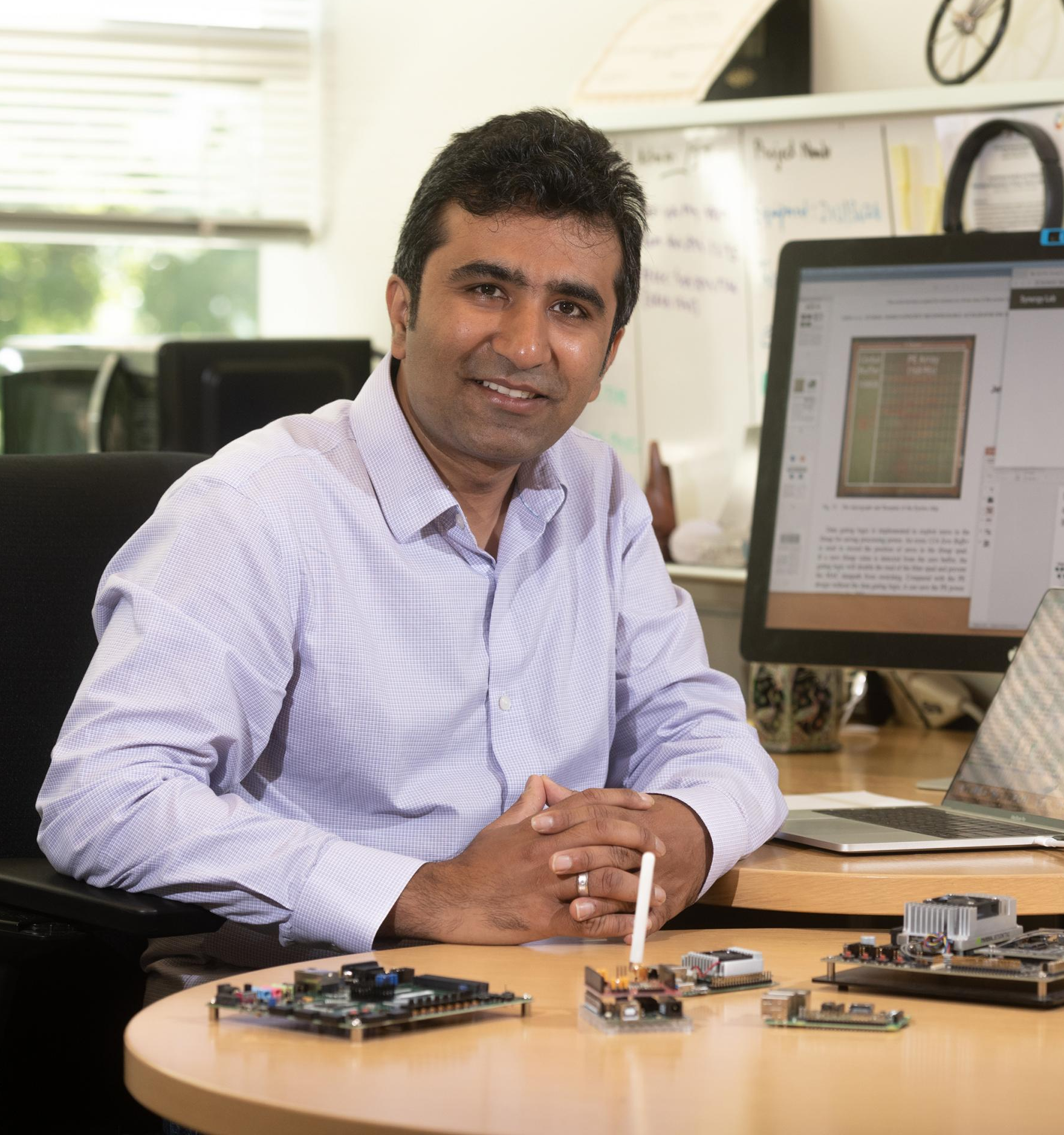
Tushar Krishna

Tushar Krishna
tushar@ece.gatech.edu
ECE Profile Page

Tushar Krishna is an Associate Professor in the School of Electrical and Computer Engineering at Georgia Tech. He also holds the ON Semiconductor Junior Professorship. He has a Ph.D. in Electrical Engineering and Computer Science from MIT (2014), a M.S.E in Electrical Engineering from Princeton University (2009), and a B.Tech in Electrical Engineering from the Indian Institute of Technology (IIT) Delhi (2007). Before joining Georgia Tech in 2015, Krishna spent a year as a researcher at the VSSAD group at Intel, Massachusetts.

Krishna’s research spans computer architecture, interconnection networks, networks-on-chip (NoC) and deep learning accelerators – with a focus on optimizing data movement in modern computing systems. Three of his papers have been selected for IEEE Micro’s Top Picks from Computer Architecture, one more received an honorable mention, and three have won best paper awards. He received the National Science Foundation (NSF) CRII award in 2018, a Google Faculty Award in 2019, and a Facebook Faculty Award in 2019 and 2020.

ON Semiconductor Junior Professor, School of Electrical and Computer Engineering
Phone
404.894.9483
Office
Klaus 2318
Additional Research

Networks-on-Chip (NoC)Interconnection NetworksReconfigurable Computing and FPGAsHeterogeneous ArchitecturesDeep Learning Accelerators

Google Scholar
https://scholar.google.com/citations?hl=en&user=P__ztgcAAAAJ&view_op=list_works&sortby=pubdate
LinkedIn Personal Research Site
Tushar
Krishna
Show Regular Profile

Milos Prvulovic

Milos Prvulovic
milos@cc.gatech.edu
Website
Milos Prvulovic, Ph.D., is a professor in the School of Computer Science, College of Computing at the Georgia Institute of Technology. His research focuses on hardware and software support for program monitoring, debugging, and security. His research of side-channel emmanations and side-channel attacks has led to widespread interest from professional societies, the media and additional reserach sponsors -- most recently attracting a $9.4 million award from the Defense Advanced Research Projects Agency (DARPA) for continued study. In general, the goal of his research is to make both hardware and software more reliable and secure. Prvulovic is a senior member of Association of Computing Machinery (ACM) and Institute of Electrical and Electronics Engineers (IEEE), served as the chair of the IEEE Technical Committee on Microprogramming and Microarchitecture in 2016, and is a member of the Steering Committee for the ACM/IEEE MICRO conference. Prvulovic received his doctorate from the University of Illinois at Urbana-Champaign.
Professor
Phone
404.385.6364
Office
KACB 2332
Milos
Prvulovic
Show Regular Profile

David S. Citrin

David S. Citrin
david.citrin@ece.gatech.edu
Website

Professor Citrin earned a B.A. from Williams College (1985) and a M.S. (1987) and a Ph.D. (1991) from the University of Illinois, all in physics, where his dissertation was on the optical properties of semiconductor quantum wires. Subsequently, he was a post-doctoral research fellow at the Max Planck Institute for Solid State Research, Stuttgart, Germany (1992-1993) and Center Fellow at the Center for Ultrafast Optical Science at the University of Michigan (1993-1995). Dr. Citrin was an assistant professor of physics and materials science at Washington State University (1995 to 2001).

Professor Citrin joined the faculty at Georgia Tech in 2001 where his work focuses on terahertz technology and nanotechnology. He is a recipient of a Presidential Early Career Award for Scientists and Engineers and of a Friedrich Bessel Award from the Alexander Von Humboldt Stiftung. In addition, he is Project Coordinator on Nonlinear Optics and Dynamics at Georgia Tech-CNRS UMI 2958 located at Georgia Tech-Lorraine. Professor Citrin’s research in terahertz imaging is featured in the Georgia Tech press release, ”Imaging Technique Unlocks the Secrets of 17th Century Artists"; a list of some media placements from the press release may be found at http://photonics.georgiatech-metz.fr/node/33.

Research interests: 

  • Terahertz nondestructive testing of materials
  • Terahertz characterization of art and cultural heritage
  • Chaos and nonlinear dynamics in external-cavity semiconductor lasers
  • Nanophotonics
  • High-speed electronic, photonic, and optoelectronic devices
  • Nonlinear optical properties of semiconductor materials and devices
Professor
Phone
404.894.2000
Office
MIRC 211
David
Citrin
S.
Show Regular Profile

Helen Xu

Helen Xu

Helen Xu comes to Georgia Tech from Lawrence Berkeley National Laboratory where she was the 2022 Grace Hopper Postdoctoral Scholar. She completed her Ph.D. at MIT in 2022 with Professor Charles E. Leiserson. Her main research interests are in parallel and cache-friendly algorithms and data structures. Her work has previously been supported by a National Physical Sciences Consortium fellowship and a Chateaubriand fellowship. She has interned at Microsoft Research, NVIDIA Research, and Sandia National Laboratories. 

Josiah Hester

Josiah Hester

Josiah Hester works broadly in computer engineering, with a special focus on wearable devices, edge computing, and cyber-physical systems. His Ph.D. work focused on energy harvesting and battery-free devices that failed intermittentently. He now focuses on sustainable approaches to computing, via designing health wearables, interactive devices, and large-scale sensing for conservation. 
   

David S. Citrin

David S Citrin

Professor Citrin earned a B.A. from Williams College (1985) and a M.S. (1987) and a Ph.D. (1991) from the University of Illinois, all in physics, where his dissertation was on the optical properties of semiconductor quantum wires. Subsequently, he was a post-doctoral research fellow at the Max Planck Institute for Solid State Research, Stuttgart, Germany (1992-1993) and Center Fellow at the Center for Ultrafast Optical Science at the University of Michigan (1993-1995). Dr. Citrin was an assistant professor of physics and materials science at Washington State University (1995 to 2001).

Arijit Raychowdhury

Artijit Raychowdhury

Arijit Raychowdhury is currently an Professor in the School of Electrical and Computer Engineering at the Georgia Institute of Technology where he joined in January, 2013. He received his Ph.D. degree in Electrical and Computer Engineering from Purdue University (2007) and his B.E. in Electrical and Telecommunication Engineering from Jadavpur University, India (2001). His industry experience includes five years as a Staff Scientist in the Circuits Research Lab, Intel Corporation, and a year as an Analog Circuit Designer with Texas Instruments Inc.

Azad Naeemi

Azad Naeemi

Azad Naeemi received his B.S. degree in electrical engineering from Sharif University, Tehran, Iran in 1994, and his M.S. and Ph.D. degrees in electrical and computer engineering from the Georgia Institute of Technology, Atlanta, Ga. in 2001 and 2003, respectively.

Prior to his graduate studies (from 1994 to 1999), he was a design engineer with Partban and Afratab Companies, both located in Tehran, Iran. He worked as a research engineer in the Microelectronics Research Center at Georgia Tech from 2004 to 2008 and joined the ECE faculty at Georgia Tech in fall 2008.

Saibal Mukhopadhyay

Saibal Mukhopadhyay

Saibal Mukhopadhyay received the bachelor of engineering degree in electronics and telecommunication engineering from Jadavpur University, Calcutta, India in 2000 and the Ph.D. degree in electrical and computer engineering from Purdue University, West Lafayette, IN, in August 2006. He joined the faculty of the Georgia Institute of Technology in September 2007. Mukhopadhyay worked at IBM T. J. Watson Research Center, Yorktown Heights, N.Y. as research staff member from August 2006 to September 2007 and as an intern in summers of 2003, 2004, and 2005.

Sung Kyu Lim

Sung Kyu Lim

Sung Kyu Lim was born and grew up in Seoul, Korea, and moved to Los Angeles with his family at the age of 19. He received B.S. (1994), M.S. (1997), and Ph.D. (2000) degrees all from the Computer Science Department of University of California at Los Angeles (UCLA). During 2000-2001, he was a post-doctoral scholar at UCLA, and a senior engineer at Aplus Design Technologies, Inc. In August 2001, he joined the School of Electrical and Computer Engineering at Georgia Institute of Technology an assistant professor.