
The Ghost of Libraries Past, Present, and Future:
How a Library Research Scientist Is Reshaping
the Future of Work for Book Lovers
The Georgia Tech Library’s Raven Davis turned a lifelong love of books into a career in data analytics. Her work is shaping a future where libraries remain the heart of academic life.
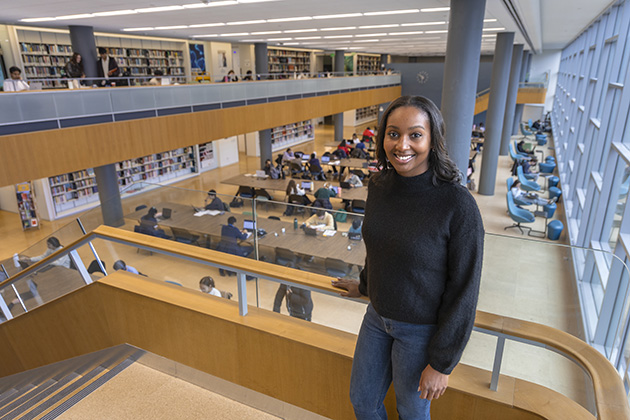
Raven Davis is pictured in the Georgia Tech Library, surrounded by books and students preparing for finals. Her work ensures students have access to the tools and resources they need to succeed.
On a typical afternoon in the Georgia Tech Library, Raven Davis strolls between rows of books and clusters of students hunched over laptops. It’s a campus setting that feels familiar, but her role here is anything but traditional. Davis is the Library’s first research scientist in data analytics, a position that blends instruction, data analysis, and research collaboration in ways that reflect the changing shape of academic libraries.
“Yes, we still have books,” she laughed. “That was quite the campus rumor a few years back, and I can assure you we still have lots of books. But libraries are not just about books. We exist to support our community. That means we enable research, provide access to tools and software, and connect people with resources they need to succeed.”
Davis’ journey to the Library started, as it does for many career librarians, with a childhood love of literature. But her arrival at data science reflects a new reality, and the vast possibilities found at the intersection of knowledge and technology.
“Libraries are not just about books. We exist to support our community. That means we enable research, provide access to tools and software, and connect people with resources they need to succeed.”
Libraries Past
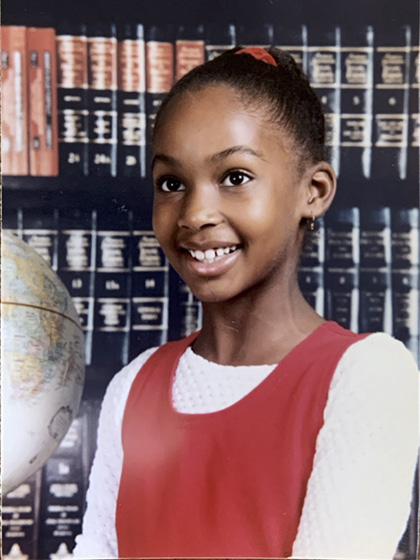
From an early age, Davis found wonder in books – a passion her family nurtured and celebrated.
Davis grew up in Snellville, Georgia, in a home where books were treasured.
“Books were my Christmas presents,” she said. “I was always reading.”
Her childhood was steeped in creativity, from writing her own stories to taking acting classes at Atlanta’s Alliance Theatre. She devoured stories like Mrs. Piggle Wiggle by Betty MacDonald and, later, Sarah Dessen’s young adult novels.
“I still stand by those books,” she said with a smile.
As an undergraduate at Agnes Scott College, Davis majored in English and creative writing. She was interested in computer science but didn’t love math and felt like she had to choose one path or the other. So, she edited Aurora, the campus literary magazine, and interned at Atlanta Magazine. Throughout her studies, she took refuge in the school’s historic McCain Library.
“It’s such a place of comfort,” she said. “They have a huge fireplace, and there are a lot of little nooks and crannies to hide in. They were open 24 hours a day during finals and midterms, so I would be there all night. That was a defining library for me.”
After graduation, Davis worked in publishing and marketing before moving to work in the Gwinnett public library system, a path that felt aligned with her love of literature and learning. She also became a mother. But a chance encounter with an article about predictive analytics and maternal health sparked a new curiosity.
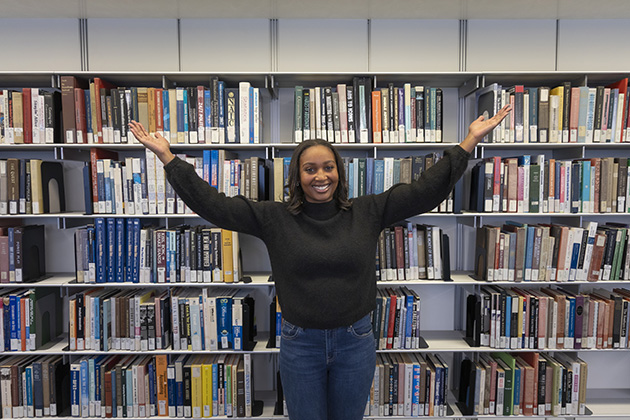
Books have been a constant throughout Davis’ life, and even in her work today as a research scientist, she remains surrounded by them.
“I didn’t know people were doing that with data,” she said. “It really intrigued me.”
Davis began working as a public services associate at the Georgia Tech Library in 2017, and her curiosity about data inspired her to pursue Georgia Tech’s Online Master of Science in Analytics (OMS Analytics).
Balancing full-time work, motherhood, and graduate school was grueling.
“It was a blur — a big, stressful blur,” Davis said. “I had to learn linear algebra from scratch and teach myself to code.”
Late nights, weekends, and study sessions squeezed between shifts at the Library became routine. But to Davis, the analytics program represented more than a degree.
“The OMS programs are equalizers,” she said. “They make advanced education accessible for people who are parents, midcareer professionals, or anyone who cannot do a traditional program.”
“A lot of university libraries are offering more data-centered programming and resources. Libraries are adapting to the needs of the people they serve.”
Libraries Present
Today, Davis is a research scientist in data analytics at the Georgia Tech Library, a first-of-its-kind role created as the Library expands its data services. Her work blends instruction and research: teaching workshops on Python and Tableau, partnering with faculty on data ethics, and analyzing internal library data to improve student outcomes.
Her role also reflects a broader shift in academic libraries nationwide.
“A lot of university libraries are offering more data-centered programming and resources. Libraries are adapting to the needs of the people they serve,” she explained
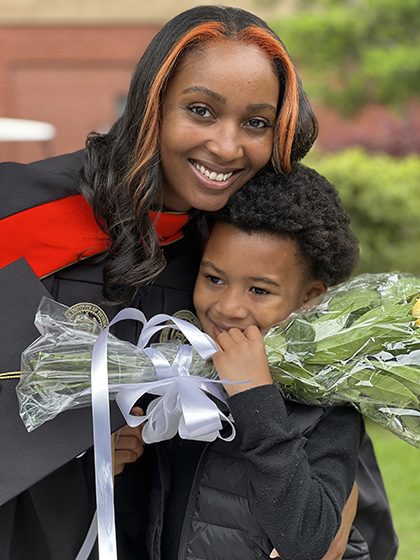
Davis shared a proud moment with her son at her 2024 graduation from Georgia Tech’s OMS Analytics program — a milestone that paved the way for her career as a research scientist at the Library.
One recent project highlights that evolution. Davis analyzed a partnership between the Library and the School of Electrical and Computer Engineering. The Library began offering free checkout of MyDAQ and mbed kits — portable devices that allow students to prototype systems and learn engineering through hands-on experimentation. This equipment previously cost students hundreds of dollars.
“We wanted to see how free tools would affect student performance and to see, through numbers, our real impact on students,” said Davis. “Analysis of this initiative showed an increase of 0.78 grade points for high-risk students who check one of these gadgets out of the Library.”
Given its success, the project is now expanding to evaluate other library resources, such as podcasting equipment.
“We are diving into how these programs affect student grades and outcomes,” said Davis. “It’s a new way to understand the Library’s role in student success.”
Instruction is another cornerstone of Davis’ role. She leads workshops on coding and data visualization, often partnering with faculty across campus. Recently, she co-hosted a session on Python and data ethics with a faculty member from the Institute for People and Technology.
“We used a social justice dataset,” said Davis. “It was a great way to combine technical skills with ethical considerations. Grounding data instruction in real examples makes the process feel more connected to real-world outcomes and emphasizes the importance of ethics in data work.”
These collaborations underscore a common thread Davis sees among research faculty: a commitment to students.
“Even research faculty who are not in classrooms are shaping student journeys.”
“It can be hard to imagine yourself in these data-focused roles if you’ve taken a nontraditional route. But there is so much space for people from different backgrounds in academic settings.”
Libraries of the Future
Davis envisions a future where roles like hers redefine what’s possible in academic library systems — where, by bridging literature and data, knowledge is not only preserved but amplified, shaping how communities learn, connect, and create. She hopes that more people will recognize this intersection as a powerful force for equity, discovery, and the advancement of society, and pursue careers in libraries.
“It can be hard to imagine yourself in these data-focused roles if you’ve taken a nontraditional route,” said Davis. “But there is so much space for people from different backgrounds in academic settings. In the future, we'll see more crossover in roles like mine — people who are from traditional library backgrounds but have technical skills and want to work at a place like Georgia Tech.”
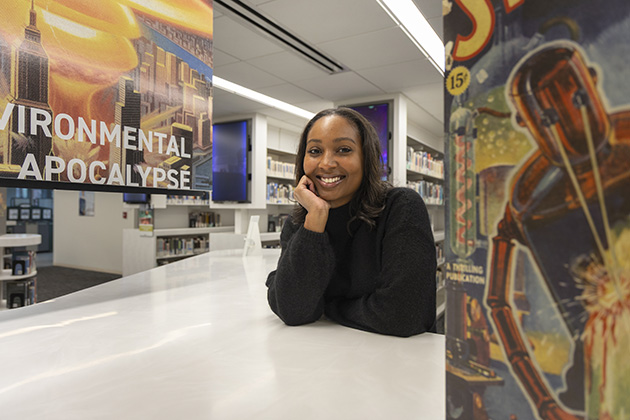
Davis sees libraries as catalysts for progress, blending literature and data to expand access, spark innovation, and empower communities.
Davis’ dream is to one day design library fellowships for students to gain hands-on experience in analytics and to build partnerships with nonprofits and campus departments.
“I would love to ease barriers for students or other staff pivoting into data careers,” she said. “Creating equity and accessibility is important to me.”
Despite her technical focus, Davis’ love of books remains deeply personal. Her current reading list includes fantasy like The Poppy War by R.F. Kuang and The Hundred Thousand Kingdoms by N.K. Jemisin, as well as classics like Tar Baby by Toni Morrison. At home, she shares her love of reading with her son, though his selections lean more toward Pokémon than Toni Morrison.
“If he grows up wanting to read for fun, that is a win,” Davis laughed.
One day, her son might grow up to frequent his public or campus library. It may not have the cozy, quiet academic vibes of the Agnes Scott library, with its Gothic wooden beams, leather chairs, and fireplace. It may look like the soaring modern architecture and sun-filled atria of the Georgia Tech Library — or perhaps something new that has yet to be imagined.
For now, Davis is helping to reimagine what a library can be: an ever-changing resource, rooted in the history of libraries past, serving today’s Georgia Tech, and opening doors to a future where knowledge and data enable limitless possibilities.

Writer and Media Contact: Brittany Aiello, Faculty Communications Program Manager, Executive Communications | brittany.aiello@gatech.edu
Video: Christopher McKenney, Video Producer, Research Creative Services
Photos: Christopher McKenney and courtesy of Raven Davis
Series Design: Daniel Mableton, Senior Graphic Designer, Research Creative Services
About the Georgia Tech Library
The Georgia Tech Library defines excellence in the creation, preservation, curation, and connection of scholarship. Through this work we create new paths of learning, knowledge, information, and resources to develop leaders who advance technology and improve the human condition.
Learn More
To explore careers in research, visit the Georgia Tech Careers website. To learn more about life as a research scientist at Georgia Tech, visit our guide to Research Resources or explore the Prospective Faculty hub on the Office of the Vice Provost for Faculty website.
Unexpected Paths Series
With so many paths to research careers, finding the right one can be daunting. In the Unexpected Paths series, we explore the journeys of 12 research faculty members from across the Institute and learn about their unique paths to research careers at Georgia Tech.


