
Taking a Cue From Horror Movies: When Music Tells You What’s Coming
Georgia Tech researchers are arranging music to help you see what’s behind you.
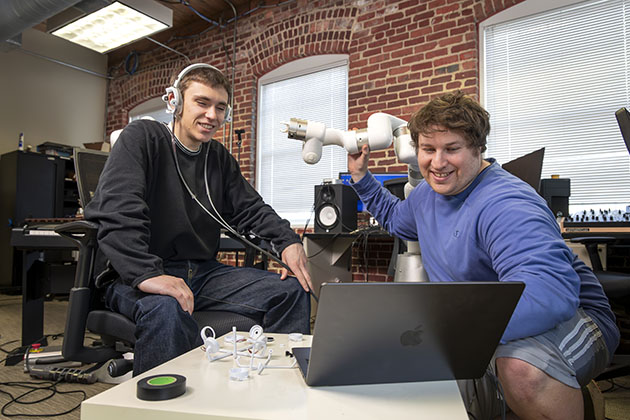
Music Technology master’s student Lennon Seiders (left) and recent Ph.D. graduate Amit Rogel test Spherephones.
In horror movies, music is a dead giveaway. Tension builds with each note, and you brace for the inevitable jump scare. The same sense of anticipation has taken a leading role in an unlikely venue: a Georgia Tech robotics lab.
Amit Rogel developed Spherephones as a Ph.D. student in Gil Weinberg’s Robotic Musicianship Group, inside the Georgia Tech Center for Music Technology. The idea began on factory floors, where humans and robots increasingly work side by side.
Robots don’t wait for you to notice them. They move first. People react second. That delay is where injuries can happen. Traditional alarms can warn that something is wrong, but they don’t say what, where, or how soon. Over time, workers tune them out.
“Alerts always demand your attention, even when they don’t need to,” Rogel said. “Music doesn’t have to do that.” That idea eventually took shape as Spherephones, a wearable system designed to turn movement around you into music you can anticipate.
Music can sit in the background, rise and fall, and warn you without breaking your focus. The sound plays through an open-ear headset. Spherephones has four speakers encircling each ear — in front, behind, above, and below. The speaker below the ear is the key; most headphones can’t place sound there.
“As the robot gets closer, a melody starts to play,” Rogel said. “I can predict when the melody will end, which is when the robot will arrive and hand me an object.” The entire exchange happens without ever demanding full attention. You don’t stop and look. You register it and keep working.
In early tests, participants kept their hands moving — assembling, sorting, focusing — even as the sound shifted around them.
"Am I going to freak out?" That was Georgia Tech President Ángel Cabrera's first question when he walked into the Spherephones lab. He sat down, put the headset on, and became immersed in a whole new world.
Video Short Description
Georgia Tech President Ángel Cabrera experiences Spherephones, an immersive audio technology developed by Georgia Tech researchers. During a virtual reality demonstration, he enters a simulated forest environment where spatial audio is synchronized with the VR experience. Researchers explain how the system's innovative speaker design allows users to perceive sound direction naturally, creating the sensation of sounds coming from above, below, in front of, and behind the listener.
Video Short Transcript (Open Captions Also Displayed in Video)
Whoa, the eagle is, oh my God. The directionality of the sound is actually synchronized with the VR.
Hey, where is he? How are you? Good, how are you doing? I'm working on the Spherephones project.
Hi, Gil. How are you, sir? How are you? This looks fantastic. Right now, we're going to give you a quick little demo.
Okay, I'm going to freak out.
Oh, it's going to be fun. It's a fun one. Yeah, I see my hands.
I'm in the woods. Well, the eagle is flying. The directionality of the sound is actually synchronized with the VR. So there's four speakers on either side.
And is that up, down, front, back?
Yeah, exactly. And then they're designed in a very unique way where it's pointed to make sure that your ear actually does the localization itself.
Yeah, whoa, the e-ball is, oh my God.
Yes, I've totally got that. And then you can also hear sounds from below, which is typically very tricky with audio.
Oh yeah, that is very cool. Very cool.
Music Without Words
Weinberg and Rogel wondered whether music could also serve as a cue, or a shared language, between a robot and the person working nearby.
His lab found it could.
The music itself is computer-generated lo-fi, a quiet, slow genre often used as study music. “You can know not only that something is coming at you, but from what direction,” Weinberg said. “And whether it is dangerous or not.”
The Space for Sound
Early versions of the system mounted speakers around the workspace. Every worker heard every cue — including cues meant for someone else.
“It was a mess,” Weinberg said.
His solution was to make the sound personal: one worker, one wearable, one stream of audio tuned only to the robots within reach.
The difference was immediate. When a robot approaches at ground level, the music sounds as if it’s coming from ground level, not suggested or inferred, but placed there. The sound feels physical, intuitive, and difficult to ignore.
That single design choice opened the door to everything that followed.
A Key Change
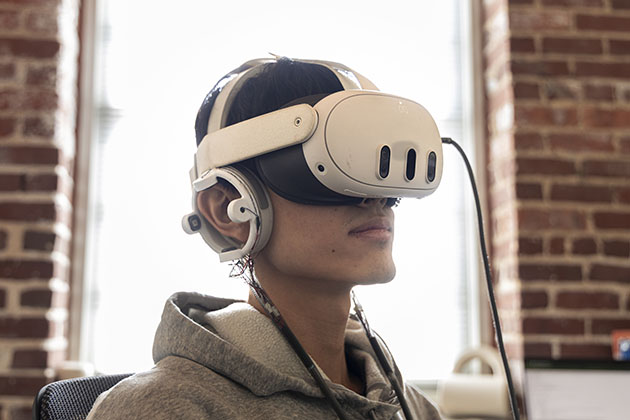
Recent computer science graduate Mikhail Titov tests Spherephones for use in virtual reality.
The headset that solved a factory-floor problem soon revealed broader potential.
With the help of music technology master’s student Lennon Seiders and recent computer science graduate Mikhail Titov, the team has developed a virtual reality experiment in which a bird flew around a user, who turned to follow it. Then a sound was played from behind the user — no visual object, just sound. The user flinched as if something were physically there.
“I knew it was going to work,” Weinberg said.
The mechanism was the same. The application was new.
“The world is not yet filled with people working with robots,” Weinberg said. “But it is already full of gamers.”
Conventional gaming headphones divide sound between left and right. Spherephones adds above, behind, and below — offering milliseconds of warning a player didn’t have before. The open-ear design also allows players to stay aware of the world around them.
“It’s not as separating,” Rogel said. “You get a different experience.”
Encore
A device designed to prevent collisions with robots is now being studied as a tool for gamers, for people navigating the world without sight, and for veterans coping with PTSD.
The first version of Spherephones had one purpose: safety for factory workers. The current version has many, and the lab is still discovering what comes next.
The ear has always known what’s coming before the eye does. Filmmakers noticed this long ago. Without their iconic scores, Jaws and Psycho lose the tension that made them classics. Hollywood uses music to build dread. Spherephones uses it to kill surprise.
Spherephones was developed through Weinberg’s National Science Foundation–funded research.

Writer: Michelle Azriel
Media Contact: Shelley Wunder-Smith | shelley.wunder-smith@research.gatech.edu
Photos and Video: Christopher McKenney
Design: Josie Giles
Series Design: Stephanie Stephens
Copyediting: Stacy Braukman

About Georgia Tech Commercialization
Georgia Tech Commercialization provides a foundation for faculty seeking to translate the Institute's leading-edge research into real-world applications. Commercialization encompasses four pivotal units: CREATE-X, VentureLab, Quadrant-i, and Technology Licensing. These units empower students and faculty to launch startups, provide comprehensive commercialization support, manage intellectual property, and facilitate the transformation of research into viable businesses. The Office of Commercialization’s mission is to provide world-class commercialization services, catalyzing research and innovation to improve the human condition, and enhancing Georgia Tech's position as a leader in technology and entrepreneurial impact.
Paradigm Shifters
At Georgia Tech, cutting-edge research is a constant — it fuels discovery, challenges norms, and inspires progress every day. And occasionally, technologies emerge with the power to fundamentally change life for the better.
These breakthroughs transform how we live, how we work, and even how we heal. Many years and minds in the making, these technologies are the culmination of collaboration, persistence, and ingenuity. These are the paradigm shifters.
Discover these extraordinary innovations as they begin to make their mark on the world. The future is taking shape right here at Georgia Tech.
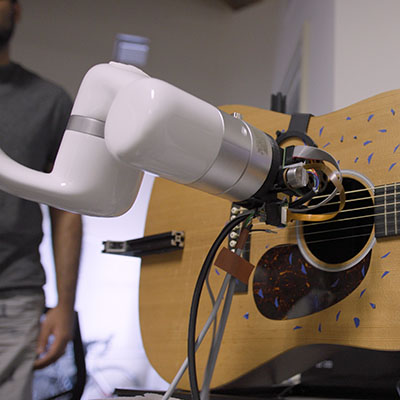 Art and Technology Harmonize in School of Music
 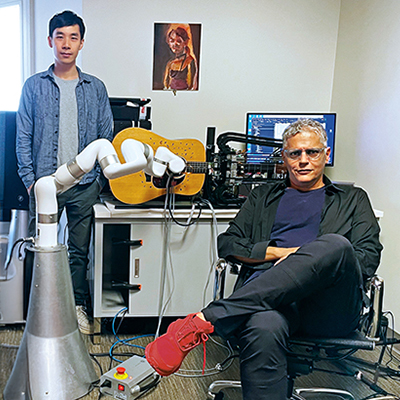 Robot Guitarist Plays With Human Expressivity
  Bridging Tradition and Technology: Robotics and AI Open a New Path for Classical Indian Music


