
Scaling Innovation: Georgia Tech Manufacturing 4.0 Consortium Builds for the Future
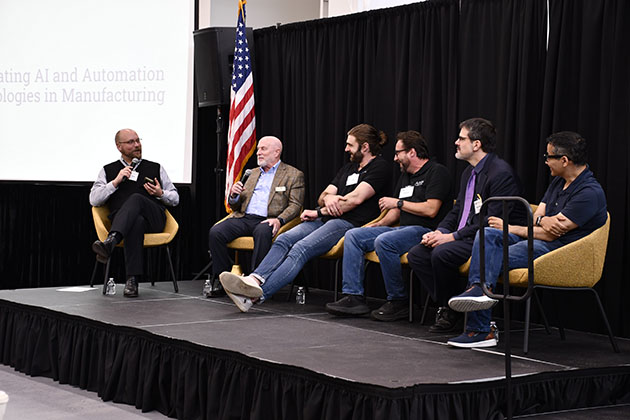
Moderator Branden Kappes (Contextualize) leads a discussion on AI and automation with Chuck Boyles (Factory Automation Systems), Roby Lynn (R2Labs), Flavio DePaula (Albitek), Michael Bakas (U.S. Army DEVCOM), and Ali Khademhosseini (MatterX).
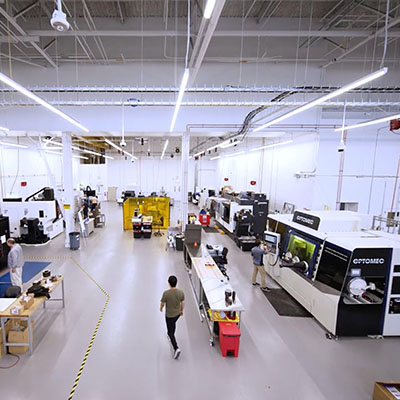
Moving a new idea from a research lab to production remains one of industry’s toughest challenges. But at the Georgia Tech Manufacturing Institute (GTMI), which leads the nation in translating research into technologies that shape the future of U.S. manufacturing, that gap is being closed by design. This effort was on full display during AMPF Week, a two-day celebration marking the official opening of the newly renovated Georgia Tech Advanced Manufacturing Pilot Facility (AMPF).
The week opened with the Manufacturing 4.0 Consortium Annual Public Meeting, drawing a crowd of industry leaders to this AI “playground”, the nation’s first-of-its-kind university-led space where digital automation and AI are used to test and advance manufacturing. More than a technical symposium, the consortium’s annual meeting demonstrated how GTMI is shifting the industry from machines that simply repeat tasks to intelligent systems that can see, think, and adapt on their own.
Advancing Manufacturing Innovation
The Georgia Tech Manufacturing 4.0 Consortium is membership-based, bringing together industry, academia, and government to advance manufacturing innovation.
“We built the consortium to close the gap between innovation and implementation in manufacturing,” said Steven Ferguson, executive director of the consortium and deputy director of GTMI. “Our role is to translate research into practice, working side by side with industry to deploy advanced technologies in real production environments.”
Today, the consortium includes over 35 founding members, including companies like Rockwell Automation, Siemens, and Mazak, working on shared challenges like edge computing and AI integration.
GTMI leads the consortium by bringing companies into partnership with Georgia Tech to accelerate technology transition, strengthening the competitiveness of U.S. manufacturing.
“Our role is to translate research into practice, working side by side with industry to deploy advanced technologies in real production environments.” — Steven Ferguson
Shift Toward Advanced Manufacturing
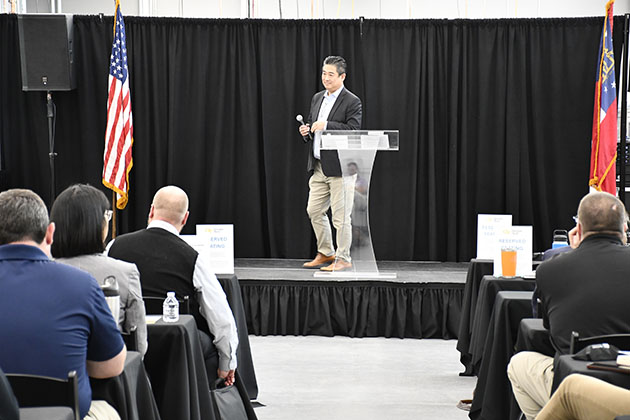
Steven Jahng, Director of Government Affairs at Hyundai Motor Group, addresses attendees at the Georgia Tech Advanced Manufacturing Pilot Facility (AMPF).
Central to the Manufacturing 4.0 Consortium Annual Public Meeting discussion was industry leaders’ focus on how manufacturing systems can adapt in real time while remaining reliable.
A panel featuring leaders from Contextualize, MatterX, R2Labs and two other startup companies explored what that balance looks like in practice, including when to allow systems to adapt and when consistency is critical. As Chuck Boyles, vice president of Factory Automation Systems, framed it, “You don’t want a robot tending a die-cast machine to be creative; you want it repeatable and safe.”
Beyond the panel, other perspectives addressed how the field itself is evolving.
Steven Jahng, vice president at Hyundai Motor Group, framed the industry’s future, describing modern manufacturing as a high-tech, AI-driven frontier that is safer, cleaner, and more vital than ever. His perspective was paired with ongoing research highlights from Jing Li, professor in Georgia Tech’s School of Industrial and Systems Engineering, along with insights from the Air Force Research Laboratory and Savannah River National Laboratory.
Self-Driving Lab Has Arrived
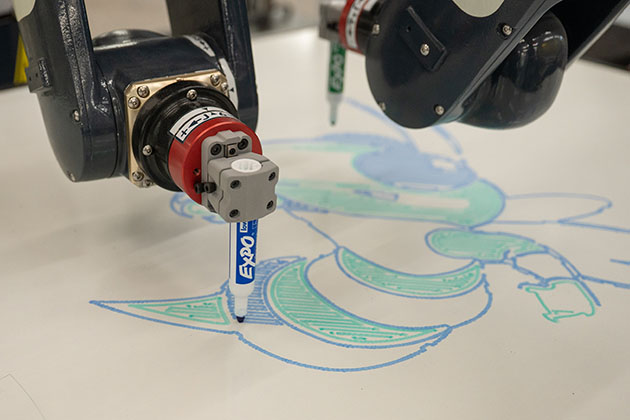
Robotic collaboration and process planning for wire arc additive manufacturing (WAAM), an emerging technology for producing large-scale metal components with applications in defense and industrial manufacturing.
The discussions were followed by a tour of the renovated 60,000-square-foot AMPF. Attendees saw “Cooperative Robotics” in action, where multiple robots work in tandem to weld massive parts. They also explored the Hybrid DED systems that can build a metal part and then immediately polish it to a mirror finish.
But AMPF’s real breakthrough is its transition into a fully integrated “self-driving” laboratory.
Beyond automated testing suites and wet labs, the AMPF operates through a unified digital architecture, where systems are linked across the entire research process. A researcher can design a material or part, send it to be fabricated or machined, and have it automatically transferred, tested, and analyzed, with each stage feeding data into the next, so experiments can be tracked, adjusted, and repeated in real time.
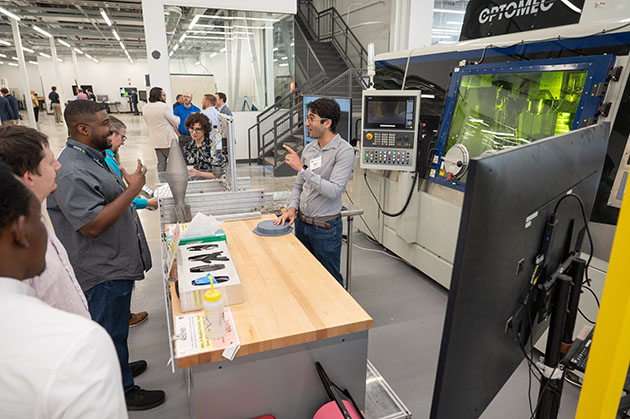
Student demonstrates the Optomec hybrid DED system, which utilizes a companion robot and advanced digital architecture to automate the research process via “robotic scientists.”
The day concluded with a student research poster session, displaying one of the consortium’s greatest assets: direct access to the next generation of scientists. Top student projects were recognized:
- Gold (1st Place): Tahsin Saniat, Khushi Shah, Karina Mealey, Shuonan Dong — Large Scale Robotic Machining on Flexible Bodies Faculty Advisor: Shreyes N. Melkote
- Silver (2nd Place): Pantea Habibi — “PORE-XR: Porous Objects Research and Exploration in Extended Reality” Faculty Advisor: Mohsen Moghaddam
- Bronze (Honorable Mention): 1) Akshar Kota, Jack Lam, Aryan Thacker — Multi-Material Additive Manufacturing Faculty Advisors: Preet Singh and Shreyes N. Melkote 2) Abigal Hefferan — Autonomous Hypothesis Generation Faculty Advisor: Aaron Stebner
Join the Future. The Manufacturing 4.0 Consortium is now welcoming members for 2026-2027.
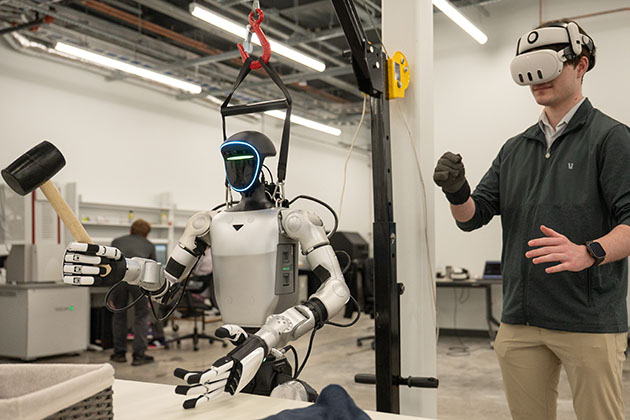
A student demonstrates human-robot interaction using virtual reality controls and collaborative robotics technology at the AMPF.
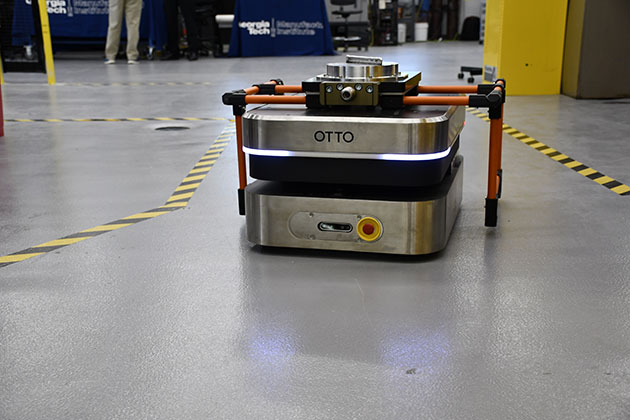
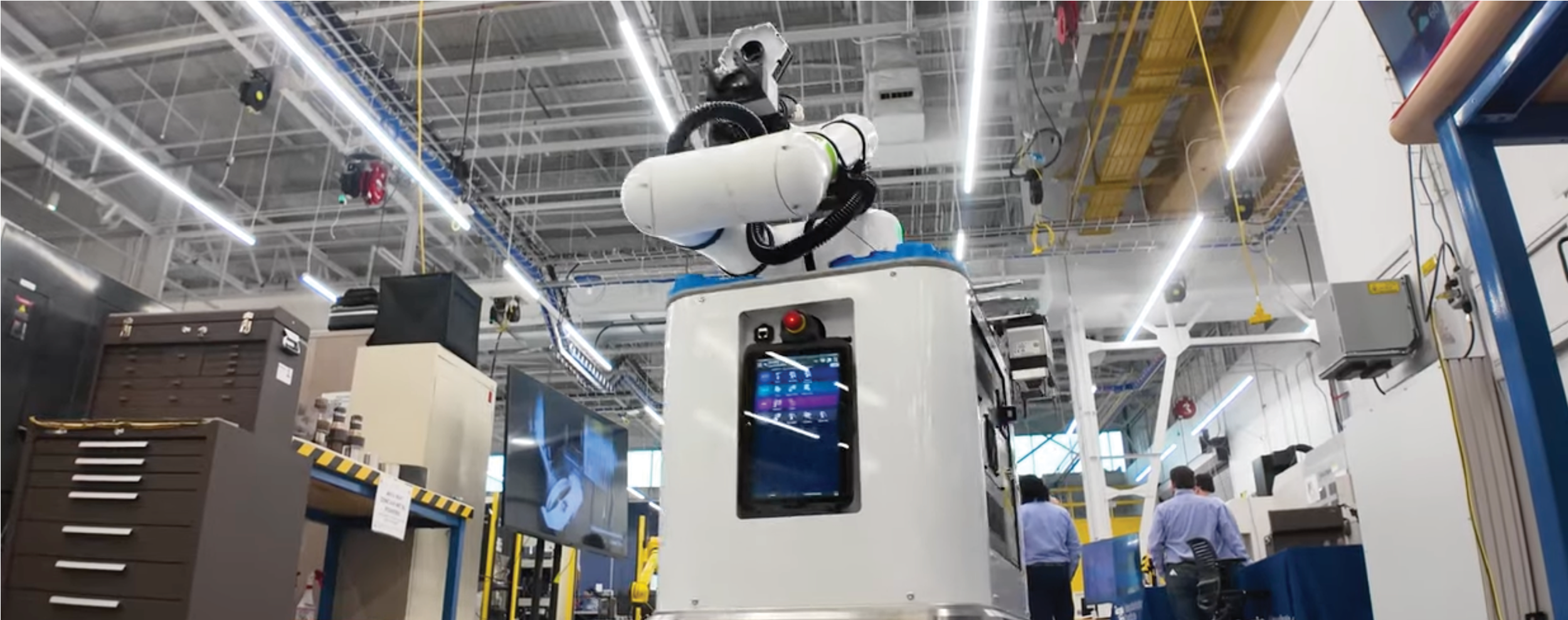
An autonomous mobile robot (AMR) designed to transport materials throughout the facility as part of the self-driving lab, moving build plates from 3D printers for mechanical testing, chemical analysis, and materials characterization.
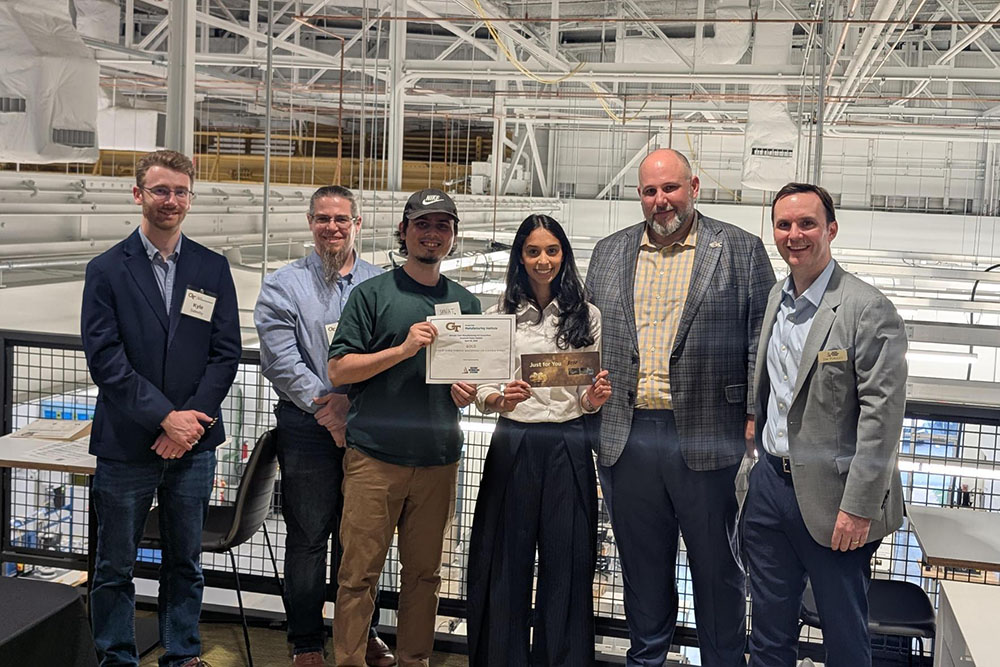
From left are Kyle Saleeby, Zachary Brunson, gold-place winners Tahsin Sejat Saniat and Khushi Shah, Aaron Stebner, and Jim Purseley .

Writer: Yanet Chernet
Media Contact: Jennifer Martin | jennifer.martin@research.gatech.edu
Video: Christopher McKenney
Photos: Rob Felt, Belinda Vogel, and Yanet Chernet
 Manufacturing the Workforce of the Future
 How a Veteran Gained Invaluable Skills in AI Manufacturing at Georgia Tech
  Manufacturing Consortium Helps Industry Close the Finish Gap


