
Manufacturing Consortium Helps Industry Close the Finish Gap
Dec 15, 2025 —
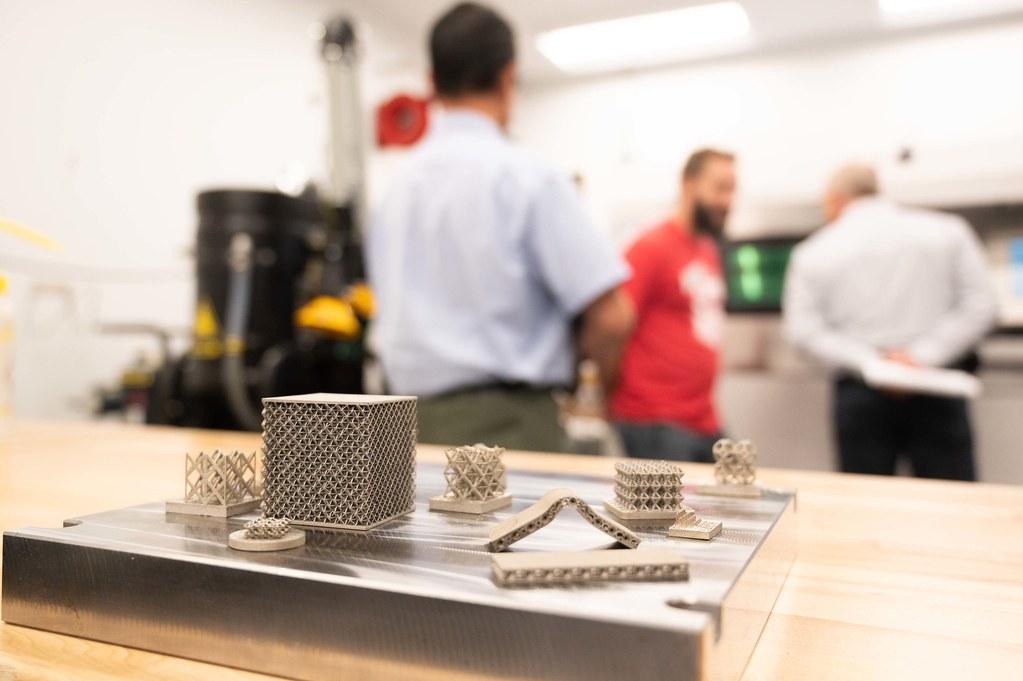
High-performance parts used in aerospace and defense systems need to be precise and durable, even with complex geometries. Advanced manufacturing methods enable the production of complicated parts that traditional machining can't achieve, like those seen here at GTMI's Advanced Manufacturing Pilot Facility. (Photo by Georgia Tech)
From fighter jets to medical devices, today’s most advanced machines depend on parts as intricate as their missions. These components aren’t just geometrically complex — they’re made from specialized metals engineered to withstand extreme heat, friction, and wear. But that strength comes with a challenge. How do you shape metals tough enough to survive the heat of a jet engine?
One solution is to start with a more moldable form of these super-metals: powder. In a specialized form of additive manufacturing (like 3D printing), manufacturers start with fine metal powders and fuse them, layer by layer, using focused energy. Known as powder bed fusion (PBF), this method enables highly complex shapes and reduces the amount of finishing work needed. Still, when a micron of extra material can make or break the final product, even near-perfect parts require precise finishing touches.
“The introduction of new, exotic materials produced through additive manufacturing has brought unique challenges, especially for applications in space and missile systems,” says David Antonuccio, business development director at Halocarbon, a Georgia-based company producing advanced chemical solutions used in manufacturing and other fields. “While these materials offer distinct properties, they are notoriously difficult to machine.”
That’s where the Georgia Tech Manufacturing Institute (GTMI) comes in. Through its Manufacturing 4.0 Consortium, GTMI connects industry manufacturers like Halocarbon with researchers and innovators to tackle real production challenges like this. Membership includes access to GTMI’s Advanced Manufacturing Pilot Facility (AMPF), where companies can test ideas and collaborate on new solutions.
Halocarbon recently teamed up with Freemelt, a leader in producing PBF systems and a fellow consortium member, to address this bottleneck. Their goal: to determine whether Halocarbon’s specialized metalworking fluids could enhance the finishing process for PBF-manufactured parts made from tungsten and molybdenum, two high-temperature, hard-to-machine metals.
“The future of manufacturing depends on how well we integrate talent, technology, and collaboration,” says Steven Ferguson, interim director of Research Operations at GTMI and managing director of the consortium. “By bringing companies together around shared challenges, we’re closing critical gaps and strengthening the nation’s advanced manufacturing capability.”
Solving the Post-Processing Bottleneck
Even with advanced methods like electron beam powder bed fusion (E-PBF), which uses an electron beam to fuse metal powders inside a vacuum chamber, finishing remains a critical hurdle. “Surface finish in powder bed fusion is fundamentally tied to the particle size of the metal powder,” says Ian Crawford, a materials and application engineer at Freemelt. “Post-processing will almost always be part of the equation for high-performance components.”
In traditional machining, coolants and cutting fluids used in these finishing steps are often overlooked, and the methods haven’t changed much in decades. Halocarbon’s metalworking fluid aims to bring these fluids into a new era, using innovative polymer chemistry to extend tool life, improve surface quality, and boost efficiency when machining these challenging alloys.
The two companies initiated their joint project during their free AMPF equipment use time, which comes with the full level of consortium membership. From there, GTMI designed and executed controlled studies comparing the use of Halocarbon’s fluids to two standard finishing methods, dry machining and EDM-based finishing. The results showed a 6% improvement in side milling and a 26% improvement in end milling versus dry machining, with even greater gains over EDM. These improvements translate into higher-quality parts, tighter specifications, lower scrap rates, extended tool life, and reduced downstream costs — exactly what aerospace and defense suppliers need to meet stringent requirements.
The findings were shared at the 2025 National Space & Missile Materials Symposium, reinforcing the value of industry-academic collaboration.
“Industry keeps pushing materials to handle more heat and stress, but that makes post-processing harder,” says Matt Carroll, one of the GTMI researchers on the project. “By bringing equipment makers and chemistry innovators into the same experiment, we were able to prove where the gains really are and give manufacturers data they can act on.”
“No single manufacturing method solves every challenge,” says Crawford. “To achieve the performance and cost targets that aerospace and defense applications demand, we need to bring together the right combination of technologies, and collaborations like this show what's possible when we do.”
Collaborative research at the Georgia Tech Manufacturing Institute teamed is working to improve the finishing processes for hard to machine metals like tungsten. (Photo via Halocarbon)
Writer: Audra Davidson
Research Communications Program Manager
Georgia Tech Manufacturing Institute
Contact: Belinda Vogel
Research Engagement Manager
Georgia Tech Manufacturing Institute


