
2026 Suddath Symposium Showcases Biomedical Applications of Synthetic Biology
Apr 08, 2026 —
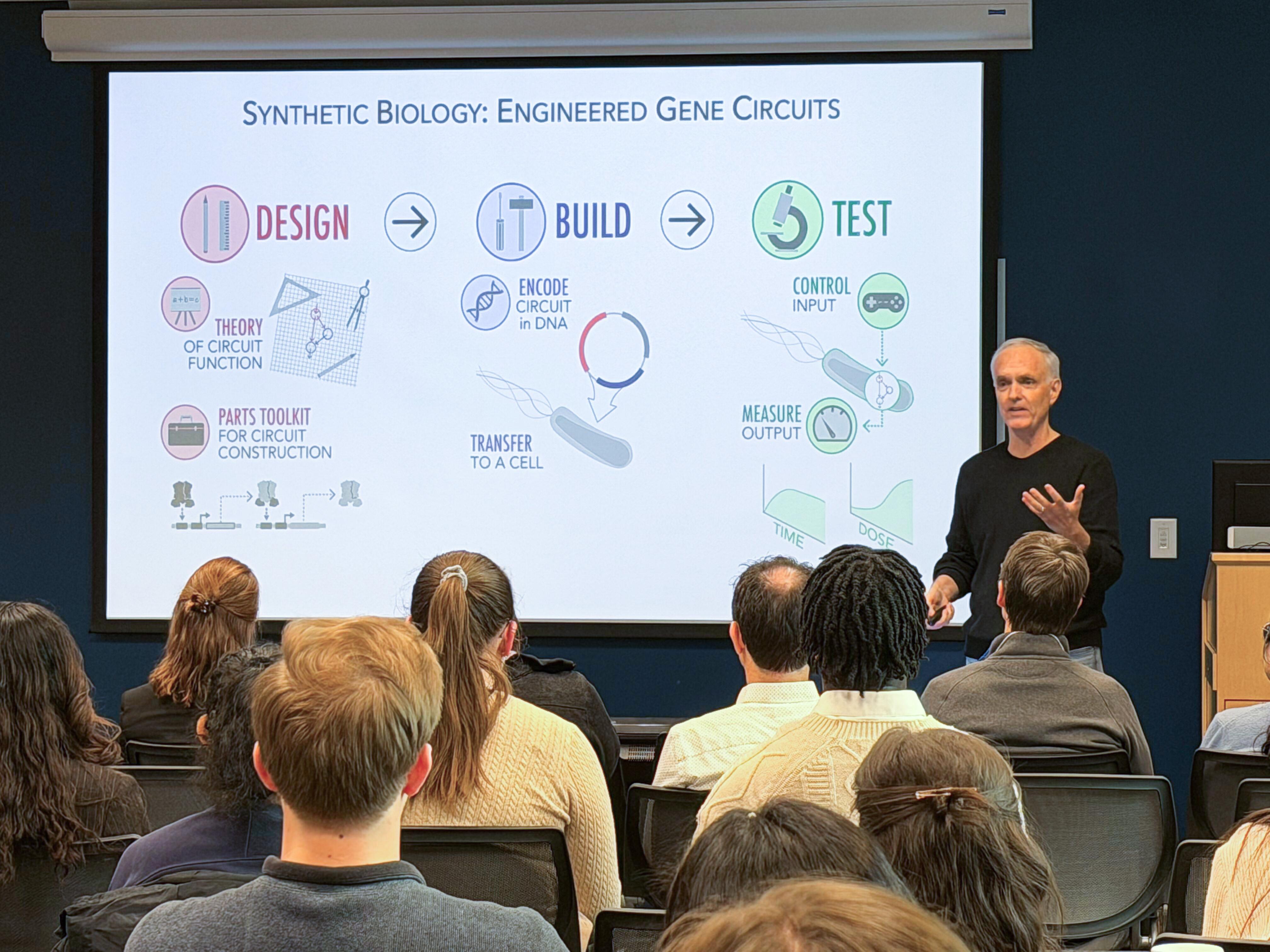
James Collins from the Massachusetts Institute of Technology (MIT) was one of the featured speakers at this year's symposium.
The 34th annual Suddath Symposium, hosted by the Parker H. Petit Institute for Bioengineering and Bioscience (IBB) on March 18-19, brought together researchers, trainees, and invited speakers from across disciplines to discuss cutting-edge efforts to translate synthetic biology advances into human health-relevant technologies, including diagnostics, therapeutics, and clinical tools.
“The topic of the Suddath Symposium changes every year, which allows the Georgia Tech research community to annually learn about recent advances on a specific topic from across the immense fields of bioengineering and bioscience,” said Nicholas Hud, Regents’ Professor in the School of Chemistry and Biochemistry and Associate Director of IBB.
The symposium also included presentation of the 2026 Suddath Award, which recognizes outstanding graduate research. This year’s award was presented to Myeongsoo Kim, a Ph.D. candidate in the Bioengineering Graduate Program, for his work at the intersection of cell engineering, cancer treatment, and biomedical imaging. The award is presented each year by members of the Suddath family, including Vincent Suddath, grandson of Bud and a current freshman at Georgia Tech majoring in mathematics.
The symposium and award honor the legacy of F. L. “Bud” Suddath and his lasting contributions to the Institute and the wider Georgia Tech research community.
“Bud was influential in promoting the growth of bioscience research at Georgia Tech, efforts that helped establish IBB in the 1990s,” Hud said. “Bud’s research interests were at the forefront of structural biology, a field that laid the foundation for much of what we know today about biology at the molecular level. It’s fitting that we honor Bud’s contributions by annually providing the Georgia Tech community with the opportunity to learn about research on a timely topic within the biological sciences.”
Symposium co-chairs Tara Deans and Mark Styczynski said that in addition to upholding the legacy of Bud Suddath, the event also provides a unique setting and opportunity for both established researchers and trainees to interact over the course of the two day event. The intimate format of the symposium, which is limited to approximately 100 attendees, and the annual selection of a different interdisciplinary topic sets it apart from other symposia.
“The Suddath Symposium is an amazing opportunity to bring multiple world-class researchers right to our trainees’ front door, to hear about their work and connect with them in a small setting that you can’t really find at most conferences,” said Styczynski, who is a professor in the School of Chemical and Biomolecular Engineering. “We are really grateful to IBB and the Suddath family for supporting this unique event.”
Deans, who is an associate professor in the Wallace H. Coulter Department of Biomedical Engineering, highlighted how this year’s theme reflects a broader shift in the field.
“This year’s focus on biomedical applications of synthetic biology highlights a major inflection point in the field: the transition from proof-of-concept systems to human health-relevant technologies,” she said. “The theme also reflects increasing convergence across disciplines; synthetic biology is no longer operating in isolation, but it is deeply intertwined with immunology, machine learning, diagnostics, and clinical translation. Addressing real-world biomedical problems requires this kind of integration, and the symposium captured that shift very clearly.”
The Suddath Symposium annually serves as a cornerstone event for Georgia Tech’s bioengineering and bioscience community — connecting researchers, honoring scientific legacy, and spotlighting the next generation of scientific innovation.
Ashlie Bowman | Communications Manager
Parker H. Petit Institute for Bioengineering and Bioscience


