
Building Space, Tools, and Trust
Gary Spinner has spent 30 years expanding Georgia Tech’s cleanroom and core facilities — and the shared practices that make them work.
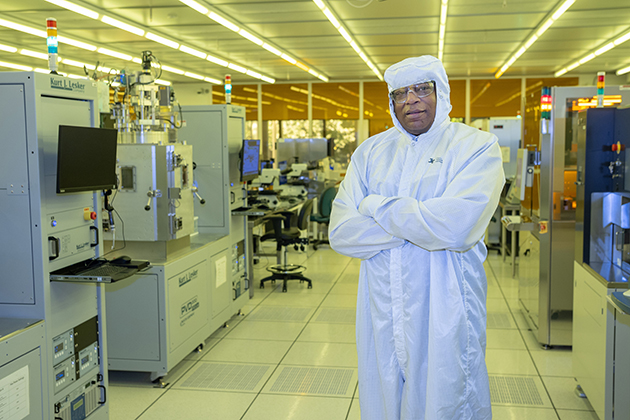
Spinner in the Marcus Nanotechnology Cleanroom shortly after the newest expansion opened in Fall 2025.
Gary Spinner never intended to go to college, let alone spend most of his career working at one.
“At 16, I was working full-time as a cook, and when I graduated high school, my dad told me get a real job with benefits or go to college,” said Spinner, director of operations for the fabrication facilities in Georgia Tech’s Institute for Matter and Systems (IMS).
Having missed the application deadlines for four-year colleges, Spinner enrolled at DeVry University in Atlanta. He enjoyed the engineering classes and then made engineering his major. After graduating with an associate’s degree in applied electronics, he moved to New York where he began working in semiconductor production.
Spinner spent several years in New York and New Mexico with IBM and Intel before deciding he was ready for a change. He found that opportunity in an open cleanroom technician position at Georgia Tech. A microfabrication cleanroom is a highly controlled laboratory where researchers build tiny devices — often smaller than the width of a human hair — such as computer chips, sensors, and other advanced technologies. Knowing little about Georgia Tech or the specific job requirements, he took a leap of faith.
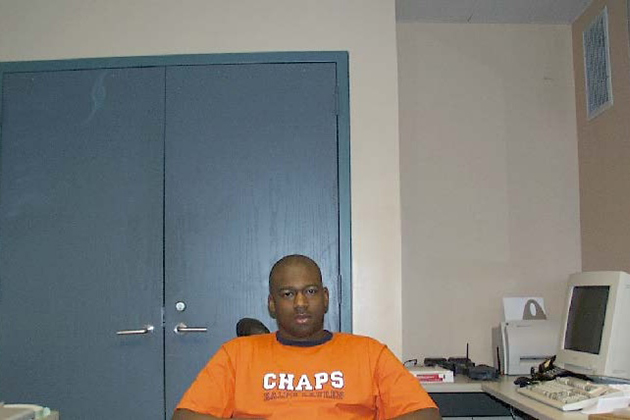
In an early “selfie” style photo, Spinner documented his early days in the MiRC.
“I made a cold call,” he said. “They passed me through to Jerry Hill, the associate director at the time, and we started talking about the position.”
Spinner joined Georgia Tech in 1994, in a role that focused on lab support and installation. Some of that installation work is still in use today — from pipes to electrical wiring.
Thirty years ago, Tech’s campus looked considerably different than it does today. The Microelectronics Research Center (MiRC), the backbone of what is now IMS, had just been established. And the cleanroom facilities were less than a quarter of their current size.
During the 1990s, Spinner completed his bachelor’s degree in technical management and worked his way up from research equipment specialist to instrument calibration manager. Still in the cleanroom every day, his responsibilities expanded from installing and maintaining tools to training new users on the equipment. He eventually supervised graduate student employees working in the cleanroom.
“I consider Gary not only my first professional mentor but also the most influential one in shaping my engineering career.” –Jason Herrington
Mentorship That Scaled Beyond the Lab
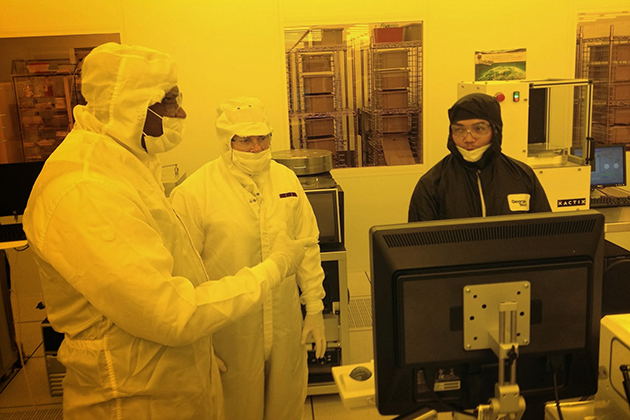
Former EVPR Steve Cross toured the MiRC cleanroom in the early 2010’s and soon after, he charged Spinner’s team with revamping the tool access systems.
When Spinner arrived at Tech, the cleanroom lived up to its name — perhaps too literally. students jokingly called it “one of the worst jobs on campus” because they were not allowed to contribute to research. Instead, their responsibilities were limited to cleaning the equipment and labs, with little opportunity to develop technical skills.
But Spinner saw potential in those students. He trusted that their degree programs prepared them to work competently in a technical environment, and rather than treat them like student workers, he treated them like junior engineers.
The impact of this approach speaks for itself. Many of Spinner’s former student employees keep in touch with him; some even work with him at IMS.
“I credit much of my early development as an engineer to my undergraduate co-op in the MiRC,” said Jason Herrington (EE 2002, MSHCI 2012), Shared User Management System (SUMS) developer. “I consider Gary not only my first professional mentor but also the most influential one in shaping my engineering career.”
Spinner’s leadership also left a lasting impression on Brandon Harrington (CSE 2005, MSECE 2008), director of MEMS Development at AMFitzgerald, a microtechnology development firm specializing in MEMS, photonics, and microelectronic product design and prototyping.
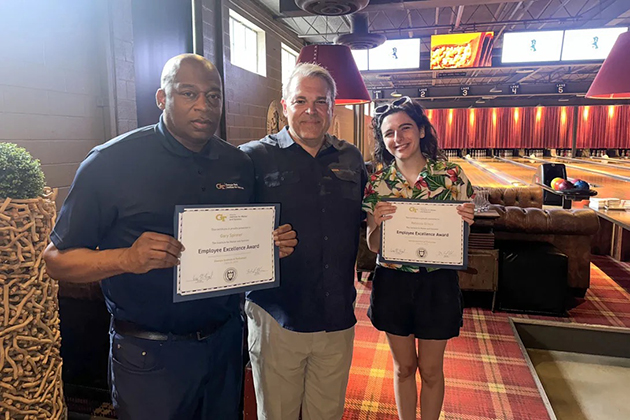
Spinner was recognized as an IMS Employee of Excellence in 2025.
Harrington began working in the MiRC as a freshman and credits his time on Spinner’s team as one of the reasons he works in MEMS, or microelectromechanical systems. MEMS are tiny integrated devices that combine mechanical and electrical components at the microscale and are used in technologies such as sensors, actuators, and medical devices.
“Gary trusts people to learn and take ownership of what they are working on. He enables you to take pride in the work that you do,” Harrington said. “In my career, I don’t think anyone has been more impactful than Gary.”
Because of the culture of trust Spinner helped build, some of his former students never left the cleanroom. Others took jobs in industry or national labs and later returned — like Mikkel Thomas (EE 1997, MSEE 1999, Ph.D. EE 2008), now IMS associate director of education and outreach.
"Gary treated me like a staff member while I was a graduate student here,” said Thomas. “I was trusted to do things only staff members were previously allowed to do. When the opportunity to return and officially join the team arose, I leapt at it."
Spinner also contributed to transforming the size of the cleanroom itself. When he began working in the MiRC, it was roughly 6,000 sq. ft. He helped oversee its expansion to 10,000 sq. ft. through four rounds of renovations and later oversaw the construction and outfitting of the cleanroom space in the Marcus Nanotechnology Building expanding the Georgia Tech cleanroom facilities footprint to more than 20,000 sq. ft. Today, it is the largest academic cleanroom in the Southeast.
“Gary treated me like a staff member while I was a graduate student here. When the opportunity to return and officially join the team arose, I leapt at it.” –Mikkel Thomas
Transforming Technology and Increasing Access
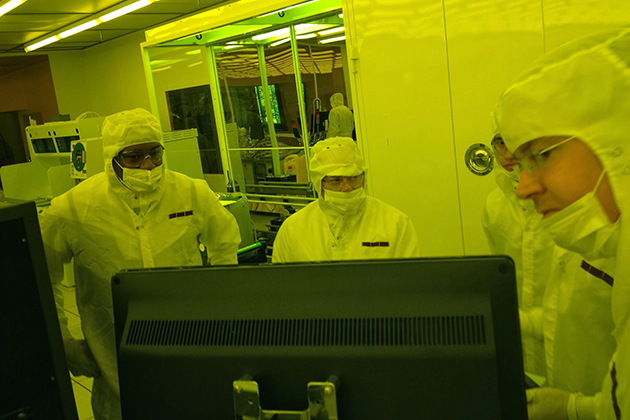
Cleanroom technicians review data at a workstation using SUMS, the platform that streamlines equipment searches, access requests, scheduling, and billing for core facility tools across campus.
Anyone who has used a Georgia Tech cleanroom tool has been impacted by Spinner’s legacy — not only the tools, but also through software and systems connected to the core facilities across campus.
Steve Cross, the Institute’s executive vice president for Research from 2010 to 2018, charged Spinner’s team with expanding the system that allowed users to access research tools and labs. Cross wanted them to improve access to core research facilities, which are centralized labs that enable multiple research groups to share equipment rather than each lab buying and maintaining expensive equipment on its own, across campus.
Spinner had members of his team, including former student Herrington, investigate a system that would fit all the Georgia Tech research enterprise’s needs which included user access, maintenance notifications, and tool information. Nothing fit. So, in 2015, Spinner had the team develop software for reserving and using the tools.
“At that time, neither of us had experience with full-scale web application development,” noted Herrington. “Despite this, Gary took a leap of faith and offered his full support. His trust and commitment were instrumental; without his leadership, it would not have been realized, let alone grown into a vital campus-wide service.”
The result was SUMS, a centralized, home-grown platform that enables cleanroom users to search for equipment, request and manage access, schedule usage, and process billing for any registered tool — all within a single, streamlined portal. Developed more than a decade ago, SUMS continues to be widely used by departments across campus and remains an integral part of the day-to-day operations of core facility users.
Looking Forward
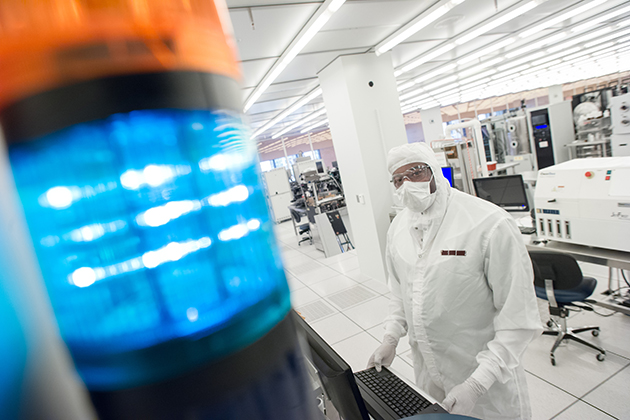
Spinner working on a tool in the 20,000-sq.-ft. Marcus Nanotechnology Building cleanroom.
For Spinner, transformation never stops.
With the increased national focus on advanced packaging, the integration of multiple components into a single electronic device, Spinner and his team have once again expanded the Institute’s cleanroom facilities. This time, they created space for an even larger toolset dedicated to advanced packaging research and development, positioning Georgia Tech to meet the growing demands of the CHIPS Act era and to attract more external users to the facilities.
But for Spinner, new square footage is only part of the story. He envisions a future where Tech’s capabilities help anchor a thriving semiconductor ecosystem across the state. He hopes to see more companies moving into the metro Atlanta area to take advantage of everything Georgia Tech has to offer — from world-class students to world-class facilities.
He also sees continued growth in the cleanroom itself, additional buildouts, expanding research capabilities, and deeper industry collaborations. In his view, the facilities are not just research spaces, but launchpads: places where students gain hands-on experience that changes the trajectory of their careers.
After 30 years, Spinner’s impact can be measured in renovated labs, expanded cleanroom space, and campus-wide software systems. But it is most visible in the engineers, researchers, and industry leaders who began their journeys within the cleanroom’s walls.

Writer/Media Contact: Amelia Neumeister, Institute for Matter and Systems | amelia.neumeister@research.gatech.edu
Photos: Rob Felt, Candler Hobbs, Amelia Neumeister, and courtesy of Gary Spinner


