
Engineering Curiosity: How a Georgia Tech Researcher Sparks Imagination in K–12 Classrooms
As a child, Nisha Detchprohm dreamed of becoming an inventor. Now, as a research engineer at Georgia Tech, she’s creating educational tools that ignite curiosity and fuel creativity.
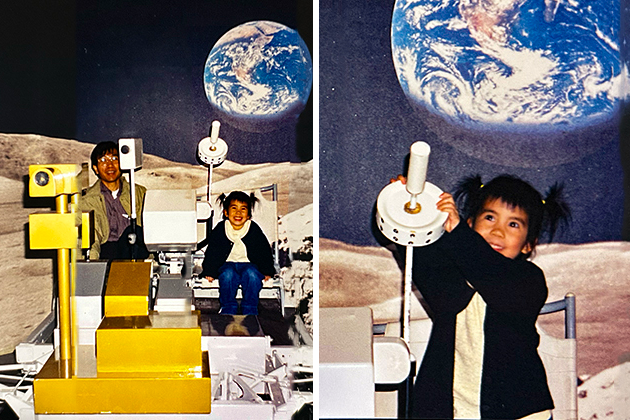
As a child, Nisha’s father took her to see a rover at the Kennedy Space Center in Florida. A tactile learner from the start, experiences like that visit fueled her deep curiosity and inventiveness.
When Nisha Detchprohm saw an episode of the Discovery Channel’s MythBusters as a middle school student, she realized it was possible to make a career out of testing theories, building and conducting experiments, and finding solutions.
Channeling her inner MythBuster, Detchprohm jumped at any opportunity to work on projects around the house and dreamed of becoming an inventor.
The daughter of an electrical and electronics engineer and a chemist and the sister of a future industrial engineer, Detchprohm was born in Bangkok, Thailand. She lived in Japan, Florida, California, and New York before moving to Atlanta in 2013. Exposure to a variety of learning environments led her to realize there are an infinite number of approaches to problem-solving.
“Growing up and experiencing different educational settings helped me realize there are different ways to learn, and each person’s background shapes them in unique ways,” Detchprohm said. “Not everyone may see themselves as a traditional learner, but there are so many ways to unlock their potential.”
Today, this outlook guides her work as a research engineer in the Center for Education Integrating Science, Mathematics, and Computing (CEISMC) in Georgia Tech’s College of Lifetime Learning and as an instructor for a lab section of Creative Decisions and Design (ME 2110). She focuses on the accessibility and development of K-12 STEAM — science, technology, engineering, arts, and math — curricula.
And she aims to provide K-12 and undergraduate educators with the tools and education to ignite student engagement and inspire the next generation.
“Growing up and experiencing different educational settings helped me realize there are different ways to learn, and each person’s background shapes them in unique ways,” Detchprohm said. “Not everyone may see themselves as a traditional learner, but there are so many ways to unlock their potential.”
Finding Her Path
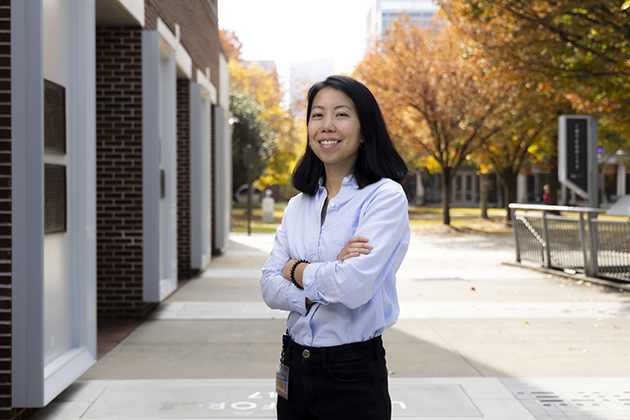
An unexpected path led Nisha Detchprohm to stay at Georgia Tech after completing her master’s degree. Now at CEISMC, she helps K-12 students discover new skills and futures through research-driven design and fun, hands-on learning tools.
As a student at Pope High School in Marietta, Georgia, Detchprohm took a career aptitude test, which revealed two primary fields that could be a good fit: engineering and sanitation work. Detchprohm knew she wanted to work with her hands. Attending a Women in STEM camp, where she built a mousetrap car, helped her decide to pursue a career in engineering.
“Using resources we were familiar with to make something unfamiliar was the kind of out-of-the-box thinking that let me know this was the career for me,” she said.
“As we get older, we tend to lose some of that curiosity, and that’s the kind of activity and problem-solving I wanted to bring to others.”
After seeing a Georgia Tech flag hanging in front of a neighbor’s house, Detchprohm decided to learn more about the place where she would earn her bachelor's and master’s degrees in mechanical engineering (ME).
She was encouraged to pursue STEM from an early age, but when it came time to choose an engineering field, she gravitated toward ME. Growing up, she describes herself as being at odds with static electricity, often shocking herself on metal door handles, so she opted to avoid open circuits as much as possible. The prospect of designing physical systems and tools appealed to her as she navigated her journey at Tech.

Nisha is pictured with her mother, father, and brother as they celebrated her undergraduate graduation from Georgia Tech — a proud family moment marking the culmination of years of hard work and discovery.
Detchprohm assumed she would graduate and immediately enter the workforce, but after joining ME Adjunct Associate Professor Katherine Fu’s lab as a student researcher, she felt like there was more to accomplish. With Fu’s support, Detchprohm became a graduate researcher and completed a two-year thesis track in one year.
“Katherine Fu’s lab was a place that made me feel safe, heard, and she taught me things that went beyond how to study and how to write a research paper,” Detchprohm said. “I’m so grateful to her because, sometimes, it can be so easy to talk yourself out of doing something, but it just takes that one person to believe in you and guide you onto an entirely different path.”
After earning her master’s degree in 2021, Detchprohm’s path continued at Tech as a graphic designer and prototyper in CEISMC. She would also spend time as a research engineer in the George W. Woodruff School of Mechanical Engineering before moving into her current role on CEISMC’s Educational Innovation and Development team.
“When we share our work with teachers, and they are excited to learn about these resources, or when we get to see students interact with these materials and have that moment of, ‘Oh, I understand this now,’ and they light up, those moments let me know we are fulfilling Tech’s mission of using technology to improve lives.”
Research Meets Classroom Impact
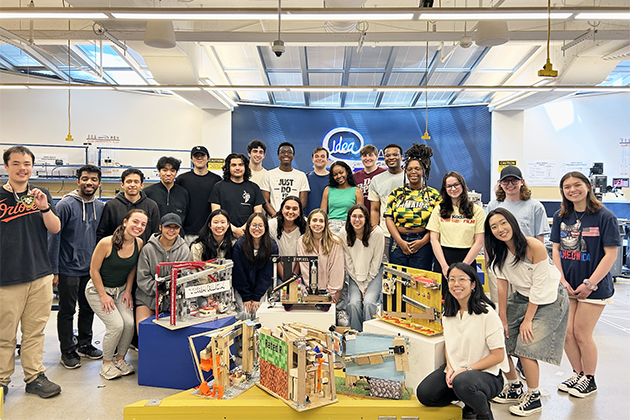
Nisha (front) and GTA Zachary Shuler (far left) join their Spring 2025 ME 2110 class in the IDEA Lab to showcase the systems they designed.
Detchprohm intends for her research to bridge gaps between instructors and their students using accessible resources, a concept she focused on following listening sessions with teachers, K-12 students, and teams in CEISMC’s K-12 InVenture Prize at Georgia Tech.
Her creativity shines through projects such as the creation of a board game for the K-12 InVenture Prize that teaches the basics of design engineering. She played a role in developing curricular elements, workshops, and website elements around EarSketch — which teaches coding through music composition — and has developed aerospace teaching tools using cereal boxes and other household items.
Detchprohm has also crafted career development-related curriculum for CEISMC’s Student-Centered Computing program, which is taught in classrooms across the country, and created visuals for the Biologically Inspired Design in High School Engineering Education (BIRDEE) program taught in Georgia high schools.
She works each day to create and lead teacher-training sessions for these resources, so teachers can use them effectively. Detchprohm hopes the tools and curriculum elements she designs will allow students to try something new and explore a subject they may not have initially considered pursuing.
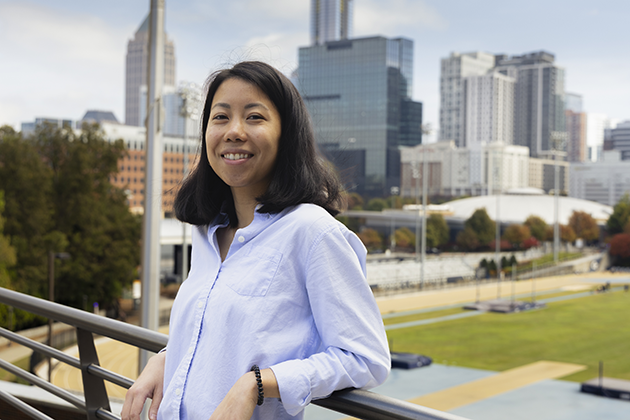
A two-time Yellow Jacket and now a research engineer at Georgia Tech, Nisha Detchprohm hopes her work will help bridge gaps between instructors and students, inspiring the next generation of curious young inventors to see new possibilities for their futures.
“When we share our work with teachers, and they are excited to learn about these resources, or when we get to see students interact with these materials and have that moment of, ‘Oh, I understand this now,’ and they light up,” Detchprohm noted, “those moments let me know we are fulfilling Tech’s mission of using technology to improve lives.”
Like her mentors did for her, Detchprohm hopes to help her ME 2110 students chart their own path. She received the CIOS Student Recognition of Excellence in Teaching for ME 2110 three times in the past two years. She also received the CIOS award for the CREATE-X Startup Lab in 2023.
A role in academia was an unexpected one for Detchprohm. But after working various jobs at Tech and finding her calling within a lab, she believes she wound up on the right path after all.
“Across all the opportunities I’ve had on campus, I’ve wanted to do what I can to create a welcoming environment,” she said. “I’m so energized by being in the classroom and working with education every day, with an opportunity to surprise students with how much they can do given the chance and the tools. So, when I reflect on my time at Georgia Tech, maybe it’s not all that unexpected that I landed in this role.”
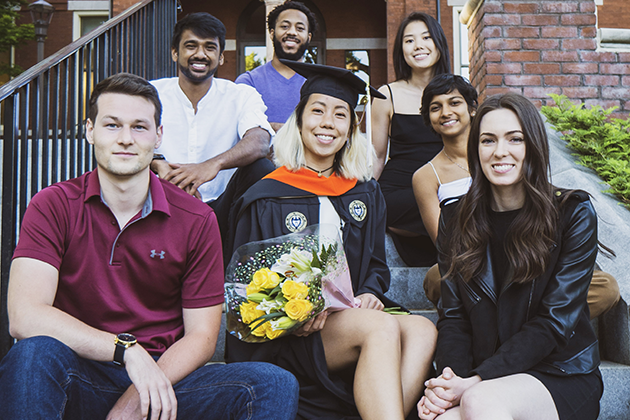
Nisha (center) is pictured at her master’s commencement, surrounded by fellow Georgia Tech alumni who cheered her on every step of the way.
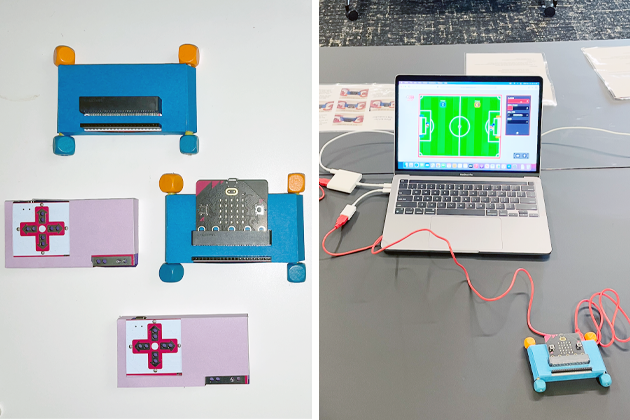
Through creative prototyping, Nisha shapes her projects for the K-12 Inventure Prize.

Writer and Media Contact: Steven Gagliano, Communications Officer II, Institute Communications | steven.gagliano@gatech.edu
Video: Christopher McKenney, Video Producer, Research Creative Services
Photos: Christopher McKenney and courtesy of Nisha Detchprohm
Series Design: Daniel Mableton, Senior Graphic Designer, Research Creative Services
About CEISMC and the College of Lifetime Learning
The Center for Education Integrating Science, Mathematics, and Computing (CEISMC), a foundational unit in the College of Lifetime Learning (CoLL), provides inclusive and inspiring STEM/STEAM experiences in K-12 classrooms and out-of-school settings. The CEISMC team develops research and implementation programs across multiple dimensions of STEM educational reform, innovative curricula, and teacher professional development. These initiatives are achieved through school/community outreach and sustainable partnerships that foster student success and workforce development.
Learn More
To explore careers in research, visit the Georgia Tech Careers website. To learn more about life as a research scientist at Georgia Tech, visit our guide to Research Resources or explore the Prospective Faculty hub on the Office of the Vice Provost for Faculty website.
Unexpected Paths Series
With so many paths to research careers, finding the right one can be daunting. In the Unexpected Paths series, we explore the journeys of 12 research faculty members from across the Institute and learn about their unique paths to research careers at Georgia Tech.


