
Next-Generation Pesticide Disrupts Bumblebee Reproduction
Jun 22, 2026 —
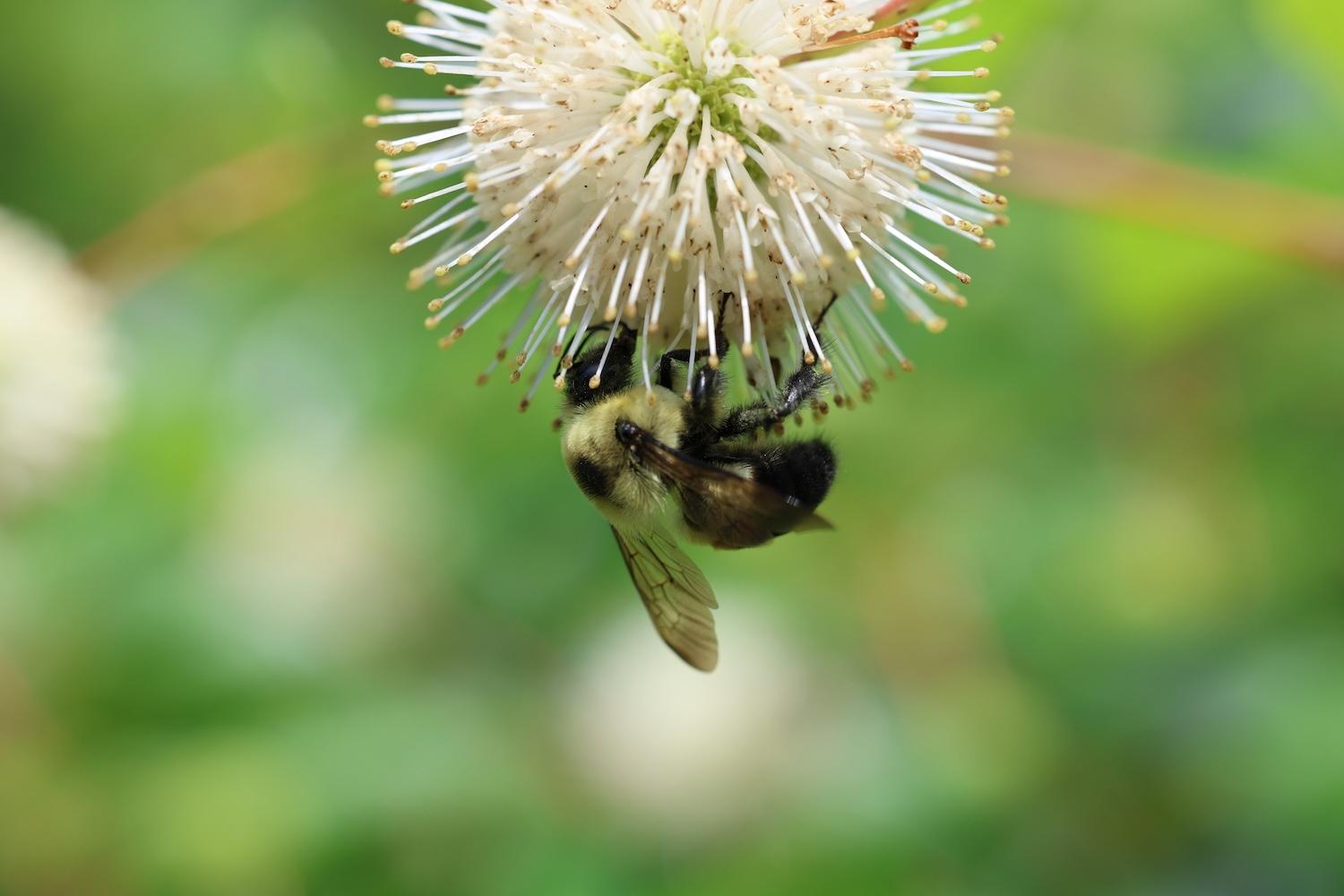
Photo by Sarah Orr
Bumblebees are only an inch long, but they help power the global food system. Roughly one-third of the food we grow depends on pollinators like bees — and those bees are regularly decimated by pesticides.
Modern pesticides have helped boost crop yields, but they can also harm the insects that make those yields possible. Sulfoxaflor, a next-generation pesticide introduced in 2013, kills sap-feeding pests like aphids in crops, including soybeans and corn. Sulfoxaflor is also known to be toxic to bees. Scientists are still working to understand how low-dose exposure affects bee reproduction at the molecular level.
Researchers at Georgia Tech have found that sulfoxaflor disrupts reproduction and gene expression. In a study funded by the U.S. Department of Agriculture, the team exposed groups of worker bumblebees to low doses of the pesticide and analyzed changes in gene activity. They found that ovarian tissues showed the most significant shifts in gene expression. These changes could contribute to reduced reproductive output and, over time, affect bee populations.
In the study, the researchers flash-froze bee tissues and analyzed RNA to track how gene activity shifted after pesticide exposure. The Georgia Tech team used computational models to pinpoint which biological systems were most affected.
“What makes this study exciting is that it connects molecular changes in gene expression to real-world consequences for individual bees and their colonies,” said Michael Goodisman, a professor in the School of Biological Sciences. “That type of connection is rare and gives us a much clearer picture of how pesticides affect bees.”
The implications of the study highlight a pressing challenge in agriculture.
“We need pesticides to control crop pests, but they can also harm essential non-target insects like bumblebees,” said Sarah Orr, who led the research as a postdoctoral fellow at Georgia Tech and now works as an assistant professor at the University of Tampa. “As a scientist, my goal is to identify practical solutions that support pest management while also protecting beneficial insects and the food systems that depend on them.”
That balance between pest control and pollinator protection is critical. “We need many bees for successful pollination,” Orr said. “If they’re not producing enough offspring, pollination will decline.”
Pesticides are only one of several threats facing bumblebees. Stressors like heatwaves also play a growing role. By better understanding how chemicals like sulfoxaflor affect bee biology, researchers hope to help farmers protect both their crops and the pollinators that sustain them.
Michael A. Catto, Jixiang Xu, Kayla A. Murray, Emma Leigh M. Bossard, Michael A.D. Goodisman, Sarah E. Orr, Integrative assessment of sulfoxaflor effects on gene expression, reproduction, and behavior in the bumblebee Bombus impatiens, Ecotoxicology and Environmental Safety, Volume 315, 15 April 2026, 120101, ISSN 0147-6513.
https://doi.org/10.1016/j.ecoenv.2026.120101
Tess Malone, Senior Research Writer/Editor
tess.malone@gatech.edu


