
GTRI Develops Climate, Moisture Control Technologies to Optimize Poultry House Operations
Aug 20, 2025 —
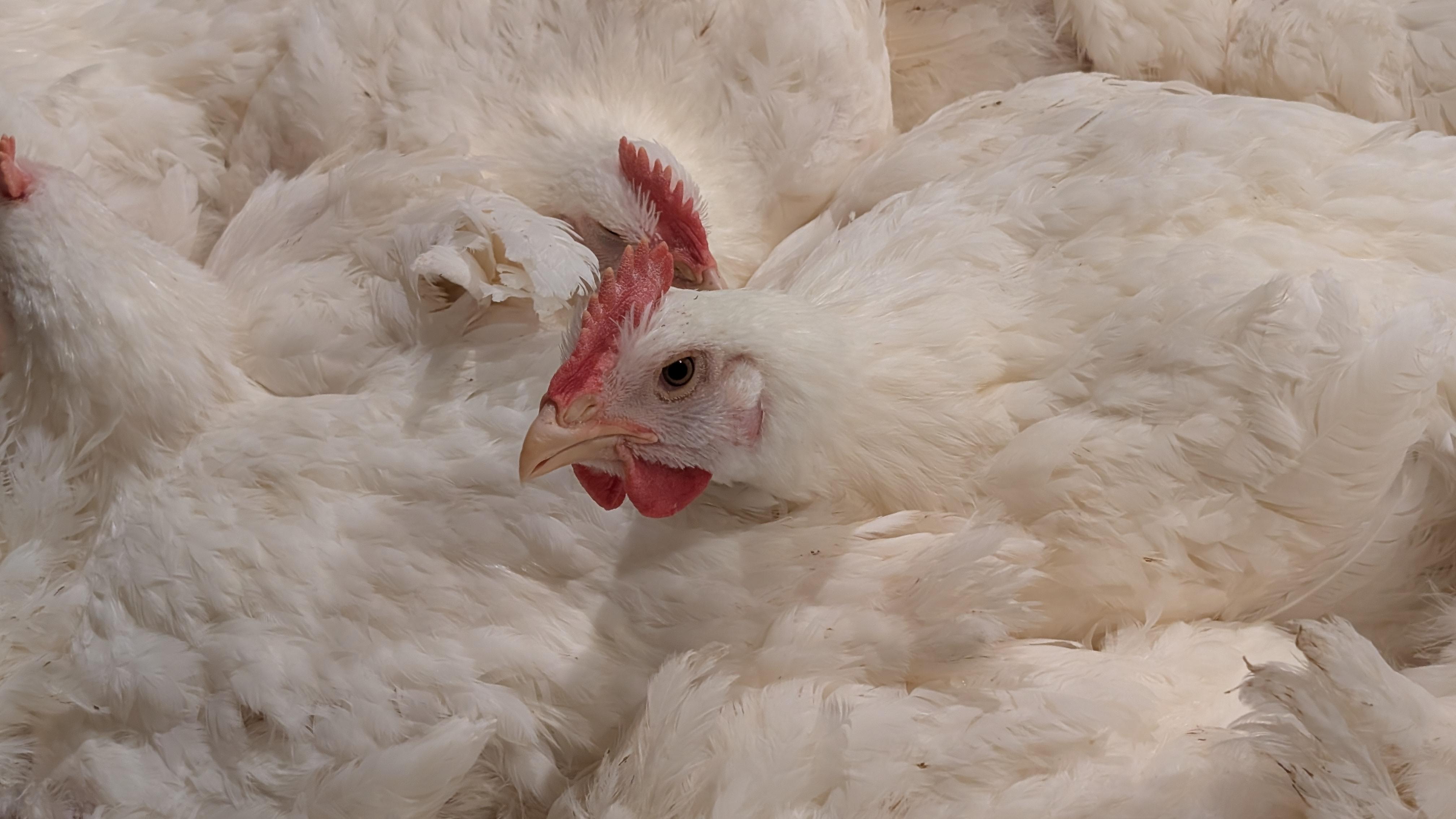
In Georgia, chickens make up the biggest agricultural product with a whopping annual state economic impact of over $28 billion. However, it can be extremely challenging - and costly - for poultry farmers to maintain optimal temperature and moisture levels inside poultry houses. By addressing this challenge, GTRI's two technologies could result in healthier birds and save farmers money.
In Georgia, where chickens are the biggest agricultural product with an annual state economic impact of over $28 billion, maintaining the right temperature and moisture levels in a poultry house is crucial for bird health and efficiency. However, this can be challenging due to changing weather, bird density and size, and high energy costs.
The Georgia Tech Research Institute (GTRI) is addressing these challenges with two technologies: the Broiler House Integrated Guided-Motion Excreta Saturation System (BHIG-MESS) and a protective chicken enclosure known as “chicken bubble.” BHIG-MESS addresses moisture concerns by removing poultry waste from the house regularly and automatically, which helps reduce ventilation needs and energy consumption. “Chicken bubble” uses an inflatable barrier to reduce the volume of air that needs conditioning, lowering energy expenses that are among the highest costs for farmers.
“One of the biggest challenges for poultry houses and farmers is maintaining the internal environment of the house,” said GTRI Principal Research Scientist Alex Samoylov. “While issues related to feed and water have been more or less resolved, creating an optimal environment within the house is still very much an art rather than an exact science.”
Poultry house energy costs are primarily driven by heating fuel and electricity for essential needs like keeping chickens warm, providing adequate lighting and powering ventilation systems.
“How well farmers manage their energy costs directly impacts the health and productivity of the birds – and by extension, their profitability,” Samoylov said.
BHIG-MESS consists of a specially designed tiled floor where manure falls through into a tray beneath, allowing for daily removal. In traditional houses, wood shavings absorb manure and it remains in place for the flock's entire stay. By clearing out the manure every day, BHIG-MESS significantly reduces moisture levels inside the house and, consequently, the need for intensive ventilation.
The “chicken bubble” system’s inflatable technology reduces the amount of air that needs to be ventilated and conditioned. By displacing a significant portion of air inside the house, farmers could cut these air requirements by at least half, Samoylov said.
GTRI has conducted trials of BHIG-MESS at the University of Georgia’s (UGA) Poultry Experimental Center. During the trials, researchers replaced half of the floor with GTRI’s system and the other half remained traditional wood shavings. The birds were raised for seven weeks and GTRI collected data on manure accumulation, bird health and weight distribution.
They observed that the birds on GTRI’s flooring system had significantly fewer instances of footpad dermatitis, a condition in chickens where the skin on the bottom of their feet becomes inflamed and irritated, often caused by wet and dirty litter. The system also demonstrated that it did not cause more chicken deaths compared to traditional methods. Chickens on the new system also had similar weight patterns and, in some cases, were healthier than those raised on the traditional wood shavings.
GTRI plans to test “chicken bubble” in 2026, starting in controlled environments before moving to larger poultry houses. This project has been supported by GTRI’s Agricultural Technology Research Program (ATRP).Once more testing has been completed, GTRI plans to partner with commercial entities that would manufacture and distribute these technologies. Samoylov said his team envisions a partnership where these companies would handle production and installation while GTRI continues focusing on further research and technical refinement.
“Our focus is on enhancing sustainability and profitability for the poultry industry,” he said. “By creating innovative solutions, we aim to secure food supply and help growers thrive.”
Writer: Anna Akins
Photos: Sean McNeil
Additional Photo Credit: Alex Samoylov
GTRI Communications
Georgia Tech Research Institute
Atlanta, Georgia
For more information, please contact gtri.media@gtri.gatech.edu.
To learn more about GTRI, visit: Georgia Tech Research Institute | GTRI
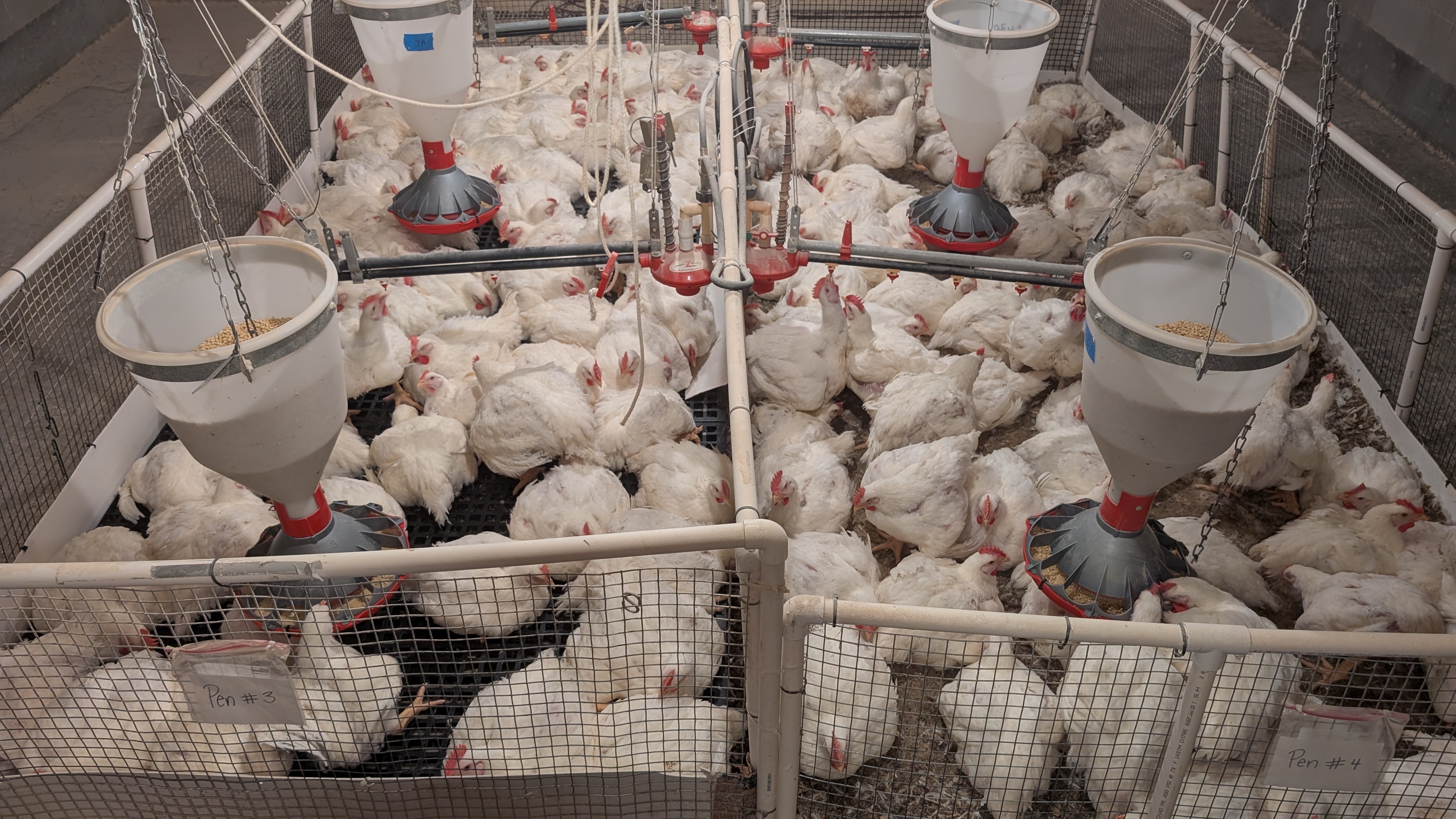
During recent trials at UGA, GTRI observed that birds on GTRI's BHIG-MESS flooring system (on left) had fewer instances of footpad dermatitis along with similar weight patterns and better overall health in some cases than those on raised traditional wood shavings (Photo Credit: Alex Samoylov).
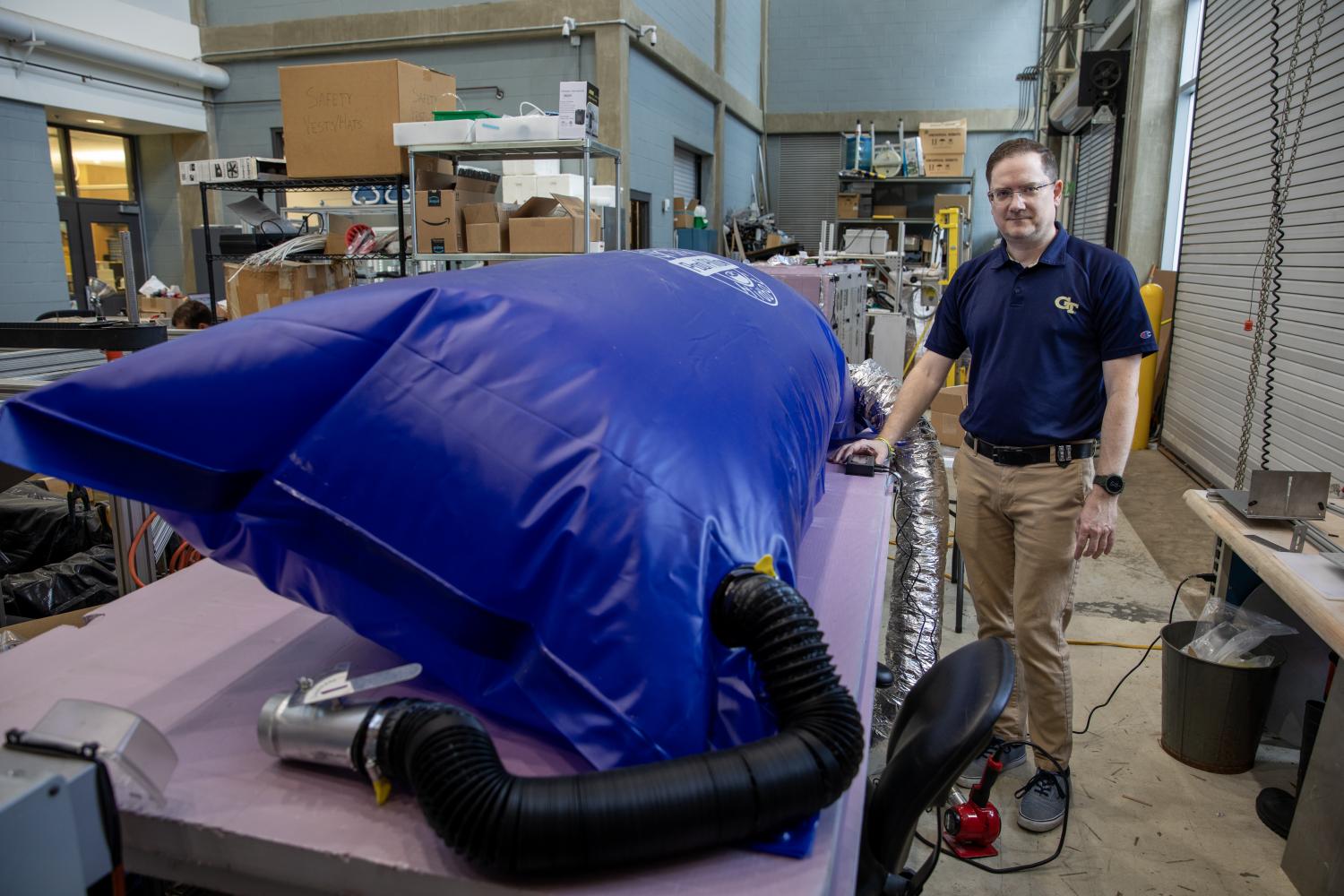
GTRI Principal Research Scientist and project lead Alex Samoylov stands next to a prototype he has developed of GTRI's "chicken bubble" technology. "Chicken bubble" reduces the volume of air in poultry houses that needs conditioning, lowering energy expenses that are among the highest costs for farmers. GTRI plans to test this technology out in the field sometime next year (Photo Credit: Sean McNeil, GTRI).
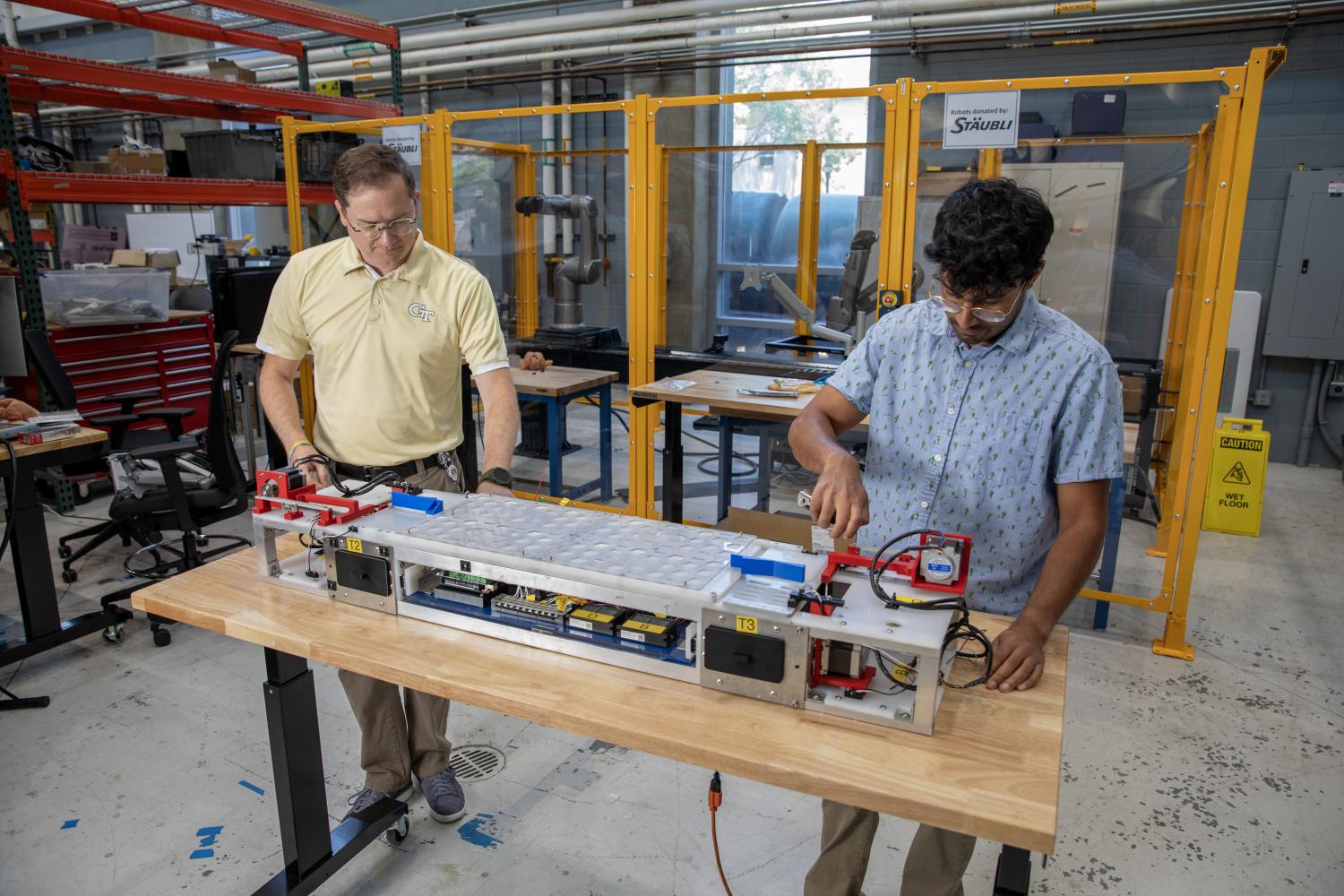
GTRI Principal Research Scientist and project lead Alex Samoylov (left) and GTRI Research Engineer Parth Mandrekar (right) have developed a BHIG-MESS prototype and are seen working on it here (Photo Credit: Sean McNeil, GTRI). BHIG-MESS addresses moisture concerns in poultry houses by removing waste regularly and automatically, which helps reduce ventilation needs and energy consumption.
Author: Anna Akins anna.akins@gtri.gatech.edu
GTRI media contact info: gtri.media@gtri.gatech.edu


