
Georgia Tech Students Create Chemical Safety Model for Everyday Exposures
Jun 02, 2026 —
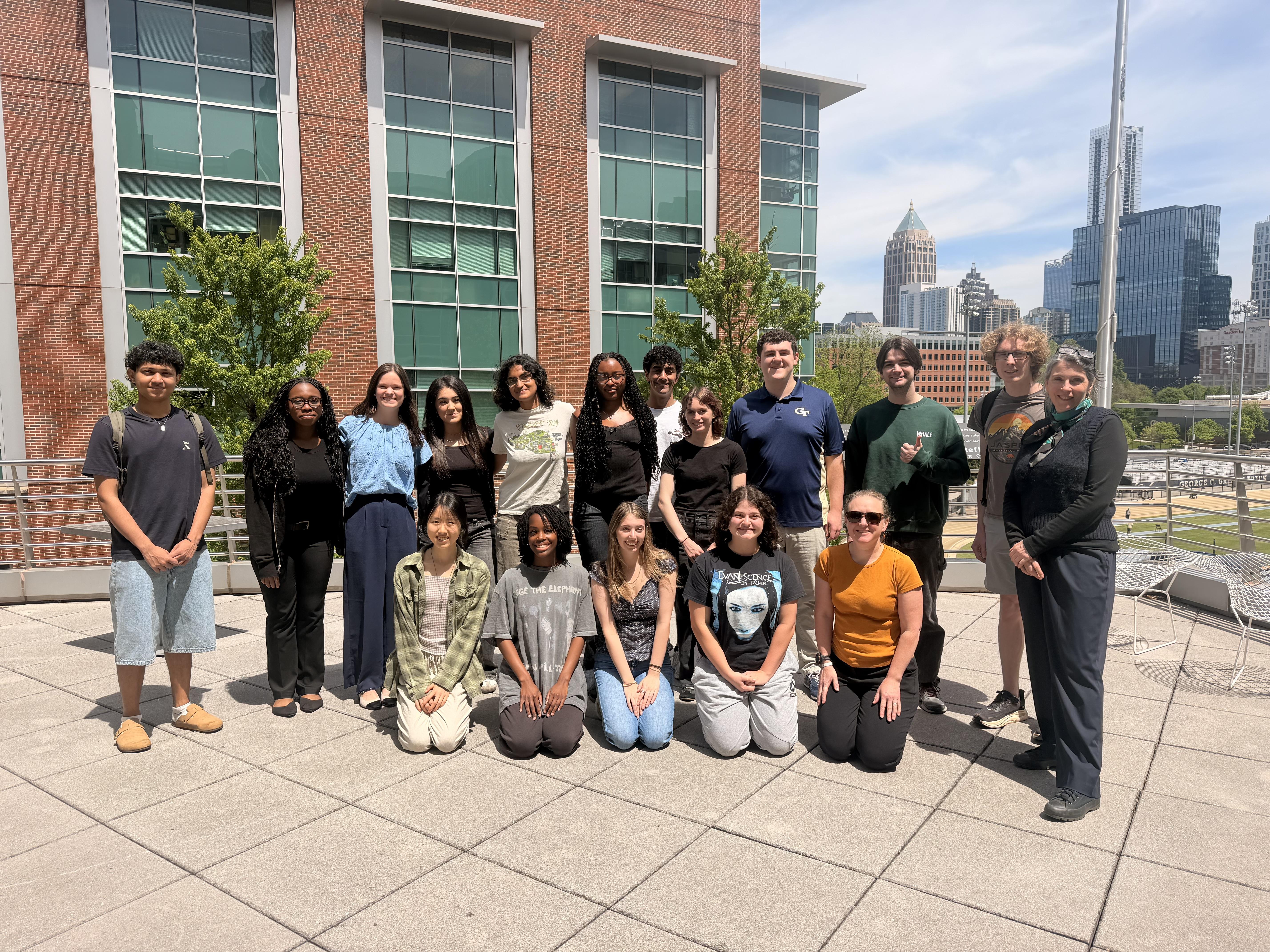
The most recent VIP class.
In just one course, Georgia Tech student Diya Godavarti helped develop a tool that could improve workers' responses to chemical spills or open containers.
Godavarti, then a second-year chemical and biomolecular engineering (ChBE) student, joined a course on chemical equity focused on reducing chemical exposure in vulnerable communities. The class, part of Georgia Tech’s Vertically Integrated Projects (VIP) program, embeds students in long-term research teams that span disciplines and semesters.
She and her classmates developed a computational model that estimates how dangerous chemical vapors build up in enclosed spaces, such as tanker trucks. Their work culminated in a paper, “Modeling Time-Dependent Chemical Concentrations in Confined Spaces for General Safety Applications,” published recently in ACS Chemical Health & Safety.
For Godavarti, the experience helped clarify her future career endeavors.
“I was always motivated to keep going on this project because chemical equity is something I genuinely care about,” she said. “I realized I really enjoyed working on open-ended projects after this class, and this confirmed my desire to pursue a Ph.D.”
She will begin her ChBE doctoral studies at Northwestern University this fall.
Bridging Disciplines
The VIP class grew out of a gap between research labs and reality. Pamela Pollet, a faculty member in Tech’s School of Chemistry and Biochemistry, is used to working in controlled lab settings with safety measures like vent hoods. But after she consulted on a project where commercial workers were accidentally exposed to harmful chemicals, she started to think about safety differently.
“There was a disconnect between what we do with chemicals in our controlled environments, which we understand very well, and how people interact with chemicals every day,” she said.
To bridge that gap, Pollet partnered with Jenny Houlroyd, the occupational group health manager of the Enterprise Innovation Institute’s (EI2) Safety, Health, and Environmental Services Program. Houlroyd works with Georgia businesses to reduce workplace hazards and protect employee health.
“We realized how siloed this work can be,” Houlroyd said. “Chemical safety researchers and chemists often operate separately, but their skills are complementary. That’s how we came up with the idea for the class.”
The VIP format made that collaboration possible. The 20-student team included majors from chemistry, biochemistry, biology, computer science, neuroscience, and ChBE. In addition to research, students heard from guest speakers — including journalists, lawyers, and policymakers — whose work intersects with chemical safety.
Modeling a Real-World Risk
The students focused on a practical problem in industrial hygiene: quickly estimating a person’s exposure to hazardous chemicals after a spill or open container in a confined space.
“If you hire an industrial hygienist like me, it’s going to take time to schedule, and it’s going to be expensive,” Houlroyd said. “But if there’s a chemical spill event happening, you need that safety data right away.”
To address this, the students built a computational model that simulates how chemicals evaporate and spread through air in enclosed environments. Using benzene, a common solvent, as a test case, the model predicts how benzene concentrations change over time, from minutes to hours after a spill or residual pool in an enclosed space. It can also estimate exposure at different heights, accounting for whether someone is standing upright or crouching in a chemical-heavy area.
“We’re addressing important gaps in modeling chemical exposures,” said John Pederson, a chemistry Ph.D. student who mentored the student team. “There’s been strong work in industrial settings, but less attention to environments found in transportation, agriculture, and sanitation, for example. It's an easily overlooked fact that working with paints, coatings, cleaning solutions, and other solvents presents a risk of acute or chronic exposure.”
From Classroom to Impact
The team ultimately hopes to make the model widely accessible and create a user-friendly app. While that work is ongoing, Pollet and Houlroyd say the project already demonstrates the power of interdisciplinary learning.
“This project was a very nice overlap of our fields,” Pollet said. “It helps students understand real-world scenarios in a way you can’t replicate in a traditional classroom.”
For Houlroyd, the collaboration also extended her impact beyond the field.
“I work for EI2, and we’re primarily external-facing and helping businesses out across the state of Georgia, but this has been a great opportunity to take what I'm learning in the field and then share it with the students,” she said. “I am so proud of the students. To see them take this big issue and make it into something the industry can use is so exciting.”
Modeling Time-Dependent Chemical Concentrations in Confined Spaces for General Safety Applications
Diya Godavarti, Waynell Simbafo, John Pederson, Jenny Houlroyd, and Pamela Pollet
ACS Chemical Health & Safety Article ASAP
DOI: 10.1021/acs.chas.6c00021
Tess Malone, Senior Research Writer/Editor
tess.malone@gatech.edu


