
Georgia Tech Researchers Discover New Form of NAND Flash Data Storage for Deep Space Missions
May 18, 2026 —
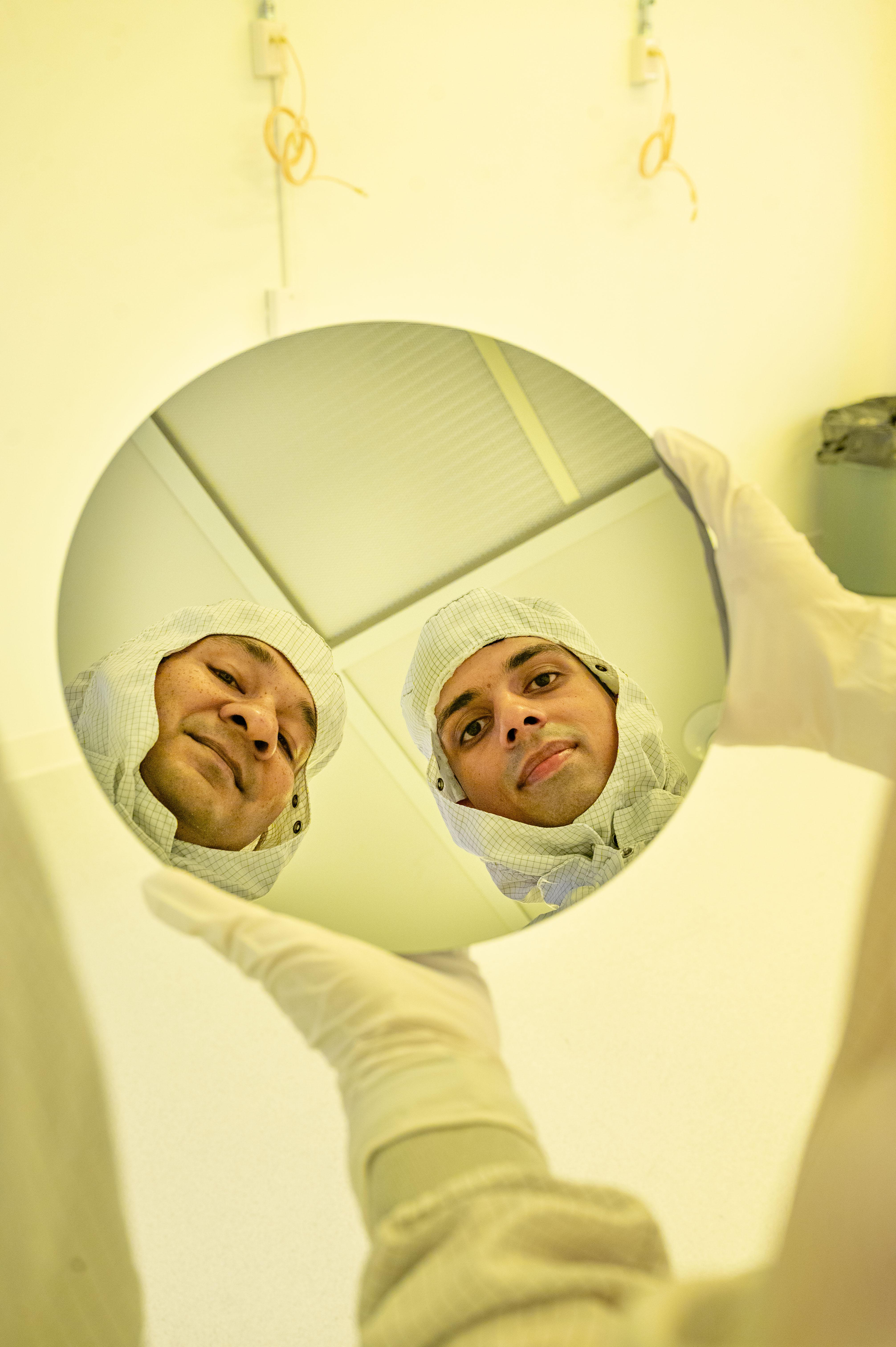
Asif Khan and Lance Fernandes built the ferroelectric NAND memory chips in Georgia Tech’s cleanroom, then sent the chips for radiation testing to collaborators at Pennsylvania State University. Those tests revealed just how extreme the technology’s tolerance could be.
As space missions travel farther from Earth, spacecraft must increasingly be able to process and store their own data. Soon, artificial intelligence (AI) could be the primary tool for handling this growing volume of information. NAND flash memory is the current state-of-the-art technology used to store these massive amounts of data, offering storage capacities in the terabit range. It’s the same technology used in laptops, smartphones, and data centers. Ensuring NAND’s reliability in space is critical as these systems increasingly rely on high-density, low-power storage.
But the radiation in harsh space environments can significantly degrade data stored in NAND flash memory. To counteract this, Georgia Tech researchers have developed a new form of NAND flash memory that can both handle AI and withstand extreme radiation.
This technology uses ferroelectricity, which is when certain materials can hold a permanent, spontaneous electric charge, called polarization. In a recent Nano Letters paper, the researchers show that NAND flash memory made with ferroelectric materials can withstand radiation levels up to 30 times higher than more conventional NAND flash memory.
“If you send traditional flash memory to space, the radiation interacting with flash memory’s trapped electric charge can easily corrupt the data,” said Asif Khan, an associate professor in the School of Electrical and Computer Engineering (ECE). “In contrast, ferroelectric NAND flash storage does not store data as trapped electrical charge, but rather stores it as polarization in the material. And polarization is very resilient to radiation effects.”
Radiation Revelation
The insight that NAND flash-compatible ferroelectric memory could withstand high amounts of radiation surprised the researchers. Ferroelectricity in hafnium oxide — the silicon-compatible material that makes this memory possible — was discovered just 15 years ago, and Khan’s lab has been determining its capabilities for the past decade. The team knew ferroelectricity was radiation-tolerant, but not exactly how tolerant when implemented in NAND flash architectures.
Lance Fernandes, an ECE Ph.D. student and the paper’s first author, built the ferroelectric NAND memory chips in Georgia Tech’s cleanroom, then sent the chips for radiation testing to collaborators at Pennsylvania State University. Those tests revealed just how extreme the technology’s tolerance could be.
The Penn State researchers’ testing showed that ferroelectric flash technology can sustain radiation as high as 1 million rads (radiation absorbed doses) — the equivalent of 100 million X-rays — making it 30 times more durable than traditional memory. This is well within the radiation-tolerance threshold for most spacecraft: Low-Earth orbit satellites require a tolerance of 5 – 30 kilorads, geostationary orbits need 100 – 300 kilorads, and deep space missions top out at 1 million rads.
“For data storage in space, it’s not enough for memory to work. It has to remain reliable under extreme radiation,” said Fernandes.
“And what makes our storage especially exciting," added Khan, “is that ferroelectric NAND flash isn't just radiation-tolerant; it also stays reliable even in extremely harsh radiation environments. That's exactly what we need for space.”
From orbiting satellites to future missions surveying Jupiter’s moons, successful space exploration requires electronics that can process abundant AI data and will not fail when communication is delayed. Ferroelectric memory offers a way to keep critical data intact, no matter how harsh the environment.
The work was supported in part by SUPREME, one of seven centers in JUMP 2.0, a Semiconductor Research Corporation (SRC) program sponsored by DARPA. The work was performed as part of the Interaction of Ionizing Radiation With Matter University Research Alliance, sponsored by the Department of Defense, Defense Threat Reduction Agency, under grant HDTRA1-20-2-0002.
Enabling Radiation Hardness in Solid-State NAND Storage Utilizing a Laminated Ferroelectric Stack Lance Fernandes, Stuart Wodzro, Prasanna Venkatesan, Priyankka Ravikumar, Ming-Yen Lee, Minji Shon, Dyutimoy Chakraborty, Taeyoung Song, Sanghyun Kang, Salma Soliman, Mengkun Tian, Jason Yeager, Jackson Adler, Jiayi Chen, Zekai Wang, Douglas Wolfe, Shimeng Yu, Andrea Padovani, Suman Datta, Biswajit Ray, and Asif Khan. Nano Letters 2026 26 (10), 3390-3397
DOI: 10.1021/acs.nanolett.5c05947
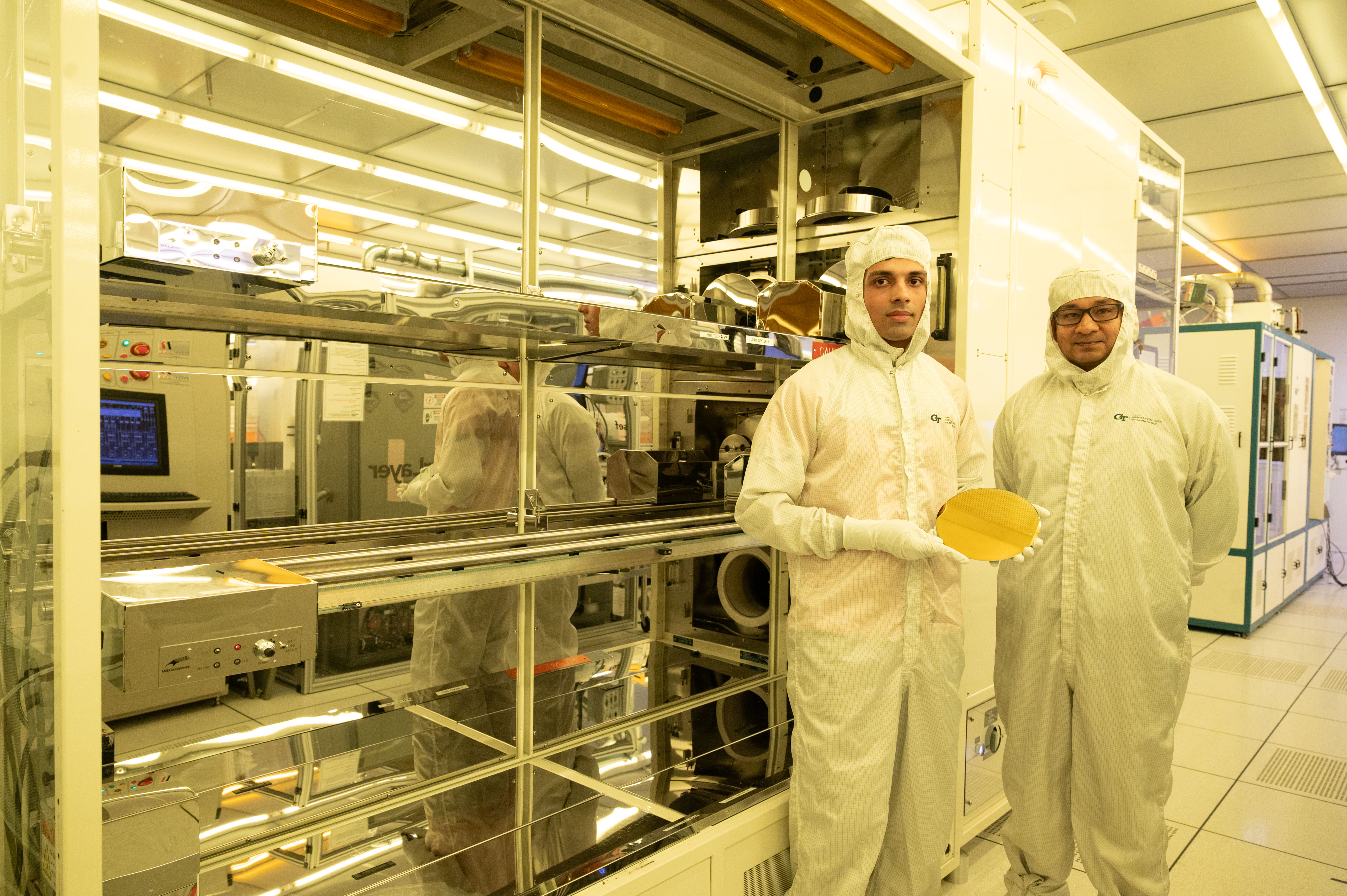
Lance Fernandes and Asif Khan in the cleanroom.
Tess Malone, Senior Research Writer/Editor
tess.malone@gatech.edu


