
Getting the Message Across: One Researcher’s Mission to Make Communications Work for Everyone
From disaster alerts to job tools, Salimah LaForce is working toward a digital world that includes people with disabilities in every way.
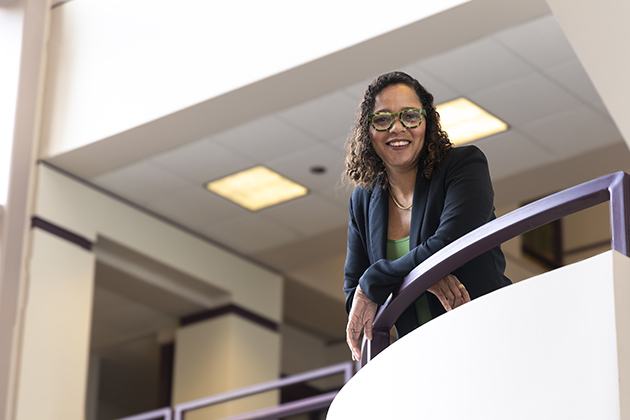
Salimah LaForce studies where information systems fail and where they can be improved. Her work helps ensure that people with disabilities aren’t sidelined when it comes to safety, health, and opportunity.
Most of the digital environment isn’t designed with all users in mind. From emergency phone alerts to job search platforms, a lot of technology doesn’t work well — or at all — for people with disabilities. Enter real-life barriers: to safety, healthcare, information, and making a living.
Fortunately, some people make it their mission to bring down those barriers. Salimah LaForce, senior research scientist for Georgia Tech’s Center for Advanced Communications Policy (CACP), studies where information systems fail and where they can be improved. Her research shapes policies, tools, and educational resources to make sure everyone — not just the non-disabled — can access the same opportunities and protections.
“Technology works best when it works for everyone,” LaForce said. “There should be no sociodemographic or systemic barriers to accessing lifesaving information or having the tools you need to work and live well.”
LaForce’s work spans the breadth of accessibility research. She makes recommendations on how emergency mobile alerts can be improved, accesses job outcomes for people with disabilities, and even designs virtual games that help older adults protect themselves in the face of disaster.
But how did a humanities enthusiast from California end up designing virtual reality (VR) studies in Atlanta? It’s a path that, while unexpected, ended up coming full circle.
“Technology works best when it works for everyone. There should be no sociodemographic or systemic barriers to accessing lifesaving information or having the tools you need to work and live well.”
An English Major Finds Her Way (Back) to Science
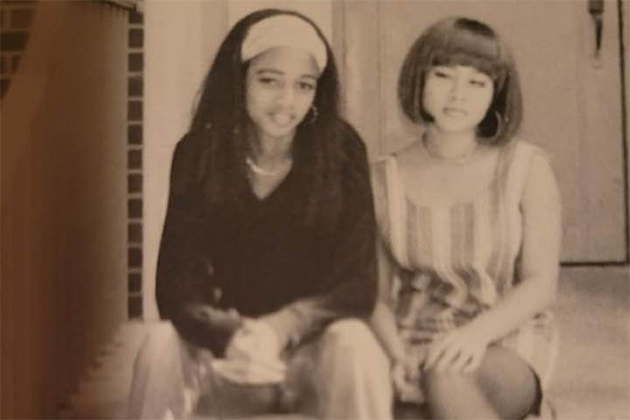
LaForce is pictured (left) with her best friend (right) in a 1992 Atlanta-area high school publication.
A child and grandchild of Civil Rights Movement organizers, LaForce spent her early childhood in 1980s San Francisco. In 1988, her mother moved to Atlanta to take a job at the National Black Women's Health Project, and shortly after, LaForce moved to Atlanta to join her.
Agnes Scott College offered LaForce a scholarship too good to turn down following her graduation from high school. Though she considered a degree in math or science, LaForce ultimately majored in English, her first love.
“Reading and writing are my thing,” she said. “And fundamentally, it’s what I do in my job today as a research scientist when I write about policy research.”
After college, LaForce worked as an executive assistant at a law firm, where a colleague mentioned a new center launching at Georgia Tech. The colleague’s aunt, Helena Mitchell, had just started the university’s Office of Technology Policy and Programs. After reaching out to Mitchell several times, LaForce finally got her foot in the door in 2001.
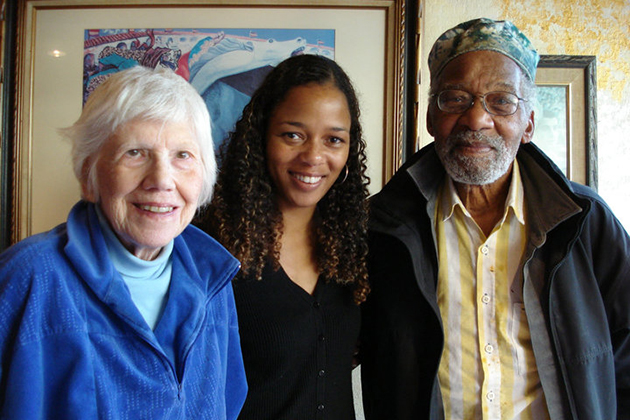
LaForce’s grandparents (pictured) and parents were Civil Rights activists, a legacy that she carries on in her accessibility research.
“I convinced her my writing could help translate engineering research from — for lack of a better word — a stale concept into a real story,” LaForce said.
A specialized unit, the center researched disability access with a focus on communications, advanced telecommunications, and associated policy issues. Over time, that office expanded and is now the Center for Advanced Communications Policy.
While LaForce’s initial role was coordinating report submissions to the Federal Communications Commission, she was soon writing the reports herself.
“My supervisors kept encouraging me to get an advanced degree,” LaForce said. “They said, ‘Salimah, you’re doing the work anyway, so you might as well have the credentials.’ I finally listened to them.”
LaForce enrolled in an online master's program in clinical psychology at Capella University. At the time, she was raising two small children and couldn’t afford to quit her job or go down to part time. LaForce worked full-time and did coursework in the evenings and on weekends.
Earning her degree empowered LaForce to design her own research program and incorporate new cognitive dimensions into her work.
“The world of accessible communications encompasses a lot of different interventions,” LaForce said. “For people with visual disabilities, contrast can enhance their access. Hearing-related disabilities, cognitive disabilities, learning disabilities, physical disabilities, and even dyslexia all require unique interventions.
“There was so much to consider, and after I earned my degree, I really started broadening my research.”
“When you're doing this work, you can't help but notice that, for someone to have emergency communications access, they need to have access to communications in the first place. And in this space, by ‘access’ we mean accessibility to communications in a way that is appropriate for your disability.”
From Research to Access
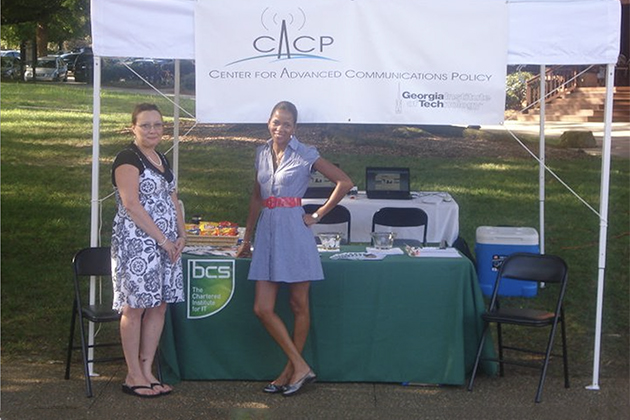
LaForce started working at Georgia Tech in 2001 and is pictured early in her career as a Yellow Jacket, hosting an informational booth with a colleague from the Center for Advanced Communications Policy.
LaForce’s work as a research scientist is especially influential in the realm of emergency communications. She helps lead national research on wireless alert systems — identifying how alerts reach (or fail to reach) people with visual, hearing, cognitive, or mobility-related disabilities. She recently contributed to the design of a VR tool aimed at teaching older adults how to prepare for emergencies, with the hope of increasing their resilience during disasters.
“When you're doing this work, you can't help but notice that, for someone to have emergency communications access, they need to have access to communications in the first place,” LaForce said. “And in this space, by ‘access’ we mean accessibility to communications in a way that is appropriate for your disability.”
LaForce also researches employment outcomes for people with physical disabilities. Currently, she directs a project for the Rehabilitation Research and Technical Assistance Center. The project is a longitudinal survey that collects data on assistive technology and workplace accommodations, and seeks to understand that relationship to employment outcomes, including length of time, job salary, job satisfaction, and how those carry over to quality of life.
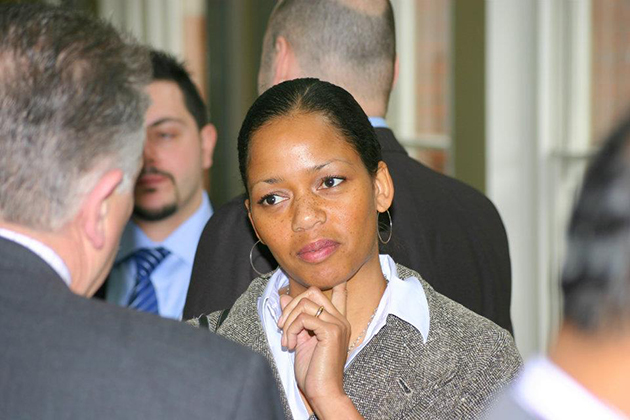
LaForce at a recent BCS event in London. BCS is a nonprofit dedicated to ensuring technology creates a safe, positive future for all of society.
The goal is to inform policy and practice around the employment of people with disabilities, especially about their use of assistive technology and workplace accommodations. In September 2025, the project will begin its third year — but Salimah and her colleagues hope the study will run for a few decades, to paint the fullest possible picture of employment outcomes.
According to LaForce, one of her key accomplishments — and the one closest to her heart — is a pilot project that analyzes accessible diabetes health literacy for people who are Deaf. LaForce is the study’s principal investigator.
“People who are Deaf are among the most excluded when it comes to effective communication in general, and health information specifically,” LaForce said.
LaForce’s study, the American Sign Language-Accessible Diabetes Education project, showed that when Deaf participants received health education in ASL — rather than through captioned text — their health behaviors improved significantly. It’s a project LaForce is fiercely committed to, despite the challenge of securing major funding for such a specialized population.
“I will never give up on that,” she says. “People who rely on ASL as their first language are often excluded from everyday information the rest of us take for granted.”
Full Circle
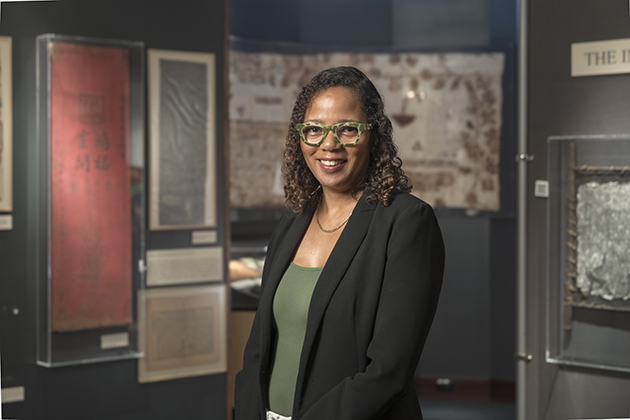
By championing accessible design in both crisis response and daily life, LaForce is contributing to a body of work that makes inclusion the standard, not the exception.
“Though it didn’t occur to me before I started working at Georgia Tech in disability policy and disability access, I realized that this community is also fighting for access to things that people without disabilities already have,” LaForce said. “My family’s history in Civil Rights is one of the reasons this field really resonates with me.”
Through her work, LaForce collaborates with experts across Georgia Tech’s campus, including the Center for Inclusive Design and Innovation. Working with passionate colleagues from various disciplines is one of the best parts of being a research scientist, LaForce added.
“The way I see it, working at Georgia Tech has brought me full circle to my initial dream of being interested in STEM but having a love for the humanities.”
LaForce’s work helps ensure that people with disabilities aren’t sidelined when it comes to safety, health, and opportunity. By making emergency systems and everyday tools more inclusive, she’s helping to build a world where everyone is protected and empowered.

Writer and Media Contact: Catherine Barzler, Senior Writer, Research Communications | catherine.barzler@gatech.edu
Video: Christopher McKenney, Video Producer, Research Creative Services
Photos: Christopher McKenney and courtesy of Salimah LaForce
Series Design: Daniel Mableton, Senior Graphic Designer, Research Creative Services
About the Ivan Allen College of Liberal Arts
Georgia Tech’s Ivan Allen College of Liberal Arts offers innovative, human-centered perspectives at the intersection of the humanities, social sciences, arts and STEM.
Its six schools — Economics; History and Sociology; Literature, Media, and Communication; Modern Languages; Jimmy and Rosalynn Carter School of Public Policy; and the Sam Nunn School of International Affairs — along with 18 research centers, including the Center for Advanced Communications Policy, provide programs and experiences that redefine the role of the humanities and social sciences. Nearly 350 tenured, tenure-track, non-tenure-track and permanent research faculty work in the college.
Learn More
To explore careers in research, visit the Georgia Tech Careers website. To learn more about life as a research scientist at Georgia Tech, visit our guide to Research Resources or explore the Prospective Faculty hub on the Office of the Vice Provost for Faculty website.
Unexpected Paths Series
With so many paths to research careers, finding the right one can be daunting. In the Unexpected Paths series, we explore the journeys of 12 research faculty members from across the Institute and learn about their unique paths to research careers at Georgia Tech.


