
This Small Sensor Could Make Huge Impacts on Brain Injury Treatment
Researchers develop a tinier sensor for less invasive intracranial monitoring.
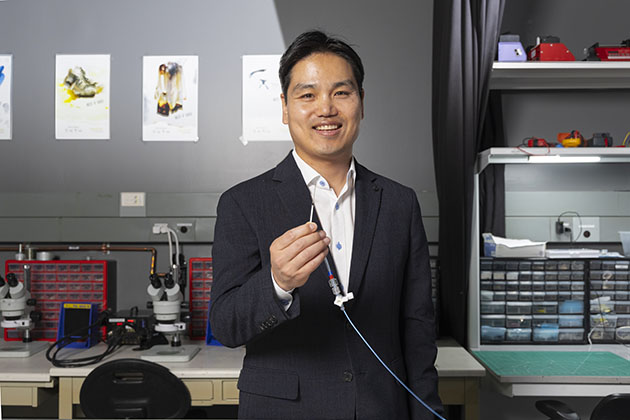
Hong Yeo holds an in-stent nanomembrane sensor that can detect intracranial pressure.
A car accident, football game, or even a bad fall can lead to a serious or fatal head injury. Annually, traumatic brain injuries (TBI) cause half a million permanent disabilities and 50,000 deaths. Monitoring pressure inside the skull is key to treating TBI and preventing long-lasting complications.
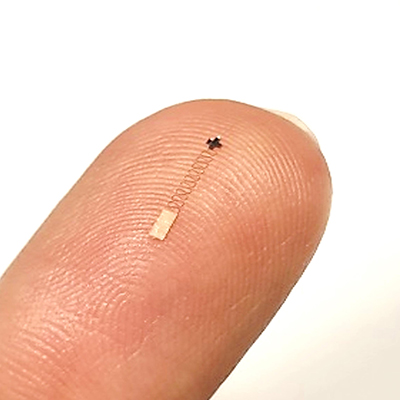
Most of these monitoring devices are large and invasive, requiring surgical emplacement. But Georgia Tech researchers have recently created a sensor smaller than a dime. The miniature size offers huge benefits.
“Surgery means extensive recovery time and can significantly impact patient health. Our system doesn't require surgery because we use a conventional stent, the catheter, as a delivery vehicle,” said W. Hong Yeo, the Harris Saunders Jr. Endowed Professor and an associate professor in the George W. Woodruff School of Mechanical Engineering.
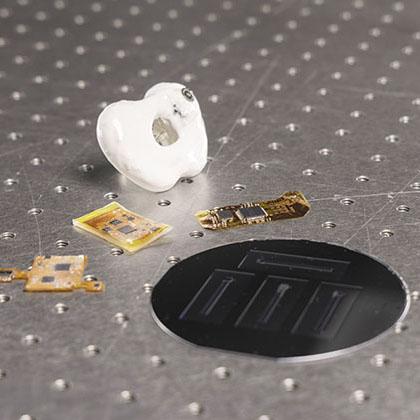
Made from ultra-thin, flexible silicone, these nanosensors can be embedded in almost anything, from pacifiers to catheters. But size was just one element the researchers needed to consider when developing this device; accuracy was just as important.
“We believe that this first development will bring new opportunities to measure signals with minimal complications caused by conventional surgery.”
“The key challenge was to make tiny sensors but at the same time maintain the sensitivity and functionality at a high level,” said Yeo, who also directs the Wearable Intelligent Systems and Healthcare Center (WISH Center) at the Institute for Matter and Systems.
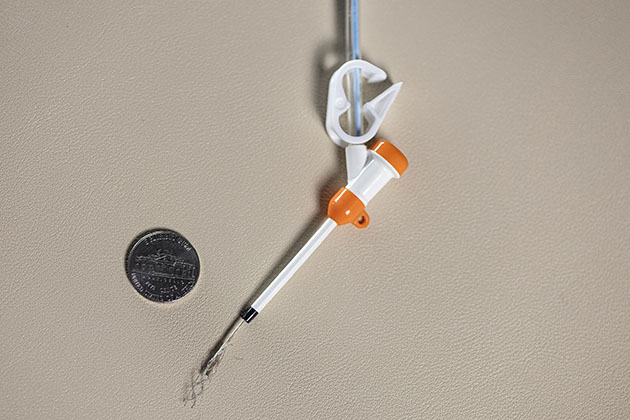
The sensor is smaller than a dime.
Once the researchers’ catheter is in the patient’s skull, the sensor has the potential to continuously gather data at an especially sensitive rate compared to traditional devices. With this sensor, even the smallest pressure changes could register and alert clinicians that further treatment is needed.
Yeo and his collaborators published this research in Advanced Healthcare Materials in February, when it was selected for the inside front cover. The inspiration for the catheter came from co-author Deok Hee Lee, a South Korean physician Yeo met at a conference where Yeo presented on these smaller sensors. The two have collaborated to bring nanotechnology to some of the most common medical problems Lee treats, such as monitoring intracranial pressure after TBIs, high blood pressure, and other ailments. Three years later, with funding from the National Science Foundation, they developed this sensor.
Yeo thinks this is just the start of what they can track.
“We believe that this first development will bring new opportunities to measure signals with minimal complications caused by conventional surgery,” he said.
While the researchers can’t prevent TBIs, this device could help improve patient outcomes — and a less invasive procedure can lead to a more expansive future.
Funding from the National Science Foundation.

Writer and Media Contact: Tess Malone | tess.malone@gatech.edu
Photos: Christopher McKenney
Copy Editor: Stacy Braukman
Design: Josie Giles
Series Design: Stephanie Stephens

About Georgia Tech Commercialization
Georgia Tech Commercialization provides a foundation for faculty seeking to translate the Institute's leading-edge research into real-world applications. Commercialization encompasses four pivotal units: CREATE-X, VentureLab, Quadrant-i, and Technology Licensing. These units empower students and faculty to launch startups, provide comprehensive commercialization support, manage intellectual property, and facilitate the transformation of research into viable businesses. The Office of Commercialization’s mission is to provide world-class commercialization services, catalyzing research and innovation to improve the human condition, and enhancing Georgia Tech's position as a leader in technology and entrepreneurial impact.
Paradigm Shifters
At Georgia Tech, cutting-edge research is a constant — it fuels discovery, challenges norms, and inspires progress every day. And occasionally, technologies emerge with the power to fundamentally change life for the better.
These breakthroughs transform how we live, how we work, and even how we heal. Many years and minds in the making, these technologies are the culmination of collaboration, persistence, and ingenuity. These are the paradigm shifters.
Discover these extraordinary innovations as they begin to make their mark on the world. The future is taking shape right here at Georgia Tech.
 Family Loss Brings About Medical Breakthrough
 This Pacifier Could Monitor Babies’ Vitals in the NICU
 New Wearable Brain-Computer Interface


