
Generative AI Takes Center Stage at Georgia Tech’s 2025 Research Collaboration Forum
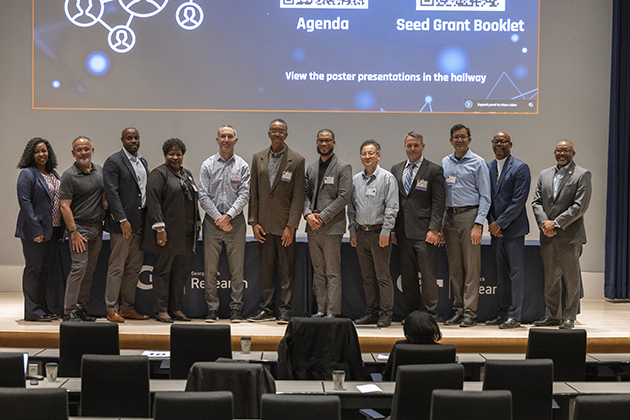
Researchers and partners from Georgia Tech and HBCUs at the 2025 Research Collaboration Forum.
This year’s Research Collaboration Forum (RCF), held November 11-12, gathered researchers and industry partners from across the Institute and 21 Historically Black Colleges and Universities (HBCUs) to examine how generative AI, which can produce new text, images, and data from patterns it learns, is opening new pathways for cross-disciplinary research collaboration and innovation.
Now returning for a second year, the Research Collaboration Forum (RCF) is a part of Georgia Tech’s broader Research Collaboration Initiative. By deepening ties with HBCUs and other minority-serving institutions (MSIs), the initiative works to build a research ecosystem capable of sharing expertise and resources essential to tackling global challenges.
Acknowledging the projects and partnerships that have emerged through the forum, Executive Vice President for Research Tim Lieuwen emphasized how central collaboration is to Georgia Tech’s mission.
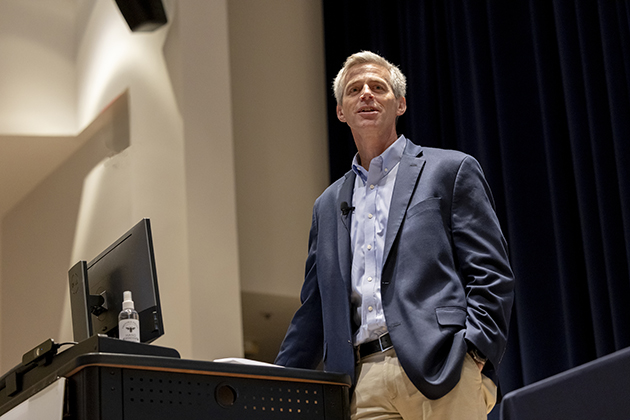
Tim Lieuwen, Georgia Tech’s Executive Vice President for Research, speaks about the role of collaboration in driving impact.
“To serve humanity and discover solutions to our greatest challenges, we must work together,” said Lieuwen. “At Georgia Tech, we want to use higher education and research to create more opportunities for more people. And to move things forward and achieve impact takes partnerships. My commitment is to continue to invest in partnerships.”
In just the last two years, the RCF has funded 12 RCF seed grants, supporting research partnerships with 11 HBCUs. It has also launched partnerships with national labs, expanding access and capacity across fields. This year’s forum continued that momentum.
Day one opened with a reception and a gallery-style poster session featuring this year’s seed grant recipients, whose projects span AI, sustainability, and health applications.
Day two opened with a talk from Irfan Essa, Distinguished Professor in the School of Interactive Computing, who spoke about the power and use of generative AI in film.
This year’s forum also marked the launch of the HBCU AI Network, an initiative designed to connect researchers and students across institutions who are exploring AI applications in science, engineering, and social impact.
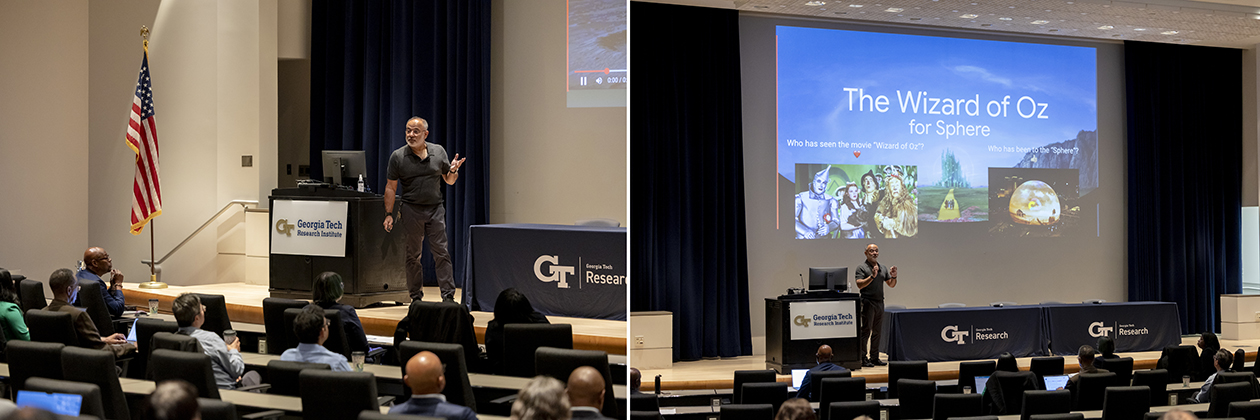
Irfan Essa, Distinguished Professor in the School of Interactive Computing, discusses generative AI’s influence on film and media.
“The HBCU AI Network represents an opportunity to bring together more HBCUs and other stakeholder partners, especially as AI becomes a key enabler of innovation, research, and productivity across sectors,” said George White, Executive Director for Strategic Partnerships.
The launch builds on the work established at the inaugural November 2023 forum, which helped form teams that went on to secure joint seed grants, co-author proposals, and begin collaborative pilot projects across multiple research areas.
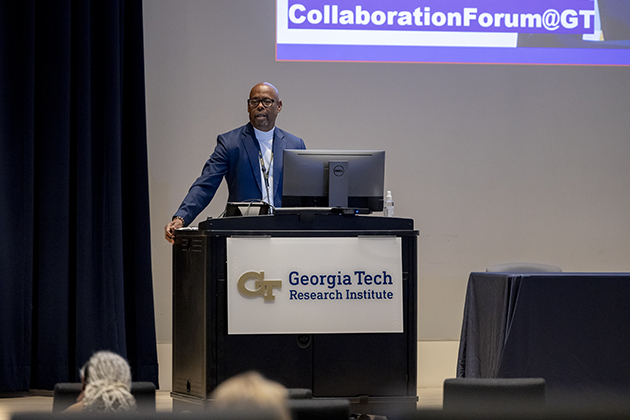
George White, Executive Director for Strategic Partnerships, introduces the new HBCU AI Network.
Frances Williams, Vice President for Research and Sponsored Programs at Clark Atlanta University (CAU), noted that the network reflects a growing commitment to influence both collaborative research and workforce pathways. “The HBCU AI Network gives institutions a unique opportunity to strengthen research and enhance the talent pipeline in areas that will shape the future workforce,” said Williams.
This year, participants took part in breakout sessions designed to spark new collaborations. Each session opened with a keynote who laid out the challenges and opportunities in areas such as health and wellness, semiconductor manufacturing, sustainability, and energy.
Those talks flowed into panel discussions with subject-matter experts from Georgia Tech, Cadence, Sandia National Laboratories, Micron, and other industry partners that unpacked how generative AI is reshaping these sectors in real time.
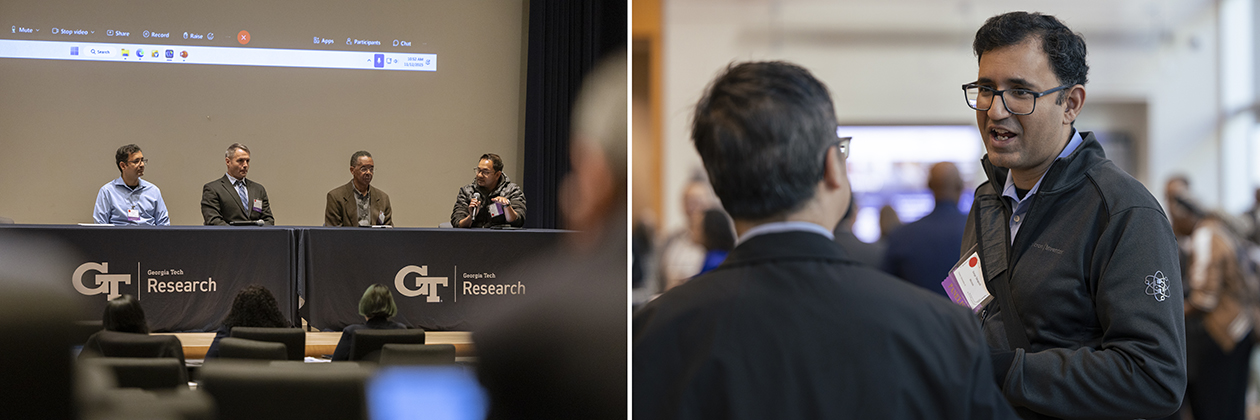
Attendees connect during breakout sessions designed to spark new collaborations.
Attendees were encouraged to begin forming teams for the next round of seed grants —funding intended to catalyze research projects and strengthen institutional capacity for future, larger-scale proposals.
“Seeing these teams come together gives me real optimism for what’s ahead,” said White. “There’s a great deal of work to do, but we’re building the structures and partnerships to move forward together.”

Writer/Media Contact: Yanet Chernet | ychernet3@gatech.edu
Photos: Christopher McKenney


