
Target the Tumor. Spare the Body.
A Georgia Tech researcher is working to send cancer drugs to tumors — and avoid healthy tissue.
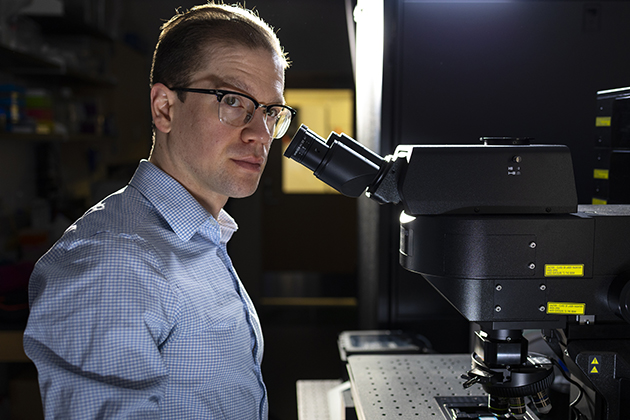
Housley’s drug delivery system is called SANGs, short for “self-assembling nanohydrogels.”
Exhaustion creeps in. Appetite vanishes. Hair thins. The person in the mirror looks gaunt. It’s the paradox of cancer treatment: The same drugs meant to save a life can also wear the body down.
Nick Housley, assistant professor in Georgia Tech’s School of Biological Sciences, wants to change that. He studies where cancer drugs go once they’re inside the body, including places they were never intended to reach. Some of the medicine finds the tumor. The rest interacts with healthy tissue.
This approach has saved millions of lives. It can also create punishing side effects.
“The problem isn’t that these drugs don’t work,” said Housley. “It’s that they affect far more of the body than they need to.”
When Chemistry Does the Work
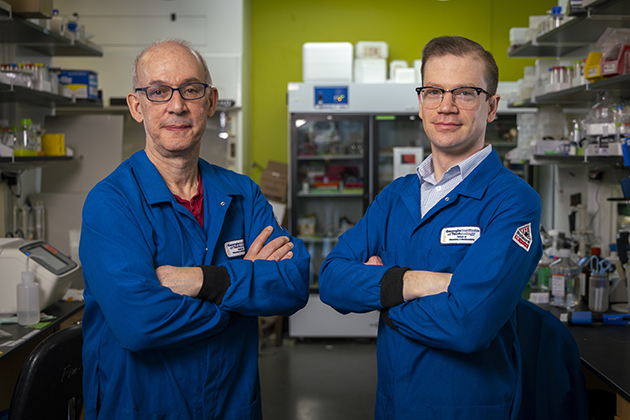
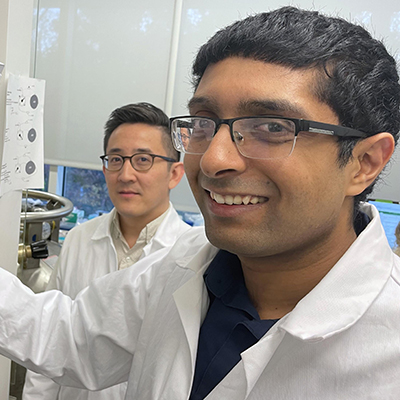
M.G. Finn, a Regents’ Professor in the School of Chemistry and Biochemistry and a frequent collaborator, is shown at left in the lab with Housley.
Cancer cells consume oxygen and nutrients at a higher rate than healthy tissue, and that changes the environment around a tumor. In a recent Nature Communications paper, Housley and his team introduced a drug delivery system that senses those physical changes and guides medicine to the disease. The drug is released only when it encounters those tumor-specific conditions.
Housley’s system is designed to work across many cancer types. Rather than being tailored to a specific tumor type or genetic marker, the system is “cancer agnostic.”
“We don’t need to know anything about the tumor ahead of time,” said Housley. “These particles circulate through the body, but they persist where tumors create those conditions.”
The Whack-a-Mole Problem
Housley’s design sidesteps a constant challenge in cancer treatment. Tumors are not static. They change in response to pressure from therapy, creating what Housley describes as “a whack-a-mole problem”, where hitting one target can push the disease to reemerge in a different form.
“Tumors are constantly changing,” said Housley. “You hit one thing with a targeted therapy, and that pressure causes the tumor to evolve. That’s a big problem with classically targeted therapies.”
“It has the potential to be a breakthrough at the clinic…patients in early trials could benefit directly; that’s rare and exciting.” –Nick Housley
Letting the Body Lead
Housley’s drug delivery system is called SANGs, short for “self-assembling nanohydrogels.” Nanohydrogels are microscopic, gel-like particles designed to carry drugs through the bloodstream. As the nanohydrogels circulate, they keep the drug contained. The particles pass through healthy tissue without releasing medicine. When they encounter the environment created by a tumor, they linger and release the drug where it’s needed most.
In preclinical studies, the nanohydrogels did what they were designed to do. They circulated through the body without releasing the drug too early, responding to tumor-specific conditions and concentrating treatment at the disease site.
Moving Toward Patients
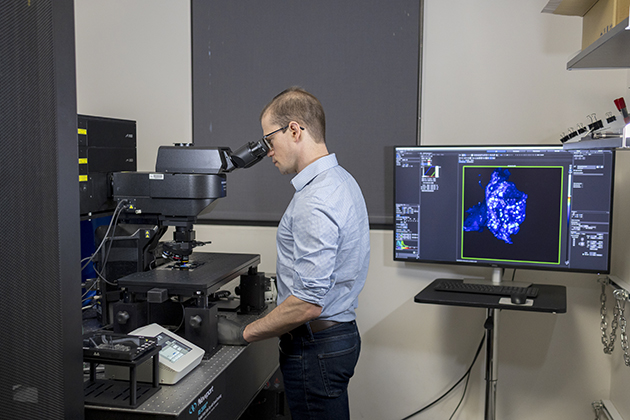
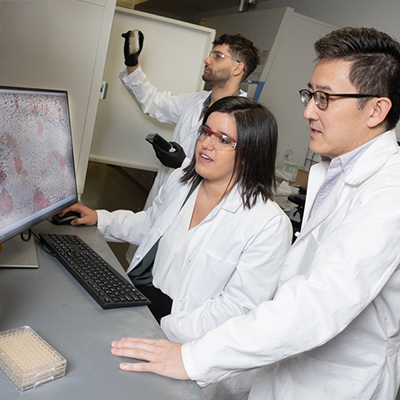
Housely examines microscopic nanohydrogels, gel-like particles designed to carry drugs through the bloodstream. As the nanohydrogels circulate, they keep the drug contained and pass through healthy tissue without releasing medicine.
Housley and his team are now planning to test SANGs with additional drugs and across a wider range of cancers, laying the groundwork for human clinical trials.
“The moment we can get our first patient in the study, the moment we can collect that first data and begin to see what this really changes, that will be a big moment,” he said.
Cancer treatment is physically taxing, but it also forces people into what Housley describes as “a constant calculus — weighing time gained against what that time will feel like.”
The goal isn’t to remove uncertainty from cancer care. It’s to narrow the impact of treatment, so patients aren’t forced to sacrifice how they feel for how long they live.
Housley’s research is supported by Georgia Tech startup funds, the Georgia Research Alliance, Biolicity, foundation awards from the Ovarian Cancer Institute, the Jack McCallum Foundation, and a National Institutes of Health/National Cancer Institute grant.

Writer and Media Contact: Michelle Azriel | mazriel3@gatech.edu
Photos: Christopher McKenney
Copy Editor: Stacy Braukman
Design: Josie Giles
Series Design: Stephanie Stephens

About Georgia Tech Commercialization
Georgia Tech Commercialization provides a foundation for faculty seeking to translate the Institute's leading-edge research into real-world applications. Commercialization encompasses four pivotal units: CREATE-X, VentureLab, Quadrant-i, and Technology Licensing. These units empower students and faculty to launch startups, provide comprehensive commercialization support, manage intellectual property, and facilitate the transformation of research into viable businesses. The Office of Commercialization’s mission is to provide world-class commercialization services, catalyzing research and innovation to improve the human condition, and enhancing Georgia Tech's position as a leader in technology and entrepreneurial impact.
Paradigm Shifters
At Georgia Tech, cutting-edge research is a constant — it fuels discovery, challenges norms, and inspires progress every day. And occasionally, technologies emerge with the power to fundamentally change life for the better.
These breakthroughs transform how we live, how we work, and even how we heal. Many years and minds in the making, these technologies are the culmination of collaboration, persistence, and ingenuity. These are the paradigm shifters.
Discover these extraordinary innovations as they begin to make their mark on the world. The future is taking shape right here at Georgia Tech.
 Cancer Atlas Offers a Roadmap to Detecting Tumors Earlier Than Ever
 Painting a Target on Cancer to Make Therapy More Effective
 New Biosensors Could Revolutionize Cancer Detection


