
Kinemo: Turning Small Movements Into New Possibilities
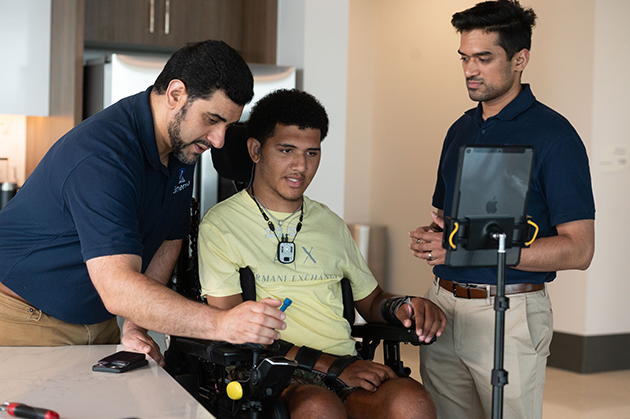
Kinemo co-founders Nordine Sebkhi and Arpan Bhavsar work with Wendell Odom during an assistive technology session using the Kinemo device to support independent computer and device control.
A few miles outside Huntsville, Alabama, a young man named Wendell sits upright in his chair and tilts his head toward a screen. A small sensor mounted near his ear recognizes the shift. The cursor moves. A shrug of his shoulder leads to a click. The action is simple, almost quiet. For Wendell and his family, it signals possibility and a measure of independence.
The tool behind the moment began at Georgia Tech. What started as a research question in an engineering research lab is now shaping the daily lives of patients who are learning new ways to interact with technology.
Within the lab, research engineers Nordine Sebkhi and Arpan Bhavsar began to explore whether small, intentional movements such as a head tilt or a biceps flinch could serve as reliable digital inputs for people with limited mobility. From their research, the startup Kinemo took shape, focusing on physiological sensing and human-centered signal interpretation. Early prototypes showed promise but revealed an important insight. The interface had to adapt to each user’s capabilities. That principle, designing the person and not the product, became the foundation of Kinemo’s philosophy.
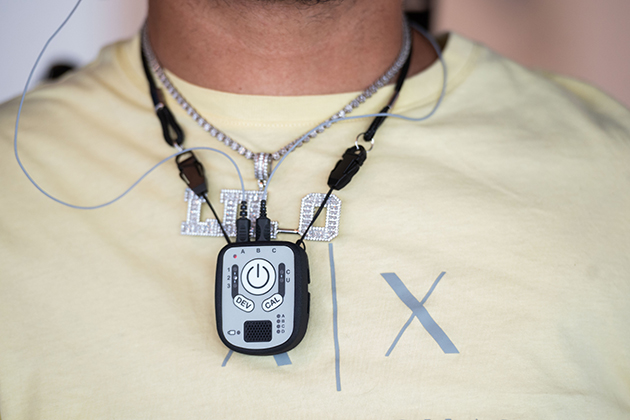
Wendell Odom wears the Kinemo assistive technology device, which uses small intentional movements to help users independently control digital devices.
As the technology matured, Sebkhi and Bhavsar turned to Georgia Tech’s Office of Commercialization to understand how the concept could reach beyond the lab. The office's lab-to-market ecosystem provided the framework and mentorship to move from research to real-world applications. The team connected with mentors who helped them explore early markets and engage caregivers, clinicians, and rehabilitation centers. CREATE-X Startup Launch then helped the researchers further refine their business model and validate its potential impact.
“We want someone to put our device on and regain access to their digital life right away,” Sebkhi said. “If it only works in the lab, it cannot serve the people who need it most.”
In addition, Sebkhi credits much of Kinemo’s trajectory to the guidance of Omer Inan, professor in the School of Electrical and Computer Engineering and director of the Inan Research Lab. Inan mentored Sebkhi and Bhavsar from the earliest stages of the research, helping them navigate both the scientific challenges and the transition from academic discovery to real-world application. His support provided the foundational confidence and strategic direction for Sebkhi and Bhavsar to begin seriously pursuing commercialization.
“We want someone to put our device on and regain access to their digital life right away. If it only works in the lab, it cannot serve the people who need it most.” — Nordine Sebkhi, Kinemo co-founder and Georgia Tech researcher
Shaped by Patients and Clinicians
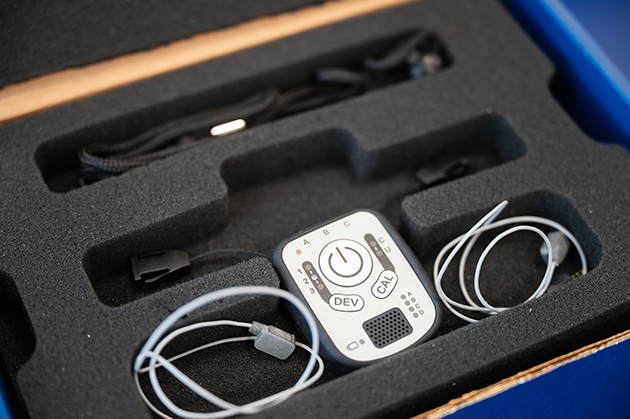
The Kinemo assistive technology device uses physiological sensing and small intentional movements to help users independently control phones, tablets, and computers.
As Kinemo developed, the team began collaborating with clinicians and researchers at Shepherd Center, a neurorehabilitation hospital known for advancing assistive technologies. Patients at Shepherd tested early prototypes, and their feedback guided key design decisions.
“The first version was a bit difficult to set up,” said Delaney Cowart, program manager in Shepherd’s Accessibility User Research Collective. “It required small facial movements such as raising an eyebrow or twitching part of your face, which were hard for many patients. Now, the patient’s entire head acts like a joystick. It is much simpler and more intuitive.”
That evolution was driven by an ongoing partnership between Georgia Tech engineers and Shepherd’s assistive technology specialists.
“Being able to control your environment through small, intentional movements changes everything,” said John Morris, director of the Accessibility User Research Collective at Shepherd. “Kinemo introduced proportional control, which adjusts your speed depending on how far you tilt your head. That level of precision and comfort really stood out.”
“A lot of our patients do not want bulky devices around their faces. Kinemo gives them a more discreet option. It’s simple and flexible, and it feels personal.” — Jared Grier, rehabilitation engineer at Shepherd Center
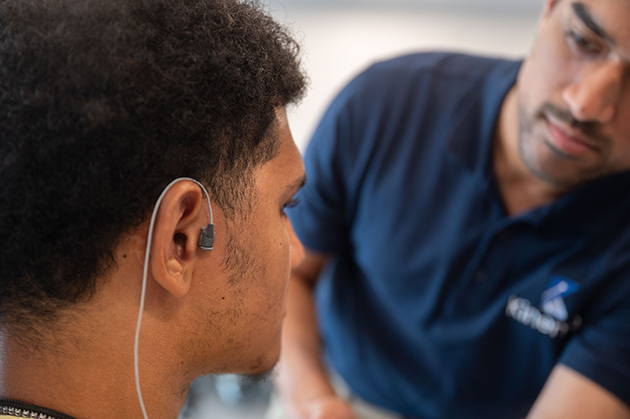
Kinemo co-founder Arpan Bhavsar works with Wendell Odom during an assistive technology session focused on helping users control digital devices through small intentional movements.
Jared Grier, a rehabilitation engineer specializing in assistive technology at Shepherd, added, “A lot of our patients do not want bulky devices around their faces. Kinemo gives them a more discreet option. It’s simple and flexible, and it feels personal.”
Shepherd’s collaboration with Georgia Tech continues to expand through new initiatives that explore how engineering and rehabilitation research can improve mobility and quality of life for people with spinal cord injuries.
In addition to its partnership with Shepherd Center, Kinemo engaged with clinical partners at the U.S. Department of Veterans Affairs’ Richmond Assistive Technology Program to gather early feedback and refine usability and device placement.
“Having direct collaboration with the end user is critical,” said Seth Hills, rehabilitation engineer at the VA Richmond Assistive Technology Program. “The sooner you get that feedback, the better.”
Restoring Independence
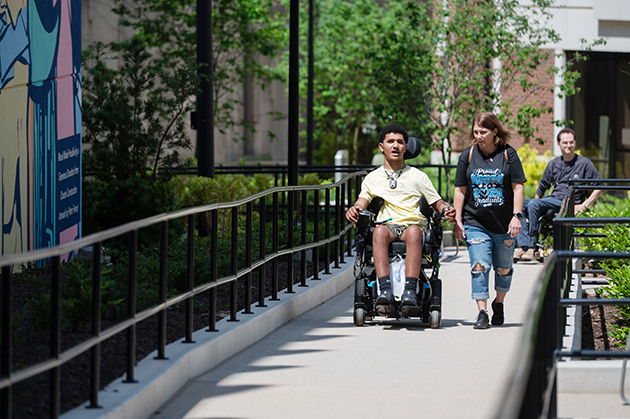
Wendell Odom and his mother, Christy Lamar, walk through Shepherd Center, where Wendell continues working with clinicians and researchers using Kinemo assistive technology following his spinal cord injury.
For patients like Tracy Brooks of Mississippi, Kinemo represents more than innovation. It represents independence. Nearly a decade after a diving accident left him with a C-4 spinal cord injury, Brooks has used several assistive technologies. Earlier systems, he said, were bulky and obvious. They worked, but reminded him of his limitations.
“Kinemo is different,” said Brooks. “It is discreet. Most people do not even realize I am using it.”
Brooks uses the device primarily to operate his phone but has also connected it to his TV and music system, allowing him to change channels, control audio, and navigate daily life on his own. “It lets me do things independently again,” he said. “That is something you cannot really put a price on.”
He continues to work with Shepherd Center to explore future applications of the technology and says he hopes to one day see similar systems that could make driving possible for people with limited mobility.
“I want to lean toward biomedical engineering to help people like me in similar situations because I live this life day to day.” — Wendell Odom
The Path to Impact
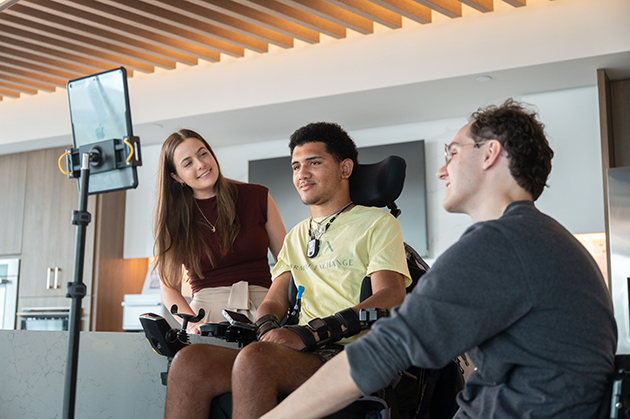
Wendell Odom works with Delaney Cowart and Jared Grier from Shepherd Center during a Kinemo assistive technology session focused on improving independent computer and device control through small intentional movements.
As patients continue working with the device, they review images and videos from past sessions to refine how they navigate screens and communicate using movements tailored to their abilities. Each interaction reinforces how small signals, paired with thoughtful engineering, can create new pathways for independence.
Kinemo reflects Georgia Tech’s commitment to translating research into meaningful societal impact. It is one example of how the Office of Commercialization connects researchers, engineers, and students with the support to move promising ideas toward adoption. That progress was further strengthened by financial support from the Georgia Research Alliance, secured through Quadrant-i, a commercialization unit within the Office of Commercialization that helps startups secure early funding and move research from the lab to the market.
Looking Ahead
Kinemo continues to evolve through collaboration, feedback, and a strong foundation at Georgia Tech. Its next phase is supported by a grant from the National Institute on Disability, Independent Living, and Rehabilitation Research, the federal government’s primary disability research organization. The funding will enable deeper research and broader user testing, advancing Kinemo’s mission to help people with physical disabilities perform more activities on their own terms.
This collaboration is a reminder that innovation gains its purpose when it reaches the people it was designed to serve.

Writer: Lacey Cameron
Media Contact: Angela Barajas Prendiville | aprendiville@gatech.edu
Photos: Allison Carter
Design: Josie Giles
Series Design: Stephanie Stephens
Copyediting: Stacy Braukman

About Georgia Tech Commercialization
Georgia Tech Commercialization provides a foundation for faculty seeking to translate the Institute's leading-edge research into real-world applications. Commercialization encompasses four pivotal units: CREATE-X, VentureLab, Quadrant-i, and Technology Licensing. These units empower students and faculty to launch startups, provide comprehensive commercialization support, manage intellectual property, and facilitate the transformation of research into viable businesses. The Office of Commercialization’s mission is to provide world-class commercialization services, catalyzing research and innovation to improve the human condition, and enhancing Georgia Tech's position as a leader in technology and entrepreneurial impact.
Paradigm Shifters
At Georgia Tech, cutting-edge research is a constant — it fuels discovery, challenges norms, and inspires progress every day. And occasionally, technologies emerge with the power to fundamentally change life for the better.
These breakthroughs transform how we live, how we work, and even how we heal. Many years and minds in the making, these technologies are the culmination of collaboration, persistence, and ingenuity. These are the paradigm shifters.
Discover these extraordinary innovations as they begin to make their mark on the world. The future is taking shape right here at Georgia Tech.
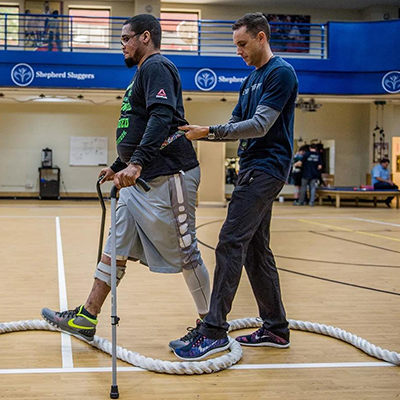 Georgia Tech, Shepherd Center Award Inaugural Seed Grants
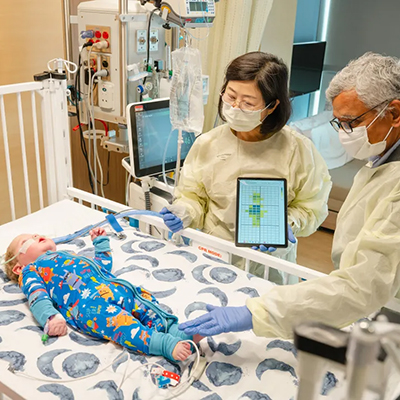 The Penicillin of Pressure Injuries: Researchers Develop New Sensor System to Prevent a Common Hospital Complication
 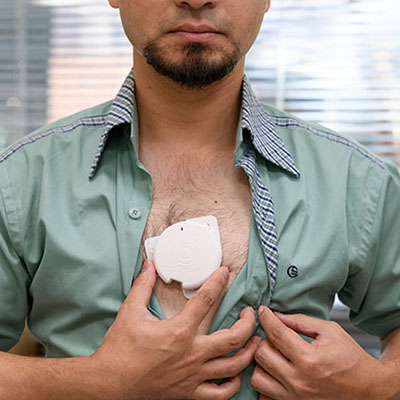 Georgia Tech Startup Sets Sights On Transforming Heart Failure Care


