
From Classroom to Manufacturing Floor: Teachers Build Real-World Manufacturing Skills at Georgia Tech
Jun 22, 2026 —
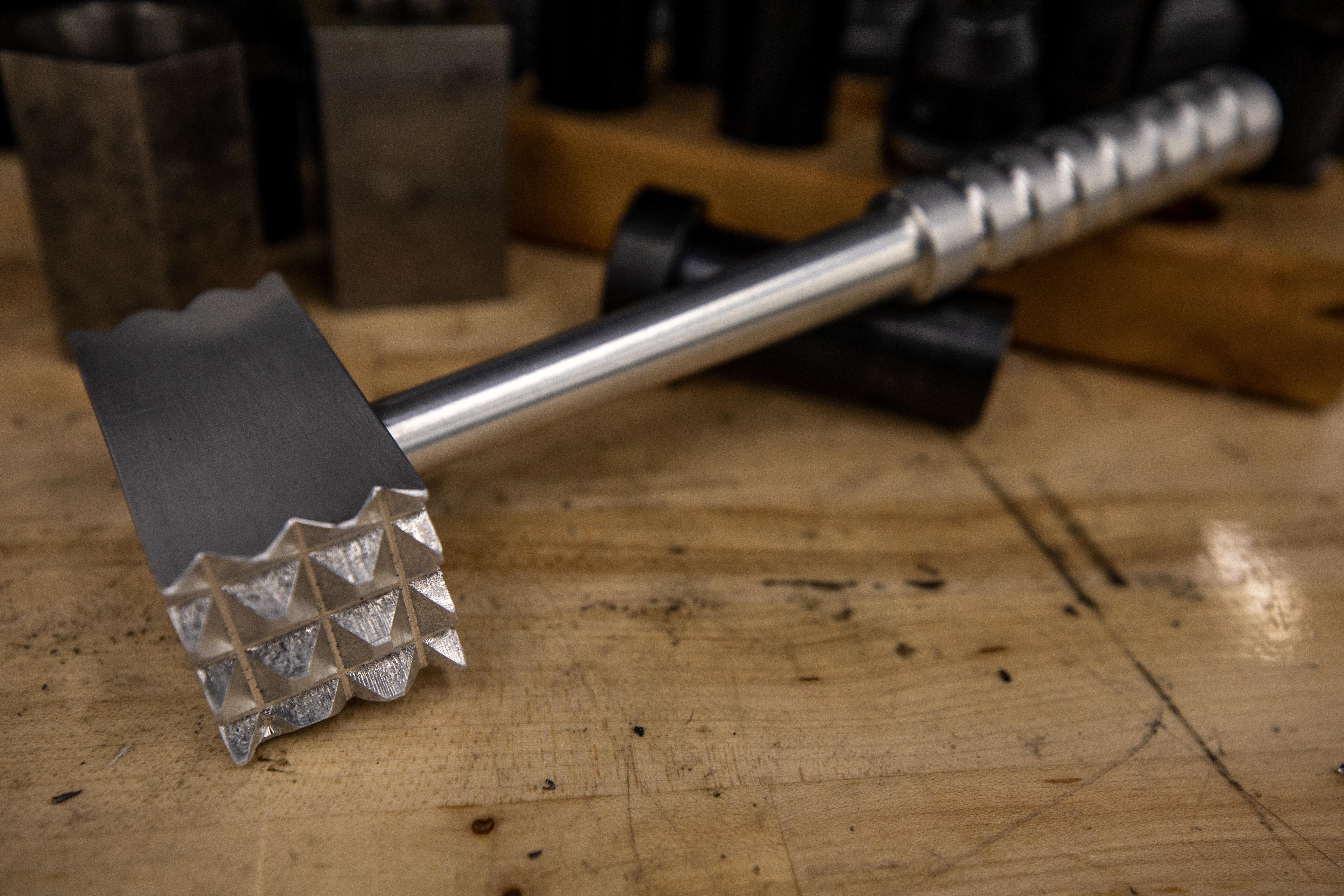
A metal meat tenderizer created by participants during the workshop.
For three days in June, a dozen middle and high school teachers from rural Georgia traded their classrooms for Georgia Tech’s Montgomery Machining Mall, a machine shop where students and researchers design and build custom parts. Instead of grading papers, they cut metal on bandsaws, lathes, and milling machines while learning skills they’ll take back to their students this fall.
The workshop is part of Georgia Tech’s Advanced Manufacturing Pathways (AMP) program, a collaboration between the Georgia Tech Manufacturing Institute (GTMI) and Georgia Tech Research Institute (GTRI), which connects rural educators with hands-on manufacturing training. This particular training was delivered through a partnership between GTMI, STEM@GTRI — GTRI’s K-12 outreach program — and the George W. Woodruff School of Mechanical Engineering, leveraging the facilities and expertise of the Montgomery Machining Mall to provide teachers with direct experience in modern manufacturing. Building on GTRI’s Rural Computer Science Initiative, the program expands access to high-skill, high-wage career pathways across rural communities. The initiative is supported through state funding.
The workshop comes at a time when demand for skilled manufacturing workers continues to grow nationwide, particularly in roles requiring precision, technical expertise, and problem-solving.
Inside the Machine Shop
The training took place June 3 – 5 in the Montgomery Machining Mall, where staff provided access to facilities, equipment, and technical expertise that made the immersive learning experience possible.
Teachers designed and manufactured a metal meat tenderizer and a metal coaster etched with both the Georgia Tech logo and their name. For many, this was their first exposure to advanced manufacturing tools and processes, and a glimpse into high-skill, high-wage careers within reach for their students.
“Many of these teachers have never been exposed to any advanced manufacturing,” said Sean Mulvanity, a program manager for STEM@GTRI and project lead for this workshop. “By the time they walk out of here, they’ve actually created and manufactured physical items they can take back to their students.” Unlike traditional professional development, the workshop places teachers directly in the machine shop, working on heavy equipment.
For AMP program leaders, this pilot was a way to build momentum for school districts that may add advanced manufacturing courses and to make the machine shop feel less intimidating in the process.
“One of the biggest misconceptions about modern manufacturing is that it is inaccessible or limited to specialized factory environments,” said GTMI Deputy Director Steven Ferguson. “Today’s manufacturing combines hands-on skills, digital technologies, AI, and problem-solving in ways that are relevant to students across many career pathways. By giving teachers direct experience in the machine shop, we help them bring that excitement back to their classrooms and show students that they can design, build, and innovate in their own communities.”
From the Shop Floor to the Classroom
One of the workshop participants is James Beveridge, who teaches computer science for grades 6-12 in the Chattahoochee County School District, a small, rural district south of Columbus. He has participated in multiple Georgia Tech-led training programs, and he runs a full computer science pathway for 450 middle and high school students. This fall will mark his third year in the Rural Computer Science Initiative and teaching computer science after two decades in industry.
Beveridge had some informal experience with tools growing up — his father taught him basic carpentry and welding — but he had never done formal machining work before the AMP workshop.
“Working with metal is different than working with wood, obviously, but it’s been really interesting to see the precision involved,” he said. “With wood, you can be off by a sixteenth of an inch, and nobody cares. When you’re machining metal parts, it has to be very, very precise. Learning to use the precision measuring tools has been eye-opening.”
For Beveridge, one of the biggest benefits of his ongoing work with Georgia Tech through the Rural Computer Science Initiative and related programs is that he never leaves empty-handed.
“Every time I come up here to learn something new, they send me home with the equipment to teach it with,” he said. “The first time, I left with a classroom set of robots so my students could learn to program. Another time, it was a more advanced humanoid robot with artificial intelligence. Now, I’m going back with new skills in machining and a physical project I can show my students.”
Another participant, Juone Brown, teaches high school computer science and AI to students at Dooly County High School in Vienna, Georgia. This is her second year in the rural computer science partnership and her fourth year teaching at Dooly. Previously, Brown was a professor for 25 years at Fort Valley State University.
Like Beveridge, Brown has no formal machining background but said the way workshop instructors broke down each step — especially the math behind the cuts — made the work feel approachable.
“It has been fantastic and really well-paced,” she said. “We all come from different backgrounds, but the way they present the information makes it click. We know the math, but when you’re on the machine, and they show you easier ways to get the cut you need, it’s very encouraging.”
She’s already thinking about how to translate that feeling for her students, many of whom prefer building things to writing code. “I’m always telling them that skills pay the bills,” Brown said. “A lot of my students are hands-on. Now I can connect what we’re doing in class to real parts and jobs.”
Bringing Advanced Manufacturing to More Georgia Classrooms
After the workshop, teachers are expected to integrate machining concepts into existing courses or help build new manufacturing pathways at their schools.
AMP program leaders intentionally kept this pilot cohort small. The team plans to repeat the workshop several times over the coming year, expanding to more schools and districts across Georgia, building local champions who can help launch advanced manufacturing programs in their communities.
About the Georgia Tech Manufacturing Institute (GTMI)
The Georgia Tech Manufacturing Institute (GTMI) convenes industry leaders, government partners, and top researchers to collaborate on the grand challenges facing manufacturing today: accelerating technology development and deployment; creating, maintaining, and filling quality jobs; ensuring global competitiveness; and advancing economic and environmental stability.
Our vision is to ensure rapid innovation that secures U.S. dominance in advanced manufacturing. Through the design and development of artificial intelligence systems, secure digital manufacturing, additive and subtractive processes, and large-scale production enterprises, GTMI stands at the forefront of manufacturing innovation — leveraging state-of-the-art facilities, including the Advanced Manufacturing Pilot Facility, to turn research breakthroughs into market-ready solutions.
About the Georgia Tech Research Institute (GTRI)
The Georgia Tech Research Institute (GTRI) is the nonprofit, applied research division of the Georgia Institute of Technology (Georgia Tech). Founded in 1934 as the Engineering Experiment Station, GTRI has grown to more than 3,000 employees, supporting eight laboratories across more than 20 locations nationwide and performing more than $919 million in problem-solving research annually for government and industry. GTRI's renowned researchers combine science, engineering, economics, policy, and technical expertise to solve complex problems for the U.S. federal government, state, and industry.
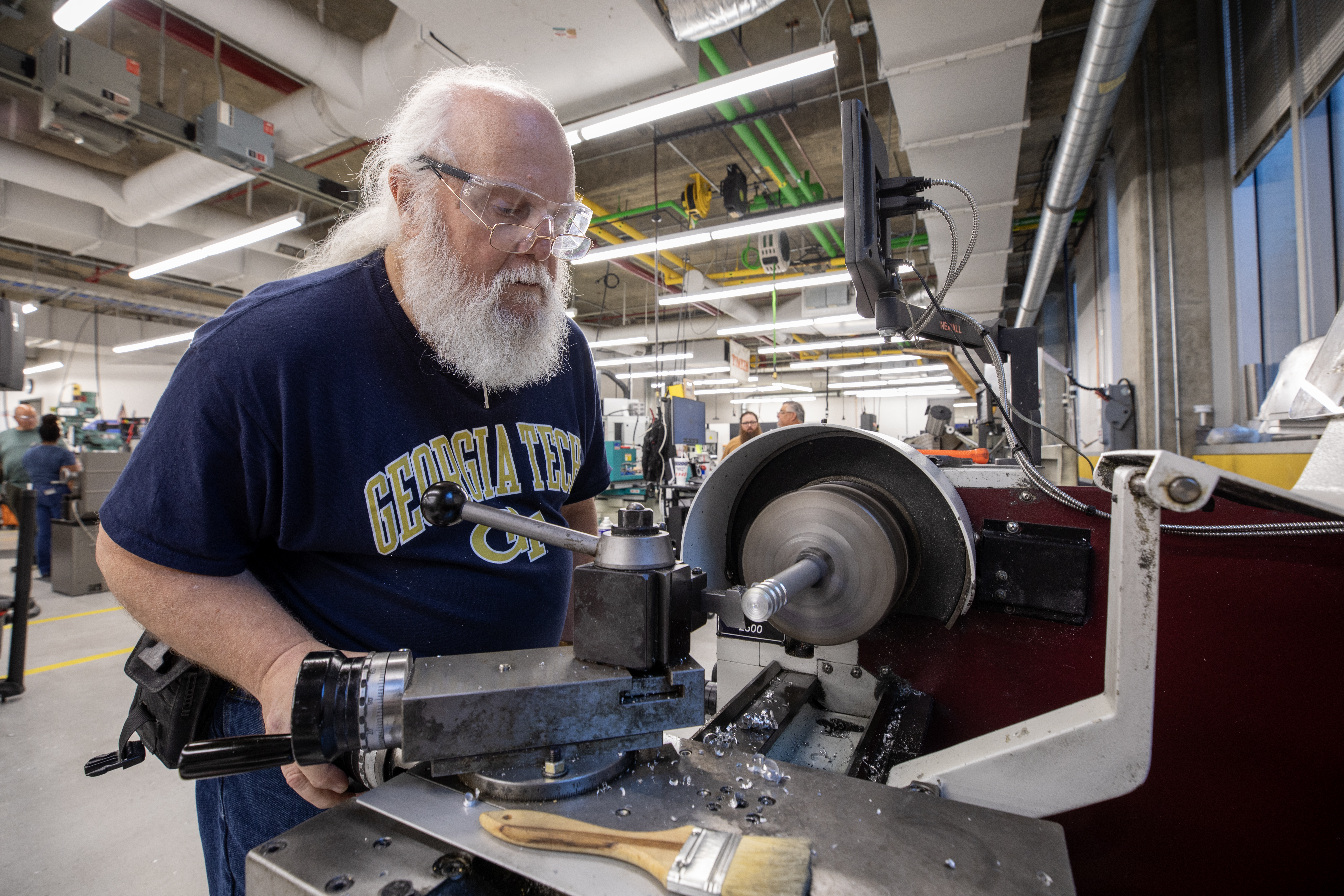
James Beveridge, a computer science teacher in the Chattahoochee County School District, said he is excited to take back new machining skills and physical items back to share with his students.
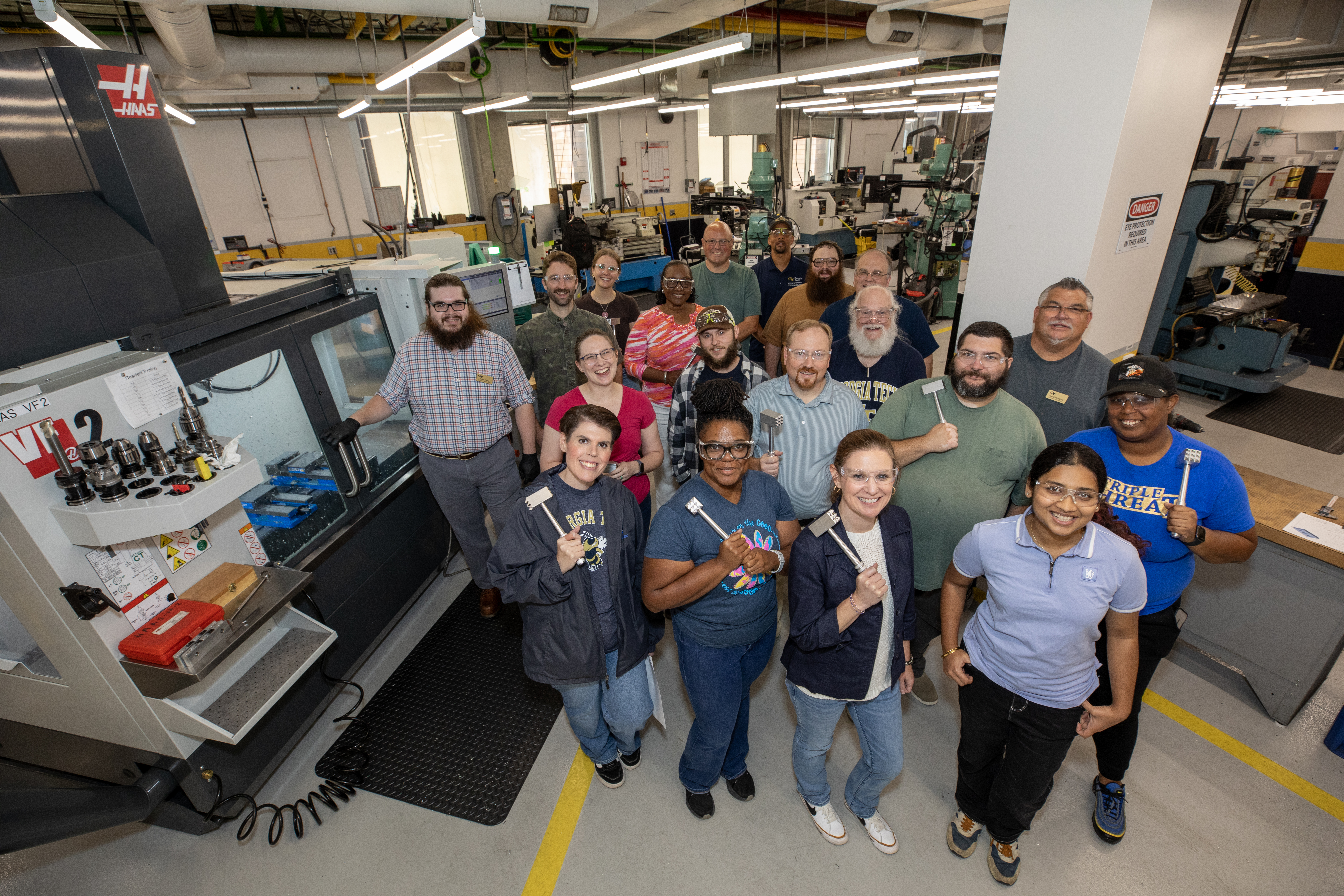
Rural Georgia teachers pose with the metal meat tenderizers they made during a machining workshop hosted by the Georgia Tech Manufacturing Institute (GTMI) and Georgia Tech Research Institute (GTRI) at the Montgomery Machining Mall.
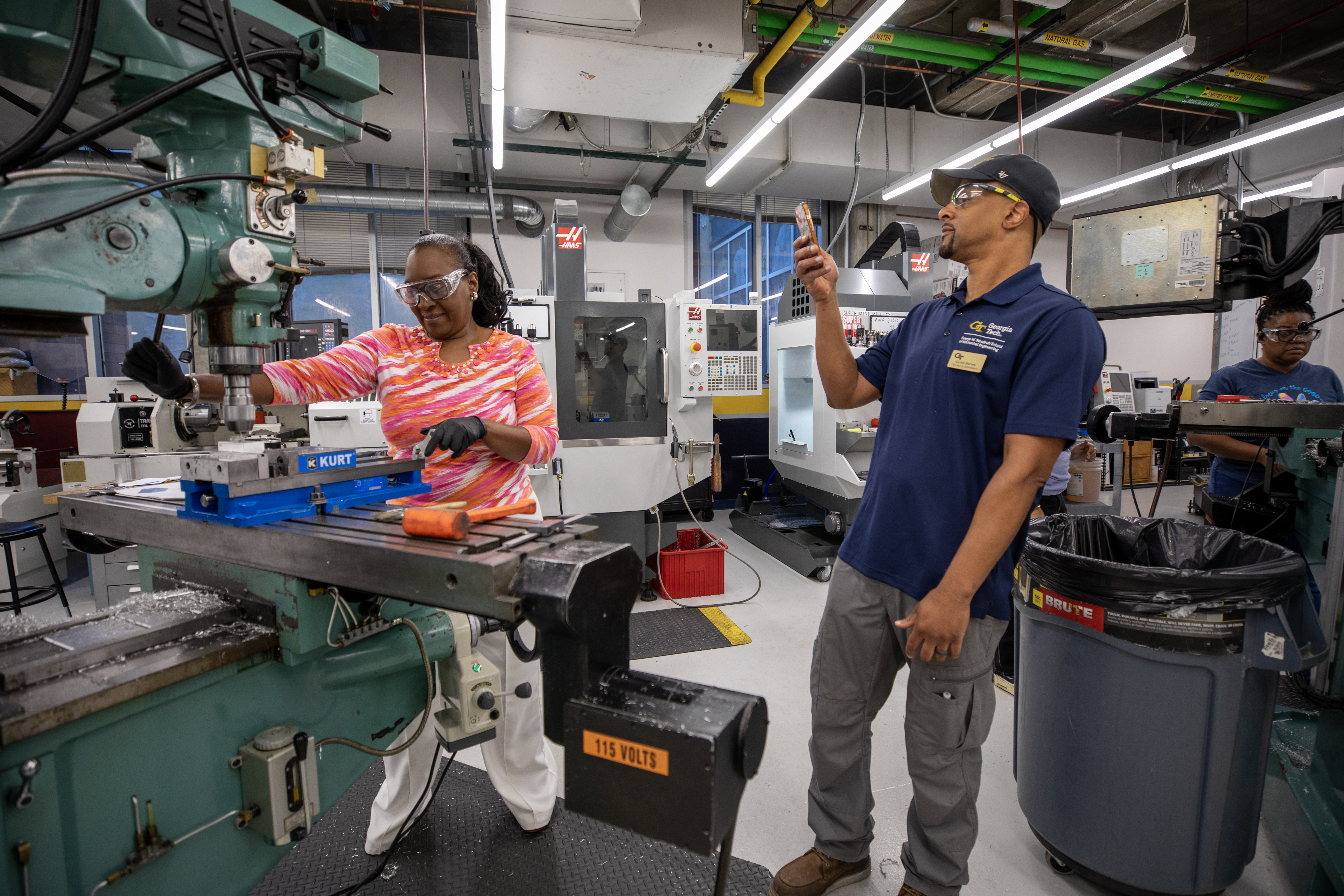
Juone Brown (left), a teacher at Dooly County High School in Vienna, Georgia, called the bootcamp well-paced and plans to bring what she learned back to her students this fall, many of whom prefer hands-on learning.
Writer: Anna Akins | anna.akins@gtri.gatech.edu
Photos: Sean McNeil
Copyediting: Stacy Braukman


