
Accelerating Discovery With AI
May 18, 2026 —
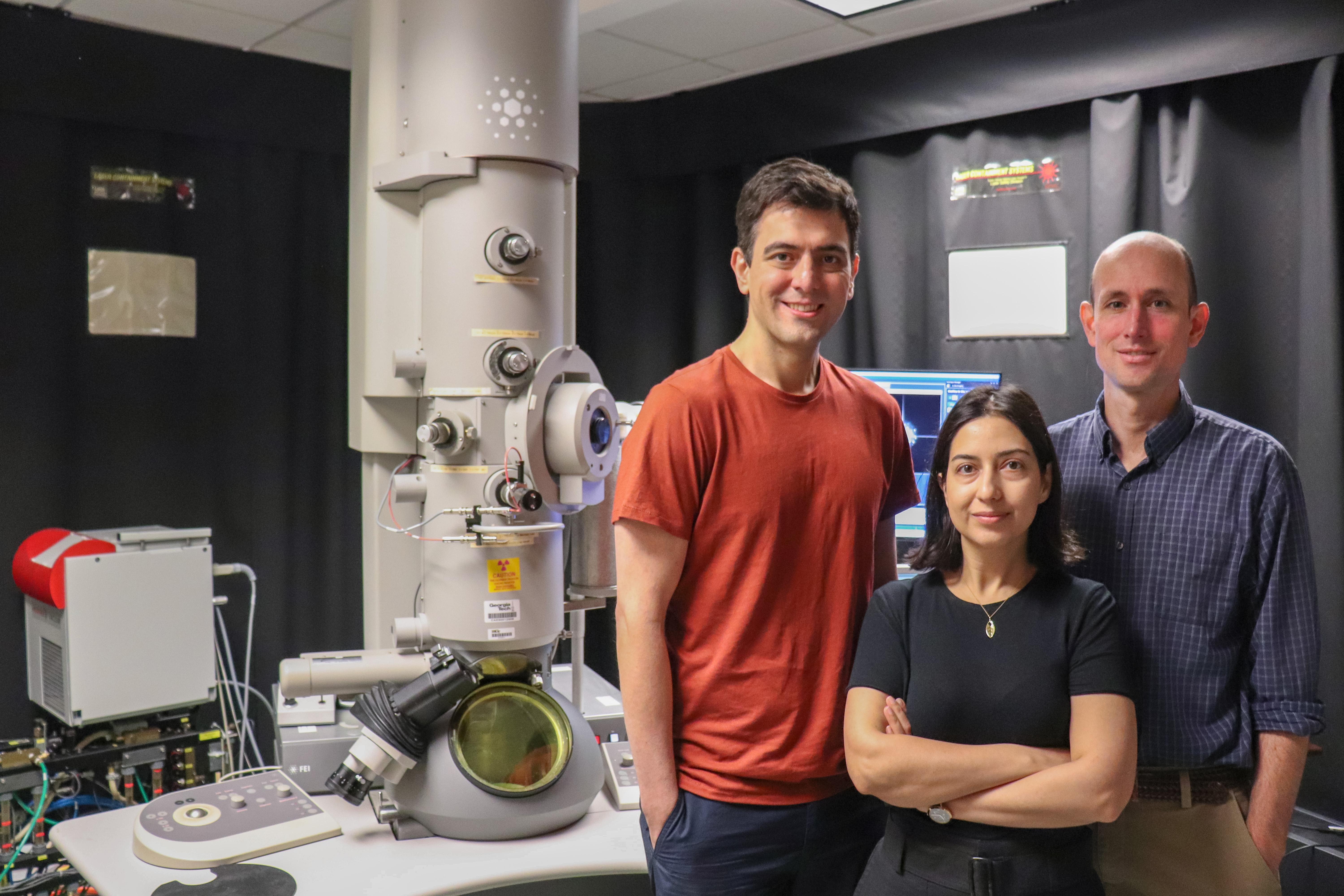
A photo of Vida Jamali, assistant professor the School of Chemical and Biomolecular Engineering; Amirali Aghazadeh, assistant professor in the School of Electrical and Computer Engineering; and Josh Kacher, associate professor in the School of Materials Science and Engineering standing in front of a TEM at Georgia Tech.
Scientific discovery is often portrayed as the result of long hours alone in a lab, but true science is inherently collaborative. The most robust experimental processes are developed through partnerships across multiple areas of research. The need for specialized, multidisciplinary teams slows experiment design, execution, data analysis, and process updates, delaying technological validation and deployment. But if the increasingly automated tools scientists already use in the lab could contribute to this team process of experimental design, the timeline for these goals could be greatly accelerated.
This concept of “lab tool as lab assistant” is the premise of a recent paper in npj | Computational Materials titled “Thinking Microscopes: Agentic AI and the Future of Electron Microscopy,” by Vida Jamali, assistant professor the School of Chemical and Biomolecular Engineering; Amirali Aghazadeh, assistant professor in the School of Electrical and Computer Engineering; and Josh Kacher, associate professor in the School of Materials Science and Engineering.
In the paper, the team introduces the concept of “thinking electron microscopes,” in which agentic AI systems are directly integrated with the instrument. This allows microscopes to move beyond their conventional role as characterization tools and toward functioning as co-scientists for human users.
Drawing on advances in specialized large language models, or LLMs, that demonstrate their ability to collaborate, reason over data, and integrate prior knowledge, the team envisions specialized LLM-based agents assigned to specific roles and areas of knowledge expertise. By explicitly incorporating domain knowledge into specialized agents and distributing information across multiple agents with focused expertise, the approach enables parallel evaluation of competing hypotheses, clearer separation of roles — such as planning, simulation, and critique — and more transparent and robust reasoning.
Within the experimental pipeline, these agents can analyze materials’ properties, physical data, chemical processes, and other relevant parameters. They could also collaborate with an agent that specializes in experimental design, refining iterative closed-loop experimentation, and real-time scientific discovery.
Although the research focuses on AI collaboration, the team notes that human researchers must retain accountability for the accuracy and integrity of both the experimental process and the results reported. This oversight begins with advocating for greater open access to research materials in all formats, building community-driven data repositories, and adopting standardization in how experimental parameters and metadata are reported. Equally important, researchers should be willing to report data from failed experiments as well as successful outcomes. Finally, organizations should work together to standardize secure APIs that enable shared, remote access to infrastructure across distances.
We see this as a step toward scientific instruments that do more than acquire data; systems that can reason over experiments, adapt measurements, and participate in the scientific discovery process alongside researchers. - Vida Jamali, assistant professor the School of Chemical and Biomolecular Engineering
The team is already developing these systems by connecting cloud-based, agentic infrastructures to microscopes at the Institute for Matter and Systems at Georgia Tech. With the addition of agentic AI, the goal is to accelerate discovery and engineering of new nanoscale materials for energy and quantum applications, as well as advance capabilities in cryo-electron microscopy and structural biology. These tools can optimize data collection, link real-time microscope observations with structural models of proteins, and dynamically adjust and prioritize experiments. The team sees this work as the first step toward the next generation of “thinking” electron microscopes, as well as an advancement in scientific discovery across domains.
- Christa M. Ernst
This research is supported by the Institute for Data Engineering and Science and the Institute for Matter and Systems
Original Publication
Jamali, V., Aghazadeh, A. & Kacher, J. Thinking microscopes: agentic AI and the future of electron microscopy. npj Computational Materials 12, 149 (2026). https://doi.org/10.1038/s41524-026-02077-y


