
2025-2026 Novelis Scholars
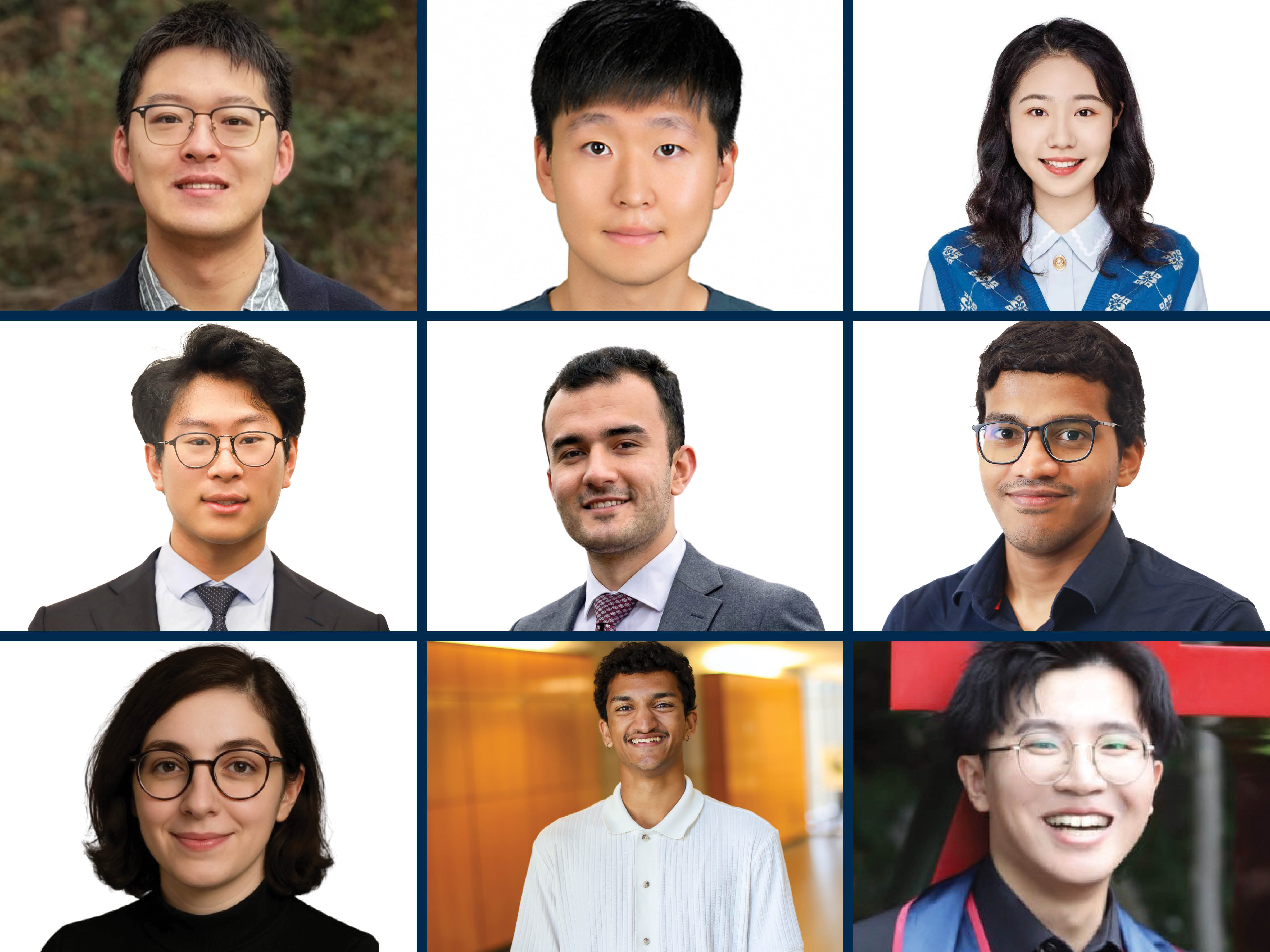
Graduate Scholars
Top row (left to right): Haoyu Chen, Hyuck Joo Choi, Xinyi Ding
Middle row (left to right): Yichen Ma, Mohammad Ali Seyed Mahmoud, Nazal Mohamed
Bottom row (left to right): Seyedeh Fatemeh Nabavi, Hari Sridhara, Ziting Tian
Haoyu Chen is a third-year Ph.D. student in the School of Chemical and Biomolecular Engineering at Georgia Tech, advised by Dr. Ryan Lively. He earned his B.S. in Chemical Engineering from the University of Illinois at Urbana-Champaign in 2022. His research focuses on developing scalable materials and contactor designs for direct air capture (DAC) of CO2 by repurposing and recycling commercially manufactured fibers into DAC sorbent platforms. His work aims to enable cost-effective and industrially scalable DAC systems while maintaining high capture performance and durability under realistic operating conditions. He is passionate about collaborating with industry partners and sponsors to translate his research into deployable technologies and manufacturing applications. His broader research interests include fundamental membrane transport phenomena, such as uphill diffusion of CO2 driven by water chemical potential gradients. In his spare time, he enjoys reading books.
Hyuck Joo Choi is a Ph.D. candidate in the School of Chemical and Biomolecular Engineering, advised by Dr. Marta C. Hatzell. He earned a B.S.E in Chemical and Biomolecular Engineering and B.A in Chemistry at the University of Pennsylvania. At Georgia Tech, Hyuck focuses on electrochemical reactive membrane separation for resource recovery CO2 and NH4 from waste streams. Specifically, he explores simultaneous CO2 separation and conversion into carbon fuels using bipolar membrane electrodialysis. Outside of work, he enjoys playing tennis and golf.
Xinyi Ding is a Ph.D. student in the School of Materials Science and Engineering at the Georgia Institute of Technology, advised by Prof. Shucong Li. She received her B.S. degree in Materials Physics from Fudan University in 2024, where she was named an Outstanding Graduate. Her research focuses on the mechanism-driven design of soft matter systems for sustainable water and energy technologies. In particular, she develops hierarchically engineered sorbent architectures for atmospheric water harvesting. By integrating phase behavior, microstructural engineering, and additive manufacturing, her work bridges fundamental materials physics with practical design considerations to advance scalable and energy-efficient solutions.
Yichen Ma is a Ph.D. student in the H. Milton Stewart School of Industrial and Systems Engineering at Georgia Tech. He earned his B.S. degree in Industrial Engineering from Georgia Tech in 2024. His research interests include 3D machine learning, time-series foundation models, and data analytics for quality prediction and control in complex engineering systems. He conducts research with the Composite and Hybrid Materials Interfacing (CHMI) research center and has contributed to multiple research proposals. He is also a member of the Institute of Industrial and Systems Engineers (IISE) and the Institute for Operations Research and the Management Sciences (INFORMS).
Mohammad Ali Seyed Mahmoud is a Ph.D. student in the George W. Woodruff School of Mechanical Engineering at Georgia Tech, advised by Dr. Surya Kalidindi. He earned his M.Sc. in Mechanical Engineering from the University of Tehran. His research sits at the intersection of materials informatics, solid mechanics, and probabilistic modeling, with a focus on applying machine learning and Bayesian inference to materials characterization and damage modeling. Currently, he is developing an inverse framework for high-throughput mechanical property identification from Small Punch Tests, combining full-field Digital Image Correlation measurements with finite element simulations, flow-based generative models, and uncertainty quantification to enable rapid, data-driven materials characterization from small-scale specimens. His work on sequential Bayesian calibration of the GTN damage model using multimodal experimental data was published in Acta Materialia in 2026.
Nazal Mohamed is a PhD student in the H. Milton Stewart School of Industrial & Systems Engineering at Georgia Tech, advised by Dr. Nagi Gebraeel. He completed BTech in Aerospace Engineering and an MTech in Computational Engineering from the Indian Institute of Technology Madras. His research develops machine learning approaches, particularly federated learning and causal inference to characterize and learn interdependencies in multi-client, distributed manufacturing enterprises. A core theme of his work is making data-driven modeling feasible in settings where data are fragmented across sites and cannot be centrally pooled, requiring methods that are privacy-aware, interpretable, and reliable. He has co-authored multiple research articles and presented his work at leading Machine Learning and Operations Research conferences. Through this work, he aims to improve monitoring, prediction, and decision-making in complex industrial operations by combining principled statistical modeling with modern machine learning.
Seyedeh Fatemeh Nabavi is a PhD student in Materials Science and Engineering at the Georgia Institute of Technology, specializing in laser-based additive manufacturing, advanced process modeling, and AI-assisted materials design. Her research integrates analytical, numerical, and AI-driven approaches to predict thermo-metallurgical and mechanical behaviors in LPBF and DED processes. She has authored more than 20 high-impact journal articles, co-authored four scholarly books, and holds several patents.
Hari Sridhara is a Ph.D. student in Materials Science and Engineering advised by Professor Matthew McDowell. He earned his B.S. in Chemical Engineering in 2023 from the University of Southern California. At Georgia Tech, his research revolves around improving solid-state battery technology, specifically at the interface formed between the anode and electrolyte. Additionally, his efforts focus on analyzing internal cell dynamics and behaviors using x-ray computed tomography, traveling to numerous synchrotron light sources to collect data. He serves as one of the co-presidents of the MSE Graduate Student Advisory Group to support all aspects of the graduate student experience in the department. Outside of the lab, Hari plays the saxophone, solves lots of crossword puzzles, and has recently gotten into bouldering.
Ziting Tian is a Ph.D. student in Materials Science and Engineering at the Georgia Institute of Technology. He works in Prof. Anju Toor’s research group and is co-advised by Prof. Antonio Facchetti. His research focuses on hydrogel electrolytes for stretchable batteries and soft electronic systems. In his work, Ziting develops and optimizes hydrogel compositions—often exploring different salt combinations and battery chemistries—to achieve both strong electrochemical performance and mechanical robustness. These hydrogels are integrated into functional prototypes, including stretchable batteries as well as other emerging devices such as organic electrochemical transistors (OECTs) and organic solar cells. He also collaborates with industry partners to improve battery performance and explore practical applications of these materials. Ziting is a member of the second cohort of the NSF SUStainable development of smart MEDical devices (SUSMED) program. Outside the lab, he enjoys playing tennis and basketball, and taking road trips.
Undergraduate Scholars
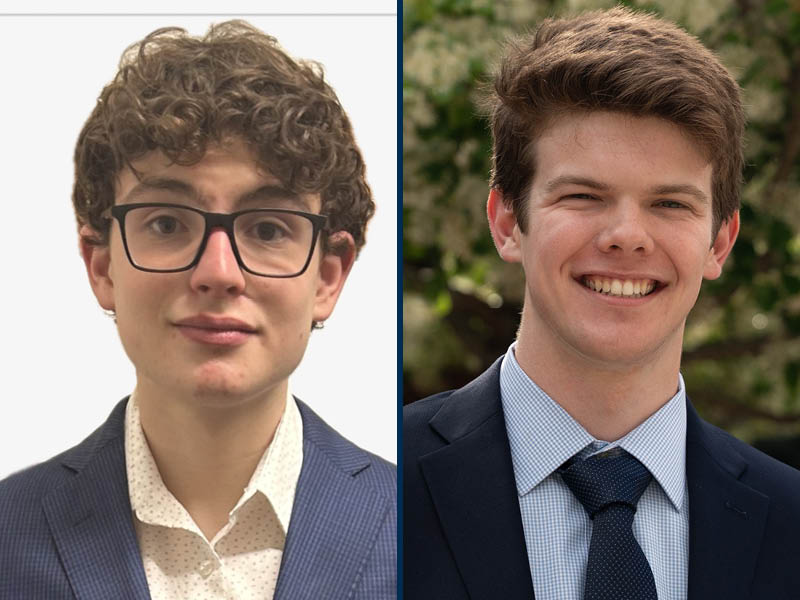
James Genovese (left) and Sam Woolsey (right).
James Genovese is a third-year undergraduate in the college of Materials Science and Engineering (MSE). In the summer and fall of 2025, he worked as a metallurgical co-op in Novelis’ Spokane, WA facility, and he will be returning for summer 2026. He worked under Kumar Sundaram on numerous projects focused on improving efficiency and investigating issues faced by production facilities. They are currently working on experiments relating to purification of scrap aluminum using boron treatment and the separation of unwanted phases through stirring techniques. Improving the aluminum recycling process furthers the goal of a circular economy by allowing more scrap to be reused at lower costs. In his first and second years, James worked as a lab assistant with Jiahe Huang of Dr. Yuhang Hu’s research lab, focusing on selective and repeatable polymerization, de-polymerization, and the dynamic functionality of gels. He is a current technical operator in the MSE makerspace, the MILL. In his free time, he enjoys participating in events with the GT Catholic Center and going on runs and walks.
Sam Woolsey is a third-year undergraduate student in the George W. Woodruff School of Mechanical Engineering working with Dr. Srinivas Garimella. His research focuses on the use of surfactants to increase heat transfer in nonpolar, two-phase flow. His work demonstrates surfactants as a drop-in improvement to energy efficiency in existing thermal systems. Sam has also developed a novel, exergy-based cost metric for energy systems and presented this work at the 2025 ASME Summer Heat Transfer Conference. Sam has received two Georgia Tech President’s Undergraduate Research Awards and is a 2026 Fulbright Canada-Mitacs Research Scholar. Outside of the lab, Sam serves as President of Georgia Tech Solar Racing, where he leads a team of 150 students in developing solar electric vehicles for competition on public roads. Sam spends his free time finding new places to climb, bike, or hike.


