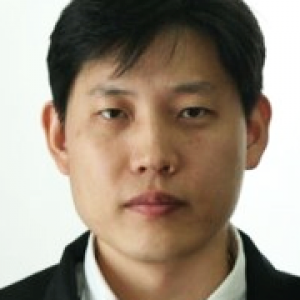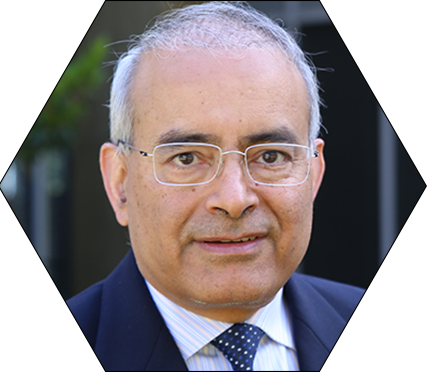
Yogendra Joshi

Yogendra Joshi
yogendra.joshi@me.gatech.edu
ME Profile Page

Prior to joining the Georgia Tech faculty in 2001 as a Professor, Yogendra Joshi held academic positions at the University of Maryland, College Park, and the Naval Postgraduate School, Monterey, California. He also worked in the semiconductor assembly industry on process thermal model development. He was named to the McKenney/Shiver Chair in 2004.

John M. McKenney and Warren D. Shiver Distinguished Chair, George W. Woodruff School of Mechanical Engineering
Professor, George W. Woodruff School of Mechanical Engineering and School of Electrical and Computer Engineering
Phone
404.385.2810
Office
Love 338
Additional Research

Thermal SystemsSystem Design & Optimization

Google Scholar
https://scholar.google.com/citations?hl=en&user=YIW1IqcAAAAJ&view_op=list_works&sortby=pubdate

Microelectronics & EmergingTechnologies Thermal Lab
Yogendra
Joshi
Show Regular Profile

David S. Citrin

David S. Citrin
david.citrin@ece.gatech.edu
Website

Professor Citrin earned a B.A. from Williams College (1985) and a M.S. (1987) and a Ph.D. (1991) from the University of Illinois, all in physics, where his dissertation was on the optical properties of semiconductor quantum wires. Subsequently, he was a post-doctoral research fellow at the Max Planck Institute for Solid State Research, Stuttgart, Germany (1992-1993) and Center Fellow at the Center for Ultrafast Optical Science at the University of Michigan (1993-1995). Dr. Citrin was an assistant professor of physics and materials science at Washington State University (1995 to 2001).

Professor Citrin joined the faculty at Georgia Tech in 2001 where his work focuses on terahertz technology and nanotechnology. He is a recipient of a Presidential Early Career Award for Scientists and Engineers and of a Friedrich Bessel Award from the Alexander Von Humboldt Stiftung. In addition, he is Project Coordinator on Nonlinear Optics and Dynamics at Georgia Tech-CNRS UMI 2958 located at Georgia Tech-Lorraine. Professor Citrin’s research in terahertz imaging is featured in the Georgia Tech press release, ”Imaging Technique Unlocks the Secrets of 17th Century Artists"; a list of some media placements from the press release may be found at http://photonics.georgiatech-metz.fr/node/33.

Research interests: 

  • Terahertz nondestructive testing of materials
  • Terahertz characterization of art and cultural heritage
  • Chaos and nonlinear dynamics in external-cavity semiconductor lasers
  • Nanophotonics
  • High-speed electronic, photonic, and optoelectronic devices
  • Nonlinear optical properties of semiconductor materials and devices
Professor
Phone
404.894.2000
Office
MIRC 211
David
Citrin
S.
Show Regular Profile

Seung-Joon Paik

Seung-Joon Paik

Seung-Joon Paik received his B.S. degree at the School of Electrical Engineering in 1999 and the M.S. and Ph.D. degrees at the Electrical Engineering and Computer Science from Seoul National University, Seoul, Korea, in 2001 and 2005, respectively. His doctorate research focused on the design, microfabrication and testing of silicon microneedles for neurophysiologic applications, including microfluidic channels and microelectrodes.

David S. Citrin

David S Citrin

Professor Citrin earned a B.A. from Williams College (1985) and a M.S. (1987) and a Ph.D. (1991) from the University of Illinois, all in physics, where his dissertation was on the optical properties of semiconductor quantum wires. Subsequently, he was a post-doctoral research fellow at the Max Planck Institute for Solid State Research, Stuttgart, Germany (1992-1993) and Center Fellow at the Center for Ultrafast Optical Science at the University of Michigan (1993-1995). Dr. Citrin was an assistant professor of physics and materials science at Washington State University (1995 to 2001).

Lauren Garten

Lauren Garten

Lauren Garten joined the School of Material Science and Engineering as an assistant professor in Fall 2021. Her group focuses on developing new materials for energy and electronic applications, particularly at the nexus between ferroelectricity, ferromagnetism, electronics, and photovoltaics. 

Shyh-Chiang Shen

Shyh-Chiang Shen

Shyh-Chiang Shen received his Ph.D. degree in electrical engineering at the University of Illinois at Urbana-Champaign (UIUC) in 2001. He was a key contributor of high-cycle low-voltage radio-frequency (RF) microelectromechanical system (MEMS) switches and GaAs metal-semiconductor field effect transistors (MESFETs) millimeter-wave integrated circuits (MMICs) during his tenure at UIUC.

Sung Kyu Lim

Sung Kyu Lim

Sung Kyu Lim was born and grew up in Seoul, Korea, and moved to Los Angeles with his family at the age of 19. He received B.S. (1994), M.S. (1997), and Ph.D. (2000) degrees all from the Computer Science Department of University of California at Los Angeles (UCLA). During 2000-2001, he was a post-doctoral scholar at UCLA, and a senior engineer at Aplus Design Technologies, Inc. In August 2001, he joined the School of Electrical and Computer Engineering at Georgia Institute of Technology an assistant professor.

Benjamin Kein

Benjamin Kein

Benjamin Klein received his B.S. and M.S. in Electrical Engineering from the University of Wisconsin-Madison in 1994 and 1995, respectively. He received his Ph.D. in Electrical Engineering from the University of Illinois – Urbana-Champaign in 2000. The subject of his doctoral dissertation was the theory and modeling of vertical-cavity surface-emitting lasers (VCSELs), which are a class of semiconductor laser used for telecommunications applications.

Jennifer Hasler

Jennifer Hasler

Jennifer Hasler received her B.S.E. and M.S. degrees in electrical engineering from Arizona State University in August 1991. She received her Ph.D. in computation and neural systems from California Institute of Technology in February 1997. Hasler is a professor at the Georgia Institute of Technology in the School of Electrical and Computer Engineering; Atlanta is the coldest climate in which Hasler has lived. Hasler founded the Integrated Computational Electronics (ICE) laboratory at Georgia Tech, a laboratory affiliated with the Laboratories for Neural Engineering.