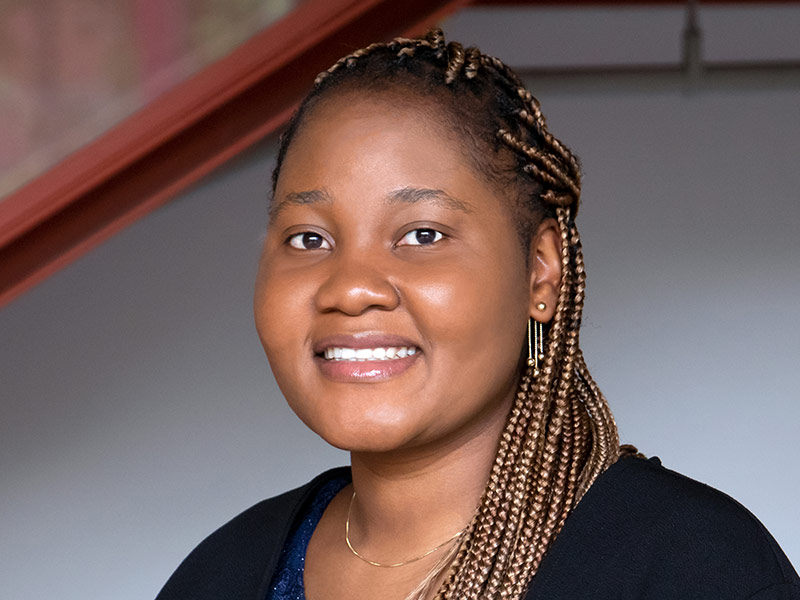
Lu Gan

Lu Gan
lgan@gatech.edu
Lunar Lab @ GT

Lu Gan joined the Daniel Guggenheim School of Aerospace Engineering at the Georgia Institute of Technology as an Assistant Professor in January 2024. She leads the Lu's Navigation and Autonomous Robotics (Lunar) Lab at Georgia Tech, and is on the core faculty of the Institute for Robotics and Intelligent Machines. Her research interests include robot perception, robot learning, and autonomous navigation. Her group explores the use of computer vision, machine learning, estimation, probabilistic inference, kinematics and dynamics to develop autonomous systems in ground, air, and space applications.

She holds a B.S. in Automation from the University of Electronic Science and Technology of China, an M.S. in Control Engineering from Beihang University, and received her M.S. and Ph.D. in Robotics from the University of Michigan, Ann Arbor. Before joining Georgia Tech, she had a two-year appointment as a Postdoctoral Scholar at the Graduate Aerospace Laboratories of the California Institute of Technology and the Center for Autonomous Systems and Technologies at Caltech.

Assistant Professor - School of Aerospace Engineering
Office
Guggenheim 448A
Additional Research

Computer VisionPerception & NavigationRobot AutonomyFlight Mechanics & ControlsHuman-Robot Interaction

Google Scholar
https://scholar.google.com/citations?hl=en&user=mVY8wE8AAAAJ&view_op=list_works&sortby=pubdate
AE Profile Page Personal Website
Lu
Gan
Show Regular Profile

Benjamin Joffe

Benjamin Joffe
benjamin.joffe@gtri.gatech.edu
GTRI Aerospace, Transportation & Advanced Systems Laboratory

Benjamin Joffe is a Research Scientist in the Aerospace, Transportation & Advanced Systems Laboratory at the Georgia Tech Research Institute. He holds an M.S. in Computer Science from Georgia Tech. His work is at the intersection of Computer Vision, Machine Learning, and Robotics. His research interests include 3D Perception for highly-variable and deformable objects; robot learning for manipulation tasks; real-world generalization from synthetic and multi-modal data; Machine Learning for chemical sensing and biomanufacturing; Deep Learning algorithms for novel modalities and low-data scenarios. 

Research Scientist II
Phone
404.407.8848
Office
Food Processing Technology Building
Additional Research

3D PerceptionAgricultural RoboticsComputer VisionMachine Learning for Chemical & Bio SensingRobot LearningRobotic Manipulation

Research Focus Areas
IRI And Role
GTRI
Geogia Tech Research Institute > Aerospace, Transportation & Advanced Systems Laboratory
Google Scholar
https://scholar.google.com/citations?hl=en&user=IaNhZ9AAAAAJ&view_op=list_works&sortby=pubdate
LinkedIn
Benjamin
Joffe
Show Regular Profile

Maegan Tucker

Maegan Tucker
mtucker@gatech.edu
Personal Website

Maegan received her Ph.D. in Mechanical Engineering (ME) from the California Institute of Technology (Caltech) in May 2023. Prior, she also received a M.S. in ME from Caltech in 2019 and a B.S. in ME from Georgia Tech in 2017. After graduating with her Ph.D., Maegan conducted a brief postdoc at Caltech (May–August 2023), followed by a brief research position at Disney Research (September–December 2023). Generally speaking, her research interests lie at the intersection of control theory and human-robot interaction, with specific applications towards lower-limb assistive devices. Much of her research is centered around the question: “What is the right way to walk?”. In her free time, Maegan enjoys puzzles, playing video games, and the piano.

Maegan Tucker joined Georgia Tech as an assistant professor with joint appointments in the School of Electrical & Computer Engineering and the School of Mechanical Engineering in January 2024.

Assistant Professor
Additional Research

Lower-Body Assistive Devices Bipedal Locomotion Nonlinear Control Theory Human-Robot Interaction Preference-Based Learning Human Biomechanics

IRI And Role
Google Scholar
https://scholar.google.com/citations?hl=en&user=mgQTjk0AAAAJ&view_op=list_works&sortby=pubdate
LinkedIn ECE Profile Page
Maegan
Tucker
Show Regular Profile

Lonnie Parker

Lonnie Parker
lonnie.parker@gtri.gatech.edu

Dr. Lonnie Parker is the Collaborative Autonomy Branch Chief in the Robotics and Autonomous Systems Division of the ATAS Laboratory at GTRI and serves as the PI for multiple programs. He has 10+ years of experience in managing DoD-sponsored projects and is focused on designing collaborative behaviors for unmanned systems in both the maritime and air domains. Prior to joining GTRI, Dr. Parker spent seven years at a NAVSEA warfare center, NUWC Division Newport, where he performed research into maritime autonomy through ONR-sponsored and internally funded efforts. Lonnie received a Ph.D. in Electrical & Computer Engineering from Georgia Tech in 2012. His research advisor was Prof. Ayanna M. Howard. Lonnie received an M.S. and B.S. in Electrical Engineering from the Rochester Institute of Technology in 2006.

Collaborative Autonomy Branch Chief - Robotics and Autonomous Systems Division, ATAS Lab @ GTRI
Senior Research Scientist
Additional Research

Collaborative autonomy algorithms Multi-robot systems

IRI And Role
GTRI
Geogia Tech Research Institute > Aerospace, Transportation & Advanced Systems Laboratory
Google Scholar
https://scholar.google.com/citations?hl=en&user=LeY2uTEAAAAJ&view_op=list_works&sortby=pubdate
LinkedIn Aerospace, Transportation & Advanced Systems Laboratory
Lonnie
Parker
Show Regular Profile

Omobolanle Ogunseiju

Omobolanle Ogunseiju
omobolanle@gatech.edu
College of Design Profile Page

Omobolanle Ogunseiju is an assistant professor in the School of Building Construction, at Georgia Tech. Omobolanle received her Ph.D. in Environmental Design and Planning, from the Department of Building Construction, at Virginia Tech.

Her research interests focus on advancing workforce development (safety, health, and well-being), and developing smart communities through the application of wearable robots and Artificial Intelligence (enabled by digital twin, cyber-physical systems, data sensing, and reality capture technologies). She is particularly interested in understanding and shaping the human–technological dynamics involved in workforce development, safety, and health, especially within the construction sector. This includes understanding the ethical concerns of automation and robotics in the construction industry.

Omobolanle is an active member of the Diversity and Inclusion Council at the College of Design. During her Ph.D. studies, Omobolanle was recognized as the outstanding doctoral candidate at the Myers Lawson school of construction, and the outstanding doctoral student in the College of Architecture and Urban Studies at Virginia Tech.

She believes that the next generation of construction engineers should be trained to serve as innovators, risk managers, and leaders that shape public policy. As such, Omobolanle believes that teaching should be based on promoting experiential learning amongst students, applying a variety of engagement techniques, and providing hierarchical learning assessments. Omobolanle developed and teaches Construction Cost Management at the School of Building Construction, Georgia Tech, and will teach and develop Construction Technology courses in the coming semesters. She had the opportunity to teach course sections and conduct laboratories in Smart Construction, Building Systems Technology, and Wireless Sensing in Construction Management as a graduate teaching assistant at Virginia Tech.

Assistant Professor
Phone
404.894.7102
Office
Caddell Building, Rm 233
Additional Research

Workforce Development Data Analytics Construction Safety Construction Robotics Construction Automation

IRI And Role
Google Scholar
https://scholar.google.com/citations?hl=en&user=LrB4zNsAAAAJ&view_op=list_works&sortby=pubdate
Omobolanle
Ogunseiju
Show Regular Profile

Danfei Xu

Danfei Xu
danfei@gatech.edu
College of Computing Profile

Dr. Danfei Xu is an Assistant Professor in the School of Interactive Computing at Georgia Tech. Dr. Xu received a B.S. in Computer Science from Columbia University in 2015 and a Ph.D. in Computer Science from Stanford University in 2021. His research goal is to enable physical autonomy in everyday human environments with minimum expert intervention. Towards this goal, his work draws equally from Robotics, Machine Learning, and Computer Vision, including topics such as imitation & reinforcement learning, representation learning, manipulation, and human-robot interaction. His current research focuses on visuomotor skill learning, structured world models for long-horizon planning, and data-driven approaches to human-robot collaboration.

Assistant Professor; School of Interactive Computing
Additional Research

Artificial Intelligence Computer Vision

Research Focus Areas
Google Scholar
https://scholar.google.com/citations?hl=en&user=J5D4kcoAAAAJ&view_op=list_works&sortby=pubdate
Personal Webpage
Danfei
Xu
Show Regular Profile

Stuart Michelson

Stuart Michelson
stuart.michelson@gtri.gatech.edu
Georgia Tech Research Institute

Stuart Michelson is a member of the research faculty at the Georgia Tech Research Institute and is known as a subject matter expert in Human Systems Engineering. He leads Human Factors and Ergonomics and Human Systems Integration (HSI) efforts for DoD customers specializing in tactical display design spanning command and control, training, unmanned vehicle ground control stations, Manned-unmanned teaming, and mission planning. He has expertise in digital human modeling/ergonomic/anthropometric analyses to assess cockpit accommodation and experience with wearable soldier systems and tactical equipment design.

Since 2000, Michelson has organized the American venue and annual Symposium on Dynamic Flight Behavior for Aerial Robotics for the International Aerial Robotics Competition (IARC), the longest running collegiate aerial challenge in the world focused on advancing the state of the art in aerial robotic behavior.

Michelson has held an Associate Human Factors Professional status from the Board of Certification in Professional Ergonomics, is recognized as a graphic design professional by the International Academy of Computer Training, and is certified to conduct ethical Human Subjects Research.

Michelson has supported and led numerous programs within the Georgia Tech Research Institute leveraging his knowledge of soldier loadout and autonomous unmanned systems. Notably, he has designed graphical user interfaces, developed human-centered system requirements, led programs to quantify human performance, assessed anthropometric accommodations, and supported system test and evaluation for DoD stakeholders spanning the United States Navy, Air Force, Army, and Marine Corps.

Phone
404.407.6162
Additional Research

Human Machine Teaming in Complex Environments Fully Autonomous Machines Command and Control Design of Complex Systems Human Systems Integration

GTRI
Geogia Tech Research Institute > Electronic Systems Laboratory
LinkedIn Electronic Systems Laboratory
Stuart
Michelson
Show Regular Profile

Alexander Adams

Alex Adams

Alex Adams’s research focuses on designing, fabricating, and implementing new ubiquitous and wearable sensing systems. In particular, he is interested in how to develop these systems using equity-driven design principles for healthcare. Alex leverages sensing, signal processing, and fabrication techniques to design, deploy, and evaluate novel sensing technologies.

Benjamin Joffe

Benjamin Joffe is a Research Scientist in the Aerospace, Transportation & Advanced Systems Laboratory at the Georgia Tech Research Institute

Benjamin Joffe is a Research Scientist in the Aerospace, Transportation & Advanced Systems Laboratory at the Georgia Tech Research Institute. He holds an M.S. in Computer Science from Georgia Tech. His work is at the intersection of Computer Vision, Machine Learning, and Robotics.

Matthew Hale

Matthew Hale joined the School of Electrical & Computer Engineering as an Associate Professor in the spring of 2024

Matthew Hale joined the School of Electrical and Computer Engineering at Georgia Tech as an Associate Professor in the spring of 2024. His research interests include multi-agent control and optimization, deceptive decision-making, and applications of these methods to drones and other robots. He has received the NSF CAREER Award, ONR YIP, and AFOSR YIP. Prior to joining Georgia Tech, Matthew was Assistant Professor of Mechanical and Aerospace Engineering at the University of Florida.