Christopher White
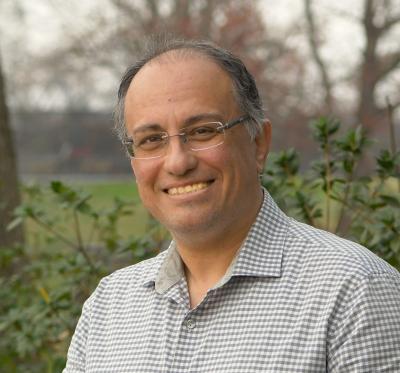
Manos Tentzeris was born and grew up in Piraeus, Greece. He graduated from Ionidios Model School of Piraeus in 1987 and he received the Diploma degree in Electrical Engineering and Computer Science (Magna Cum Laude) from the National Technical University in Athens, Greece, in 1992 and the M.S. and Ph.D. degrees in Electrical Engineering and Computer Science from the University of Michigan, Ann Arbor in 1993 and 1998. He is currently a Professor with the School of ECE, Georgia Tech and he has published more than 550 papers in refereed Journals and Conference Proceedings, 4 books and 23 book chapters, while he is in the process of writing 1 book. He has served as the Head of the Electromagnetics Technical Interest Group of the School of ECE, Georgia Tech. Also, he has served as the Georgia Electronic Design Center Associate Director for RFID/Sensors research from 2006-2010 and as the GT-Packaging Research Center (NSF-ERC) Associate Director for RF research and the leader of the RF/Wireless Packaging Alliance from 2003-2006. Also, Dr. Tentzeris is the Head of the A.T.H.E.N.A. Research Group (20 students and researchers) and has established academic programs in 3D Printed RF electronics and modules, flexible electronics, origami and morphing electromagnetics, Highly Integrated/Multilayer Packaging for RF and Wireless Applications using ceramic and organic flexible materials, paper-based RFID 's and sensors, inkjet-printed electronics, nanostructures for RF, wireless sensors, power scavenging and wireless power transfer, Microwave MEM 's, SOP-integrated (UWB, mutliband, conformal) antennas and Adaptive Numerical Electromagnetics (FDTD, MultiResolution Algorithms). He was the 1999 Technical Program Co-Chair of the 54th ARFTG Conference and he is currently a member of the technical program committees of IEEE-IMS, IEEE-AP and IEEE-ECTC Symposia. He was the TPC Chair for the IMS 2008 Conference and the Co-Chair of the ACES 2009 Symposium. He was the Chairman for the 2005 IEEE CEM-TD Workshop. He was the Chair of IEEE-CPMT TC16 (RF Subcommittee) and he was the Chair of IEEE MTT/AP Atlanta Sections for 2003. He is a Fellow of IEEE, a member of MTT-15 Committee, an Associate Member of European Microwave Association (EuMA), a Fellow of the Electromagnetics Academy, and a member of Commission D, URSI and of the the Technical Chamber of Greece. He is the Founder and Chair of the newly formed IEEE MTT-S TC-24 (RFID Technologies). He is one of the IEEE C-RFID DIstinguished Lecturers and he has served as one IEEE MTT-Distinguished Microwave Lecturers (DML) from 2010-2012. His hobbies include basketball, swimming, ping-pong and travel.
3D-Printed/Inkjet-Printed RF Electronics, Batteries and Sensors "Green" and sustainable energy harvesting (e.g. RF, mechanical, thermal, UV) and Wireless Power Transfer systemsNanotechnology-based Ultrasensitive Sensors Origami Antennas and RF Modules with Morphing Characteristics Novel Flexible Electronics, Packaging & 3D Modules up to mm-wave Frequency-range Wearable and Implantable Wireless Body-Area Networks Internet of Things, "Smart Skin", "Zero-Power", and "Smart Energy" ApplicationsReal-Time Multiresolution Algorithms for the Analysis and Design of Wireless Communication Front-Ends.Novel RFID Antennas, Architectures and Sensor Systems
Shyh-Chiang Shen received his Ph.D. degree in electrical engineering at the University of Illinois at Urbana-Champaign (UIUC) in 2001. He was a key contributor of high-cycle low-voltage radio-frequency (RF) microelectromechanical system (MEMS) switches and GaAs metal-semiconductor field effect transistors (MESFETs) millimeter-wave integrated circuits (MMICs) during his tenure at UIUC. At Xindium Technologies (2000-2004), he developed a proprietary commercial-grade InP single-heterojunction bipolar transistor (SHBT) technology that led to the first demonstration of monolithically integrated 40Gb/s PIN+TIA differential-output optical receivers.
Shen joined the Georgia Institute of Technology in 2005 as an Assistant Professor and was promoted a Full Professor in 2018. His research has yielded 8 awarded U.S. patents, 5 book chapters, 170+ publications in refereed journals and conferences, and many invited seminar talks to date. He is also an editor of a book entitled Nitride Semiconductor LEDs (2nd Ed., October 2017.) His current research is focused on wide bandgap semiconductor (WBG) microelectronics and optoelectronic devices with emphasis on physical device study, fabrication processing technique development, and device characterizations.
High sensitivity, III-nitride-based UV photodetectorsAdvanced III-nitride coherent light emittersIII-nitride transistor technologies (unipolar and bipolar transistors)WBG high power electronicsCompound-semiconductor Integrated circuit technologiesSustainable, “green” technologies
Stephen E. Ralph is a Professor with the School of Electrical and Computer Engineering at Georgia Tech. He received the BEE degree in Electrical Engineering with highest honors from the Georgia Institute of Technology in 1980. He received a Ph.D. in Electrical Engineering from Cornell University in 1988 for his work on highly nonequilibrium carrier transport in semiconductor devices. He is currently the director of the Georgia Electronic Design Center, a cross-disciplinary electronics and photonics research center focused on the synergistic development of high-speed electronic components and signal processing to enable revolutionary system performance. He is also the founder and director of the new Terabit Optical Networking Consortium, an industry led communications and information technology consortium. Prior to Georgia Tech he held a postdoctoral position at AT&T Bell Laboratories and was a visiting scientist with the Optical Sciences Laboratory at the IBM T. J. Watson research center. He has widely published in peer-reviewed journals and conferences and holds more than 10 patents in the fields of optical communications, optical devices and signal processing. His current research focuses on high-speed optical communications systems including modulation formats, coherent receivers, microwave photonics, integrated photonics and signal processing. Ralph is an Associate Editor of the IEEE Transactions on Electronic Devices. He is a Fellow of the Optical Society (OSA).
Integrated photonicsMachine learning and signal processingPhotonics in aerospace applicationsUltra high capacity optical communication systemsSimulation and modeling of communication systems
Saibal Mukhopadhyay received the bachelor of engineering degree in electronics and telecommunication engineering from Jadavpur University, Calcutta, India in 2000 and the Ph.D. degree in electrical and computer engineering from Purdue University, West Lafayette, IN, in August 2006. He joined the faculty of the Georgia Institute of Technology in September 2007. Mukhopadhyay worked at IBM T. J. Watson Research Center, Yorktown Heights, N.Y. as research staff member from August 2006 to September 2007 and as an intern in summers of 2003, 2004, and 2005. At IBM, his research primarily focused on technology-circuit co-design methodologies for low-power and variation tolerant static random access memory (SRAM) in sub-65nm silicon technologies. Mukhopadhyay has (co)-authored over 90 papers in reputed conferences and journals and filed seven United States patents
Low-power, variation tolerant, and reliable VLSI systemsDevice/circuit level modeling/estimation of power, yield, and reliabilityTechnology-circuit co-design methodologiesSelf-adaptive systems with on-chip sensing and repair techniqueMemory design for VLSI applicationsUltra-low power and fault-tolerant nanoelectronics: technology, circuit, and computing platforms
J. Stevenson Kenney was born in St. Louis, MO in 1962. He received the BSEE, MSEE, and Ph.D. in Electrical Engineering, all from the Georgia Institute of Technology in 1985, 1990, and 1994, respectively. Kenney has over 14 years of industrial experience in wireless communications. He has held engineering and management positions at Electromagnetic Sciences, Scientific Atlanta, Pacific Monolithics, and Spectrian. He is a Senior Member of the IEEE and the Microwave Theory and Techniques Society. In January 2000, Kenney returned to Georgia Tech as Associate Professor in Electrical and Computer Engineering. Kenney has authored or co-authored more than 100 technical papers in the areas of microwave electronics, acoustics, and signal processing.
RF and Microwave Power Amplifier DesignBehavioral Simulation and PA LinearizationAdvanced RFIC DesignPhase Shifters and Beam Forming Networks for Smart Antennas
Benjamin Klein received his B.S. and M.S. in Electrical Engineering from the University of Wisconsin-Madison in 1994 and 1995, respectively. He received his Ph.D. in Electrical Engineering from the University of Illinois – Urbana-Champaign in 2000. The subject of his doctoral dissertation was the theory and modeling of vertical-cavity surface-emitting lasers (VCSELs), which are a class of semiconductor laser used for telecommunications applications.
From 2000-2003, Klein worked as a postdoctoral researcher at the National Institute of Standards and Technology in Boulder, Colorado, working on the modeling and design of semiconductor quantum-dot based devices, including single photon emitters and single electron transistors. From 2003-2020 he was a faculty member at the Georgia Institute of Technology, first on the Savannah campus, and later in Atlanta. At the time of his departure from Georgia Tech, he was an Associate Professor and the Associate Chair for Graduate Affairs in the School of Electrical and Computer Engineering.
Nanowire semiconductor devicesQuantum nanostructuresSemiconductor radiation detectorsPhotonic structures
Cressler grew up in Georgia, and received the B.S. degree in physics from Georgia Tech in 1984. From 1984 until 1992 he was on the research staff at the IBM Thomas J. Watson Research Center in Yorktown Heights, NY, working on high-speed Silicon and Silicon-Germanium (SiGe) microelectronic devices and technology. While continuing his full-time research position at IBM, he went back to pursue his graduate studies at Columbia University in 1985, receiving his M.S. and Ph.D. degrees in applied physics in 1987 and 1990, respectively.
In 1992 Cressler left IBM Research to pursue his dream of becoming a professor, and joined the faculty at Auburn University, where he served until 2002, when he left to join Georgia Tech. He is presently a Regents Professor and the Schlumberger Chair in Electronics at Georgia Tech.
Cressler is interested in the understanding, development, and application of new types of silicon-based bandgap-engineered microelectronic devices and circuits for high-speed electronics in emerging 21st century communications systems. He and his team have published over 700 technical papers in this field, and he has written five non-fiction books (two for general audiences). He has recently become enamored with writing historical fiction. His novels are interfaith love stories set in medieval Muslim Spain, including: Emeralds of the Alhambra, Shadows in the Shining City, and Fortune’s Lament (with a fourth in the works). His hobbies include wine collecting, cooking, gardening, fly fishing, mushroom foraging, and hiking.
Silicon-Germanium (SiGe) microelectronic devices and technologySi-based RF/microwave/mm-wave heterostructure devices and circuitsRadiation effects in electronicsCryogenic electronicsReliability physics and modelingTransistor-level numerical simulation and compact circuit modeling
Matthieu R. Bloch is a Professor in the School of Electrical and Computer Engineering. He received the Engineering degree from Supélec, Gif-sur-Yvette, France, the M.S. degree in Electrical Engineering from the Georgia Institute of Technology, Atlanta, in 2003, the Ph.D. degree in Engineering Science from the Université de Franche-Comté, Besançon, France, in 2006, and the Ph.D. degree in Electrical Engineering from the Georgia Institute of Technology in 2008. In 2008-2009, he was a postdoctoral research associate at the University of Notre Dame, South Bend, IN. Since July 2009, Bloch has been on the faculty of the School of Electrical and Computer Engineering, and from 2009 to 2013 Bloch was based at Georgia Tech Lorraine. His research interests are in the areas of information theory, error-control coding, wireless communications, and cryptography. Bloch has served on the organizing committee of several international conferences; he was the chair of the Online Committee of the IEEE Information Theory Society from 2011 to 2014, an Associate Editor for the IEEE Transactions on Information Theory from 2016 to 2019, and he has been on the Board of Governors of the IEEE Information Theory Society since 2016 and currently serves as the 2nd Vice-President. He has been an Associate Editor for the IEEE Transactions on Information Forensics and Security since 2019. He is the co-recipient of the IEEE Communications Society and IEEE Information Theory Society 2011 Joint Paper Award and the co-author of the textbook Physical-Layer Security: From Information Theory to Security Engineering published by Cambridge University Press.
Communications and information theoryError-control codingWireless communicationsPhysical-layer security