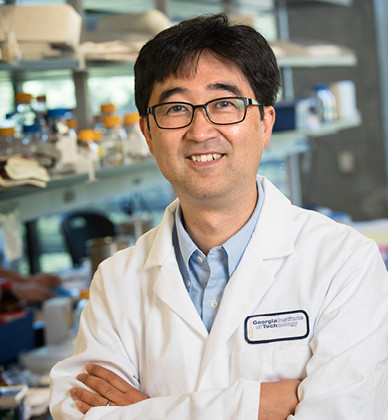
Scott Danielsen

Scott Danielsen
scott.danielsen@mse.gatech.edu
https://danielsen.mse.gatech.edu/

Scott Danielsen is an Assistant Professor in the School of Materials Science and Engineering at the Georgia Institute of Technology. He obtained his Ph.D. in chemical engineering at the University of California, Santa Barbara in 2018 and his B.S.E. in chemical and biomolecular engineering at the University of Pennsylvania in 2014. He then spent five years as a postdoctoral associate at Duke University and as a visiting scholar at the University of North Carolina School of Medicine from 2019-2023. 

Prof. Danielsen’s group uses a combination of theoretical, computational, and experimental methods to reveal structure–property–processing relationships of soft materials. Their current primary research interests are the structure and dynamics of nonideal structured fluids, particularly polymer gels and biological fluids, with a focus on designing new materials and processing conditions for functional materials.

Assistant Professor, School of Materials Science and Engineering
Scott
Danielsen
Show Regular Profile

Vida Jamali

Vida Jamali
vida@gatech.edu
Jamali Lab

Vida Jamali earned her Ph.D. in chemical and biomolecular engineering from Rice University under the guidance of Professor Matteo Pasquali and her B.S. in chemical engineering from Sharif University of Technology. Jamali was a postdoctoral researcher in Professor Paul Alivisato's lab at UC Berkeley and Kavli Energy Nanoscience Institute before joining Georgia Tech. The Jamali Research Group uses experimental, theoretical, and computational tools such as liquid phase transmission electron microscopy, rheology, statistical and colloidal thermodynamics, and machine learning to study the underlying physical principles that govern the dynamics, statistics, mechanics, and self-organization of nanostructured soft materials, in and out of thermal equilibrium, from both fundamental and technological aspects.

Assistant Professor, School of Chemical and Biomolecular Engineering
Phone
404.894.5134
Office
ES&T 1222
Additional Research

Studying dynamics and self-assembly of nanoparticles and macromolecules in heterogeneous chemical and biological environmentsInvestigating individual to collective behavior of active nanomachinesHarnessing the power of machine learning to understand physical rules governing nanostructured-soft materials, design autonomous microscopy experimentation for inverse material design, and develop new statistical and thermodynamic models for multiscale phenomena

ChBE Profile Page
Vida
Jamali
Show Regular Profile

Ching-Hua Huang, Ph.D.

Ching-Hua Huang, Ph.D.
ching-hua.huang@ce.gatech.edu
Departmental Bio

Ching-Hua Huang, Ph.D., is the Turnipseed Family Chair and Professor in the School of Civil and Environmental Engineering at Georgia Institute of Technology. Huang received her Ph.D. and M.S. degrees in environmental engineering from Johns Hopkins University. Huang’s expertise includes environmental chemistry, advanced water/wastewater treatment technology, contaminants of emerging concern, sustainable water reuse, waste remediation and resource recovery. Huang has supervised many research projects sponsored by various agencies, and has published more than 170 peer-reviewed journal papers, book chapters and conference proceeding papers. She is the Associate Editor of the American Chemical Society's Environmental Science & Technology Water and the Editorial Advisory Board member of Environmental Science & Technology. 

Turnipseed Family Chair and Professor, School of Civil and Environmental Engineering
Phone
404.893.7694
Office
School of Civil and Environmental Engineering
Ching-Hua
Huang
Show Regular Profile

C.P. Wong

C.P. Wong
cp.wong@mse.gatech.edu
Website

Professor C. P. Wong is the Charles Smithgall Institute Endowed Chair and Regents’ Professor. After his doctoral study, he was awarded a two-year postdoctoral fellowship with Nobel Laureate Professor Henry Taube at Stanford University. Prior to joining Georgia Tech, he was with AT&T Bell Laboratories for many years and became an AT&T Bell Laboratories Fellow in 1992. 

His research interests lie in the fields of polymeric materials, electronic packaging and interconnect, interfacial adhesions, nano-functional material syntheses and characterizations. nano-composites such as well-aligned carbon nanotubes, grahenes, lead-free alloys, flip chip underfill, ultra high k capacitor composites and novel lotus effect coating materials. 

He received many awards, among those, the AT&T Bell Labs Fellow Award in 1992, the IEEE CPMT Society Outstanding Sustained Technical Contributions Award in 1995, the Georgia Tech Sigma Xi Faculty Best Research Paper Award in 1999, Best MS, PhD and undergraduate Thesis Awards in 2002 and 2004, respectively, the University Press (London) Award of Excellence, the IEEE Third Millennium Medal in 2000, the IEEE EAB Education Award in 2001, the IEEE CPMT Society Exceptional Technical Contributions Award in 2002, the Georgia Tech Class of 1934 Distinguished Professor Award in 2004, Outstanding Ph.D. Thesis Advisor Award in 2005, the IEEE Components, Packaging and Manufacturing Technology Field Award in 2006, the Sigma Xi’s Monie Ferst Award in 2007, the Society of Manufacturing Engineers (SME)’s TEEM Award in 2008, the 2009 IEEE -CPMT David Feldman Outstanding Contribution Award and the 2009 Penn State University Distinguished Alumni Award. The 2012 International Dresden Barkhausen Award (Germany). 

He holds over 65 U.S. patents, numerous international patents, has published over 1000 technical papers, 12 books and a member of the National Academy of Engineering of the USA since 2000.

Regents' Professor, School of Materials Science and Engineering
Smithgall Institute Endowed Chair
Phone
404-894-8391
Office
Love 367
School of Materials Science and Engineering
C.P.
Wong
Show Regular Profile

Shuichi Takayama

Shuichi Takayama
takayama@gatech.edu
Takayama lab

Shu Takayama earned his BS and MS in Agricultural Chemistry at the University of Tokyo. He earned a Ph.D. in Chemistry at The Scripps Research Institute in La Jolla, California studying bio-organic synthesis with Dr. Chi‐Huey Wong. He then worked as a postdoc with Dr. George Whitesides at Harvard University where he focused on applying microfluidics to studying cell and molecular biology.

Takayama began his career at the University of Michigan, where led his lab in the Department of Biomedical Engineering and Macromolecular Science & Engineering for over 17 years. In 2017, the lab moved to Georgia Tech where Shu became the Georgia Research Alliance Price Gilbert Chair Professor of Biomedical Engineering in the Wallace H. Coulter Department of Biomedical Engineering.

Takayama’s research interests are diverse and motivated by clinical and biotechnology needs. He is always interested in hearing from stakeholders in these areas who are seeking engineering collaboration.

Professor, Wallace H. Coulter Department of Biomedical Engineering
GRA Eminent Scholar, Wallace H. Coulter Department of Biomedical Engineering
Price Gilbert, Jr. Chair in Regenerative Engineering andMedicine
Phone
404.385.5722
Office
EBB 4018
Additional Research

Use of micro/nanofluidics for cell analysis; diagnostics; and chromatin analysis; High throughput 3D cell cultures; Organs-on-a-chip construction and design; Role of rhythm in cell signaling; Self-switching fluidic circuits; Fracture fabrication

Google Scholar
https://scholar.google.com/citations?hl=en&user=IkhTUu4AAAAJ&view_op=list_works&sortby=pubdate
LinkedIn BME Profile Page
Shuichi
Takayama
Show Regular Profile

Sheng Dai

sheng.dai@ce.gatech.edu
Website

Sheng Dai, Ph.D., P.E., earned his degrees from Tongji University and Georgia Tech. He worked as an ORISE postdoc at the National Energy Technology Laboratory of the U.S. Department of Energy, and returned to Georgia Tech as a faculty member in 2015. He is currently an associate professor in the School of Civil and Environmental Engineering, Ocean Science and Engineering. and holds a courtesy appointment at the School of Earth and Atmospheric Sciences at Georgia Tech.

Dr. Dai's group addresses emerging energy and environment challenges through studying subsurface geomechanics, geomaterials characterization, energy geotechnics, bio-inspired geotechnics, flow in porous media, and granular dynamics. His research has been funded by federal funding agencies (DOE, NSF, NASA, DOT), national labs (INL, NETL), and industry (AECOM, GTI, Leidos).  Dr. Dai has been recognized for his research and teaching, including being a recipient of the NSF CAREER award, the ORISE Fellowship, the Bill Schutz Junior Faculty Teaching Award, and the Class of 1969 Teaching Fellows at Georgia Tech.

He is an associated editor of the Journal of Geophysical Research: Solid Earth and Advances in Geo-Energy Research, an editorial advisor of Geomechanics for Energy and Environment, and serves on the Pressure Core Advisory Board for U.S. Geological Survey, the GOM2 Marine Test Technical Advisory Committee for UT/DOE, the National Gas Hydrate Program for NETL, and the Task Force Leader of TC308 Energy Geotechnics of ISSMGE. 

Assistant Professor, School of Civil and Environmental Engineering
Phone
(404)385-4757
Additional Research

Oil/Gas; Combustion; Electronics; Energy Harvesting; Energy Storage; Thermal Systems

University, College, and School/Department

Sheng
Dai
Show Regular Profile

Nick Sahinidis

Nick Sahinidis
nikos@gatech.edu
Website

Nick Sahinidis is the Butler Family Chair and Professor in the H. Milton Stewart School of Industrial and Systems Engineering and the School of Chemical and Biomolecular Engineering at Georgia Tech. His current research activities are at the interface between computer science and operations research, with applications in various engineering and scientific areas, including: global optimization of mixed-integer nonlinear programs: theory, algorithms, and software; informatics problems in chemistry and biology; process and energy systems engineering. Sahinidis has served on the editorial boards of many leading journals and in various positions within AIChE (American Institute of Chemical Engineers). He has also served on numerous positions within INFORMS (Institute for Operations Research and the Management Sciences), including Chair of the INFORMS Optimization Society. He received an NSF CAREER award, the INFORMS Computing Society Prize, the MOS Beale-Orchard-Hays Prize, the Computing in Chemical Engineering Award, the Constantin Carathéodory Prize, and the National Award and Gold Medal from the Hellenic Operational Research Society. Sahinidis is a member of the U.S. National Academy of Engineering and a fellow of AIChE and INFORMS.

Gary C. Butler Family Chair
Professor
Phone
(404) 894-3036
Research Focus Areas
Nick
Sahinidis
Show Regular Profile

Nian Liu

Nian Liu
nliu82@mail.gatech.edu
Website

Nian Liu began as an Assistant Professor at Georgia Institute of Technology, School of Chemical and Biomolecular Engineering in January 2017. He received his B.S. in 2009 from Fudan University (China), and Ph.D. in 2014 from Stanford University, where he worked with Prof. Yi Cui on the structure design for Si anodes for high-energy Li-ion batteries. In 2014-2016, he worked with Prof. Steven Chu at Stanford University as a postdoc, where he developed in situ optical microscopy to probe beam-sensitive battery reactions. Dr. Liu 's lab at Georgia Tech is broadly interested in the combination of nanomaterials, electrochemistry, and light microscopy for understanding and addressing the global energy challenges. Dr. Liu is the recipient of the Electrochemical Society (ECS) Daniel Cubicciotti Award (2014) and American Chemical Society (ACS) Division of Inorganic Chemistry Young Investigator Award (2015).

Assistant Professor, School of Chemical and Biomolecular Engineering
Phone
404-894-5103
Office
ES&T 1230
Additional Research

Electronic Systems; Packaging and Components; Nanostructures & Materials; Optoelectronics Photonics & Phononics; Semiconductors; Materials & Processes

Google Scholar
https://scholar.google.com/citations?user=nvMAHY8AAAAJ&hl=en
LinkedIn Related Site
Nian
Liu
Show Regular Profile

Nagi Gebraeel

Nagi Gebraeel
nagi.gebraeel@isye.gatech.edu
Website

Professor Nagi Gebraeel is the Georgia Power Early Career Professor and Professor in the H. Milton Stewart School of Industrial and Systems Engineering at Georgia Tech. He received his MS and PhD from Purdue University in 1998 and 2003, respectively.

Dr. Gebraeel's research interests lie at the intersection of Predictive Analytics and Machine Learning in IoT enabled maintenance, repair and operations (MRO) and service logistics. His key focus is on developing fundamental statistical learning algorithms specifically tailored for real-time equipment diagnostics and prognostics, and optimization models for subsequent operational and logistical decision-making in IoT ecosystems. Dr. Gebraeel also develops cyber-security algorithms intended to protect IoT-enabled critical assets from ICS-type cyberattacks (cyberattacks that target Industrial Control Systems). From the standpoint of application domains, Dr. Gebraeel has general interests in manufacturing, power generation, and service-type industries. Applications in Deep Space missions are a recent addition to his research interests, specifically, developing Self-Aware Deep Space Habitats through NASA's HOME Space Technology Research Institute.

Dr. Gebraeel leads Predictive Analytics and Intelligent Systems (PAIS) research group at Georgia Tech's Supply Chain and Logistics Institute. He also directs activities and testing at the Analytics and Prognostics Systems laboratory at Georgia Tech's Manufacturing Institute. Formerly, Dr. Gebraeel served as an associate director at Georgia Tech's Strategic Energy Institute (from 2014 until 2019) where he was responsible for identifying and promoting research initiatives and thought-leadership at the intersection of Data Science and Energy applications. He was also the former president of the Institute of Industrial and Systems Engineers (IISE) Quality and Reliability Engineering Division, and is currently a member of the Institute for Operations Research and the Management Sciences (INFORMS), and IISE (since 2005).

Georgia Power Associate Professor, School of Industrial Systems Engineering
Phone
404.894.0054
Office
Groseclose Building, Room 327
Additional Research
  • Data Mining
  • IoT
  • Sensor-based Prognostics & Degradation Modeling
  • Reliability Engineering
  • Service Logistics
  • System Design & Optimization
  • Cyber/ Information Technology
Research Focus Areas
Nagi
Gebraeel
Show Regular Profile

Martha Grover

Martha Grover
martha.grover@chbe.gatech.edu
Grover Group

Grover’s research activities in process systems engineering focus on understanding macromolecular organization and the emergence of biological function. Discrete atoms and molecules interact to form macromolecules and even larger mesoscale assemblies, ultimately yielding macroscopic structures and properties. A quantitative relationship between the nanoscale discrete interactions and the macroscale properties is required to design, optimize, and control such systems; yet in many applications, predictive models do not exist or are computationally intractable.

The Grover group is dedicated to the development of tractable and practical approaches for the engineering of macroscale behavior via explicit consideration of molecular and atomic scale interactions. We focus on applications involving the kinetics of self-assembly, specifically those in which methods from non-equilibrium statistical mechanics do not provide closed form solutions. General approaches employed include stochastic modeling, model reduction, machine learning, experimental design, robust parameter design, and estimation.

Professor, School of Chemical and Biomolecular Engineering
James Harris Faculty Fellow, School of Chemical and Biomolecular Engineering
Member, NSF/NASA Center for Chemical Evolution
Phone
404.894.2878
Office
ES&T 1228
Additional Research

Colloids; Crystallization; Organic and Inorganic Photonics and Electronics; Polymers; Discrete atoms and molecules interact to form macromolecules and even larger mesoscale assemblies, ultIMaTely yielding macroscopic structures and properties. A quantitative relationship between the nanoscale discrete interactions and the macroscale properties is required to design, optimize, and control such systems; yet in many applications, predictive models do not exist or are computationally intractable. The Grover group is dedicated to the development of tractable and practical approaches for the engineering of macroscale behavior via explicit consideration of molecular and atomic scale interactions. We focus on applications involving the kinetics of self-assembly, specific those in which methods from non-equilibrium statistical mechanics do not provide closed form solutions. General approaches employed include stochastic modeling, model reduction, machine learning, experimental design, robust parameter design, estIMaTion, and optimal control, monitoring and control for nuclear waste processing and polymer organic electronics

Google Scholar
https://scholar.google.com/citations?hl=en&user=PgpLoqIAAAAJ&view_op=list_works&sortby=pubdate
ChBE Profile Page
Martha
Grover
A.
Show Regular Profile