Kinsey Herrin

Kinsey  Herrin
kinsey.herrin@me.gatech.edu
ME Page

Kinsey Herrin is a Senior Research Scientist in the Woodruff George W. Woodruff School of Mechanical Engineering. She supports a number of wearable robotics research efforts across Georgia Tech's campus and holds the ABC credential for a Certified Prosthetist/Orthotist. Kinsey is passionate about advancing state of the art technology available to individuals with physical challenges and amputations as well as the exploration of wearable technology to augment and enhance human performance. She was the former Clinical Liaison & Coordinator and academic faculty within the Georgia Tech MSPO program. She completed her residency training in orthotics and prosthetics at Children's Healthcare of Atlanta and the University of Michigan, respectively, and has over 10 years of experience working with and treating a wide variety of patients in clinical and research settings.

Principal Research Scientist; School of Mechanical Engineering
Phone
404.894.6269
Office
555 14th St Building
Additional Research

wearable technology to augment and enhance human performance.

Research Focus Areas
IRI And Role
Kinsey
Herrin
Show Regular Profile

Harish Ravichandar

Harish Ravichandar
harish.ravichandar@cc.gatech.edu
Harish Ravichandar, Ph.D.

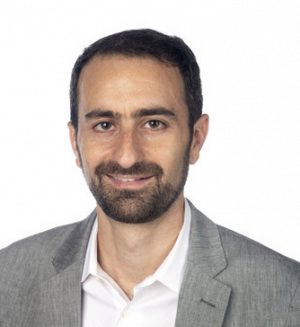
Harish is an Assistant Professor in the School of Interactive Computing at Georgia Institute of Technology. He is also a core faculty member of Georgia Tech’s Institute for Robotics and Intelligent Machines (IRIM). His research interests span the areas of robot learning, human-robot interaction, and multi-agent systems. He directs the Structured Techniques for Algorithmic Robotics (STAR) Lab, where he and his team works on structured algorithms that help robots reliably operate and collaborate in unstructured environments alongside humans.

Assistant Professor; School of Interactive Computing
Additional Research

Robot Learning; Human-Robot Interaction; Multi-Agent Systems

Research Focus Areas
IRI And Role
Google Scholar
https://scholar.google.com/citations?hl=en&user=d2HP6SMAAAAJ&view_op=list_works&sortby=pubdate
Harish
Ravichandar
Show Regular Profile

Sehoon Ha

Sehoon Ha
sehoonha@gatech.edu
Personal Page

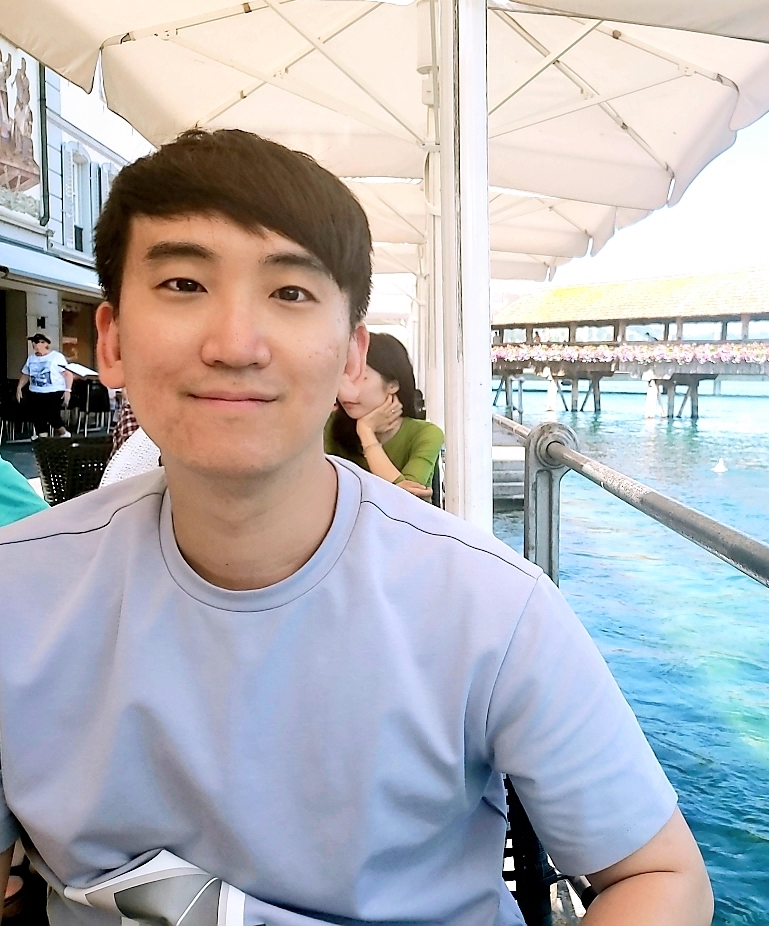
I'm an assistant professor at Georgia Institute of Technology. Before joining Georgia Tech, I was a research scientist at Google and Disney Research Pittsburgh. I received my Ph.D. in Computer Science from the Georgia Institute of Technology in 2015. My advisor was Dr. C. Karen Liu. I have a B.S. degree in Computer Science from KAIST in 2009. I am interested in character animation, robotics, and artificial intelligence.

Assistant Professor; School of Interactive Computing
Office
TSRB 230A
Additional Research

robotics; computer graphics; machine learning

Research Focus Areas
Google Scholar
https://scholar.google.com/citations?hl=en&user=Q6F3O0sAAAAJ&view_op=list_works&sortby=pubdate
Sehoon
Ha
Show Regular Profile

Kyriakos Vamvoudakis

Kyriakos Vamvoudakis
kyriakos@gatech.edu
AE Profile Page

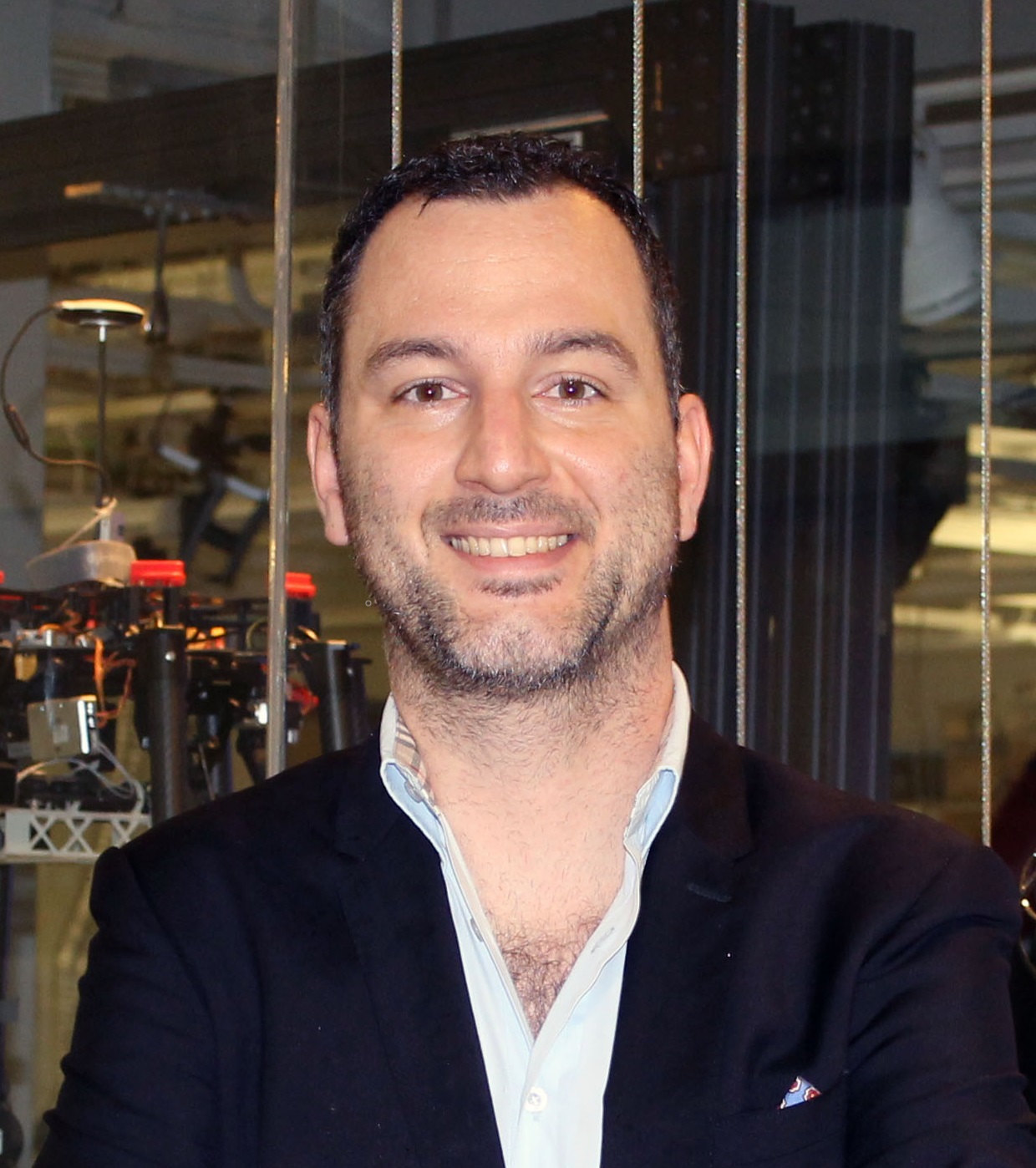
Kyriakos G. Vamvoudakis was born in Athens, Greece. He received the Diploma (a 5 year degree, equivalent to a Master of Science) in Electronic and Computer Engineering from Technical University of Crete, Greece in 2006 with highest honors. After moving to the United States of America, he studied at The University of Texas at Arlington with Frank L. Lewis as his advisor and he received his M.S. and Ph.D. in Electrical Engineering in 2008 and 2011 respectively. From May 2011 to January 2012, he was working as an Adjunct Professor and Faculty Research Associate at the University of Texas at Arlington and at the Automation and Robotics Research Institute. During the period from 2012 to 2016 he was a project research scientist at the Center for Control, Dynamical Systems and Computation at the University of California, Santa Barbara. He was an assistant professor at the Kevin T. Crofton Department of Aerospace and Ocean Engineering at Virginia Tech until 2018. He currently serves as an Assistant Professor at The School of Daniel Guggenheim School of Aerospace Engineering at Georgia Tech. His research interests include approxIMaTe dynamic programming, game theory, and optimal control. Recently, his research has focused on cyber-physical security, networked control, smart grid and multi-agent optimization. Dr. Vamvoudakis is the recipient of a 2019 ARO YIP award, a 2018 NSF CAREER award, and of several international awards including the 2016 International Neural Network Society Young Investigator (INNS) Award, the Best Paper Award for Autonomous/Unmanned Vehicles at the 27th Army Science Conference in 2010, the Best Presentation Award at the World Congress of Computational Intelligence in 2010, and the Best Researcher Award from the Automation and Robotics Research Institute in 2011. He is a member of Tau Beta Pi, Eta Kappa Nu and Golden Key honor societies and is listed in Who's Who in the World, Who's Who in Science and Engineering, and Who's Who in America. He has also served on various international program committees and has organized special sessions for several international conferences. He currently is a member of the Technical Committee on Intelligent Control of the IEEE Control Systems Society (TCIC), a member of the Technical Committee on Adaptive Dynamic Programming and Reinforcement Learning of the IEEE Computational Intelligence Society (ADPRLTC), an Associate Editor of the IEEE Computational Intelligence Magazine, an Associate Editor of the Journal of Optimization Theory and Applications, an Editor in Chief of the Communications in Control Science and Engineering, a registered Electrical/Computer engineer (PE) and a member of the Technical Chamber of Greece. He is a Senior Member of IEEE.

Assistant Professor; School of Aerospace Engineering
Phone
404.385.3342
Office
Montgomery Knight 415B
Additional Research

Control Theory; Reinforcement Learning; Cyber-Physical Systems; Defense/National Security

IRI And Role
Google Scholar
https://scholar.google.com/citations?hl=en&user=4hWyM_gAAAAJ&view_op=list_works&sortby=pubdate
Kyriakos
Vamvoudakis
G.
Show Regular Profile

Jun Ueda

Jun Ueda
jun.ueda@me.gatech.edu
Biorobotics & Human Modeling Lab

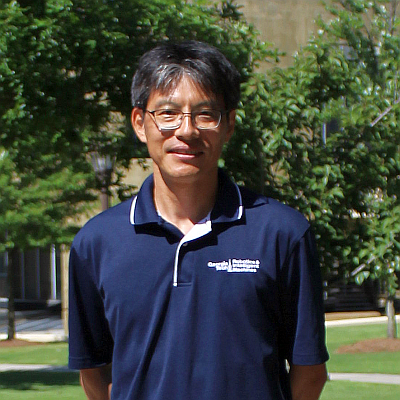
Jun Ueda joined Georgia Tech in May 2008 as Assistant Professor. Before Georgia Tech, he was a Visiting Scholar and Lecturer at MIT, where he worked on the development and control of cellular actuators inspired by biological muscle. He developed compliant, large strain piezoelectric actuators and a robust control method called stochastic broadcast feedback. From 2002-2008 he was Assistant Professor at Nara Institute of Science and Technology in Japan, where he led a research group dedicated to dynamics and control in robotics, such as robot hand manipulation, tactile sensing, and power-assisting. From 1996 to 2002 and prior to obtaining his Ph.D, he worked at the Advanced Technology R&D Center of Mitsubishi Electric Corporation in Japan. Here he was involved in a variety of activities including disk drives, machine tools, and satellite tracking antennas. His Ph.D. work at Kyoto University was on the end-point control of a robot manipulator mounted on a non-rigid base. He studied feedback control robustness in terms of the coupling of the arm and base dynamics.

Professor, George W. Woodruff School of Mechanical Engineering
Director, Biorobotics & Human Modeling Lab
Phone
404.385.3900
Office
Love 219
Additional Research

Automation & Mechatronics; Bioengineering

IRI And Role
Google Scholar
https://scholar.google.com/citations?hl=en&user=vVdRxtUAAAAJ&view_op=list_works&sortby=pubdate
Jun
Ueda
Show Regular Profile

Ai-Ping Hu

Ai-Ping Hu
ai-ping.hu@gtri.gatech.edu
Ai-Ping Hu | INTELLIGENT SUSTAINABLE TECHNOLOGIES DIVISION

Ai-Ping Hu is a principal research engineer in the Georgia Tech Research Institute’s Intelligent Sustainable Technologies Division. He received his BS in Mechanical & Aerospace Engineering from Cornell University and Ph.D. from the Georgia Institute of Technology. Prior to joining GTRI in 2009, Dr. Hu co-founded a start-up robotics company applying learning control to achieve high precision in lightweight flexible manufacturing robots.  His current research interests include agricultural robotics, nonlinear control and vision-guided manipulation.

Principal Research Engineer; Georgia Tech Research Institute
Adjunct Professor; Woodruff School of Mechanical Engineering
Phone
404.407.8815
Additional Research

Agricultural Robotics; Nonlinear Control; Vision-Guided Manipulation

Research Focus Areas
IRI And Role
GTRI
Geogia Tech Research Institute > Aerospace, Transportation & Advanced Systems Laboratory
Google Scholar
https://scholar.google.com/citations?hl=en&user=S5cSWVAAAAAJ&view_op=list_works&sortby=pubdate
Ai-Ping
Hu
Show Regular Profile

Craig Tovey

Craig Tovey
craig.tovey@isye.gatech.edu
ISyE Profile Page

Craig Tovey is a Professor in the H. Milton Stewart School of Industrial and Systems Engineering at Georgia Tech. He also co-directs CBID, the Georgia Tech Center for Biologically Inspired Design. 

Dr. Tovey's principal research and teaching activities are in operations research and its interdisciplinary applications to social and natural systems, with emphasis on sustainability, the environment, and energy. His current research concerns inverse optimization for electric grid management, classical and biomimetic algorithms for robots and webhosting, the behavior of animal groups, sustainability measurement, and political polarization.  

Dr. Tovey received a Presidential Young Investigator Award in 1985 and the 1989 Jacob Wolfowitz Prize for research in heuristics. He was granted a Senior Research Associateship from the National Research Council in 1990, was named an Institute Fellow at Georgia Tech in 1994, and received the Class of 1934 Outstanding Interdisciplinary Activity Award in 2011. In 2016, Dr. Tovey was recognized by the ACM Special Interest Group on Electronic Commerce with the Test of Time Award for his work as co-author of the paper “How Hard Is It to Control an Election?” He was a 2016 Golden Goose Award recipient for his role on an interdisciplinary team that studied honey bee foraging behavior which led to the development of the Honey Bee Algorithm to allocate shared webservers to internet traffic. 

Dr. Tovey received an A.B. in applied mathematics from Harvard College in 1977 and both an M.S. in computer science and a Ph.D. in operations research from Stanford University in 1981. 

Professor; School of Industrial and Systems Engineering
Phone
404.894.3034
Office
Groseclose 420
Additional Research
  • Algorithms & Optimizations
  • Energy
Research Focus Areas
University, College, and School/Department
Craig
Tovey
Show Regular Profile

James Hays

James Hays
hays@cc.gatech.edu
College of Computing Profile

Professor Hays's research interests span computer vision, graphics, robotics, and machine learning. Before joining Georgia Tech, he was the Manning assistant professor of computer science at Brown University. James was a post-doc at Massachusetts Institute of Technology and received his Ph.D. from Carnegie Mellon University in 2009. James received his B.S. in Computer Science from Georgia Tech in 2003.

Associate Professor; School of Interactive Computing
Principal Scientist; Argo AI
Office
CODA 11th floor
Additional Research

Computer Vision; Computer Graphics; Machine Learning; Robotics

Google Scholar
https://scholar.google.com/citations?hl=en&user=vjZrDKQAAAAJ&view_op=list_works&sortby=pubdate
Personal IC Webpage
James
Hays
Show Regular Profile

Aaron Young

Aaron Young
aaron.young@me.gatech.edu
Exoskeleton and Prosthetic Intelligent Controls (EPIC) Lab

Aaron Young is an Associate Professor in Mechanical Engineering and is interested in designing and improving powered orthotic and prosthetic control systems for persons with stroke, neurological injury or amputation. His previous experience includes a post-doctoral fellowship at the University of Michigan in the Human Neuromechanics Lab working with exoskeletons and powered orthoses to augment human performance. He has also worked on the control of upper and lower limb prostheses at the Center for Bionic Medicine (CBM) at the Rehabilitation Institute of Chicago. His master's work at CBM focused on the use of pattern recognition systems using myoelectric (EMG) signals to control upper limb prostheses. His dissertation work at CBM focused on sensory fusion of mechanical and EMG signals to enable an intent recognition system for powered lower limb prostheses for use by persons with a transfemoral amputation.

Associate Professor, George W. Woodruff School of Mechanical Engineering
Director, EPIC Lab
Phone
404.385.5306
Office
GTMI 433
Additional Research

Powered prosthesis; EMG signal processing. Young's research is focused on developing control systems to improve prosthetic and orthotic systems. His research is aimed at developing clinically translatable research that can be deployed on research and commercial systems in the near future. Some of the interesting research questions are how to successfully extract user intent from human subjects and how to use these signals to allow for accurate intent identification. Once the user intent is identified, smart control systems are needed to maximally enable individuals to accomplish useful tasks. For lower limb devices, these tasks might include standing from a seated position, walking, or climbing a stair. We hope to improve clinically relevant measures with powered mechatronic devices, including reducing metabolic cost, improving biomechanics and decreasing the time required to perform daily tasks of living.

Google Scholar
https://scholar.google.com/citations?hl=en&user=NkM21vEAAAAJ&view_op=list_works&sortby=pubdate
ME Profile Page
Aaron
Young
J
Show Regular Profile