New Robot Learns Object Arrangement Preferences Without User Input

Robotics Ph.D. student Kartik Ramachandruni posing with a robot in a Georgia Tech lab.

Kartik Ramachandruni (via LinkedIn) is a robotics Ph.D. student advised by School of Interactive Computing Associate Professor Sonia Chernova.

Kartik Ramachandruni knew he would need to find a unique approach to a populated research field.

With a handful of students and researchers at Georgia Tech looking to make breakthroughs in home robotics and object rearrangement, Ramachandruni searched for what others had overlooked.

“To an extent it was challenging, but it was also an opportunity to look at what people are already doing and to get more familiar with the literature,” said Ramachandruni, a Ph.D. student in Robotics. “(Associate) Professor (Sonia) Chernova helped me in deciding how to zone in on the problem and choose a unique perspective.”

Ramachandruni started exploring how a home robot might organize objects according to user preferences in a pantry or refrigerator without prior instructions required by existing frameworks.

His persistence paid off. The 2023 IEEE International Confrence on Robots and Systems (IROS) accepted Ramachandruni’s paper on a novel framework for a context-aware object rearrangement robot.

“Our goal is to build assistive robots that can perform these organizational tasks,” Ramachandruni said. “We want these assistive robots to model the user preferences for a better user experience. We don’t want the robot to come into someone’s home and be unaware of these preferences, rearrange their home in a different way, and cause the users to be distressed. At the same time, we don’t want to burden the user with explaining to the robot exactly how they want the robot to organize their home.”

Ramachandruni’s object rearrangement framework, Context-Aware Semantic Object Rearrangement (ConSOR), uses contextual clues from a pre-arranged environment within its environment to mimic how a person might arrange objects in their kitchen.

“If our ConSOR robot rearranged your fridge, it would first observe where objects are already placed to understand how you prefer to organize your fridge,” he said. “The robot then places new objects in a way that does not disrupt your organizational style.”

The only prior knowledge the robot needs is how to recognize certain objects such as a milk carton or a box of cereal. Ramachandruni said he pretrained the model on language datasets that map out objects hierarchically.

“The semantic knowledge database we use for training is a hierarchy of words similar to what you would see on a website such as Walmart, where objects are organized by shopping category,” he said. “We incorporate this commonsense knowledge about object categories to improve organizational performance.

“Embedding commonsense knowledge also means our robot can rearrange objects it hasn’t been trained on. Maybe it’s never seen a soft drink, but it generally knows what beverages are because it’s trained on another object that belongs to the beverage category.”

Ramachandruni tested ConSOR against two model training baselines. One used a score-based approach that learns how specific users group objects in an environment. It then uses the scores to organize objects for users. The other baseline used the GPT-3 large language model prompted with minimal demonstrations and without fine-tuning to determine the placement of new objects. ConSOR outperformed both baselines.

“GPT-3 was a baseline we were comparing against to see whether this huge body of common-sense knowledge can be used directly without any sort of frame,” Ramachandruni said. “The appeal of LLMs is you don’t need too much data; you just need a small data set to prompt it and give it an idea. We found the LLM did not have the correct inductive bias to correctly reason between different objects to perform this task.”

Ramachandruni said he anticipates there will be scenarios where user input is required. His future work on the project will include minimizing the effort required by the user in those scenarios to tell the robot its preferences.

“There are probably scenarios where it’s just easier to ask the user,” he said. “Let’s say the robot has multiple ideas of how to organize the home, and it’s having trouble deciding between them. Sometimes it’s just easier to ask the user to choose between the options. That would be a human-robot interaction addition to this framework.”

IROS is taking place this week in Detroit.

IRIM's Sonia Chernova lecturing in a classroom.

School of Interactive Computing Associate Professor Sonia Chernova lecturing in a classroom. (Photo by Terence Rushin/College of Computing)

 
News Contact

Nathan Deen, Communications Officer I

School of Interactive Computing

nathan.deen@cc.gatech.edu

New Battlefield Obscurants Could Give Warfighters a Visability Advantage

Testing Electronic Circuitry on a Nanophotonic Structure

Electronic circuitry on a nanophotonic structure under test will change the optical properties of the structure when it absorbs radio frequency energy. (Credit: Christopher Moore)

Clouds of tiny structures that are lighter than feathers – and whose properties can be remotely controlled by radio frequency (RF) signals – could one day give U.S. warfighters and their allies the ability to observe their adversaries while reducing how well they themselves can be seen. 

Using miniaturized electronics and advanced optical techniques, this new generation of tailorable, tunable, and safe battlefield obscurants – which could be quickly turned on and off – could provide an asymmetric visibility advantage. Researchers at the Georgia Institute of Technology are among several teams funded to develop a new generation of battlefield obscurants as part of the Defense Advanced Research Projects Agency’s (DARPA) Coded Visibility (CV) program. 

Smoke screens created to hide troop movements or ships at sea have been used in past conflicts. Often based on burning fuel oil, these conventional techniques have many disadvantages, including limiting the visibility of both sides and using materials that are potentially harmful to warfighters. The new approach being developed at Georgia Tech will instead use lightweight and non-toxic electrically reconfigurable structures that would form obscuring plumes able to hang in the air over a battlefield.

Nanophotonic Technologies Change Properties

“We will bring nanophotonic structures into the real world and be able to change their properties remotely without having direct contact such as with an optical fiber,” said Ali Adibi, a professor in Georgia Tech’s School of Electrical and Computer Engineering and the project’s principal investigator. “They could be part of a cloud of nanostructures formed from a foil material with different dimensions, from millimeters to centimeters. They could include an antenna and diode or heater that would allow them to respond to an RF signal, changing their properties to collectively affect light passing through.”

The transparent foil structures might be used to change the optical properties of the plume to favor visibility in one direction, depending on the RF signal sent. With differences in their sizes and properties, the plumes could include a variety of structures that would respond to different frequencies, potentially allowing the obscurant cloud to be tuned for conditions.

“We will utilize a known electromagnetic concept that, by having a different distribution of scattering properties and absorptive properties, will allow us to control the asymmetric visibility,” he said.

Adibi’s research group has pioneered development of reconfigurable nanophotonic devices, fabricating phase-change optical materials that transition from amorphous to crystalline. The technique has been used to change such properties as the colors reflected from the structures.

Structures Take Advantage of Optical Properties

Transparent materials like the foils planned for use in the project can also reflect light, similar to the way a car’s windshield allows drivers to see out – while also creating reflections, noted Brent Wagner, a co-principal investigator of the project and a principal research scientist at the Georgia Tech Research Institute (GTRI).

“A transparent material will reflect light, just because it’s in air, which gives it a different refractive index,” he said. “The light doesn’t have to reflect back in the direction it came from. It can reflect to the right or left, or even back through itself. The clouds we will be creating will tend to scatter light, which means the light carrying information will get bounced at different angles.”

The coded visibility plumes likely won’t permit picture-perfect visibility, but should give friendly forces enough information to tell what an enemy is doing. At this stage, the researchers don’t know how well the technique will ultimately work, though modeling the scattering and absorption is so far encouraging.

“We’ll be doing a lot of modeling and simulation looking at the kind of obscurants that can be created and the scattering properties at different light angles and wavelengths,” Wagner explained. “We’ll create a cloud model to study where the particles are and how they are oriented.”

Interdisciplinary Tradeoffs Guide Decisions 

The researchers are using machine learning to help select optimal phase-change materials that can be altered with minimal power. The AI technique will also help the team design the most efficient antennas and maximize the extent to which the particles can be reconfigured by the RF signals. 

“These nanophotonic devices will be very small, but we will need to reach each one of them and provide enough power to change their properties,” Adibi noted. “The more power that is needed to create that change, the more sophisticated the antennas will have to be.” During the final phase of the multi-year project, the team will conduct a demonstration of their reconfigurable obscurant in a 27-cubic meter instrumented test room. That will require producing large volumes of particles and demonstrating how their manufacture could be scaled up for actual use.

The project has brought together multiple specialties to the research team, which includes approximately a dozen faculty members, postdoctoral fellows, and students from the School of Electrical and Computer Engineering and GTRI. Additional key contributors to this multidisciplinary research project included Oliver Pierson and John Stewart of GTRI as well as Prof. Seung Soon Jang of Georgia Tech. 

“This is a true multidisciplinary project that combines technologies such as antenna design and electromagnetics with circuit design concepts and optical materials, optical devices, and AI with system-level electromagnetic analysis and characterization,” Adibi said. “We will also need to consider the effects of wind, how the clouds move and other factors. Expertise from all of these disciplines will be essential to making the project successful.”


Writer: John Toon (john.toon@gtri.gatech.edu)
GTRI Communications
Georgia Tech Research Institute
Atlanta, Georgia USA

The Georgia Tech Research Institute (GTRI) is the nonprofit, applied research division of the Georgia Institute of Technology (Georgia Tech). Founded in 1934 as the Engineering Experiment Station, GTRI has grown to more than 2,900 employees, supporting eight laboratories in over 20 locations around the country and performing more than $940 million of problem-solving research annually for government and industry. GTRI's renowned researchers combine science, engineering, economics, policy, and technical expertise to solve complex problems for the U.S. federal government, state, and industry.  

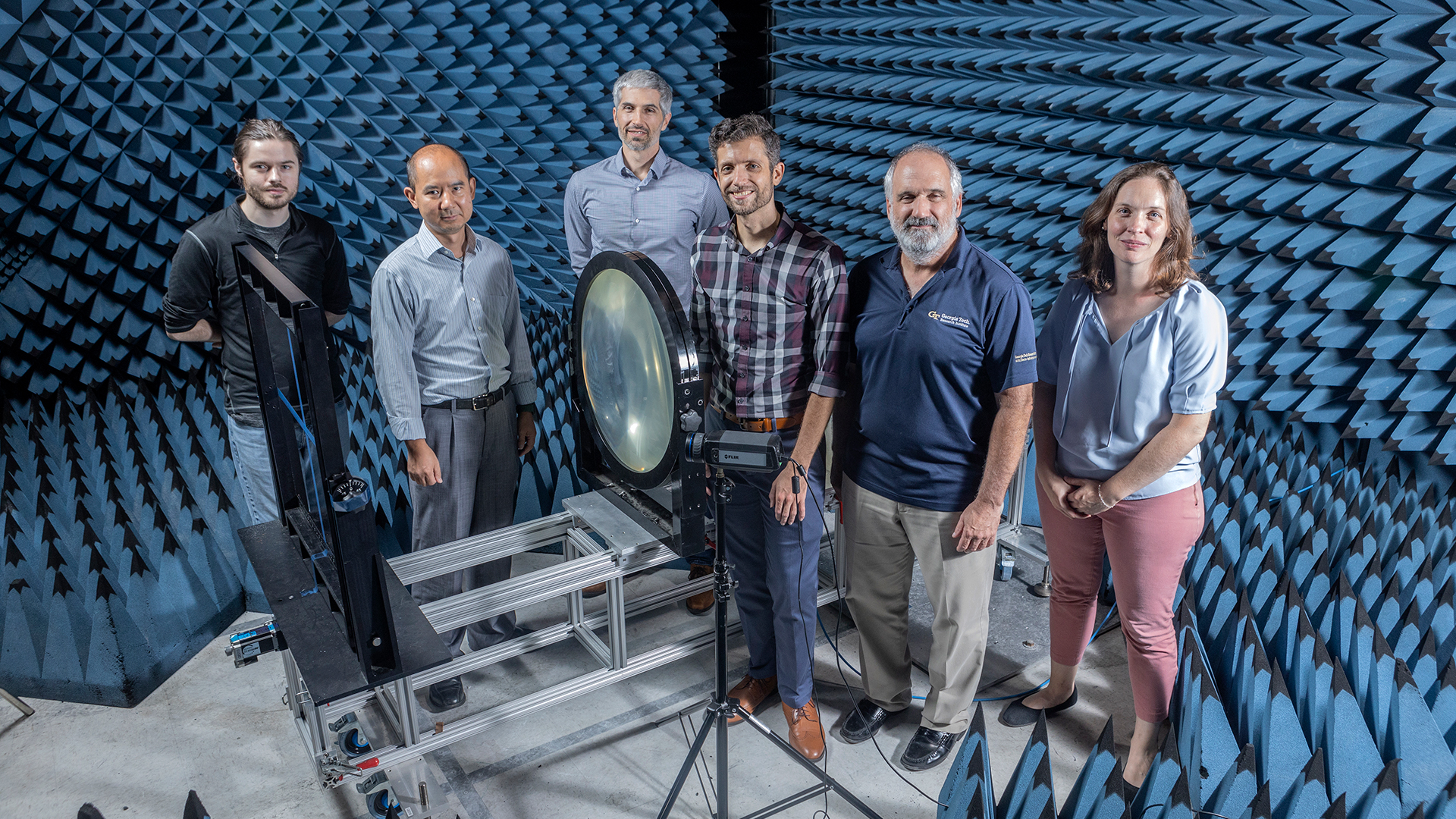
Team of GTRI Researchers Testing Nanophotonic Devices

Researchers from the Georgia Tech Research Institute are shown in the anechoic chamber where nanophotonic devices were tested. Shown are Connor Frost, Zhitao Kang, Ryan Westafer, Joshua Kovitz, Brent Wagner and Taylor Shapero. (Credit: Christopher Moore)

 
News Contact

(Interim) Director of Communications

Michelle Gowdy

Michelle.Gowdy@gtri.gatech.edu

404-407-8060

New Process 3D Prints Glass Microstructures at Low Temperature with Fast Curing

a 3D printed silica glass "GT" logo

A “GT” logo glass at only 120 x 80 micrometers. The structures was 3D printed using a process developed in Jerry Qi's lab that allows creation of transparent tiny structures at low temperatures.

Using ultraviolet light instead of extremely high temperatures, a team of Georgia Tech researchers has developed a new approach for 3D printing small glass lenses and other structures that would be useful for medical devices and research applications.

Their process reduces the heat required to convert printed polymer resin to silica glass from 1,100 degrees Celsius to around 220 degrees C and shortens the curing time from half a day or more to just five hours. They’ve used it to produce all kinds of glass microstructures, including tiny lenses approximately the width of a human hair that could be used for medical imaging inside the body.

Led by George W. Woodruff School of Mechanical Engineering Professor H. Jerry Qi, the team described their approach Oct. 4 in the journal Science Advances.

“This is one of the exploratory examples showing that it is possible to fabricate ceramics at mild conditions, because silica is a kind of ceramic,” Qi said. “It is a very challenging problem. We have a team that includes people from chemistry and materials science engaged in a data-driven approach to push the boundary and see if we can produce more ceramics with this approach.”

Read the full story on the College of Engineering website.

 
News Contact

Joshua Stewart
College of Engineering

Sea Spray, Water Worlds, and the Search for Life

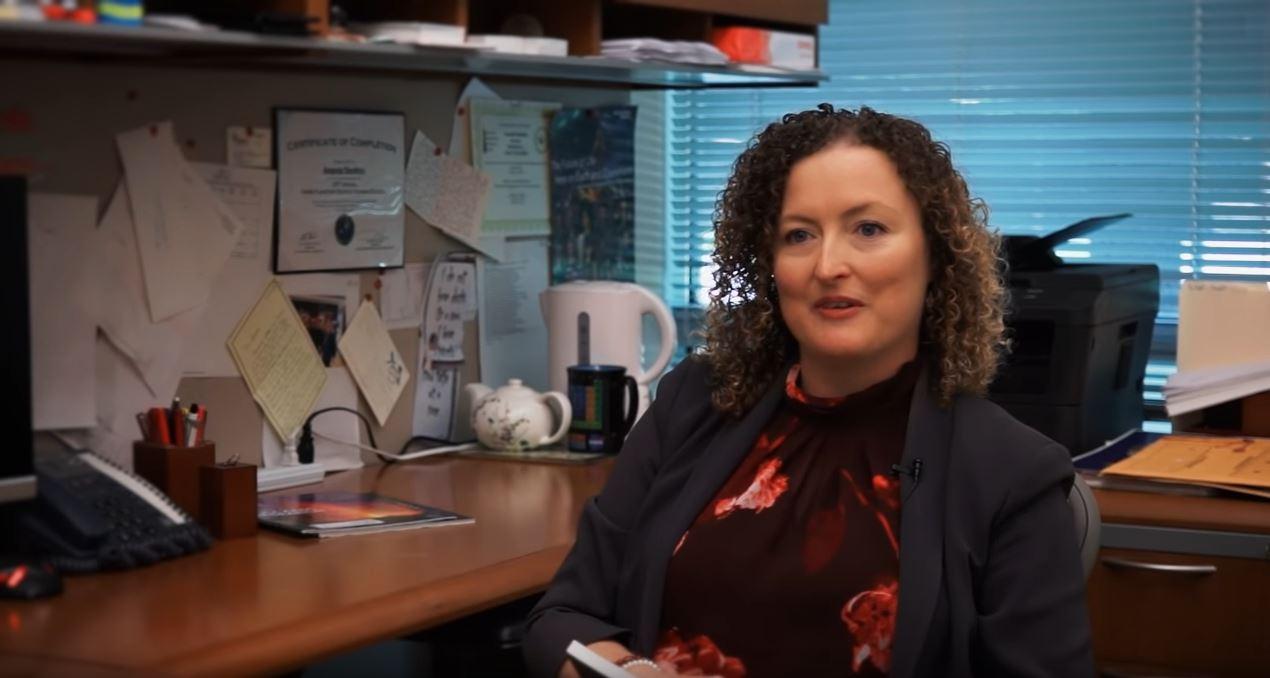
 Amanda Stockton

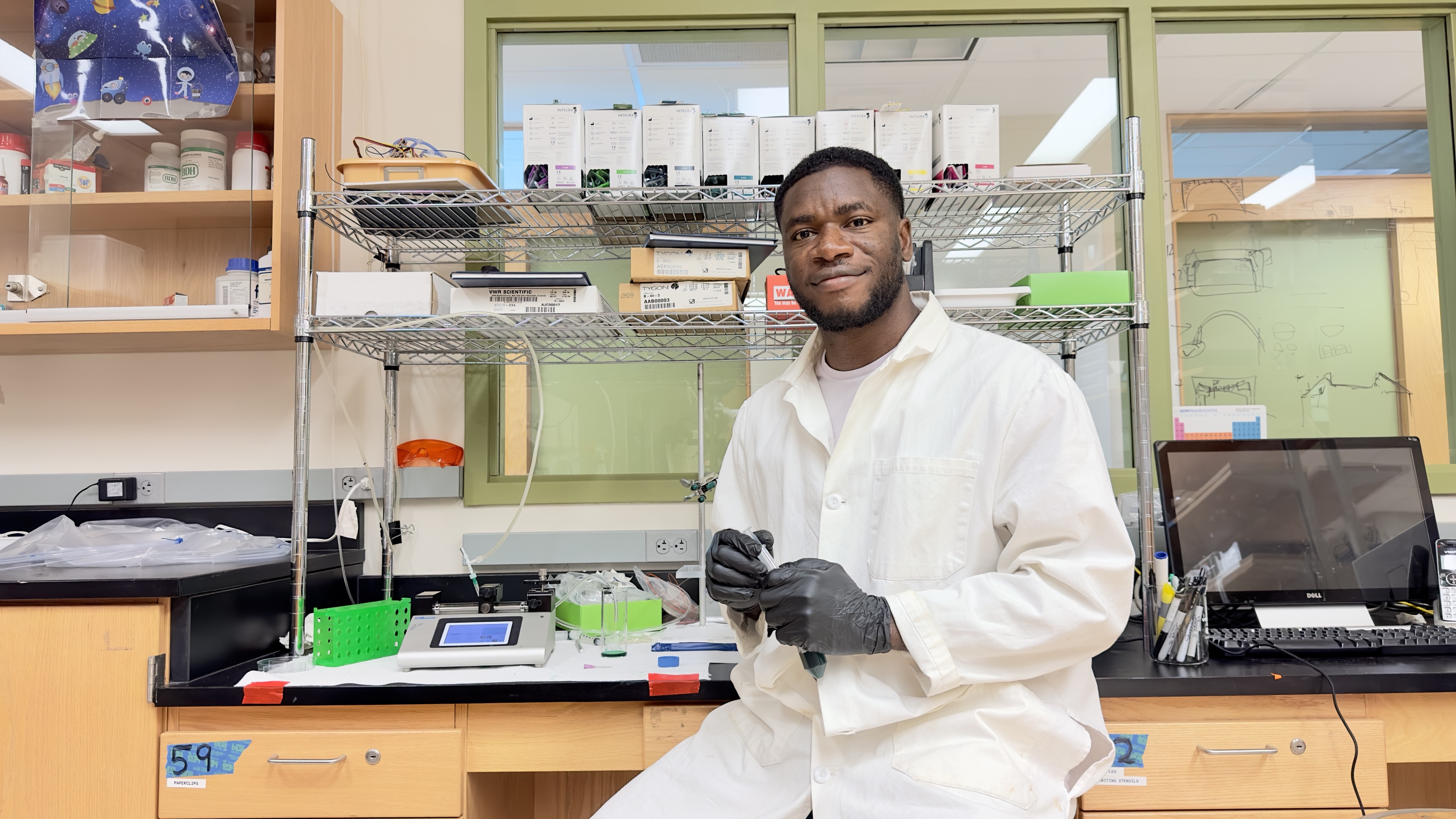
Augustine Atta Debrah, a second-year Chemistry Ph.D. student in Stockton’s Lab, is playing a key role in the research. “This project shows our dedication to uncovering the mysteries of the origins of life and expanding our knowledge about planets far beyond our own,” he says

Along coastal shorelines, tiny drops of sea spray are flung everywhere – sometimes reaching the atmosphere, where they’re transported around the world. And within these sea spray aerosols are particles, chemicals, and even microbes.

“Sea spray aerosols are very important here on Earth,” explains Amanda Stockton, an associate professor in the School of Chemistry and Biochemistry. “Earth has a complex biology contributing to and living in the oceans.”

Now, with support from a $50,0000 Scialog grant, Stockton is studying what other roles these aerosols might play, digging into how they may have impacted the evolution of life on Earth, and how they may help us search for life beyond Earth.

Scialog: Signatures of Life in the Universe is an initiative launched in 2021 by the Research Corporation for Science Advancement (RCSA) foundation to catalyze fundamental science in the search for life beyond Earth. Scialog, which stands for “Science + Dialogue,” funds innovative, cutting-edge research, while supporting dialogue and community-building across fields.

For this project, Stockton will partner with Tyler Robinson, a professor at the University of Arizona who specializes in exoplanet observation and modeling. “Tyler and I met at the Scialog Conference, which aims to generate new ideas between cross cutting disciplines that are very unrelated,” Stockton says. “So what we were thinking here is Tyler's really good at exoplanet observation and modeling. My group's really good at microfluidic generation. At first, it seems like we don’t have anything to work on together. But it turns out we do.”

Additionally, Augustine Atta Debrah, a second-year Chemistry Ph.D. student in Stockton’s Lab, is playing a key role — Debrah’s research interests are rooted in analytical chemistry, and encompass analytical method development, mass spectrometry-based applications, microfluidics, chromatography-based applications, biosensors, and lab-on-chip devices..

“We are excited to explore the fascinating world of sea sprays through our research,” Debrah says. “By recreating and analyzing the behavior of these aerosols under controlled laboratory conditions, we aim to learn more about how they might have played a role in the early Earth's chemistry and what they could tell us about other planets.”

The team has no shortage of questions to answer together. “How might these aerosols impact what we would observe here from Earth with a telescope?” Stockton asks. “How might aerosols on other planetary bodies impact our search for life? And how did sea spray aerosols contribute to the emergence of life here on Earth?”

Tiny droplets, big impact

While sea spray aerosols have been previously studied, “We don't necessarily have a good handle on how sea spray aerosols might impact other planetary bodies, like a water world,” Stockton says, adding that “an exoplanet water world that doesn’t have continents and doesn't have the same sort of chemistry that Earth has” might have a different spectrographic ‘signature’ through a telescope.

To better understand this, Stockton’s group will generate microfluidic droplets with different chemistries, which they will cycle through different conditions, including different UV irradiation conditions and different temperatures, to model the various ways that aerosols could be transported through atmospheres. 

“Then we could look at how the chemistry changes based on that transport phenomenon and also how the UV spectra or visible spectra changes,” Stockton adds. Scientists observe spectra – the light coming from each planetary object – as a way of better understanding what is present. Different properties can emit different spectra. “Eventually, we’d like to be able to see these from a distance and start to figure out what type of spectra you’d see for different conditions. For example, if the ocean has very simple organics, what you might find from just meteorites accreting to make the planet, versus the sort of spectra you might see if complex organic chemistry is taking place.”

The team also aims to uncover chemistries pertaining to early Earth by mimicking spectra from ocean chemistries that might have been present on early Earth, which could help researchers better understand how life emerged on our planet.

“There's a lot of things that also result from sea sprays on Earth that aren't necessarily being studied to the fullest extent,” Stockton adds. “For example, what are the stressors on these microorganisms and how does being confined in a droplet contribute to what pathways get turned on or off in the microbe, especially when that droplet may be evaporating, sublimating, or freezing?”

Early life on Earth — and life beyond

While Stockton notes that this research is still just beginning, there’s excitement in its focus – this year’s research will start to determine what is possible, and potential applications for the new model. “This is a proof of concept year where we want to see what we can build, what we can learn from what we can build, what the applications are of the system,” Stockton adds. “We hope that this will feed into bigger types of projects where we want to catalog what happens in multiple different types of conditions.”

The research has the potential to touch on some of the most fundamental questions humanity faces: who we are, how we got here — and many researchers, including Georgia Tech astrobiologists, are seeking to better understand water worlds like Encledeus, Titan, and early Europa.

“This project shows our dedication to uncovering the mysteries of the origins of life and expanding our knowledge about planets far beyond our own,” Debrah says.

“There are entire fields that we can branch into at varying levels of complexity,” Stockton adds. “We're very interested in what we can apply this to once we can build the hardware and show that we can do some of this controllably.”

Augustine Atta Debrah, a second-year Chemistry Ph.D. student in Stockton’s Lab, sits in a white lab coat holding a sample.
 
News Contact

Written by Selena Langner

Georgia Tech Interdisciplinary Research Institutes Create Faculty Advisory Council

RFAC gathering

Research faculty at the Georgia Institute of Technology now have their own advocacy group. Since 2022, the Research Faculty Advisory Council (RFAC) has increased research faculty engagement and addressed concerns from researchers in the Interdisciplinary Research Institutes (IRIs), joining similar organizations that address such needs in other colleges.

The group addresses issues such as retention, professional development, recognition, and compensation. Julia Kubanek, vice president for Interdisciplinary Research (VPIR), formed the group after hearing feedback from research faculty and modeled it after a similar council in the College of Sciences.

“This advisory council has helped clarify how we can improve both the status and experience of research faculty on campus,” Kubanek said. “The recommendations they’ve provided and the initiatives they’ve launched are already making a difference.”

The 12 members are nominated from across the IRIs, plus two other interdisciplinary research units supported by the VPIR. These members include:


  • Vishwadeep Ahluwalia (Center for Advanced Brain Imaging)
  • Michael Chang (Brook Byers Institute for Sustainable Systems)
  • Sriram Chockalingam (Institite for Data Engineering and Science)
  • Christine Conwell (Strategic Energy Institute)
  • Andrew Dugenske (Georgia Tech Manufacturing Institute)
  • Ulrika Egertsdotter (Renewable Bioproducts Institute)
  • Evan Goldberg (Global Center for Medical Innovation )
  • Walter Henderson (Institute for Materials)
  • Johannes Leisen (Parker H. Petit Institute for Bioengineering and Bioscience)
  • Paul Joseph (Institute for Electronics and Nanotechnology)
  • Leanne West (Pediatric Technology Center)
  • Clint Zeagler (Institute for People and Technology)

In its first year, RFAC had two co-leads: Andrew Dugenske, the director of the Factory Information Systems Center and a principal research engineer at the Georgia Tech Manufacturing Institute, and Paul Joseph, a principal research scientist and director of External User Programs for Southeastern Nanotechnology Infrastructure Corridor.

“Although the research faculty contribute significantly to the overall growth of Georgia Tech, we remain largely underrepresented, unrecognized, and underemployed because of the lack of suitable platforms to talk about the challenges faced by research faculty colleagues,” Joseph said. “It was not a surprise that the same concerns surfaced and were discovered by the council when we collected input from the research faculty throughout the IRIs on issues that concern and are important to research faculty.”

Although Joseph and Dugenske have completed their terms in their leadership roles, they are satisfied with RFAC’s initial success in creating awareness of research faculty challenges on campus, and initiatives that include a mentorship program with the Research Next team, a Research Faculty Mentoring Network, and efforts in RFAC bylaws creation. Leanne West and Walter Henderson now serve as co-leads.

“It was great for the administration to recognize the many contributions that research faculty make to the Institute and establish a way to improve research faculty job satisfaction and engagement,” Dugenske said. “During the first year of the RFAC, the committee did a great job of gathering issues of importance to research faculty and presenting clear and actionable recommendations to decision-makers.”

 
News Contact

Tess Malone, Senior Research Writer/Editor

tess.malone@gatech.edu

$50M Cancer Moonshot Grant Will Build an Atlas for Earlier Cancer Detection

Gabe Kwong

The Georgia Institute of Technology will lead development of a new generation of cancer tests capable of detecting multiple types of tumors earlier than ever with up to $50 million from President Joe Biden’s Cancer Moonshot initiative.

Led by biomedical engineer Gabe Kwong, the project will map the unique cellular profiles of cancer cells and leverage that knowledge to build new bioengineered sensors to detect those profiles. The goal is to create a new kind of multi-cancer early detection test that would allow oncologists to start treating the tumors sooner, when they’re still small and most responsive.

The funding announced Sept. 26 is from the new Advanced Research Projects Agency for Health (ARPA-H) and part of the Biden administration’s efforts to cut the cancer death rate in half in 25 years.

Read the full story on the College of Engineering website.

 
News Contact

Joshua Stewart
College of Engineering

Georgia Tech Researchers Provide Insight into Evolving Drug-Delivery Systems Technology

Closed-loop Drug Delivery Systems graphic

Alex Abramson, assistant professor in the School of Chemical and Biomolecular Engineering

Imagine having a tiny device inside your body that can continuously monitor your health and deliver the right treatment when needed. That's what closed-loop drug delivery systems (CLDDs) can provide, automatically monitoring, adjusting, and administering medication in response to specific signals within the body.

For example, CLDDs can be used to manage chronic medical conditions, such as diabetes, where maintaining precise control over mediation dosage is critical.

While they hold immense promise for improving patient outcomes and treatment adherence, CLDDs have only recently entered clinical use due to the difficulty in integrating the sensing and actuating components of human-machine Interfaces (HMIs).

Researchers at Georgia Tech’s School of Chemical and Biomolecular Engineering have published an article in Device that provides a comprehensive overview of advancements, strengths, and challenges associated with various CLDD approaches.

Examples of devices already in use include insulin pumps, implantable pain pumps, and epilepsy neurostimulators.

In the paper, titled “Communication Protocols Integrating Wearables, Ingestibles, and Implantables for Closed-Loop Therapies,” the researchers explore both passive and active CLDDs.

Passive devices (typically implantable or ingestible) can release drugs over extended periods without active, real-time monitoring, while active CLDDs incorporate real-time monitoring and feedback mechanisms to adjust drug delivery in response to changing circumstances.

“Active closed-loop, drug-delivery systems are poised to usher in a new generation of remote, personalized healthcare driven by human-machine interfaces,” said study co-author Alex Abramson, an assistant professor in Georgia Tech’s School of Chemical and Biomolecular Engineering.

“But to accentuate the shift from passive to active CLDDs, the integration of advanced sensors and actuators is crucial,” added Ramy Ghanim, a PhD student in Abramson’s lab and co-author of the paper.

Sensors in CLDDs continuously monitor specific health parameters in the body (e.g., blood glucose levels for diabetics), and that data is fed to actuators that determine if a specific treatment is needed (such as releasing insulin).

Communication Systems

In the article, the researchers explore various methods for communication transmission in CLDDs, including hardwiring, radio frequency (RF) wireless communication such as Bluetooth, ultrasound, and in-body communication (harnessing the body itself for data transfer through methods like ionic, biochemical, and optical communication). Each method comes with unique advantages and challenges, according to the researchers.

Challenges in developing advanced HMIs include battery size constraints, powering requirements, data transmission rates, and locational dependance.

One big challenge is making sure these devices work no matter where they are inside a patient. Like a cellphone working best near a Wi-Fi router, these devices need to be in the right place to communicate effectively. Sometimes, they move around inside the body, which can be a problem.

The paper explores potential solutions to various challenges, including energy harvesting techniques, wireless powering, and location tracking systems. Ensuring secure data transmission and protection against hacking is also crucial, the researchers noted.

Benefits to Patients

Benefits of CLDDs include simplicity by automating treatment, reducing side effects by delivering medication precisely in a timely manner, and cost-effectiveness by reducing hospitalizations and complications associated with patient non-compliance.

Up to half of all patients requiring frequent and redundant dosages are noncompliant, sometimes missing doses due to complex treatment regimens, according to the researchers. Consequences include decreased quality of life, preventable disease progression, and an estimated annual cost of $528.4 billion in U.S. healthcare expenditure solely due to suboptimal medication therapy.

“Closed-loop drug delivery systems are poised to transform the landscape of chronic illness treatment by enhancing therapeutic release profiles and easing drug administration, thereby improving patients’ quality of life, decreasing medical expenditures, and improving compliance,” Abramson said.

CITATION: Ramy Ghanim, Anika Kaushik, Jihoon Park, and Alex Abramson, “Communication Protocols Integrating Wearables, Ingestibles, and Implantables for Closed-Loop Therapies,” Device, https://www.cell.com/device/fulltext/S2666-9986(23)00144-8, 2023   
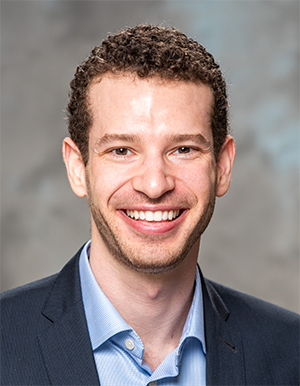
 

Alex Abramson

Ramy Ghanim, PhD student in the School of Chemical and Biomolecular Engineering

Ramy Ghanim
 
News Contact

Nga Lee Sally Ng Receives 2023 AGU Atmospheric Sciences Ascent Award

Portrait of Sally Ng

Nga Lee (Sally) Ng, Love Family Professor with joint appointments in the School of Chemical and Biomolecular Engineering and School of Earth and Atmospheric Sciences, is AGU's 2023 Atmospheric Sciences Ascent Award recipient.

The Atmospheric Sciences Ascent Award is presented annually and recognizes excellence in research and leadership in the atmospheric and climate sciences from honorees between eight and 20 years of receiving their PhD.

Being selected as a Section Honoree is bestowed upon individuals for meritorious work or service toward the advancement and promotion of discovery and solution science. AGU, the world's largest Earth and space science association, annually recognizes a select number of individuals as part of its Honors and Recognition program.

The Atmospheric Sciences Section studies the physics, chemistry, and dynamics of the atmosphere. Ng received the Ascent Award for advancing the fundamental understanding of organic aerosol measurement, sources, chemistry, trends, and impacts in Earth’s atmosphere.

Ng earned her doctorate in Chemical Engineering from the California Institute of Technology and was a postdoctoral scientist at Aerodyne Research Inc. She joined Georgia Tech as an assistant professor in 2011.

Her research focuses on the understanding of the chemical mechanisms of aerosol formation and composition, as well as their health effects. Her group combines laboratory chamber studies and ambient field measurements to study aerosols using advanced mass spectrometry techniques.

Ng currently leads the establishment of the Atmospheric Science and Chemistry mEasurement NeTwork (ASCENT), a new comprehensive, high-time-resolution, long-term measurement network in the U.S. for the characterization of aerosol chemical composition and physical properties. Ng is the inaugural editor-in-chief of the American Chemical Society's (ACS)  ACS ES&T Aira new journal that will publish novel and globally relevant original research on all aspects of air quality sciences and engineering.

Honorees will be recognized at AGU23, which will convene more than 25,000 attendees from over 100 countries in San Francisco and online everywhere on 11-15 December 2023. This celebration is a chance for AGU’s community to recognize the outstanding work of our colleagues and be inspired by their accomplishments and stories.

 
News Contact

Brad Dixon
Communications Manager
School of Chemical and Biomolecular Engineering at Georgia Tech
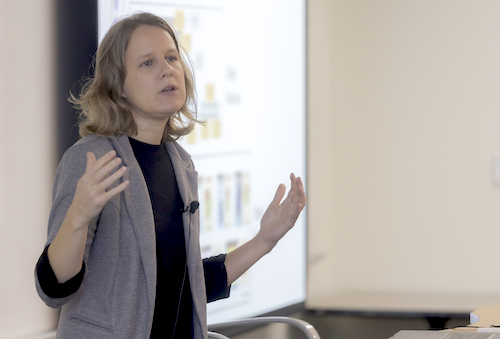
Krista Walton Chosen as Associate Vice President for Research Operations and Infrastructure

Krista Walton, newly named associate vice president for Research Operations and Infrastructure for Georgia Tech

Krista Walton, newly named associate vice president for Research Operations and Infrastructure for Georgia Tech

Krista Walton has been named associate vice president for Research Operations and Infrastructure for Georgia Tech, effective Oct. 1. In her new position, Walton will ensure effective and strategic support for research faculty and staff related to operations, infrastructure, and administration. She brings 14 years of experience at Georgia Tech, most recently as associate dean for Research and Innovation in the College of Engineering.  

“Contributing to the research enterprise at Georgia Tech has been a major focus of my career over the last 14 years,” she said. “I am passionate about academic research and have a deep understanding of the operational support our researchers need to be successful. I look forward to working alongside the Institute’s exceptional leadership, faculty, and staff to support and elevate our research endeavors, fostering an environment where groundbreaking discoveries flourish." 

In this role, Walton will oversee the facilitation and support of research across campus and will be responsible for a variety of principal investigator (PI)-facing activities within the research enterprise, including internally funded research programs. She will also oversee research space, core facilities, research computing and data, and contribute to policies related to research administration and operations.   

Walton joined the faculty in the School of Chemical and Biomolecular Engineering at Georgia Tech in 2009 as an assistant professor. Her postdoctoral research was completed at Northwestern University, and she holds a B.S.E. and Ph.D. from the University of Alabama-Huntsville and Vanderbilt University, respectively. Her research focuses on the design, synthesis, and characterization of functional porous materials for use in adsorption applications including carbon dioxide capture and atmospheric water harvesting. She was the founding director and lead PI on Georgia Tech’s first DOE Energy Frontier Research Center in 2014 and is currently an associate editor for the American Chemical Society journal Industrial & Engineering Chemistry Research.  
“This role is critically important as we grow and scale our research enterprise across all research areas at Georgia Tech,” said Robert Butera, chief research operations officer. “I worked alongside Krista during my time in the College of Engineering, and I am confident she has the skill and expertise to lead our research operations into the future.”  

 
News Contact

Georgia Parmelee | georgia.parmelee@gatech.edu