
Georgia Tech’s Center for Urban Research Charts Ambitious Path Toward Thriving and Equitable Cities
Sep 04, 2024 —

David Edwards, left, founding director of the Center for Urban Research and Brian Y. An, co-director of the Center.
The Center for Urban Research at Georgia Tech has only been around for a couple of years. Still, the joint urban policy initiative of Georgia Tech and the City of Atlanta has already started to make a regional impact on issues such as tax policy, public safety, sustainable energy, and transportation solutions.
The Center boasts a network of affiliated urban studies scholars from Georgia State University, the University of Georgia, Kennesaw State University, Emory University, Morehouse College, and Spelman College. Now, with a new co-director on board in Assistant Professor Brian Y. An, the School of Public Policy-housed Center wants to expand its footprint, becoming a national model for encouraging collaboration among researchers and policy practitioners in areas that affect the health of our cities.
“Our goal is for the Center to be at the heart of how urban studies scholarship can inform practice in urban management — housing, education, health, public infrastructure, energy, and sustainability — all the things that cities need to thrive,” said David Edwards, the Center’s founding director.
We asked Edwards and An to sit down for a conversation about the Center’s future. Their comments were edited for length and clarity.
What’s the mission of the Center for Urban Research?
David Edwards: Our goal is to connect urban studies research being done across the entire academic community and apply it to the problems facing our cities. The gap we're trying to fill is the inadequate job the public and nonprofit sectors do in leveraging academic expertise and research, and vice versa, with academics not always prioritizing the application of their work. We're trying to bridge this gap by providing a platform for collaboration in a sustainable way that drives real changes.
The genesis of this project came from conversations with former Atlanta Mayor Shirley Franklin and Atlanta developer and civic leader Egbert Perry about closing racial equity gaps. When we discussed this with Georgia Tech, they were very supportive, and the School of Public Policy turned out to be the perfect place to house this work. School Chair Cassidy Sugimoto’s vision for increasing the visibility and impact of the School of Public Policy has been instrumental in making this happen.
Where do you think the Center has the greatest opportunity to make an impact?
Edwards: We’re already making an impact in areas such as tax policy, public safety, energy sustainability, public health, and next-generation transportation solutions. Every time we explore a new area, we find opportunities to use academic work that practitioners in the public and nonprofit sectors aren't aware of or aren't taking advantage of.
Brian Y. An: We see a growing need for data-driven, evidence-based research from public agencies and nonprofits alike. For example, Atlanta Housing wants to understand how their work impacts the community, particularly in areas such as affordable housing and economic development. We’ve also worked with Georgia state house members, a group of county chief appraisers, and the City of South Fulton, which wants to know how our research can inform their policies improving rental housing and neighborhood conditions. It’s through collaborations such as these that we can be at the forefront of providing relevant research and expertise that makes a positive impact on the lives of Georgia residents.
What are some of the challenges you face?
An: The research community is highly fragmented, with experts spread across different universities and departments, often competing for limited resources and status. However, we are building an extensive network that can pull resources from various institutions and the community in a unified direction. We want to make scholarly work more visible and accessible to practitioners and policymakers. That’s where our work can make a difference.
What’s on tap for the coming year?
Edwards: We’re planning to build a full-time staff whose job will be to connect academic work in urban studies with the practitioners in the field. The secret sauce is having a dedicated team that knows how to apply academic research and expertise into practice and sustain it over time. The team will likely be a mix of people who can bridge the academic and practitioner spaces effectively, not necessarily based on credentials but on capabilities.
What is your greatest ambition for the center?
An: As a primary researcher, I want the center to be a valuable and necessary resource for policymakers across Georgia and beyond.
Edwards: Our ambitions are national. We want to create a model for how cities can address the legacy of racialized policies that have created segregation and social equity gaps in our cities. Atlanta is the right place to solve this problem because of its history, its leadership, and the impressive academic research being done here. We’re excited to showcase this kind of thinking with our upcoming first meeting of the Healthcare Initiatives Task Force, which we are assembling at the direction of the Atlanta Committee for Progress, a group that advises Atlanta Mayor Andre Dickens. Led by Grady Health System CEO John Haupert, the task force will develop strategies that policymakers can use to improve education, public safety, economic mobility, and health for all. We dream of providing a blueprint that can be used across the country.
David Edwards, co-director of the Center for Urban Research and Senior Policy Advisor for Neighborhoods for Atlanta Mayor Andre Dickens, is the Center’s founding director. An is co-director of the Center and an assistant professor in the School of Public Policy. His work has been cited by the Atlanta Journal-Constitution, WSB-TV, WABE, GPB, and the White House Council of Economic Advisers.
IAC Communications used AI tools to collect, analyze, organize, or generate content contained in this article.
Michael Pearson
Ivan Allen College of Liberal Arts
James Stroud Awarded British Ecological Society Founder's Prize
Sep 04, 2024 —

James T. Stroud, Elizabeth Smithgall Watts Early Career Assistant Professor in the School of Biological Sciences at Georgia Tech, has been awarded the prestigious Founder's Prize by the British Ecological Society (BES), the largest scientific society for ecologists in Europe.
Commemorating the enthusiasm and vision of the organization’s founders, the Founder's Prize is awarded to an outstanding early career ecologist who is beginning to make a significant contribution to the science of ecology.
Stroud is being recognized for his groundbreaking research as an integrative evolutionary ecologist, investigating how ecological and evolutionary processes may underlie patterns of biological diversity at the macro-scale.
Earlier this year, Stroud was also named an Early Career Fellow by the Ecological Society of America (ESA). He is the first person to win both seminal early career researcher awards from ESA and BES — the two largest and most influential ecological societies in the world — in the same year.
“The British Ecological Society could not have selected a more deserving recipient of this prestigious award,” says David Collard, senior associate dean in the College of Sciences and professor in the School of Chemistry and Biochemistry. “James is a model of faculty excellence in his innovative research, commitment to education, and leadership in the field. We look forward to his continued impact in driving forward the field of ecology.”
Stroud's highly multidisciplinary research combines field studies with macro-ecological and evolutionary comparative analyses, primarily studying lizards. His current interests focus on measuring natural selection in the wild, often leveraging non-native lizards as natural experiments in ecology and evolution.
"I am completely overwhelmed and honored to receive this award,” Stroud says, “and especially from a society very close to my heart. My first ever scientific conference was a BES meeting.”
Stroud will be presented with an honorarium prize during a ceremony at the BES Annual Meeting in Liverpool this December. The meeting brings together over 1,000 ecologists to discuss the latest advances in ecological research. For more than a century, the BES has been championing ecology through its journals, meetings, grants, education, and policy work.
“This award really symbolizes the amazing support and guidance I have received throughout my career from an incredible network of mentors and colleagues,” Stroud adds, “and now, the amazing people I get to work with in my own research group, as well.”
###
About the British Ecological Society
The British Ecological Society (BES), founded in 1913, is the oldest ecological society in the world, championing the study of ecology for over a century. With over 7,000 members in more than 120 countries, the BES is the largest scientific society for ecologists in Europe and promotes the study of ecology through its six academic journals, conferences, grants, education initiatives and policy work.
About Georgia Tech
The Georgia Institute of Technology, or Georgia Tech, is one of the top public research universities in the U.S., developing leaders who advance technology and improve the human condition. The Institute offers business, computing, design, engineering, liberal arts, and sciences degrees. Its more than 47,000 undergraduate and graduate students represent 54 U.S. states and territories and more than 143 countries. They study at the main campus in Atlanta, at instructional sites around the world, or through distance and online learning. As a leading technological university, Georgia Tech is an engine of economic development for Georgia, the Southeast, and the nation, conducting more than $1 billion in research annually for government, industry, and society.
Jess Hunt-Ralston
Director of Communications
College of Sciences
Georgia Institute of Technology
Davy Falkner
Media Relations Officer
British Ecological Society
Search Begins for Georgia Tech’s Executive Vice President for Research
Sep 03, 2024 — Atlanta

President Ángel Cabrera has convened a search committee, chaired by College of Sciences Dean Susan Lozier, charged with selecting Georgia Tech’s next executive vice president for research (EVPR). To assist with the process, the Institute has retained the services of executive search firm WittKieffer.
“I thank all the members of the search committee and committee chair Dean Lozier, for conducting a thorough search to identify our next executive vice president for research,” said President Cabrera. “As one of the nation’s foremost academic research institutions, Georgia Tech is looking for a leader who can sustain the growth of our research enterprise, build the infrastructure necessary to support it, and deliver on our mission to advance technology and improve the human condition.”
WittKieffer will host several town halls to gather input from the Georgia Tech community on the preferred qualifications of the next EVPR.
Community Engagement Schedule
Georgia Tech Staff Town Hall
Tuesday, September 10 at 10:00 a.m.
Hybrid: Marcus Nanotechnology Building, 345 Ferst Drive, Room 1116 / Register for virtual attendance)
GTRI Town Hall
Tuesday, September 10 at 12:00 p.m.
Virtual only (Details forthcoming for GTRI faculty and staff)
Georgia Tech Faculty Town Hall
Tuesday, September 10 at 2:00 p.m.
Hybrid: Howey Physics L3 Classroom / (Register for virtual attendance)
Open Georgia Tech and GTRI Town Hall
Wednesday, September 11 at 11:00 a.m.
Virtual only (Register online)
Additional Information
Both internal and external candidates are invited to apply. For more details, including the position description and the application process, a list of the search committee members, and the key dates, visit the EVPR search webpage.
Regents’ Professor Tim Lieuwen has been appointed interim EVPR and will serve until the new EVPR is in place.
Shelley Wunder-Smith
Director of Research Communications
shelley.wunder-smith@research.gatech.edu
Research Centers Supported by the Space Research Initiative
Sep 03, 2024 —
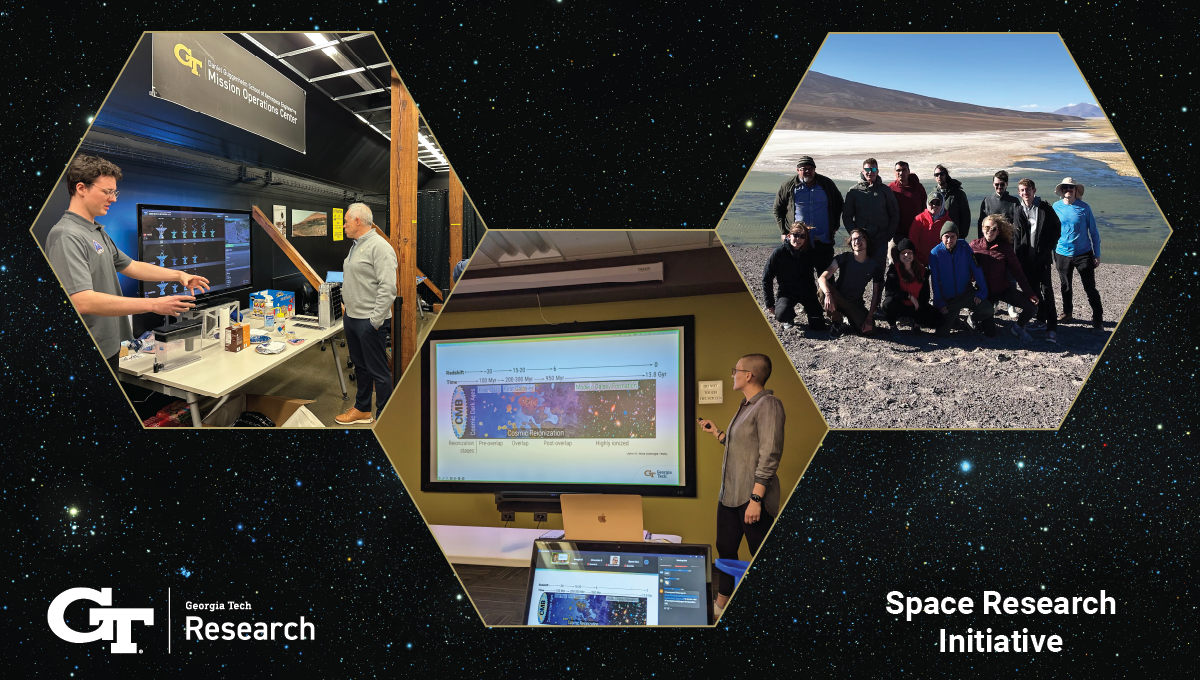
Across Georgia Tech, researchers are exploring the universe — its origins, possible futures, and humanity and Earth’s place in it. These investigations are the efforts of hundreds of astrobiologists, astrophysicists, aerospace engineers, astronomers, and experts in space policy and science fiction — and all of this work is brought together under the Institute’s new Space Research Initiative (SRI).
The SRI is the hub of all things space-related at Georgia Tech. It connects research institutes, labs, facilities, Schools, and Colleges to foster the conversation about space across Georgia and beyond. As a budding Interdisciplinary Research Institute (IRI), the SRI currently encompasses three core centers that contribute distinct interdisciplinary perspectives to space exploration.
Center for Space Technology and Research
The Center for Space Technology and Research (CSTAR) is a hub dedicated to furthering the expansion of Georgia’s aerospace industry, which is already the state’s No. 1 economic driver. The center's team at Georgia Tech conducts cutting-edge research in fields such as astrophysics, Earth science, planetary science, robotics, space policy, space technology, materials science, and space systems engineering.
CSTAR boasts a collaborative network of more than 100 Georgia Tech faculty members and research staff, supported by annual funding exceeding $20 million. Its contribution to space research is highlighted by its active multiyear research grants totaling over $100 million. Each year, CSTAR also contributes to the academic community with around 100 peer-reviewed journal articles and provides mentorship to dozens of graduate and undergraduate students, shaping the next generation of space research.
Members of CSTAR have contributed to a variety of spaceflight projects, from observing the atmosphere of Jupiter, to creating carbon nanotube-based technology on CubeSats, to building an innovative, dual-use antenna that is simultaneously a critical life-saving handrail and a radio emitter inside an airlock on the International Space Station. Several examples of this research will soon be part of a new permanent display in the National Air and Space Museum in Washington, D.C.
“The work done by the Georgia Tech research community in space is phenomenal,” said CSTAR Director Jud Ready. “We have worked on the International Space Station, launched numerous free-flying CubeSats in low Earth orbit, as well as our current crowning achievement, the Lunar Flashlight CubeSat, which is the world’s only heliocentric spacecraft currently owned and operated by an academic institution that recently demonstrated planetary optical navigation techniques for the first time, by any organization — including NASA.” Future missions include materials demonstrations on a lunar lander, as well as additional orbital activities of both the Earth and moon.
“The SRI will increase our reach and impact over and above these prior activities by at least an order of magnitude,” he said. “I am excited for what the future holds for Georgia Tech students, faculty, and research partners as a result of this new organization.”
Director: Jud Ready
Associate Directors: Morris Cohen and Jennifer Glass
Center for Relativistic Astrophysics
The Center for Relativistic Astrophysics (CRA) is housed within the College of Sciences’ School of Physics. The center’s mission is to provide students with education and training in the key research areas of astroparticle physics, theoretical astrophysics, and gravitational wave astrophysics.
CRA researchers study the breadth of space, ranging from the early universe’s large-scale structure to particle interactions. They also study black holes and the merger of compact objects, the potential outcome of the evolution of stellar binary systems, and — closer to home — exoplanets and stars found in the Milky Way. Of particular strength are computational astrophysics and multi-messenger astrophysical studies with neutrinos, photons, and gravitational waves.
In addition, CRA researchers actively participate in major international collaborations, such as the operations and development of existing and future detectors, including the IceCube Neutrino Observatory, the LIGO and LISA gravitational wave observatories, X-ray observatories NuSTAR and Athena, and gamma-ray detectors VERITAS and CTA.
“Bringing together all space research under a single umbrella will be a huge boon to the CRA’s research efforts and visibility,” said John Wise, CRA director. “I am excited about the opportunities the SRI will bring forth within such a collaborative environment, especially the prospect of Georgia Tech leading a space mission that can test the theoretical work performed within the CRA.”
Director: John Wise
Associate Director: Tamara Bogdanović
Astrobiology research at Georgia Tech, which includes experts in biochemistry, physics, aerospace engineering, planetary science, and astronomy, as well as others, seeks to answer these age-old questions: What is the origin of life? Does life exist on other worlds?
Georgia Tech’s astrobiology community includes students, staff, and faculty across campus, the educational curriculum, the Exploring Origins student-run group, an astrobiology fellows program, and keystone events.
Many globally recognized researchers in this field are at Georgia Tech, and their recent discoveries hint at the potential for life on Mars and ocean worlds like Europa. Astrobiology at Tech brings together these faculty with scholars in the humanities and social sciences to share their research with the public and give it a broader cultural context.
The Georgia Tech Astrobiology Graduate Certificate Program, an interdisciplinary initiative across several Schools and Colleges, is designed to broaden student participation in astrobiology. An undergraduate minor is in development. The purpose of these programs is to expand opportunities for both undergraduate and graduate students in the interdisciplinary field of astrobiology.
“One of the main reasons I came to Georgia Tech in 2020 is its vibrant astrobiology program,” said Christopher E. Carr, co-director of Georgia Tech Astrobiology. “It’s a true pleasure to have such amazing colleagues.”
Co-directors: Frances Rivera Hernández and Christopher E. Carr
Laurie Haigh
Research Communications
IMS Receives NSF Funding for Education and Outreach Programs
Sep 03, 2024 —
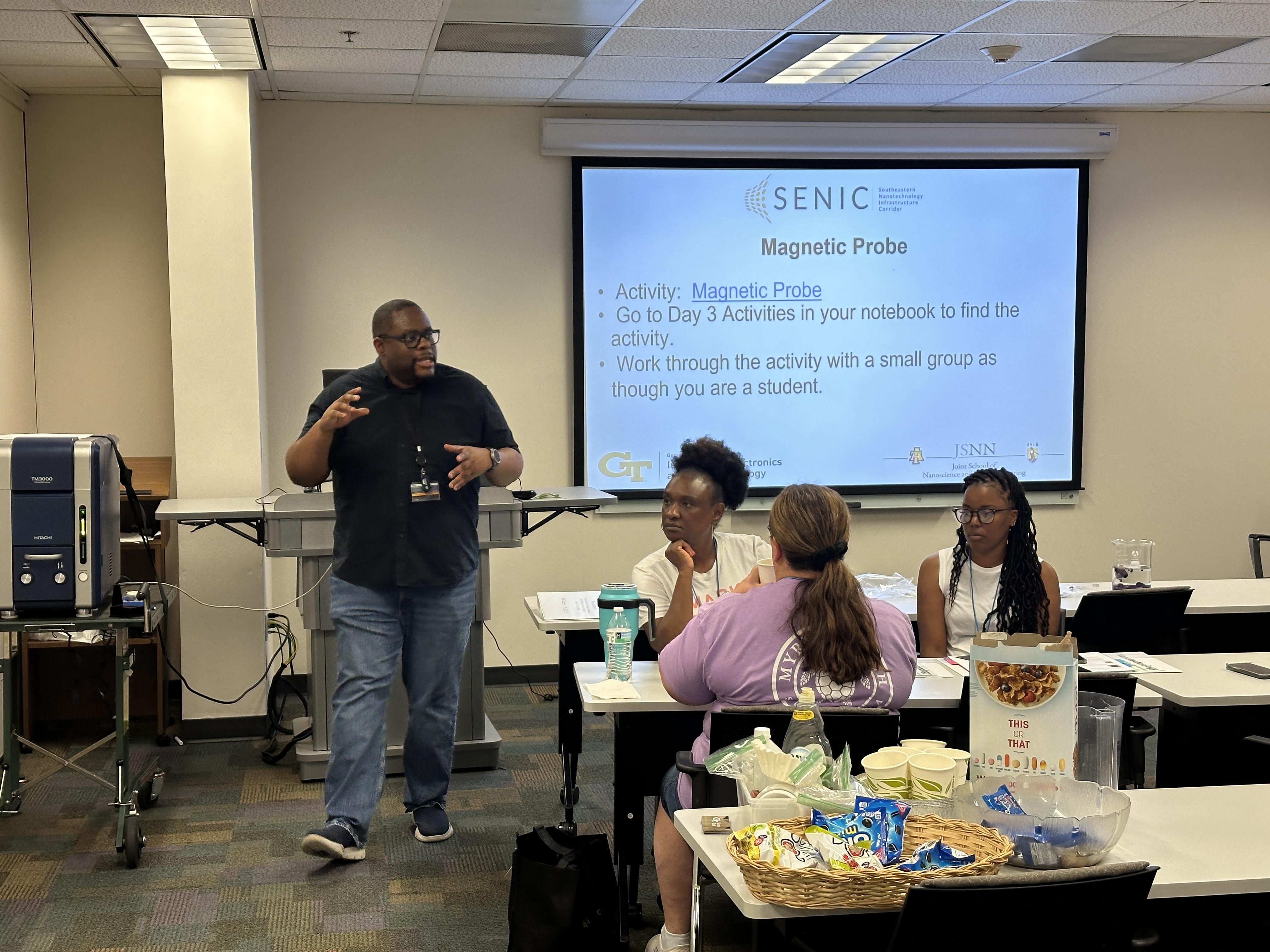
The Institute for Matter and Systems (IMS) has received $700,000 in funding from the National Science Foundation (NSF) for two education and outreach programs.
The awards will support the Research Experience for Undergraduates (REU) and Research Experience for Teachers (RET) programs at Georgia Tech. The REU summer internship program provides undergraduate students from two- and four-year programs the chance to perform cutting-edge research at the forefront of nanoscale science and engineering. The RET program for high school teachers and technical college faculty offers a paid opportunity to experience the excitement of nanotechnology research and to share this experience in their classrooms.
“This NSF funding allows us to be able to do more with the programs,” said Mikkel Thomas, associate director for education and outreach. “These are programs that have existed in the past, but we haven’t had external funding for the last three years. The NSF support allows us to do more — bring more students into the program or increase the RET stipends.”
In addition to the REU and RET programs, IMS offers short courses and workshops focused on professional development, instructional labs for undergraduate and graduate students, a certificate for veterans in microelectronics and nano-manufacturing, and community engagement activities such as the Atlanta Science Festival.
Amelia Neumeister | Communications Program Manager
Georgia Tech Cloud Hub Advances Generative AI Research with Microsoft Support
Oct 30, 2025 —

A lighted pathway through a sea of clouds.
The Cloud Hub, a key initiative of the Institute for Data Engineering and Science (IDEaS) at Georgia Tech, recently concluded a successful Call for Proposals focused on advancing the field of Generative Artificial Intelligence (GenAI). This initiative, made possible by a generous gift funding from Microsoft, aims to push the boundaries of GenAI research by supporting projects that explore both foundational aspects and innovative applications of this cutting-edge technology.
Call for Proposals: A Gateway to Innovation
Launched in early 2024, the Call for Proposals invited researchers from across Georgia Tech to submit their innovative ideas on GenAI. The scope was broad, encouraging proposals that spanned foundational research, system advancements, and novel applications in various disciplines, including arts, sciences, business, and engineering. A special emphasis was placed on projects that addressed responsible and ethical AI use.
Recognizing Microsoft’s Generous Contribution
This successful initiative was made possible through the generous support of Microsoft, whose contribution of research resources has empowered Georgia Tech researchers to explore new frontiers in GenAI. By providing access to Azure’s advanced tools and services, Microsoft has played a pivotal role in accelerating GenAI research at Georgia Tech, enabling researchers to tackle some of the most pressing challenges and opportunities in this rapidly evolving field.
Looking Ahead: Pioneering the Future of GenAI
The awarded projects, set to commence in Spring 2025, represent a diverse array of research directions, from improving the capabilities of large language models and AI-based systems to innovative applications in data use through interdisciplinary collaborations. These projects are expected to make significant contributions to the body of knowledge in GenAI and are poised to have a lasting impact on the industry and beyond.
IDEaS and the Cloud Hub are committed to supporting these teams as they embark on their research journeys. The outcomes of these projects will be shared through publications and highlighted on the Cloud Hub web portal, ensuring visibility for the groundbreaking work enabled by this initiative.
Congratulations to the Spring 2025 Winners
- Neha Kumar; IC | “Social Audits of AI: Towards Participatory Impact Evaluations of AI-Based Systems”
- Amirali Aghazadeh; ECE & Amanda Stocton; Chem and Biochem | “Agentic AI in Pursuit of Life’s Origins: Reassessing Histidine’s Prebiotic Viability”
- Peng Chen; CSE | “Generative AI for Advanced Bayesian Data Assimilation in Real-Time Flood Prediction”
- Yunan Luo; CSE | “Programmable Protein Design with Multi-Modal Generative AI”
- Anqi Wu; CSE | “Diffusion-Guided Discovery of Semantic Neural Codes in Higher Visual Cortex”
- Chao Zhang; CSE & Rampi Ramprasad; MSE | “MM-ChemAgent: A Multi-modal and Agentic LLM for Chemical Discovery”
Christa M. Ernst - Research Communications Program Manager
christa.ernst@research.gatech.edu
$3 Million NSF Grant Will Support Training in Sustainable Medical Devices
Aug 30, 2024 — Atlanta
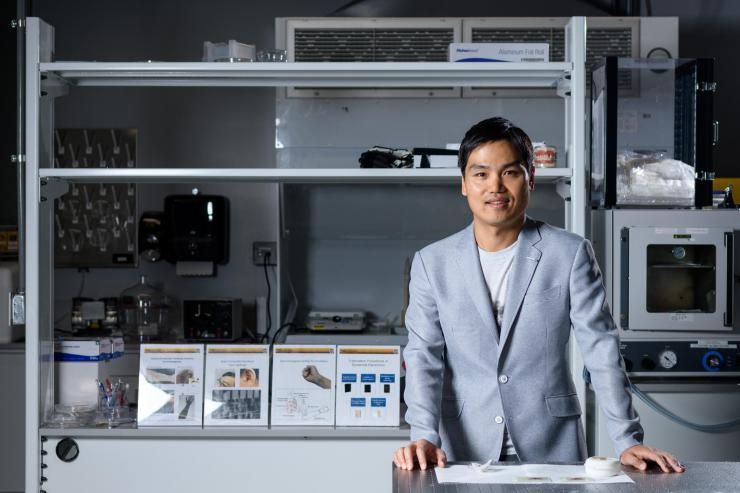
W. Hong Yeo is leading a $3 million NSF research training program to develop a new generation of engineers focused on creating sustainable medical devices.
Georgia Tech researcher W. Hong Yeo has been awarded a $3 million grant to help develop a new generation of engineers and scientists in the field of sustainable medical devices.
“The workforce that will emerge from this program will tackle a global challenge through sustainable innovations in device design and manufacturing,” said Yeo, Harris Saunders Jr. Professor and associate professor in the George W. Woodruff School of Mechanical Engineering and the Wallace H. Coulter Department of Biomedical Engineering at Georgia Tech and Emory University.
The funding, from the National Science Foundation (NSF) Research Training (NRT) program, will address the environmental impacts resulting from the mass production of medical devices, including the increase in material waste and greenhouse gas emissions.
Under Yeo’s leadership, the Georgia Tech team comprises multidisciplinary faculty: Andrés García (bioengineering), HyunJoo Oh (industrial design and interactive computing), Lewis Wheaton (biology), and Josiah Hester (sustainable computing). Together, they’ll train 100 graduate students, including 25 NSF-funded trainees, who will develop reuseable, reliable medical devices for a range of uses.
“We plan to educate students on how to develop medical devices using biocompatible and biodegradable materials and green manufacturing processes using low-cost printing technologies,” said Yeo. “These wearable and implantable devices will enhance disease diagnosis, therapeutics, rehabilitation, and health monitoring.”
Students in the program will be challenged by a comprehensive, multidisciplinary curriculum, with deep dives into bioengineering, public policy, physiology, industrial design, interactive computing, and medicine. And they’ll get real-world experience through collaborations with clinicians and medical product developers, working to create devices that meet the needs of patients and care providers.
The Georgia Tech NRT program aims to attract students from various backgrounds, fostering a diverse, inclusive environment in the classroom — and ultimately in the workforce.
The program will also introduce a new Ph.D. concentration in smart medical devices as part of Georgia Tech's bioengineering program, and a new M.S. program in the sustainable development of medical devices. Yeo also envisions an academic impact that extends beyond the Tech campus.
“Collectively, this NRT program's curriculum, combining methods from multiple domains, will help establish best practices in many higher education institutions for developing reliable and personalized medical devices for healthcare,” he said. “We’d like to broaden students' perspectives, move past the current technology-first mindset, and reflect the needs of patients and healthcare providers through sustainable technological solutions.”
Jerry Grillo
Fostering Industry Innovation: Manufacturing 4.0 Consortium Celebrates First Year of Operation
Aug 29, 2024 —

Manufacturing 4.0 Consortium members gathered at the June quarterly meeting. Photo: Audra Davidson.
Between revitalized investments in America’s manufacturing infrastructure and an increased focus on AI and automation, the U.S. is experiencing a manufacturing renaissance. A key focus of this resurgence lies in improving the resiliency of supply chains in the U.S., particularly in crucial sectors like defense.
“If we were to suddenly have a seismic shift in defense manufacturing needs,” asks Aaron Stebner, professor and Eugene C. Gwaltney Jr. Chair in Manufacturing in the George W. Woodruff School of Mechanical Engineering, “do we have the supply chain and manufacturers who could meet that sudden increase in demand? How do we do that in a way that’s sustainable for long periods of time as a nation if that need arises?”
The Georgia Tech Manufacturing Institute (GTMI) officially launched the Manufacturing 4.0 Consortium in 2023 to address that need. Designed to form a network of engaged manufacturers from across the country, the Consortium serves as a key connection point between Georgia Tech and industry partners — and as fertile ground for collaborative innovation.
“By bringing us all together,” says Stebner, who serves on the board of the Consortium, “we can do bigger, more meaningful things and find unique ways and opportunities to get money flowing back to the companies and Georgia Tech.”
With over 25 founding company members, the Consortium celebrated its first official year of operation in August.
Creating a Resilient Network
The Manufacturing 4.0 Consortium originally grew out of an 18-month pilot project funded by the Department of Defense Office of Local Community Cooperation aiming to increase defense supply chain resilience, assist Georgia manufacturers in adopting new technologies, and foster collaboration by connecting manufacturers across Georgia.
Those goals and more are tackled by the Consortium’s focus on “networking, engagement, and collaboration,” says Stebner. “It's not just a consortium for Georgia Tech to take money from industry and do stuff with their money — the goal is to create new resources that enable us to collaborate in bigger ways than we could otherwise.”
To join the Consortium, industry members pay up to $10,000 annually to access its network, intellectual property, and facilities. With a 10% membership discount for Georgia businesses and a 75% discount for small businesses, the Consortium especially aims to promote growth for small Georgia manufacturers.
“Memberships come with time at the Advanced Manufacturing Pilot Facility, which we’re expanding to be this test bed for autonomous maturation of research and development,” says Stebner. “The fact that we have what’s going to be an almost $60 million facility behind us as a mechanism and a playground for all these companies is unique.”
“Having a shared use facility that is fully equipped to solve manufacturing’s most interesting challenges is not only a perk of Consortium memberships,” said Executive Director Steven Ferguson, “but it also serves as a hub for innovation in manufacturing.”
Industry Innovation
Many consortiums founded by academic institutions are primarily focused on academic research.
“The Manufacturing 4.0 consortium has an industry focus,” said Branden Kappes, founder and president of Consortium member company Contextualize LLC. “It's more about how we take this capability that, at the moment, is trapped in a lab and transition from a wonderful concept into a wonderful product.”
The Consortium achieves that translation through shared intellectual property agreements, collaborative research initiatives, and an emphasis on creating an engaged and open network of members.
“I see camaraderie inside the Manufacturing 4.0 Consortium,” says Kappes. “I see companies that overlap and compete in some areas, are complementary in others, and are willing to build a bridge to advance the capabilities of both sides and the community as a whole. That type of mentality is very exciting.”
“This is one of the most highly engaged groups I have interacted with in a professional setting,” said John Flynn, vice president of Sales at Consortium member company Endeavor 3D. “It is an incredibly dynamic melting pot of all the different facets of industry 4.0 and digital manufacturing, bringing everyone together from that part of the supply chain to create what I know will be important and value-added projects, ultimately resulting in intellectual property.”
“We are able to connect Consortium members with subject matter experts at Georgia Tech and within the Consortium who have ‘been there and done that,’” said Ferguson. “At the same time, we are working with manufacturers to create novel solutions to complex problems through research engagements. Blending all of those activities into one organization is part of the magic that is the Consortium.”
Audra Davidson
Communications Manager
Georgia Tech Manufacturing Institute
The Mathematics of Connection: Cheng Mao awarded CAREER Grant for Unraveling Information Hidden in Networks
Aug 28, 2024 —

Photo by Clint Adair, Unsplash
Networks can be found everywhere: in our daily social exchanges, the food webs that connect every living thing on Earth, and the interactions between proteins in the living body. From the global scale to the cellular level, they are a way of mapping and understanding the interactions within and between systems.
While many connections are immediately apparent in a network, these systems also contain a large amount of hidden information. For example, a social network might connect the last 15 people you interacted with, but hidden in that network could be information about age, ethnicity, location, and more.
“When scientists are given a network, their interest is typically to extract some information or structure hidden in the network,” Cheng Mao, an assistant professor in the School of Mathematics, explains.
To do so, scientists engage in network analysis, leveraging mathematics and statistics. Now, a new $450,000 NSF CAREER grant will help Mao research and develop new mathematical methods and models to facilitate this work.
The National Science Foundation Faculty Early Career Development Award is a five-year grant designed to help promising researchers establish a foundation for a lifetime of leadership in their field. Known as CAREER awards, the grants are NSF’s most prestigious funding for untenured assistant professors.
The award, for “Statistical Inference on Random Graphs and Hypergraphs: Geometry, Combinatorics, and Computation” will also support Mao as he integrates the research into his teaching, with an emphasis on supporting students from diverse backgrounds. “I taught a topics course on Statistical Inference on Random Graphs at Georgia Tech and look forward to further developing the course,” he adds. “I aim to expand the lecture notes into a long-form text that can be used by students and junior researchers interested in this area.”
Reading between the lines
“Statistics are playing an increasingly significant role in network analysis by providing a toolbox for extracting information from noisy network data.” Mao explains. “This project aims to develop statistical models and computational methods for uncovering such hidden information so that we can make sense of large complex networks.”
Imagine a network of researchers, where each person is represented as a dot on a page — a node on a graph, in mathematical terms. Every researcher who has co-authored a paper might be connected with a line, creating a web, or network of collaborators. And while this graph does immediately convey some information, additional information is hidden within it.
“What information is hidden in this network?” Mao asks. “One example is the geographic locations of these researchers. Researchers based in the same institution or the same country may collaborate more often, so there may be more links between them in the network.” This is where Mao’s research comes in.
Using tools from statistics and information theory, Mao aims to leverage mathematical models to characterize these connections in order to decode them — and reveal information that might not be immediately available. “This part of research is closely connected to the areas of theoretical computer science and machine learning, where a major task is to develop fast algorithms and then rigorously analyze their performance,” he explains.
Mathematics, and beyond
Mao underscores the intersectionality of his research: networks are studied by economists and ecologists, psychologists, and mathematicians. “It is common that researchers in different scientific and engineering fields study a similar problem but develop their own ways to solve it,” he says, adding that “we aim to widely disseminate the research results to statisticians, computer scientists, and any researchers who study or use network analysis.” He hopes the research can facilitate the analysis of social and biological networks, leading to discoveries and innovations across many fields.
In turn, these real-word applications could lead to theoretical breakthroughs on the mathematical side of things. “While mathematical research can evolve on its own, real-world problems can also provide guidance for developing theoretical mathematics,” Mao explains. “So our goal is to make this research impactful for everyone — both theorists and practitioners.”
School of Physics Assistant Professor Zeb Rocklin has also been awarded a CAREER grant for his research on flexible metamaterials and deformable solids. Read “Smart Solids: Zeb Rocklin Awarded NSF CAREER for Flexible Metamaterials Research” to learn more.
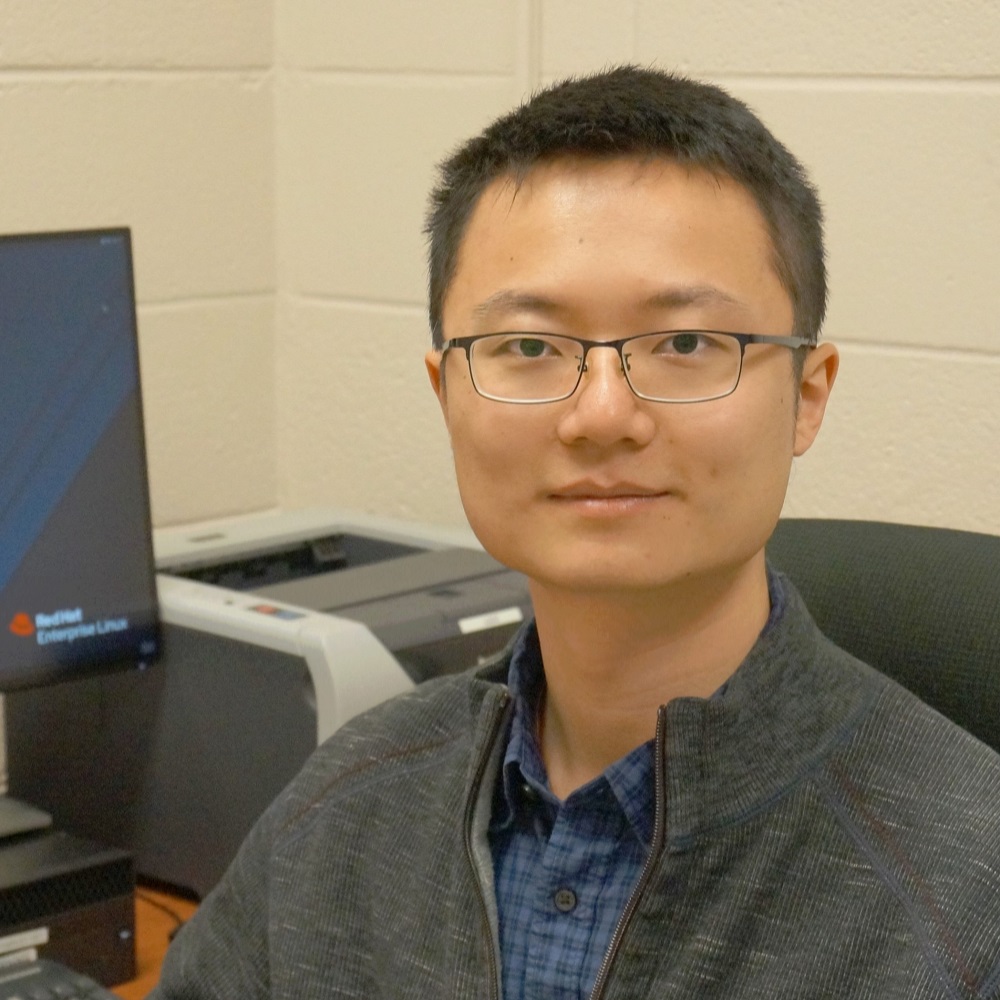
Cheng Mao
Written by Selena Langner
NSF Awards $2M to Clark Atlanta University in Collaboration With the HBCU CHIPS Network
Aug 28, 2024 —

The National Science Foundation has awarded $2 million to Clark Atlanta University in partnership with the HBCU CHIPS Network, a collaborative effort involving historically black colleges and universities (HBCUs), government agencies, academia, and industry that will serve as a national resource for semiconductor research and education.
“This is an exciting time for the HBCU CHIPS Network,” said George White, senior director for Strategic Partnerships at Georgia Tech. “This funding, and the support of Georgia Tech Executive Vice President for Research Chaouki Abdallah, is integral for the successful launch of the CHIPS Network.”
The HBCU Chips Network works to cultivate a diverse and skilled workforce that supports the national semiconductor industry. The student research and internship opportunities along with the development of specialized curricula in semiconductor design, fabrication, and related fields will expand the microelectronics workforce. As part of the network, Georgia Tech will optimize the packaging of chips into systems.
Georgia Tech Contact:
Amelia Neumeister | Research Communications Program Manager
Clark Atlanta University Contact:
Frances Williams