Tim Lieuwen: Shaping the Future of Research at Georgia Tech
Lieuwen enters the role of interim EVPR with plans to focus on research security and operational excellence and to strengthen the Institute’s ties to Georgia and the Southeast.

We are so excited to announce that RoboJackets will be celebrating our 25th Anniversary this fall. To commemorate 25 years, we will be hosting an event on September 15th at Georgia Tech’s Exhibition Hall. This event will have tournaments from BattleBots and RoboWrestling, along with demos from RoboNav, RoboRacing, and RoboCup.
Please join the Center for European and Transatlantic Studies for a guest lecture with the Foreign Minister of Latvia, Baiba Braže, on challenges the West must address in the face of Russian military aggression. Minister Braže has previously served as the NATO Assistant Secretary General for Public Diplomacy and as the Ambassador of Latvia to the United Kingdom.
Co-sponsored by the Atlanta Council on International Relations.
Speaker: Sarah Fox, Assistant Professor at Carnegie Mellon University in the Human Computer Interaction Institute
Speaker: Cheng Zhang, Ph.D.
Assistant Professor in Information Science and Computer Science
Cornell University

President Ángel Cabrera has convened a search committee, chaired by College of Sciences Dean Susan Lozier, charged with selecting Georgia Tech’s next executive vice president for research (EVPR). To assist with the process, the Institute has retained the services of executive search firm WittKieffer.
“I thank all the members of the search committee and committee chair Dean Lozier, for conducting a thorough search to identify our next executive vice president for research,” said President Cabrera. “As one of the nation’s foremost academic research institutions, Georgia Tech is looking for a leader who can sustain the growth of our research enterprise, build the infrastructure necessary to support it, and deliver on our mission to advance technology and improve the human condition.”
WittKieffer will host several town halls to gather input from the Georgia Tech community on the preferred qualifications of the next EVPR.
Community Engagement Schedule
Georgia Tech Staff Town Hall
Tuesday, September 10 at 10:00 a.m.
Hybrid: Marcus Nanotechnology Building, 345 Ferst Drive, Room 1116 / Register for virtual attendance)
GTRI Town Hall
Tuesday, September 10 at 12:00 p.m.
Virtual only (Details forthcoming for GTRI faculty and staff)
Georgia Tech Faculty Town Hall
Tuesday, September 10 at 2:00 p.m.
Hybrid: Howey Physics L3 Classroom / (Register for virtual attendance)
Open Georgia Tech and GTRI Town Hall
Wednesday, September 11 at 11:00 a.m.
Virtual only (Register online)
Additional Information
Both internal and external candidates are invited to apply. For more details, including the position description and the application process, a list of the search committee members, and the key dates, visit the EVPR search webpage.
Regents’ Professor Tim Lieuwen has been appointed interim EVPR and will serve until the new EVPR is in place.
Shelley Wunder-Smith
Director of Research Communications
shelley.wunder-smith@research.gatech.edu
HackGT 11 🎪 Registration is LIVE! Our 36-hour showstopper hackathon 🎡 will be taking place in-person at Klaus from September 27 – 29th. Juggle new ideas 🤹and take center stage with your tech marvels 💡 at our circus of inventions this fall 🎢! Learn more and claim your hacker passes on our website hack.gt 🎫
REGISTRATION CLOSES SEPTEMBER 9TH 11:59PM
Come join the conversation about climate change and climate policy while enjoying a free lunch! EPA Advisors Anna Benkeser and Zealan Hoover will be giving a talk about climate optimism and answering questions.
Date: Thursday, September 19, 2024
Time: 11 am – noon
Location: Kendeda Building, Room 230
Can't make it in person? Join online through Teams!
Meeting ID: 215 474 858 138
Passcode: fTpMTM
Questions? Reach out to SGA Sustainability Committee Chair, Kriss Ascencio-Parvy, at ksa7@gatech.edu.

A lighted pathway through a sea of clouds.
The Cloud Hub, a key initiative of the Institute for Data Engineering and Science (IDEaS) at Georgia Tech, recently concluded a successful Call for Proposals focused on advancing the field of Generative Artificial Intelligence (GenAI). This initiative, made possible by a generous gift funding from Microsoft, aims to push the boundaries of GenAI research by supporting projects that explore both foundational aspects and innovative applications of this cutting-edge technology.
Call for Proposals: A Gateway to Innovation
Launched in early 2024, the Call for Proposals invited researchers from across Georgia Tech to submit their innovative ideas on GenAI. The scope was broad, encouraging proposals that spanned foundational research, system advancements, and novel applications in various disciplines, including arts, sciences, business, and engineering. A special emphasis was placed on projects that addressed responsible and ethical AI use.
Recognizing Microsoft’s Generous Contribution
This successful initiative was made possible through the generous support of Microsoft, whose contribution of research resources has empowered Georgia Tech researchers to explore new frontiers in GenAI. By providing access to Azure’s advanced tools and services, Microsoft has played a pivotal role in accelerating GenAI research at Georgia Tech, enabling researchers to tackle some of the most pressing challenges and opportunities in this rapidly evolving field.
Looking Ahead: Pioneering the Future of GenAI
The awarded projects, set to commence in Spring 2025, represent a diverse array of research directions, from improving the capabilities of large language models and AI-based systems to innovative applications in data use through interdisciplinary collaborations. These projects are expected to make significant contributions to the body of knowledge in GenAI and are poised to have a lasting impact on the industry and beyond.
IDEaS and the Cloud Hub are committed to supporting these teams as they embark on their research journeys. The outcomes of these projects will be shared through publications and highlighted on the Cloud Hub web portal, ensuring visibility for the groundbreaking work enabled by this initiative.
Congratulations to the Spring 2025 Winners
Christa M. Ernst - Research Communications Program Manager
christa.ernst@research.gatech.edu
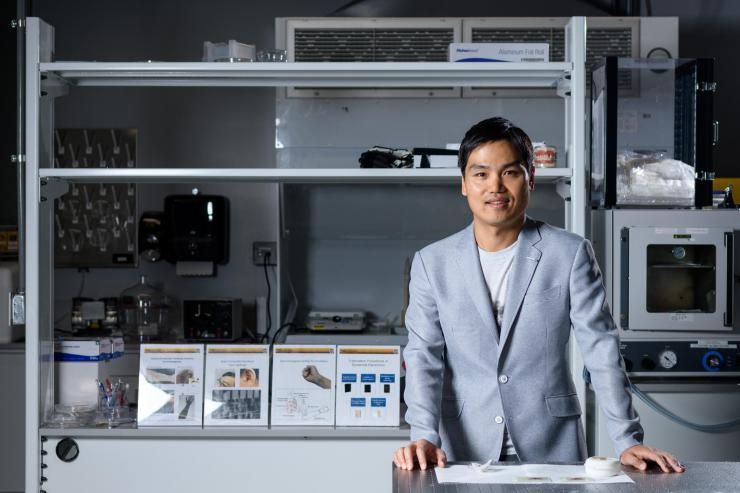
W. Hong Yeo is leading a $3 million NSF research training program to develop a new generation of engineers focused on creating sustainable medical devices.
Georgia Tech researcher W. Hong Yeo has been awarded a $3 million grant to help develop a new generation of engineers and scientists in the field of sustainable medical devices.
“The workforce that will emerge from this program will tackle a global challenge through sustainable innovations in device design and manufacturing,” said Yeo, Harris Saunders Jr. Professor and associate professor in the George W. Woodruff School of Mechanical Engineering and the Wallace H. Coulter Department of Biomedical Engineering at Georgia Tech and Emory University.
The funding, from the National Science Foundation (NSF) Research Training (NRT) program, will address the environmental impacts resulting from the mass production of medical devices, including the increase in material waste and greenhouse gas emissions.
Under Yeo’s leadership, the Georgia Tech team comprises multidisciplinary faculty: Andrés García (bioengineering), HyunJoo Oh (industrial design and interactive computing), Lewis Wheaton (biology), and Josiah Hester (sustainable computing). Together, they’ll train 100 graduate students, including 25 NSF-funded trainees, who will develop reuseable, reliable medical devices for a range of uses.
“We plan to educate students on how to develop medical devices using biocompatible and biodegradable materials and green manufacturing processes using low-cost printing technologies,” said Yeo. “These wearable and implantable devices will enhance disease diagnosis, therapeutics, rehabilitation, and health monitoring.”
Students in the program will be challenged by a comprehensive, multidisciplinary curriculum, with deep dives into bioengineering, public policy, physiology, industrial design, interactive computing, and medicine. And they’ll get real-world experience through collaborations with clinicians and medical product developers, working to create devices that meet the needs of patients and care providers.
The Georgia Tech NRT program aims to attract students from various backgrounds, fostering a diverse, inclusive environment in the classroom — and ultimately in the workforce.
The program will also introduce a new Ph.D. concentration in smart medical devices as part of Georgia Tech's bioengineering program, and a new M.S. program in the sustainable development of medical devices. Yeo also envisions an academic impact that extends beyond the Tech campus.
“Collectively, this NRT program's curriculum, combining methods from multiple domains, will help establish best practices in many higher education institutions for developing reliable and personalized medical devices for healthcare,” he said. “We’d like to broaden students' perspectives, move past the current technology-first mindset, and reflect the needs of patients and healthcare providers through sustainable technological solutions.”
Jerry Grillo