
Georgia Tech and The Carter Center Award Joint Fellowships Leveraging Technologies to Support Sustainable Peace and Democratic Principles
Oct 11, 2024 — Atlanta

New Carter Center Fellows Muzna Raheel and Delaney Gomen pictured (left-to-right).
ATLANTA (Oct. 10, 2024) — The Georgia Institute of Technology today announced the recipients of fellowships in which students will collaborate with The Carter Center during the fall 2024 academic semester.
Delaney Gomen received the second Governance and Technology Fellowship to work with the Carter Center’s Democracy Program. Muzna Raheel was awarded the first Peace Tech Fellowship and will partner with the Center’s Conflict Resolution Program.
Gomen’s research interests include democracy and technology, election administration, surveillance, censorship, and digital security education. She is pursuing a Master of Science in computer science at Georgia Tech. Gomen is also serving as a researcher for Assistant Professor Michael Specter, who has a joint appointment in computer science and cybersecurity and privacy. Gomen’s fellowship is funded jointly by the Carter Center’s Democracy Program and Georgia Tech’s Institute for People and Technology.
Raheel’s research interests focus on Middle East conflicts, specifically major causes, players, and conflict dynamics and utilizing data analysis and geographic information systems (GIS) to map conflict zones, humanitarian interventions, and peacekeeping operations. She is pursuing a Master of Science in global development at Georgia Tech. Her fellowship is funded jointly by the Center’s Conflict Resolution Program and Georgia Tech’s Sam Nunn School of International Affairs.
These research fellowships build on the long-term and ongoing collaboration between Georgia Tech and The Carter Center.
###
Contact: In Atlanta, Maria Cartaya, maria.cartaya@cartercenter.org
The Carter Center
Waging Peace. Fighting Disease. Building Hope.
A not-for-profit, nongovernmental organization, The Carter Center has helped to improve life for people in over 80 countries by resolving conflicts; advancing democracy, human rights, and economic opportunity; preventing diseases; and improving mental health care. The Carter Center was founded in 1982 by former U.S. President Jimmy Carter and former First Lady Rosalynn Carter, in partnership with Emory University, to advance peace and health worldwide.
Visit our website CarterCenter.org | Follow us on X @CarterCenter | Follow us on Instagram @thecartercenter | Like us on Facebook Facebook.com/CarterCenter | Watch us on YouTube YouTube.com/CarterCenter
About the Georgia Institute of Technology
The Georgia Institute of Technology, or Georgia Tech, is one of the top public research universities in the U.S., developing leaders who advance technology and improve the human condition. The Institute offers business, computing, design, engineering, liberal arts, and sciences degrees. Its more than 47,000 undergraduate and graduate students, representing 50 states and more than 148 countries, study at the main campus in Atlanta, at campuses in Europe and Asia, and through distance and online learning. As a leading technological university, Georgia Tech is an engine of economic development for Georgia, the Southeast, and the nation, conducting more than $1.2 billion in research annually for government, industry, and society.
Contact: Walter Rich, walter.rich@research.gatech.edu
Walter Rich
2024 Sustainability Next Seed Grant Awards
Oct 09, 2024 —

The latest Sustainability Next Research Seed grants have been awarded. The seed grant program is administered by BBISS in collaboration with the Renewable Bioproducts Institute (RBI), the Strategic Energy Institute (SEI), and the Institute for People and Technology (IPaT). The program nurtures promising areas for future large-scale collaborative sustainability research, research translation, and high-impact outreach; provides mid-career faculty with leadership and community-building opportunities; and broadens and strengthens the Georgia Tech sustainability community as a whole.
The call for proposals was modeled after the Office of the Executive Vice President for Research’s (EVPR) “Moving Teams Forward” and “Forming Teams” programs. All told, the work of 49 researchers — from 19 Schools in five Colleges, the Georgia Tech Research Institute (GTRI), and external partners and research professionals from several of Georgia Tech’s Interdisciplinary Research Institutes (IRIs) — will benefit from these grants.
Moving Teams Forward
- Toward a Center on Effective Climate Communication; Bruce Walker (Psych), Susan Lozier (EAS), Claire Arthur (Music), Jessica Roberts (IC), Carrie Bruce (IC), Amy Bower (Woods Hole Oceanographic Inst).
- Moving Teams Forward to Building a Path Toward Community-Owned Resilience Hubs for Ethical Climate Adaptation and Mitigation: An Interdisciplinary and Community-Engaged Approach; Sofia Perez-Guzman (CEE), Allen Hyde (Hist&Soc), Danielle Willkens (Arch), Alexander Robel (EAS), Jennifer Hirsch (SCoRE), Valerie Thomas (ISYE), Joe Bozeman (CEE), Nicole Kennard (BBISS), Jung-Ho Lewe (AE).
- A Digital Twin for Atlanta: Toward a Building Energy Demand/Mobility Nexus; Patrick Kastner (Arch).
- Sustainable Development in Africa: Cropland Expansion, Fire, Climate Change, and Economic Solutions; Yuhang Wang (EAS), Olga Shemyakina (Econ), Kexin Rong (CS).
- Interdisciplinary Program in Transportation; Adjo Amekudzi-Kennedy (CEE), Alexander Robel (EAS), Christopher Wiese (Psych), Kurt Wiesenfeld (Physics), Nimisha Roy (Comp Inst).
- Enabling Disadvantaged Communities to Baseline the Performance of Residential Energy Systems; Jung-Ho Lewe (AE), Scott Duncan (AE), David Solano (AE).
Forming Teams
- Identifying and Amplifying Georgia Tech’s Research Strengths in Conserving Georgia’s Biodiversity in the Face of Rapid Global Change; Jenny McGuire (Biol/EAS), James Stroud (Biol), Emily Weigel (Biol), Lauren Speare (Biol), Saad Bhamla (ChBE), Matthew Swarts (GTRI), Allen Hyde (Hist&Soc), Jennifer Hirsch (SCoRE).
- UrbAdapt CA4: Urban Climate Adaptation for Indigenous Households in Guatemala Alberto Fuentes (INTA), Gregory Randolph (City Planning), Joshua Ayers (City Planning),Erick Calderón (World Vision Intl), Sara Sywulka (World Vision Intl).
- Mitigating the Risk of Life-Threatening Power Outages During Extreme Weather; Constance Crozier (ISYE), (Brian) Yeokwang An (Pub Policy), Hiba Baroud (Vanderbilt).
- A Sustainability Data Dashboard for the GT Library Media Bridge, Yanni Loukissas (LMC), Emily Weigel (Biol), Alison Valk (Library), Jason Wright (Library), Charles Bennett (Library), Atlas Coltrain (LMC) (Co-funded by IPaT & BBISS).
Joint Initiative
- Modeling the Dispersal and Connectivity of Marine Larvae With GenAI Agents; Annalisa Bracco (EAS), Jacob Abernethy (CS), Xing Zhou (EAS), Renzhi Wu (CS), Guanghui Wang (CS) (Co-funded by IDeAS & BBISS).
Brent Verrill, Communications Research Program Manager, BBISS
Deadline for Submitting Proposals for 2025 STEAM Leadership Conference
Focusing on our different strengths, we hope to foster curiosity, build upon inquiry-based learning, and cultivate a culture of lifelong learning and innovation. Through collaboration, partnership, and shared knowledge, we seek to empower educators, researchers, students, and community stakeholders to drive positive change in education and research.
Neuro Next Grad Gathering
Join the Neuro Next Initiative for lunch!
Connect with other graduate students across campus interested in neuroscience, neurotechnology, and society. Expand your network, learn more about the Initiative, and explore opportunities in the forthcoming IRI.
Mothbox: Open-Source Science Tools and Conservation
A Keynote Lecture by Andrew Quitmeyer, Ph.D.
Location: TSRB Auditorium, Georgia Tech, Atlanta
Dates: 29th October 3PM 2024
Reframing Climate Data: Situating Data in Histories in Place
Speaker: Heidi Biggs, Assistant Professor, School of Literature, Media, and Communication at Georgia Tech
Cancelled: Art and Design: Incorporating Artistic Practice into Design and Technology
* LECTURE CANCELLED due to weather forecast
SPEAKER: Lisa Marks, Assistant Professor of Industrial Design at Georgia Tech
Wearables for Health Equity Workshop
Sep 17, 2024 — Atlanta
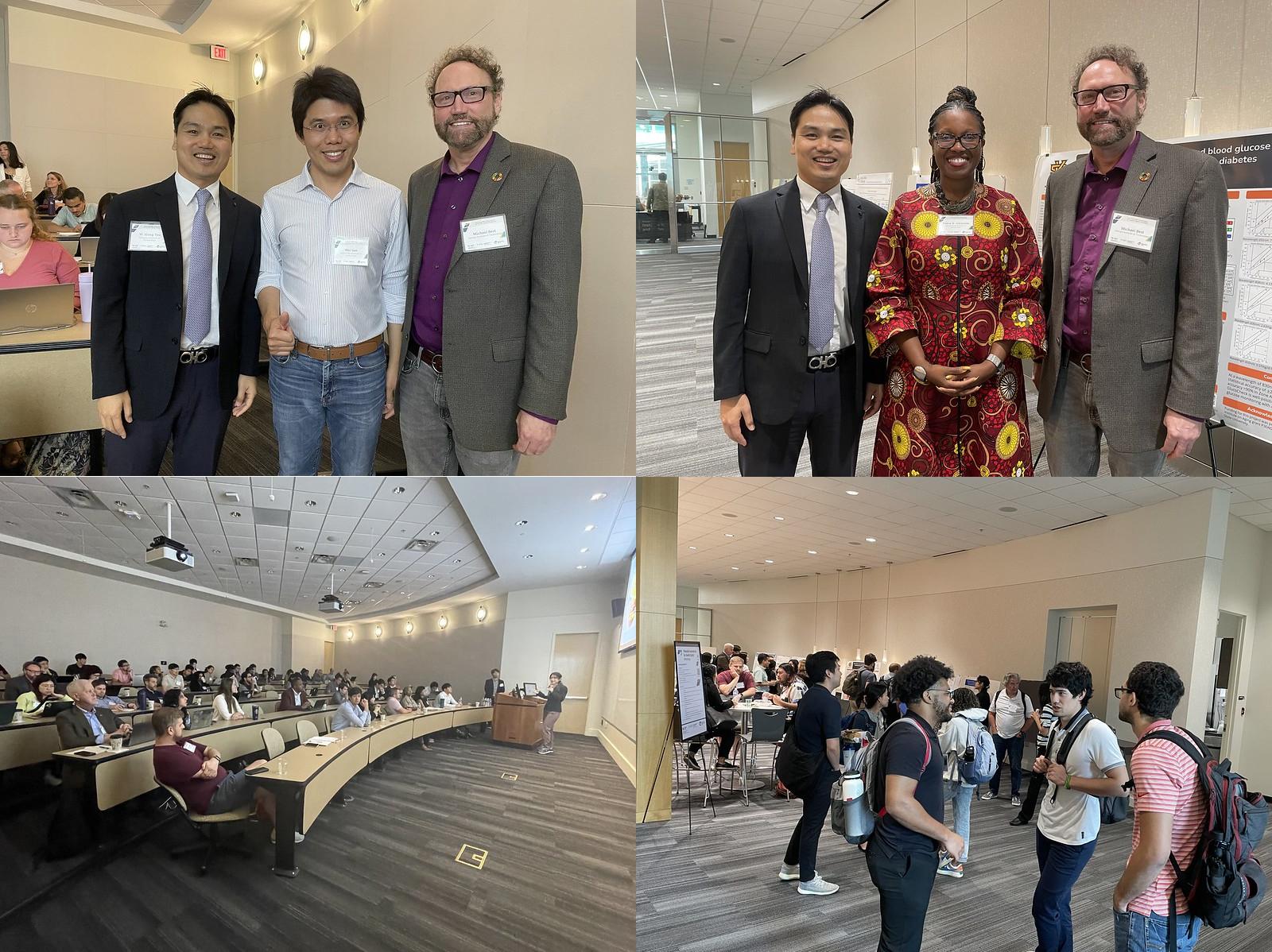
Wearable Innovations for Health Equity Workshop. Pictured clockwise: W. Hong Yeo, director of the Wearable Intelligent Systems and Healthcare Center at Georgia Tech; Wei Gao, professor at CalTech; Michael Best, executive director of IPaT; Tabia Henry Akintobi, professor at the Morehouse School of Medicine; poster sessions; and lightning talks.
The inaugural Wearable Innovations for Health Equity Workshop held on September 10, 2024 at Georgia Tech delivered a variety of new knowledge, insight, and exceptional networking opportunities.
The workshop was jointly sponsored by Georgia Tech’s Wearable Intelligent Systems and Healthcare Center, the Institute for People and Technology, the Emory Global Diabetes Research Center, and the Georgia Center for Diabetes Translation Research. The aim of the event was to raise awareness and discuss the transformative impact of wearable technologies in promoting wellness and increasing equitable health outcomes.
Attendees at the event included health practitioners, researchers, engineers, and patients who shared experiences using some of the latest wearable health devices. Workshop participants came from Georgia Tech, Emory University, Georgia State University, Morehouse School of Medicine, Children’s Healthcare of Atlanta, and the University of Georgia.
Keynote speaker Wei Gao, a professor of medical engineering from the California Institute of Technology, shared some of his latest wearable health technologies combining his chemical engineering background with the latest biochemical sensor technologies being developed in his lab at CalTech.
The second keynote speaker, Tabia Henry Akintobi, professor and chair of community health and preventive medicine at the Morehouse School of Medicine, delivered a detailed overview of her prevention research center program, community health statistics, and touched on health outcomes for different racial and ethnic groups including those with disabilities. She stressed the path forward for wearable health devices included expansion of access to data, approaching technology access through a community-driven social marketing plan, and better representativeness of diverse populations in wearable innovations research.
Poster sessions, panel discussions, and researcher lightning talks were held between the keynote speaker presentations with the event concluding with a reception and networking session at the end of the day.
Agenda and details for the event (archived).
Walter Rich
Tech Talks Business Featuring Jean Marie Richardson, Founder and CEO of iFOLIO
Georgia Tech is proud to partner with the Atlanta Mayor’s Office to host Avant South on Monday, October 7, 2024. This year's event features several tracks showcasing the latest innovations in sports, media, arts, entertainment, and entrepreneurship.
Master of Science in Global Development Information Session and Q&A
Meet faculty Dr. Alberto Fuentes and Dr. Bruce Stiftel and Ms. Anna Traykova, program coordinator, to learn more about the Global Development program and have your questions answered.
Registration Link