
The Sociotechnical Stack: Opportunities for Combatting Non-Consensual Interactions
Speaker: Sarita Schoenebeck is a Professor in the School of Information at the University of Michigan
Staff Spotlight: Supporting Global University Connections
Aug 29, 2024 — Atlanta

Faith Sumpter, program and operations manager for the Institute for People and Technology at Georgia Tech.
Faith Sumpter, program and operations manager for the Institute for People and Technology (IPaT) at Georgia Tech, is currently managing logistics for IPaT’s Convergence Innovation Competition (CIC) in Asia under the leadership of IPaT’s Executive Director Michael Best.
CIC was founded in 2007 by the Institute for People and Technology (IPaT). This year, the Asian CIC competition is co-supported by the Shenzhen Georgia Tech Education Foundation, an independent fund in support of Georgia Tech. The competition recognizes student innovation and entrepreneurship with a focus on global challenges and opportunities. Many projects are linked to United Nations sustainable development goals.
Sumpter is coordinating with eight new Asia faculty fellows recruited from IPaT’s strategic partners and anchor universities across Asia. These faculty fellows are experts in their field who have agreed to give advice and mentorship to interested student teams participating in CIC.
In addition to supporting CIC, she manages IPaT’s lending library allowing a wide range of technology to be used by faculty and students. Devices that can be checked out include: phones, tablets, and other mobile and wearable devices; Arduinos, Raspberry Pi’s and other IoT development kits; a variety of sensors; cameras and media capture devices; virtual machines and databases, home automation hubs and sensors; and a wide range of networking equipment.
She previously worked for the University of North Carolina in Ashville, Agnes Scott College, and Chattahoochee Technical College. Sumpter is currently a second-year doctoral student at the University of North Georgia in the higher education, leadership and practice program. Travelling the globe is one of her biggest hobbies and she’s planning to visit Panama and Mexico soon.
Collaborative Approaches to Haptics and Soft Robotics Research
Rural Georgia High Schools Computer Science Program Reaches New Heights
Aug 28, 2024 —
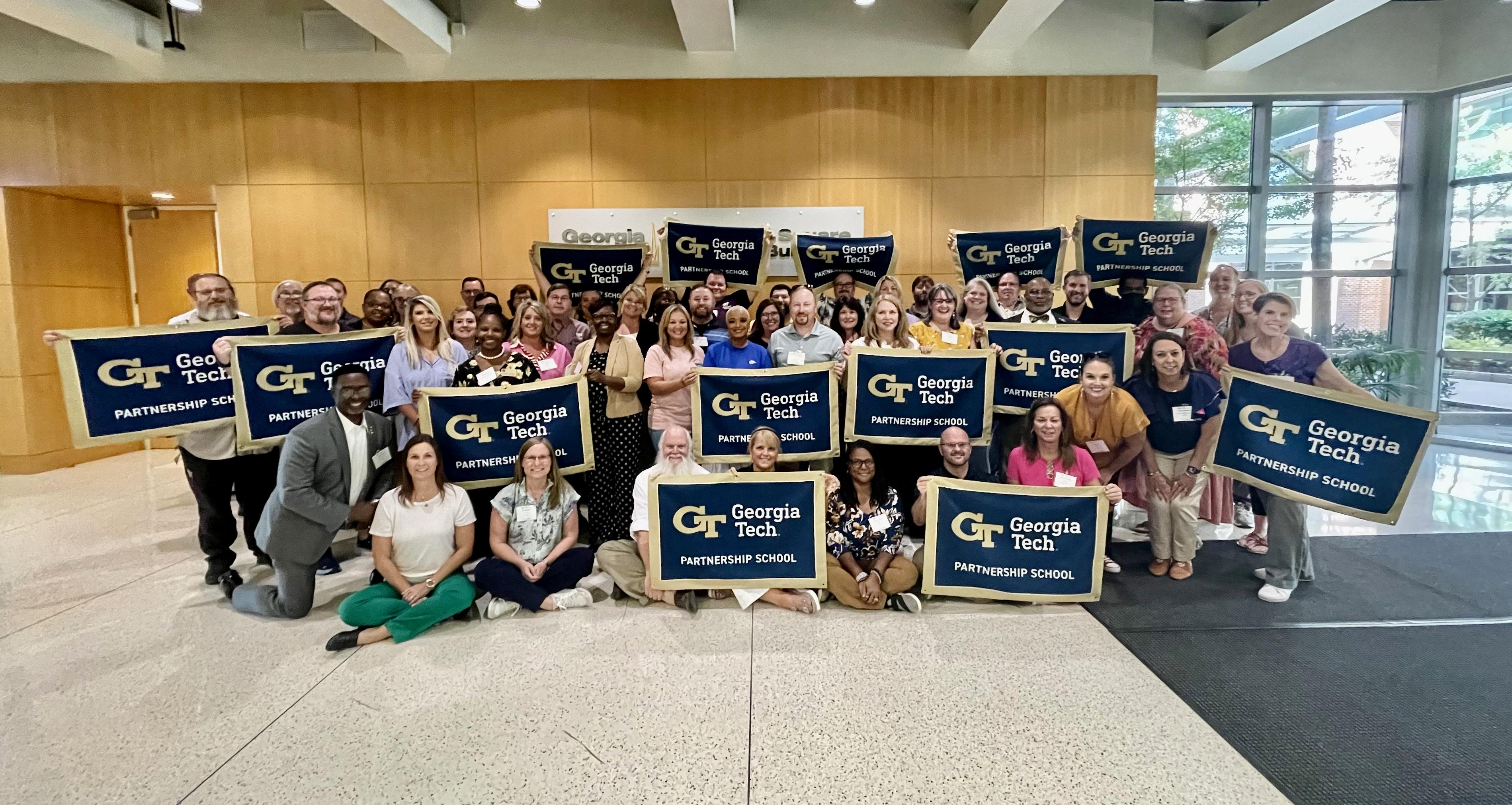
Rural high school computer science teachers meet on the Georgia Tech campus
The Georgia Tech-led Computer Science for Rural Georgia High Schools Program recently received additional financial support from the Georgia General Assembly for 2024-25. The program has exploded with unprecedented growth over the last year, going from 800 student participants to 4,400. Participating high school teachers across Georgia met at Georgia Tech Aug. 26 – 27 to share ideas and best practices going into the new school year.
Launched with funding from the state legislature in 2022, the program was developed collaboratively by Georgia Tech’s Center for Education Integrating Science, Mathematics, and Computing (CEISMC) and STEM@GTRI, Georgia Tech Research Institute’s K-12 outreach program.
It focuses on developing coding, music, artificial intelligence, and cybersecurity skills in high school students in rural parts of the state. During its pilot year, the program served 11 schools in eight school districts in Bartow, Chattooga, Effingham, Fayette, Gordon, Haralson, Liberty, and Walker counties.
Today, it serves 39 schools and 24 school districts: Candler, Catoosa, Chattahoochee, Clinch, Decatur, Dooly, Fannin, Grady, Hancock, Houston, Jeff Davis, Jones, Laurens, Lumpkin, Macon, Oglethorpe, Peach, Screven, Stephens, Tattnall, Thomas, Treutlen, and Twiggs counties.
Modules taught to students include introduction to coding, advanced coding, principles of cybersecurity, foundations of AI, introduction to robotics, intermediate coding, intermediate robotics, sensors and data science, website design, sensors, and data science.
“This rural computer science initiative has been transformative for Twiggs County schools,” said Mack Bullard, school superintendent. “We find it very difficult to find computer science teachers who are willing to come to rural Georgia to teach.”
He called partnering with Georgia Tech professors “transformative for our school system. Experiences like robotics and coding in class have excited our kids now that they've been able to see what's possible. From our collaborations with other teachers in this program, I can see future student projects in Twiggs County related to agriculture, such as the building and programming of probes. This computer science program has been phenomenal.”
Science and Engineering Day Buzzes with Excitement
Mar 13, 2023 —

A young participant that is experiencing virtual reality for the first time at Georgia Tech
More than 1,500 parents and children across the Atlanta metropolitan area attended a jam-packed second annual Georgia Tech Science and Engineering Day held on Saturday, March 11 in conjunction with the tenth annual 2023 Atlanta Science Festival. Located across five campus buildings, more than 40 demonstrations, hands-on STEAM activities, tours, and learning opportunities designed to engage and educate participants were offered by students, staff, and faculty volunteers.
Some of this year’s demonstration topics included battery fuel cells, nanotechnology, DNA, immunoengineering, chemistry, engineering, superconductivity levitation, wastewater treatment, aerospace, space outreach, virtual reality, biology, robotics, computing, 3D printing, paper making, and much more.
A parent attending from Peachtree City said, “we’ve discovered our son has an affinity for math and science. He’s handling tenth grade science level coursework, yet he’s only in the seventh grade and can understand math formulas ahead of his age group. We brought him here to expose him to a variety of technologies and advanced equipment that he won’t see or be exposed to in his middle school. The staff and professors here have been very kind to show him how to use some of the equipment we’ve seen. And his eyes have gotten bigger all day because of these interactions.”
Virginia Howell, director of the Roberts C. Williams Museum of Paper Making in the Renewable Bioproducts Institute at Georgia Tech said, “the paper museum is delighted to be part of the Georgia Tech Science and Engineering Day. It's a great opportunity for people to learn more about the paper museum and get hands-on experience in making a sheet of paper to take home. We offer workshops, classes, and tours to students across the state of Georgia. Kids have been lined up all day to participate at our tables today.”
Demonstrations included how to extract DNA, seeing LIDAR in action, experiencing heat sensing sensors, how x-rays are used, viewing scanning electron microscopes, playing a virtual reality game, experiencing chemical reactions, watching 3D printing, making slime, showing atom-level nano materials in synthesized materials, neuroscience demos, liquid nitrogen experiments, and many more.
Presentation areas were hosted by the Institute for Electronics and Nanotechnology, the Institute for Robotics and Intelligent Machines, and the Institute for Bioengineering and Biosciences who provided valuable space in their buildings to house demonstrations. The Ford Environmental Science & Technology Building and Molecular Science & Engineering Building also donated space for demonstrations.
Another tour offering during Science and Engineering Day was the Flowers Invention Studio at Georgia Tech which offers more than 5,000 square feet of industrial makerspace equipment.
“We are the largest student-run maker space in the nation,” said Lillian Tso, president of the Invention Studio and a fourth-year mechanical engineering student. “We house industrial grade equipment for prototyping and manufacturing—we support anything that students want to build. We're open for all students of all majors of all years. They can use our equipment for free which includes CNC machines, more than 50 3D printers, waterjets, laser cutters, and many other professional-level tools. This is our first year participating in the Georgia Tech Science and Engineering Day. We wanted to do a lot more outreach to the Georgia Tech campus and the greater Atlanta community."
Lucas Garza, president-elect of the Invention Studio, added, “we’ve had a busy day offering tours of our studio throughout the festival.”
Located in the mezzanine of the Marcus Nanotechnology Building, Ethan Sirak, a fourth-year aerospace student with the Georgia Space Grant Consortium, was providing kids with exposure to space facts and allowing them to perform crafts related to planets and space. The consortium is an organization under NASA which aims to promote STEM exposure to kids of all ages. He also assists with the Aerospace Engineering Outreach Program. He was partnered at his hands-on learning table with Bill McNutt Jr., a senior aerospace engineering student.
A young participant from Suwanee, Georgia, said, “I want to go to school at Georgia Tech because of aerospace engineering. I want to go on good adventures in future space flight and design things.”
His mom, a sixth-grade science teacher added, “I love coming to science fairs to get new ideas for my students and I love to bring my family because we just have a great time. This is our very first science fair here at Georgia Tech. We've been to ones in north Georgia because that's pretty close to where we live. But when we saw this was available, we're like, yeah, we're coming down to Tech for this today—and having a great time.”
While attendees were able to get a peek into one of the nation’s most research-intensive universities, the event also allowed the many researchers and students participating the opportunity to share their science and engineering work with the public.
One of the more unique tables was manned by Alison Reynolds, an instruction archivist with research services in the Georgia Tech library. She was displaying a selection of unique items from Georgia Tech’s science fiction archives and special collections. She said, “we’ve been teaching with science fiction since 1971 and our collection is now one of the largest science fiction collections in the United States. We wanted to display part of our special collection.”
“I had several Georgia school systems reach out to me that were interested in attending this event,“ said Leslie O 'Neill, education outreach manager with the Southeastern Nanotechnology Infrastructure Corridor (SENIC) at Georgia Tech. “Georgia Tech plays a vital part in its community. We wanted to showcase the campus; the student, faculty and staff research; and the amazing science and engineering being done. We’ve had a fantastic turnout this year for this event.”
Walter Rich
Industry Innovation Day Features Brain and Technology
Apr 24, 2023 —

Meta Lab's Thomas Reardon (pictured on screen) and Chris Rozell, professor and Julian T. Hightower Chair in the School of Electrical and Computer Engineering
More than 150 people attended Industry Innovation Day and the GVU Spring Research Showcase on April 19 held at the Technology Square Research Building conference center on the Georgia Tech campus. This year’s event centered around the brain and neuro-related technologies, and touched on topics ranging from brain computer interaction, cognitive aids, psychology, the future of work, artificial intelligence and various other topics that surfaced due to audience questions. The event was sponsored by the Georgia Tech Institute of People and Technology (IPaT) and the Georgia Tech Neuro community.
The keynote speaker this year was Thomas Reardon, vice president and head of neural interfaces at Meta Reality Labs. Reardon is a highly regarded neuroscientist and entrepreneur who founded CTRL-labs which was acquired by Meta (Facebook) in 2019. He currently leads a team of computational neuroscientists and biotech engineers working to connect neurons to machines via a novel non-invasive neural interface technology. Reardon’s talk topic for this year’s annual Industry Innovation Day was “Consumer Neural Interfaces: View from Meta Reality Labs.” In addition to providing an informative lecture about neural technology, he briefly displayed some of the capabilities of his Meta team’s wrist-mounted, non-invasive device that was able to translate neuro hand activity into its corresponding robotic hand movements.
“Our undergraduate degree in neuroscience is one of the Institute’s most popular degrees,” said Julia Kubanek, vice president for interdisciplinary research at Georgia Tech, who gave several introductory remarks. “The neuroscience area integrates many disciplines across campus such as the arts, humanities, social science, computer science, engineering, business, design, and the basic sciences and is a great example of the true integration of interdisciplinary research in many forms across Georgia Tech. We are particularly grateful for the participation today of companies and other organizations that collaborate with the Georgia Tech community of researchers.”
Leigh McCook, interim executive director of IPaT, emphasized the need to have dialogue and conversations between industry partners and community partners with Georgia Tech researchers to develop supportive research projects and create greater impact in the area of the human technology frontier.
“The neuro space and the IPaT space are natural partners for each other,” said Chris Rozell, professor and Julian T. Hightower Chair in the School of Electrical and Computer Engineering. “This is a perfect day to come together and talk about what the human frontier looks like. Georgia Tech hired its first neuro engineer more than 30 years ago long before it was cool to be an engineer studying neuro. Today, we have more than a 100 faculty spanning six colleges studying neuro-related topics with the additional involvement of Emory University and Georgia State University. We’ve had an incredible trajectory over the last decade and we’ve fostered a growing and active community.”
Following Reardon’s keynote were two interactive panel sessions. The first panel was focused on “brain computer input and output” was led by moderator Michelle LaPlaca, professor in the Wallace H. Coulter Department of Biomedical Engineering. Her research interests are in neurotrauma, injury biomechanics, and neuroengineering as they relate to traumatic brain injury.
The panelists were:
Melody Moore Jackson, professor in the School of Interactive Computing
Omer Inan, professor in the School of Electrical and Computer Engineering
Carlos Bremer, president North America Division - Global VP of Knowledge at brain4care
Isaac Clements, CTO and co-founder of BioCircuit Technologies
The second panel was focused on the “future of cognitive and psychological aids” and was moderated by Maribeth Gandy Coleman, director of research at the Institute for People and Technology where her work has been focused on the intersection of technology for mobile/wearable computing, augmented reality, AI, human computer interaction, healthcare, assistive technology, and gaming.
The panelists were:
Jennifer R. DuBose, director of the SimTigrate Design Lab
Tansu Celikel, chair of the School of Psychology
Deborah Backus, vice president of research and innovation, Shepherd Center
Barbara Olasov Rothbaum, director of the Emory Healthcare veterans program and chair in neuropsychopharmacology, Emory University School of Medicine
“I am really pleased with the connections we were able to foster today,” said Clint Zeagler, co-director of strategic partnerships for IPaT and principal research scientist. “Key to translational and impactful research outcomes are transdisciplinary collaboration across campus and with industry and corporate partners. Events like this with both academic and industry experts allow for deep conversations and spark interesting and innovative projects.”
Walter Rich
Michael Best Selected as Executive Director of the Institute for People and Technology
May 22, 2023 —

Michael Best Selected as Executive Director of the Institute for People and Technology
The Georgia Institute of Technology has selected Michael L. Best as the new executive director of the Institute for People and Technology (IPaT) effective August 1, 2023. Best is a professor at the Sam Nunn School of International Affairs and the School of Interactive Computing where he directs the Technologies and International Development Lab. He was founding director of the United Nations University Institute on Computing and Society (UNU-CS) in the Macau special administrative region in the People’s Republic of China. He has also served as a fellow and faculty associate of the Harvard Berkman Klein Center for Internet and Society.
He holds a Ph.D. and master’s degree from MIT and has served as director of Media Lab Asia in India and head of the eDevelopment group at the MIT Media Lab. He received his computer science and engineering bachelor’s degree from the University of California, Los Angeles.
“Both Chaouki Abdallah, executive vice president for research, and I see a bright future for IPaT with professor Michael Best coming onboard as executive director of IPaT,” said Julia Kubanek, vice president for interdisciplinary research at Georgia Tech. “Mike is our first Interdisciplinary Research Institute executive director with a primary faculty appointment in the Ivan Allen College of Liberal Arts. He brings his deep experience integrating technology and social sciences to this new role. With the rapid deployment of AI in daily life, IPaT – now combined with the GVU Center – plays a critical role in addressing not only how people interface with new technologies, but also how people should control and direct technology to meet the needs of diverse communities.”
“I’m especially appreciative of the search committee members and of professor Pinar Keskinocak for chairing the search. Together they brought forward an excellent slate of candidates. The IPaT community came out in force to meet with our four finalists and provided valuable feedback. In serving as interim executive director since January 2022, Leigh McCook has provided strong leadership and supported the merged IPaT and GVU community. Leigh will serve in this role until August 1, after which she will return to her earlier roles in IPaT and GTRI.”
Best serves as associate editor for global computing with Communications of the ACM and co-founder and editor-in-chief emeritus of the journal Information Technologies and International Development. Best has published over 100 peer-reviewed papers in books, journals, and conferences since joining Georgia Tech in 2003. He has delivered more than 100 invited and keynote lectures across the USA and internationally.
While research faculty at MIT, he served as a research fellow in the Center for International Development at Harvard University, conducting policy, strategy, and technical research in information and communication technologies for social and economic development.
In 2015, Best took a leave of absence from Georgia Tech to become founding director of the UNU Institute on Computing and Society. UNU-CS was the “people and technology” research arm of the United Nations, and Best was responsible for strategic development, government relations, research visioning, budget, and administrative supervision. As director, he recruited, hired, and supervised over 40 staff and researchers and managed an annual budget of $4 million.
“I am thrilled to take on this leadership role with IPaT,” said Best. “The intersection of people and technology – where science and engineering connect with societies and communities – defines today’s greatest challenges and opportunities. AI technologies or mRNA vaccines are as much about people, society, and policy as they are about neural networks or vaccine systems. IPaT’s ongoing purpose is to strengthen Georgia Tech’s leading research at this intersection.”
The Institute for People and Technology (IPaT) brings together researchers across Georgia Tech to support world-class research, engage students, and collaborate with industry, government, and nonprofit partners. IPaT’s goal is to maximize Georgia Tech’s societal impact through people-centered innovation. IPaT was created in 2011 to embrace opportunities and needs to create a networked research ecosystem of Georgia Tech faculty and industry partners, and to amplify their combined thought leadership and on-the-ground results to create a positive economic and societal impact in critical areas that define much of everyday life.
Michael Best will be the second executive director of IPaT, succeeding the founding director Elizabeth Mynatt.
Walter Rich
Research Interns Selected for Summer 2023
May 19, 2023 —

IPaT 2023 Summer Research Interns: Clockwise starting from the top left, Ritu Atreyas, Corinne Cutts, William Dyches, Alexa Hanna, Geehoon Jung, Amrita Manickandan, and Suchir Sur
Seven students were hired for the 2023 summer research internship program created by the Institute for People and Technology (IPaT) in 2021. The program is run in partnership with Serve-Learn-Sustain. The summer program is an opportunity for students looking to gain real-world experience related to research and community engagement. For 2023, the internship program duration is 12 weeks (May 15th to August 4th). All Georgia Tech students were invited to apply. This year’s summer interns will receive up to $6,000 for a full-time internship with stipends paid bi-weekly.
The seven selected Georgia Tech students for IPaT’s 2023 summer research internship program are:
Ritu Atreyas, junior majoring in computer science
Corinne Cutts, sophomore majoring in psychology
William Dyches, junior majoring in electrical engineering
Alexa Hanna, senior majoring in computer science
Geehoon Jung, junior majoring in computer engineering
Amrita Manickandan, junior majoring in computer science
Suchir Sur, junior majoring in mechanical engineering
Summer research projects available included:
* Aware Home: seeking students interested in evaluating, deploying, and integrating home sensing and automation tools and services to support research and demonstrations.
* Aware Home SmartBathroom Fixture Automation: seeking students interested deploying and configuring a home robotic research platform in the home to support research, academic, and demonstration capabilities. Read more about this project here.
* Coastal Equity and Resilience (CEAR) Hub: seeking students who are interested in working with diverse project teams addressing flooding on the Georgia coast. We are looking for application software developers, IoT sensor experience (e.g.Arduino), data analytics, community outreach and engagement, K-12 summer camp leads, etc.
* Esports User Research: seeking students for work in one of four projects relating to 1) novel fan experiences in mixed reality, 2) teamwork interventions to improve esport athlete performance, 3) health and safety support for esports athletes, and 4) scholastic gaming to support STEAM engagement in at-risk K-12 students."
* Augmented/Virtual Reality and Wearable Computing: seeking students interested in performing research and development in the areas of augmented/virtual reality and wearable computing. We are creating innovative systems to help diverse populations in the areas of work, healthcare, education, and entertainment.
* CellWatch is a mobile app that allows you to record, view, and analyze cellular connectivity. This app is part of a research project focused on measuring and characterizing the availability and quality of mobile broadband in rural areas. Through this project we hope to collaborate with rural and tribal communities in the US in order to inform policy and technological changes in the pursuit of digital inclusion. Building a mobile app (Android) that can record, view and analyze cellular connectivity. We are initially building a mobile app (Android) that can record, view and analyze cellular connectivity. It's a cellular speed test app. Students would help with Android, Kotlin software development for building this app. Students will also help to develop a web dashboard app; Javascript, React experience is needed and familiarity with integrating Google Maps in apps would help as well.
* Other projects may be available
Walter Rich
New Summer Internship Program for High School Students
Jun 15, 2023 —

High School Students holding their internship completion certificates. Kala Jordan from IPAT pictured far right.
This summer, five students in Georgia participated in the Institute for People and Technology’s (IPaT) inaugural summer research program at Georgia Tech specifically designed for high school students. Students participating in the summer 2023 inaugural class included:
Ryan Elchahal from Westminster High School
Nekele Hayes from Campbell High
Morgan Hildebrand from Harrison High School
Harrison Lueder from Maynard Jackson High School
Lilith (Ace) Magerko from Dekalb School of the Arts
Nekele Hayes is a high school junior and while the other students are seniors in high school.
Nathan Williams, a Dekalb County school teacher, was onsite helping to support the program.
The goal of IPaT’s high school summer internship program is to expose high school students interested in careers in science, technology, engineering, and math (STEM) to ongoing research at the Institute for People and Technology. Project areas will include Esports, augmented reality/cognitive aid design, and technologies for aging in place (Aware Home).
The team of IPaT faculty and staff members supporting the program includes:
Maribeth Coleman – Director of Research (IPaT)/Principal Research Scientist
Scott Robertson – Senior Research Scientist
Brian Jones – Principal Research Engineer/Director of the Aware Home
Laura Levy – Senior Research Scientist
Clint Zeagler, Senior Research Scientist
Tim Trent, Research Technologist II
Noah Posner, Research Scientist II
Kala Jordan, Research Technician II
Cynthia Moore, Assistant Director-Business Operations
Marcia Chandler, Administrative Operations Coordinator
Christine Robinson, Senior Administrative Professional
Leigh McCook, interim Executive Director, IPaT
At the end of the internships, students presented their projects in the large Georgia Tech Research Institute auditorium on July 21. Morgan Hildebrand, Harrison Lueder, and Ace Magerko presented their Fidget Focus project. The aim of their project was to boost productivity in virtual meetings using a browser-specific Chrome extension for distraction free collaboration. Nekele Hayes and Ryan Elchahal presented their Vidsight project. An iOS app for life skills training and appliance education using machine learning and computer vision.
Walter Rich
Exploring Art and AI in Georgia Tech's School of Literature, Media, and Communication
Jul 12, 2023 —

An image generated by the DALL-E stable diffusion engine. DALL-E is one of the tools Art & AI students use to exploring the boundaries of AI art.
Painting may seem old school, but it’s a profoundly technological practice. From the tech behind brushes to the mathematics of perspective, artists of all kinds have long placed themselves where science, technology, and art meet. But it’s never been more challenging to pinpoint where a relentless ocean of technology splashes over the ever-shifting sands of artistic expression amid the rise in artificial intelligence tools such as DALL-E and ChatGPT capable of generating images, text, and even music from relatively simple text prompts. This landscape has proven fertile ground for School of Literature, Media, and Communication (LMC) resident painter Mark Leibert, who for years has turned to algorithms and computational methods to help inspire and refine his work. Leibert and collaborators from the Georgia Tech Research Institute (GTRI) have gone even further, recruiting a team of student researchers in the Art & AI Vertically Integrated Project (VIP) to explore the artistic implications of AI and the technological implications of art. In fact, they were well ahead of the recent public buzz over artificial intelligence tools, having launched four years ago — before DALL-E and ChatGPT became household names.
Read more about art and AI in Georgia Tech's School of Literature, Media, and Communication >>
Walter Rich