
Georgia Tech Introduces New Computer Science Fellowship During Liberian Presidential Visit
May 24, 2024 — Atlanta

Pictured left-to-right: Sara Beysolow Nyanti, minister of foreign affairs; Chaouki Abdallah, executive vice president for research at Georgia Tech; Steven McLaughlin, provost at Georgia Tech; Joseph Boakai, President of Liberia; Michael Best, executive director of IPaT at Georgia Tech; Bernard Kippelen, vice provost for international initiatives at Georgia Tech; Cynthia Blandford, president of the University Consortium for Liberia.
Georgia Tech’s Institute for People and Technology (IPaT) and the College of Computing have announced the Online Master of Science in Computer Science (OMSCS) fellowship for students and faculty at the University of Liberia. These fellowships cover full tuition for the degree program.
“We are pleased to be able to offer this fellowship program to the people of Liberia,” said Steven McLaughlin, provost and executive vice president for academic affairs. “The value of a Georgia Tech degree is well-documented and programs such as this one help us deliver on our commitment to empower people of all backgrounds and stages of life to learn and contribute to technological and human progress.”
Michael Best, executive director of IPaT, made the announcement during a luncheon hosted at Georgia Tech on May 11. Joseph N. Boakai, the 26th president of the Republic of Liberia, attended along with a Liberian delegation and representatives from the University Consortium for Liberia (UCL). The UCL provides scholarships, facilitates student exchange programs, study abroad opportunities, and service-learning initiatives between Liberia and partner organizations worldwide. This was President Boakai’s first official visit to the U.S. since becoming president in January.
“Education is the key to building a successful nation, and Georgia Tech is making great research and academic contributions to the Republic of Liberia and to the world,” said President Boakai. “The OMSCS fellowship program will provide the people of Liberia with an additional opportunity to benefit from this relationship and help advance our country.”
The OMSCS program, where coursework is done asynchronously, is one of Tech’s most successful global degree programs and is designed for students seeking a top-ranked degree with the flexibility to fit their studies around work and family commitments.
The purpose of the president’s visit was to thank assembled UCL members for their partnership in Liberia’s post-conflict development. In addition to Georgia Tech leadership, UCL members from Clark Atlanta University, Kennesaw State University, Fort Valley State University, Savannah State University, and the University of Georgia were also in attendance, along with Cynthia Blandford, UCL president.
Best, who also serves as a professor with Tech’s Sam Nunn School of International Affairs and School of Interactive Computing, has a longstanding relationship with Liberia. His involvement began in 2005, just two years after the end of their civil war. His research focuses on information and communication technologies for social, economic, and political advancement. In Liberia, he has partnered in the development of their national information and communications technology and telecommunications policy, created and deployed technology-focused workforce development programs, outfitted computer facilities for public sector units, helped found the iLab Liberia technology and innovation hub, and developed novel digital systems to support that country’s post-conflict healing and reconciliation.
“President Boakai’s visit to Georgia Tech, just four months into his administration, underscores our deep ties and lasting partnership,” said Best. “These new OMSCS fellowships were received with remarkable enthusiasm, demonstrating that the relationship between the Republic of Liberia and Georgia Tech continues to flourish.”
Research Interns Selected for Summer 2024
May 23, 2024 — Atlanta

Michael Best, executive director of IPaT (far left), welcomes IPaT's 2024 Georgia Tech summer research interns and their research mentors at a kickoff meeting.
Seven students were hired for the 2024 summer research internship program created by the Institute for People and Technology (IPaT) in 2021. The summer program is an opportunity for students looking to gain real-world experience related to research and community engagement. For 2024, the internship program duration is 12 weeks (May 13th to August 2nd). All Georgia Tech students were invited to apply. This year’s summer interns will receive up to $7,000 for a full-time internship paid bi-weekly.
The seven selected Georgia Tech students for IPaT’s 2024 summer research internship program, their projects, and their research mentors are:
- Sameer Arora, sophomore majoring in computer science, who will work with Peter Presti, senior research scientist, on the prolonged exposure therapy iOS mobile app.
- Siddharth Jain, undergraduate student in the Wallace H. Coulter Department of Biomedical Engineering at Georgia Tech and Emory University.
- Seongjin Kim, sophomore majoring in electrical engineering, who will work with Celeste Mason, research scientist, on a passive haptic learning and rehabilitation project.
- Nathan Lin, senior majoring in computational media, who will work with Peter Presti and Brian Jones, principal research scientist, on the Aware Home smart bathroom project.
- Grace Littler, undergraduate majoring in architecture, who will work with Jennifer DuBose, executive director of the SimTigrate Design Lab. The SimTigrate Design Lab is an interdisciplinary research lab using evidence-based design to improve the medical experience for patients and providers.
- Matthew Perry, junior majoring in computer engineering, will work with the Aware Home researching gait speed and the smart bathroom.
- Shreya Sasmal, junior majoring in computational media, who will be working with Kala Jordan, research scientist, and Maribeth Coleman, director of research for IPaT, on an augmented reality/artificial intelligence project.
City Cycling - Georgia Tech Community Class
May 22, 2024 — Meet Behind the Campus Recreation Center on Tech Parkway

City Cycling Class
Get comfortable traveling by bike with this instructional group ride! This in-person class is offered by Parking and Transportation Services in collaboration with Propel ATL and is designed specifically for members of the Georgia Tech community — that includes students, staff, and faculty!
What to expect
We will gather BEHIND the Campus Recreation Center on Tech Parkway. Here, we will perform a few quick drills then hit the city or campus streets for a 45-minute ride of three to four gentle miles. Once rolling, we’ll
- Take it slow, stay together, and practice our skills in a safe and supportive manner
- Experience Atlanta’s existing bicycle facilities, like two-directional protected and/or single-directional bike lanes and sharrows, and
- Learn to ride safely on streets without bike lanes by exercising our legal right to “take the lane.”
How to prepare
Please bring a helmet and a bicycle in good repair that fits you. We strongly recommend that you also bring:
- Water and sunscreen
- Sneakers or other appropriate closed-toed shoes
- Comfortable, appropriate clothing for being outside and active
- A friend or three!
Please arrive promptly so all participants can benefit from the full time allotted for this instructional experience. In case of rain, this class will be rescheduled.
These free classes are provided with the support of the Georgia Governor's Office of Highway Safety.
Sign up today!
New Student Convocation 2024
All incoming undergraduate students are invited to attend New Student Convocation on Sunday, August 18, from 4 – 5 p.m. at McCamish Pavilion. This event serves as the Institute's official welcome to the campus community. The event will inspire our students to work to reach their highest potential while at Tech, acquaint new students with Georgia Tech's mission and traditions, and build camaraderie amongst the newest class of students.
Parents and guests may attend to celebrate their student's entry into Georgia Tech.
Tickets are not required.
Family Loss Brings About Medical Breakthrough
May 14, 2024 —

Hong Yeo shows off the latest version of his wearable sleep monitoring device.
The call from his mom is still vivid 20 years later. Moments this big and this devastating can define lives, and for Hong Yeo, today a Georgia Tech mechanical engineer, this call certainly did. Yeo was a 21-year-old in college studying car design when his mom called to tell him his father had died in his sleep. A heart attack claimed the life of the 49-year-old high school English teacher who had no history of heart trouble and no signs of his growing health threat. For the family, it was a crushing blow that altered each of their paths.
“It was an uncertain time for all of us,” said Yeo. “This loss changed my focus.”
For Yeo, thoughts and dreams of designing cars for Hyundai in Korea turned instead toward medicine. The shock of his father going from no signs of illness to gone forever developed into a quest for medical answers that might keep other families from experiencing the pain and loss his family did — or at least making it less likely to happen.
Yeo’s own research and schooling in college pointed out a big problem when it comes to issues with sleep and how our bodies’ systems perform — data. He became determined to invent a way to give medical doctors better information that would allow them to spot a problem like his father’s before it became life-threatening.
His answer: a type of wearable sleep data system. Now very close to being commercially available, Yeo’s device comes after years of working on the materials and electronics for an easy-to-wear, comfortable mask that can gather data about sleep over multiple days or even weeks, allowing doctors to catch sporadic heart problems or other issues. Different from some of the bulky devices with straps and cords currently available for at-home heart monitoring, it offers the bonuses of ease of use and comfort, ensuring little to no alteration to users’ bedtime routine or wear. This means researchers can collect data from sleep patterns that are as close to normal sleep as possible.
“Most of the time now, gathering sleep data means the patient must come to a lab or hospital for sleep monitoring. Of course, it’s less comfortable than home, and the devices patients must wear make it even less so. Also, the process is expensive, so it’s rare to get multiple nights of data,” says Audrey Duarte, University of Texas human memory researcher.
Duarte has been working with Yeo on this system for more than 10 years. She says there are so many mental and physical health outcomes tied to sleep that good, long-term data has the potential to have tremendous impact.
“The results we’ve seen are incredibly encouraging, related to many things —from heart issues to areas I study more closely like memory and Alzheimer’s,” said Duarte.
Yeo’s device may not have caught the arrhythmia that caused his father’s heart attack, but nights or weeks of data would have made effective medical intervention much more likely.
Inspired by his own family’s loss, Yeo’s life’s work has become a tool of hope for others.
Blair.Meeks@gatech.edu
Georgia CTSA Maternal Health Webinar
Carrie Cwiak, MD, MPH
Professor
Gynecology & Obstetrics and Epidemiology
Emory University
REGISTER HERE
Join us for a webinar to stimulate dialogue around challenges and opportunities in recruiting pregnant patients for research in the current Georgia legislative climate.
Chatbots Are Poor Multilingual Healthcare Consultants, Study Finds
May 15, 2024 — Atlanta

Georgia Tech researchers say non-English speakers shouldn’t rely on chatbots like ChatGPT to provide valuable healthcare advice.
A team of researchers from the College of Computing at Georgia Tech has developed a framework for assessing the capabilities of large language models (LLMs).
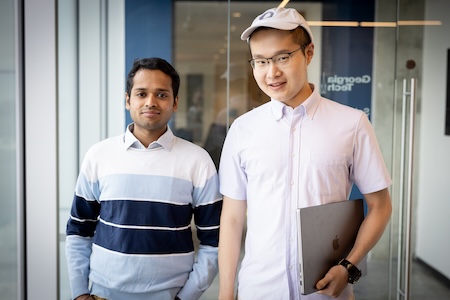
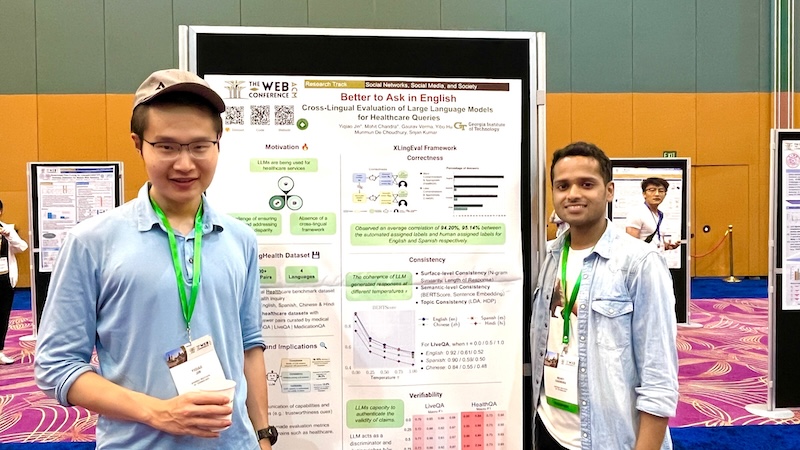
Ph.D. students Mohit Chandra and Yiqiao (Ahren) Jin are the co-lead authors of the paper Better to Ask in English: Cross-Lingual Evaluation of Large Language Models for Healthcare Queries.
Their paper’s findings reveal a gap between LLMs and their ability to answer health-related questions. Chandra and Jin point out the limitations of LLMs for users and developers but also highlight their potential.
Their XLingEval framework cautions non-English speakers from using chatbots as alternatives to doctors for advice. However, models can improve by deepening the data pool with multilingual source material such as their proposed XLingHealth benchmark.
“For users, our research supports what ChatGPT’s website already states: chatbots make a lot of mistakes, so we should not rely on them for critical decision-making or for information that requires high accuracy,” Jin said.
“Since we observed this language disparity in their performance, LLM developers should focus on improving accuracy, correctness, consistency, and reliability in other languages,” Jin said.
Using XLingEval, the researchers found chatbots are less accurate in Spanish, Chinese, and Hindi compared to English. By focusing on correctness, consistency, and verifiability, they discovered:
- Correctness decreased by 18% when the same questions were asked in Spanish, Chinese, and Hindi.
- Answers in non-English were 29% less consistent than their English counterparts.
- Non-English responses were 13% overall less verifiable.
XLingHealth contains question-answer pairs that chatbots can reference, which the group hopes will spark improvement within LLMs.
The HealthQA dataset uses specialized healthcare articles from the popular healthcare website Patient. It includes 1,134 health-related question-answer pairs as excerpts from original articles.
LiveQA is a second dataset containing 246 question-answer pairs constructed from frequently asked questions (FAQs) platforms associated with the U.S. National Institutes of Health (NIH).
For drug-related questions, the group built a MedicationQA component. This dataset contains 690 questions extracted from anonymous consumer queries submitted to MedlinePlus. The answers are sourced from medical references, such as MedlinePlus and DailyMed.
In their tests, the researchers asked over 2,000 medical-related questions to ChatGPT-3.5 and MedAlpaca. MedAlpaca is a healthcare question-answer chatbot trained in medical literature. Yet, more than 67% of its responses to non-English questions were irrelevant or contradictory.
“We see far worse performance in the case of MedAlpaca than ChatGPT,” Chandra said.
“The majority of the data for MedAlpaca is in English, so it struggled to answer queries in non-English languages. GPT also struggled, but it performed much better than MedAlpaca because it had some sort of training data in other languages.”
Ph.D. student Gaurav Verma and postdoctoral researcher Yibo Hu co-authored the paper.
Jin and Verma study under Srijan Kumar, an assistant professor in the School of Computational Science and Engineering, and Hu is a postdoc in Kumar’s lab. Chandra is advised by Munmun De Choudhury, an associate professor in the School of Interactive Computing.
The team will present their paper at The Web Conference, occurring May 13-17 in Singapore. The annual conference focuses on the future direction of the internet. The group’s presentation is a complimentary match, considering the conference's location.
English and Chinese are the most common languages in Singapore. The group tested Spanish, Chinese, and Hindi because they are the world’s most spoken languages after English. Personal curiosity and background played a part in inspiring the study.
“ChatGPT was very popular when it launched in 2022, especially for us computer science students who are always exploring new technology,” said Jin. “Non-native English speakers, like Mohit and I, noticed early on that chatbots underperformed in our native languages.”
School of Interactive Computing communications officer Nathan Deen and School of Computational Science and Engineering communications officer Bryant Wine contributed to this report.
Bryant Wine, Communications Officer
bryant.wine@cc.gatech.edu
Nathan Deen, Communications Officer
ndeen6@cc.gatech.edu
Teaching AI to Collaborate, not Merely Create, Through Dance
Jun 10, 2024 — Atlanta

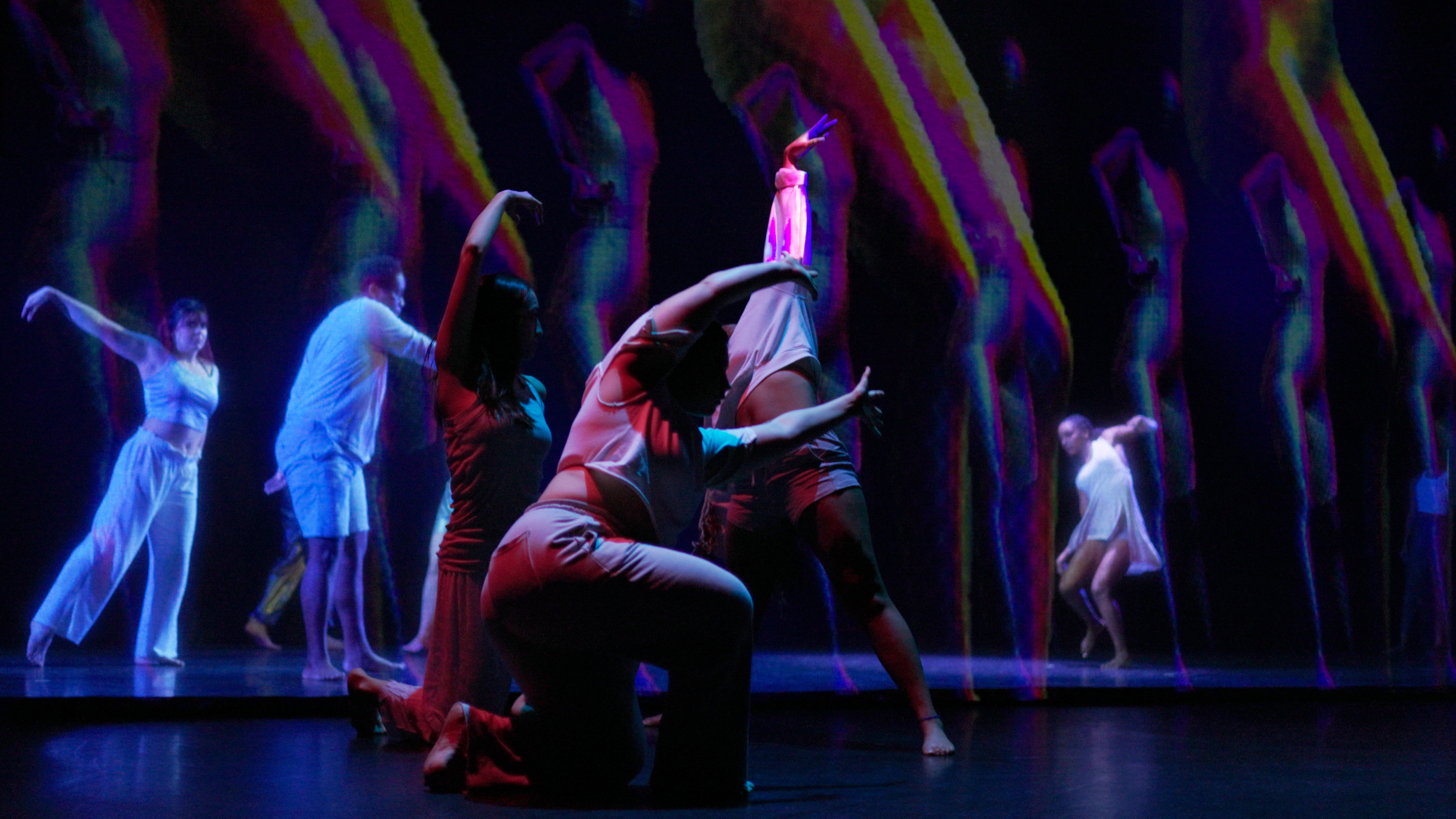
A Kennesaw State University dance student and the LuminAI-powered avatar dance together.
Two children are playing with a set of toys, each playing alone. That kind of play involves a somewhat limited set of interactions between the child and the toy. But what happens when the two children play together using the same toys?
“The actions are similar, but the choices and outcomes are very different because of the dynamic changes they’re making with the other person,” says Brian Magerko, Regents’ Professor in Georgia Tech’s School of Literature, Media, and Communication. “It’s a thing that humans do all the time, and computers don’t do with us at all.”
Welcome to the next frontier of artificial intelligence (AI) — not just generating but collaborating in real-time.
Magerko and his colleagues, Georgia Tech research scientist Milka Trajkova and Kennesaw State University Associate Professor of Dance Andrea Knowlton, are putting a collaborative AI system they’ve developed to the ultimate test: the world’s first collaborative AI dance performance.
Dance Partner
LuminAI is an interactive system that allows participants to engage in collaborative movement improvisation with an AI virtual dance partner projected on a nearby screen or wall. LuminAI analyzes participant movements and improvises responses informed by memories of past interactions with people. In other words, LuminAI learns how to dance by dancing with us.
The National Science Foundation-supported project began about 12 years ago in a lab and became an art installation and public demo. LuminAI has since moved into a different phase as a creative collaborator and education tool in a dance studio.
“We’re looking at the role LuminAI can play in dance education. As far as we’re aware, this is the first implemented version of an AI dancer in a dance studio,” says Trajkova, who was a professional ballet dancer before becoming a research scientist on the project.
To prepare LuminAI to collaborate with dancers, the research team started by studying pairs of improvisational dancers.

“We’re trying to understand how non-verbal, collaborative creativity occurs,” Knowlton says. “We start by trying to understand influencing factors that are perceived as contributing to improvisational success between two artists. Through that understanding, we applied those criteria to an AI system so it can have a similar experience with co-creative success.”
“We’re working on a creative arc,” adds Trajkova. “So instead of the AI agent just generating movements in response to the last thing that happened, we’re working to track and understand the dynamics of creative ideas across time as a continuous flow, rather than isolated instances of reaction.”
Students from Knowlton’s improvisational dance class at Kennesaw State spent two months of their spring semester working routinely with the LuminAI dancer and recording their impressions and experiences. One of the purposes the team discovered is that LuminAI serves as a third view for dancers and allows them to try ideas out with the system before trying it out with a partner.
The classroom experiment will culminate in a public performance on May 3 at Kennesaw State’s Marietta Dance Theater featuring the students performing with the LuminAI dancer. As far as the research team is aware the event is the world’s first collaborative AI dance performance.
While not all the dancers embraced having an AI collaborator, some of those who were skeptical at first left the experience more open to the possibility of collaborating with AI, Knowlton says. Regardless of their feelings toward working with AI, Knowlton says she believes the dancers gained valuable skills in working with specialized technology, especially as dance performances evolve to include more interactive media.
Refined Movement
So, what’s next for LuminAI? The project represents at least two possible paths for its learnings. The first includes continued exploration about how AI systems can be taught to cooperate and collaborate more like humans.
“With the advent of generative AI these past few years, it’s been really clear how great a need there is for this sort of social cognition,” says Magerko. “One of the things we’re going to be getting off the ground is sense-making with large language models. How do you collaborate with an AI system – rather than just making text or images, they’ll be able to make with us.”
The second involves the body movements LuminAI has been cataloging and analyzing over the years. Dance exemplifies highly refined motor skills, often exhibiting a level of detail surpassing that found in various athletic disciplines or physical therapy. While the tools designed to capture these intricate movements—through cameras and AI—are still nascent, the potential for harnessing this granular data is significant, Trajkova says.
That exploration begins on May 30 with a two-day summit being held at Georgia Tech to discuss its application for transforming performance athletics, with interdisciplinary participants in dance, computer vision, biomechanics, psychology, and human-computer interaction from Georgia Tech, Emory, KSU, Harvard, Royal Ballet in London, and Australian Ballet.
“It’s about understanding AI's role in augmenting training, promoting wellness as well as diving deep in decoding the artistry of human movements. How can we extract insights about the quality of athlete’s movements so we can help develop and enhance their own unique nuances?” Trajkova says.
Megan McRainey
megan.mcrainey@gatech.edu
Technology Licensing Lunch and Learn-Intellectual Property Litigation
Intellectual Property Litigation
Join Technology Licensing for a Lunch and Learn Presentation:
Tuesday, May 21, 2024
11am - 1pm
Location-GTAPS Classroom
Presentation given by Puja Lea, Partner, Troutman Pepper. Puja is a seasoned patent litigator and GT grad!
IPaT Hosts High School Computer Science Teachers
Mar 29, 2024 —
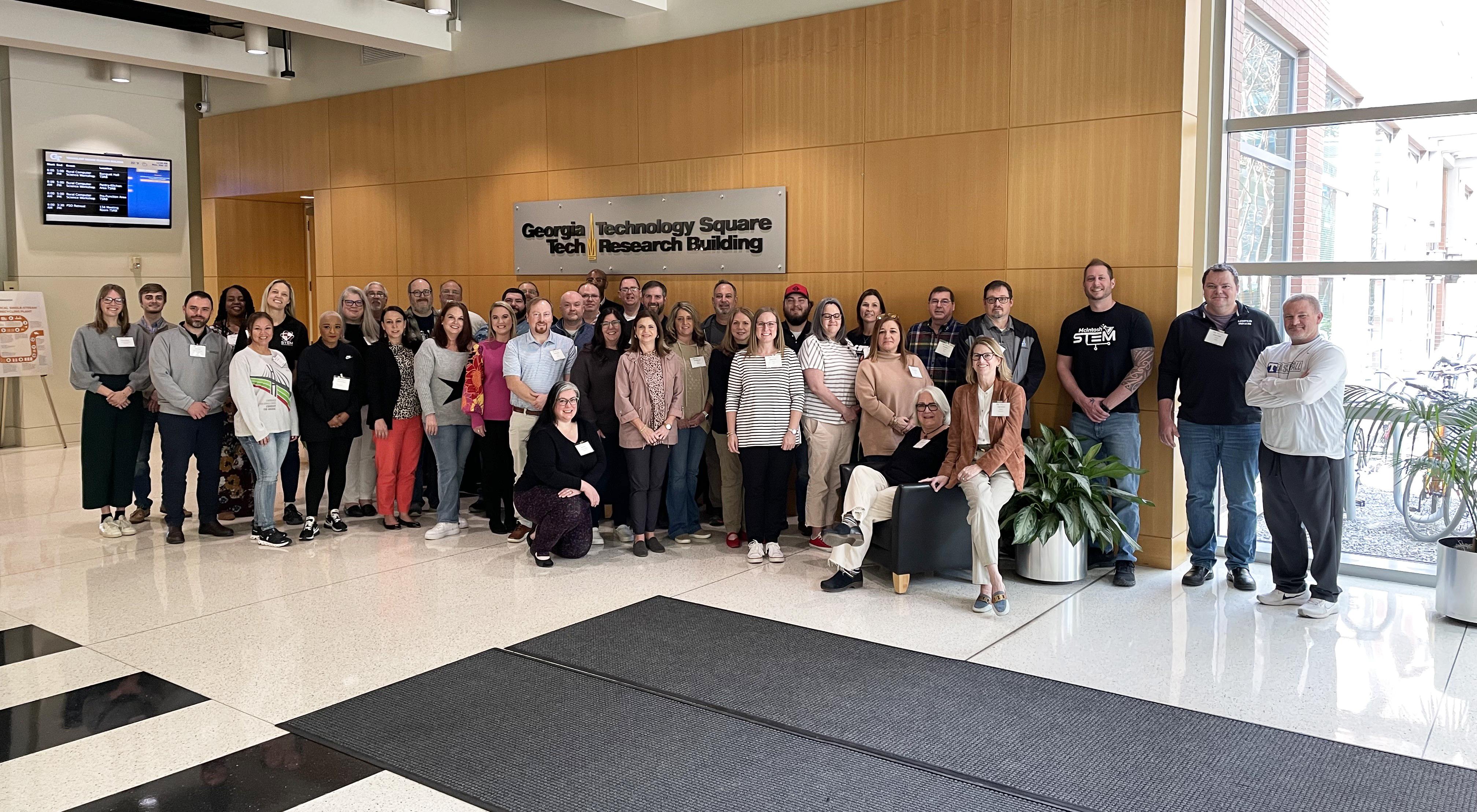
Georgia high school computer science teachers participating in the Georgia Tech Rural Computer Science Initiative
On March 25-26, the Institute for People and Technology (IPaT) hosted the spring gathering of rural Georgia high school computer science teachers participating in a state funded program to help high schoolers learn computer programming.
The Georgia Tech Rural Computer Science Initiative offers co-teaching lessons prepared by Georgia Tech professors. The program offers virtual classes in computer science to help develop career pathways by exposing high school students to critical areas such as coding, cybersecurity, artificial intelligence, sensors, and data visualization. The program is funded by the Georgia General Assembly.
The initiative, launched in 2022, includes 16 school districts, 19 high schools, and has taught 1,329 students. Continued growth of the program is expected in 2024 as the number of districts participating will grow to 24 school districts.
The program is run by Lizanne DeStefano, director of Georgia Tech’s Center for Education Integrating Science, Mathematics and Computing (CEISMC), and Leigh McCook, director with the Georgia Tech Research Institute (GTRI). There are now thirteen Georgia Tech employees supporting the program across CEISMC, GTRI, and IPaT.
The meeting was designed to gather feedback and envision future directions to make the program even more successful.