
Middle Schoolers’ Feedback Informs New Approach to AI-based Museum Exhibits
Jul 01, 2024 —

Researchers at Georgia Tech are creating accessible museum exhibits that explain artificial intelligence (AI) to middle school students, including the LuminAI interactive AI-based dance partner developed by Regents' Professor Brian Magerko.
Ph.D. students Yasmine Belghith and Atefeh Mahdavi co-led a study in a museum setting that observed how middle schoolers interact with the popular AI chatbot ChatGPT.
“It’s important for museums, especially science museums, to start incorporating these kinds of exhibits about AI and about using AI so the general population can have that avenue to interact with it and transfer that knowledge to everyday tools,” Belghith said.
Belghith and Mahdavi conducted their study with nine focus groups of 24 students at Chicago’s Museum of Science and Industry. The team used the findings to inform their design of AI exhibits that the museum could display as early as 2025.
Belghith is a Ph.D. student in human-centered computing. Her advisor is Assistant Professor Jessica Roberts in the School of Interactive Computing. Magerko advises Mahdavi, a Ph.D. student in digital media in the School of Literature, Media, and Communication.
Belghith and Mahdavi presented a paper about their study in May at the Association for Computing Machinery (ACM) 2024 Conference on Human Factors in Computing Systems (CHI) in Honolulu, Hawaii.
Their work is part of a National Science Foundation (NSF) grant dedicated to fostering AI literacy among middle schoolers in informal environments.
Expanding Accessibility
While there are existing efforts to reach students in the classroom, the researchers believe AI education is most accessible in informal learning environments like museums.
“There’s a need today for everybody to have some sort of AI literacy,” Belghith said. “Many middle schoolers will not be taking computer science courses or pursuing computer science careers, so there needs to be interventions to teach them what they should know about AI.”
The researchers found that most of the middle schoolers interacted with ChatGPT to either test its knowledge by prompting it to answer questions or socialize with it by having human-like conversations.
Others fit the mold of “content explorers.” They did not engage with the AI aspect of ChatGPT and focused more on the content it produced.
Mahdavi said regardless of their approach, students would get “tunnel vision” in their interactions instead of exploring more of the AI’s capabilities.
“If they go in a certain direction, they will continue to explore that,” Mahdavi said. “One thing we can learn from this is to nudge kids and show them there are other things you can do with AI tools or get them to think about it another way.”
The researchers also paid attention to what was missing in the students’ responses, which Mahdavi said was just as important as what they did talk about.
“None of them mentioned anything about ethics or what could be problematic about AI,” she said. “That told us there’s something they aren’t thinking about but should be. We take that into account as we think about future exhibits.”
Making an Impact
The researchers visited the Museum of Science and Industry June 1-2 to conduct the first trial run of three AI-based exhibits they’ve created. One of them is LuminAI, which was developed in Magerko’s Expressive Machinery Lab.
LuminAI is an interactive art installation that allows people to engage in collaborative movement with an AI dance partner. Georgia Tech and Kennesaw State recently held the first performance of AI avatars dancing with human partners in front of a live audience.
Duri Long, a former Georgia Tech Ph.D. student who is now an assistant professor at Northwestern University, designed the second exhibit. KnowledgeNet is an interactive tabletop exhibit in which visitors build semantic networks by adding different characteristics to characters that interact together.
The third exhibit, Data Bites, prompts users to build datasets of pizzas and sandwiches. Their selections train a machine-learning classifier in real time.
Belghith said the exhibits fostered conversations about AI between parents and children.
“The exhibit prototypes successfully engaged children in creative activities,” she said. “Many parents had to pull their kids away to continue their museum tour because the kids wanted more time to try different creations or dance moves.”
Nathan Deen
Communications Officer I
School of Interactive Computing
Novel Use of Existing Drug Could Significantly Cut Heart Attack Risk
Jun 18, 2024 — Atlanta

Christopher Bresette in the lab. [Photo by Rob Felt.]
Heart attacks have been the leading cause of death in the U.S. for a century. While most treatments for cardiac events target breaking down blood clots, Georgia Tech researchers have found a way to prevent blood clots from even forming. Dramatically, their drug is shown to completely knock out the formation of blood clots without increasing the risks of bleeds in vivo.
This drug is both affordable and already widely available for other uses, meaning patients could experience these benefits sooner than waiting for a completely new drug to go through FDA approval. Eventually, the drug could be used to prevent second heart attacks for high-risk patients or even primary heart attacks, strokes, and other complications caused by blood clots.
The researchers presented their findings in the paper, “N-Acetyl Cysteine Prevents Arterial Thrombosis in a Dose-Dependent Manner In Vitro and in Mice,” in Arteriosclerosis, Thrombosis, and Vascular Biology in April.
How Blood Clots Form
Most existing preventive treatments for clots involve anti-platelet drugs that can cause bad side effects for the patient.
“Doctors are between a rock and a hard place — we can give you a drug that may help prevent a second cardiac event, but it might also cause a lot of bleeding,” said David Ku, Lawrence P. Huang Endowed Chair for Engineering Entrepreneurship and Regents' Professor in the George W. Woodruff School of Mechanical Engineering (ME). “These blood clots are held together by a protein called von Willebrand factor (VWF), which is a different target for drugs.”
VWF is a long protein, occurring naturally in plasma, that allows blood clots to form quickly. Under normal conditions, it functions like an inert ball of yarn, but when VWF unravels, it becomes sticky and catches platelets.
“The VWF grabs platelets and the platelets activate, so they release more VWF, which grabs more platelets, creating a positive feedback loop that leads to really fast clot formation,” explained Christopher Bresette, an ME postdoctoral researcher.
Breaking Down Blood Clots
Bresette and Ku sought to break down VWF proteins using a drug already on the market, N-acetyl cysteine (NAC), typically used to treat acetaminophen overdose. Earlier researchers had tried using NAC to break down clots after formation, but Ku’s team wanted to stop clots before they even started.
“We chose NAC because of its current clinical use and safety history,” Bresette said. “Using an existing drug for off-label use can speed up the time it takes to start helping patients.”
At the Petit Institute for Bioengineering and Bioscience, the researchers ran blood through a small channel similar to a narrowing artery that could lead to a heart attack or stroke. NAC completely prevented a clot from forming under these conditions. Next, they tested NAC in a mouse model and found comparable results. Even better, NAC’s benefits lasted six hours after it left the bloodstream, keeping arteries clear for longer.
The researchers envision the drug will be most useful if a patient has already had a heart attack but is at risk of having a second one soon after. An IV injection of NAC could lower immediate risk. Eventually, NAC derivatives could be administered orally as a daily pill to reduce heart attack risk.
Heart attacks and strokes are just the beginning. From stopping embolisms to other blockages, the future with NAC is only just beginning. The researchers are hoping to conduct a clinical trial and receive FDA approval so NAC can help patients as soon as possible.
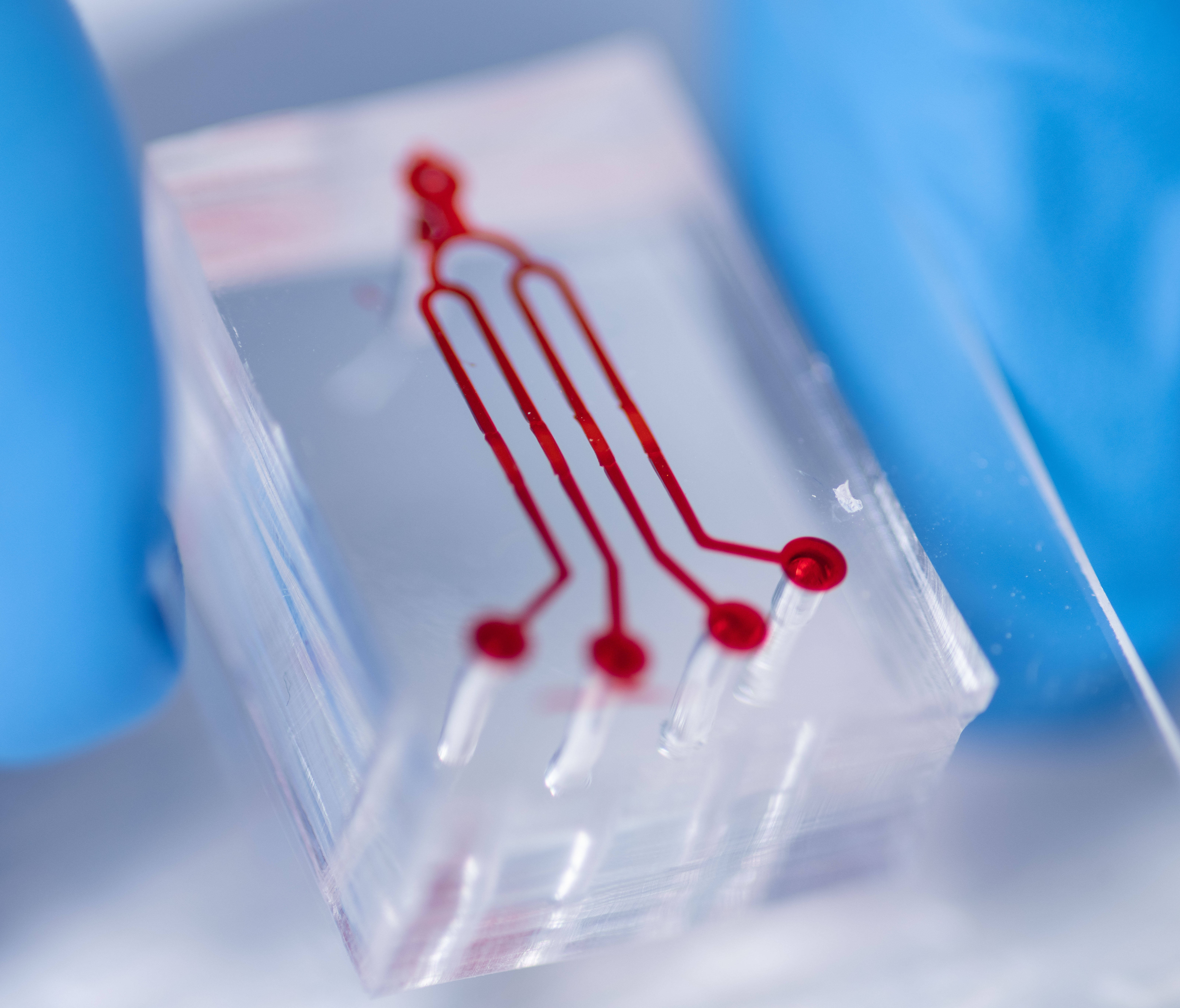
The blood comes in from the top and splits into four channels that can be observed separately. The middle region is where the channel narrows to mimic an atherosclerotic plaque. [Photo by Rob Felt]
Tess Malone, Senior Research Writer/Editor
tess.malone@gatech.edu
Fall Student Hiring Information Session | Aug 1
These sessions provide practitioners with information from key stakeholders related to the student employment process. These meetings serve as space for updates and reminders for practitioners. Click to register.
Fall Student Hiring Information Session
These sessions provide practitioners with information from key stakeholders related to the student employment process. These meetings serve as space for updates and reminders for practitioners. Click to register.
Additional dates
- Thursday, Aug 1 | 2:30p – 3:30p
Georgia CTSA Virtual Visiting KL2 Scholar Grand Rounds Lecture
Jiong Li, Ph.D.
Assistant Professor
School of Pharmacy
Department of Medicinal Chemistry
Virginia Commonwealth University
REGISTER HERE for Zoom link
Georgia CTSA Maternal Health Roundtable
Future Faculty Job Search Academy
This workshop is open to graduate students and postdoctoral scholars interested in higher education careers. The Job Search Academy will equip you for the unique academic job search experience. Participants will plan their academic job search strategy and create drafts of their entire job search packet including CV, cover letter, and teaching and research statements.
Together in Innovation: Opportunity is knocking – are you ready?
Together in Innovation: Opportunity is knocking – are you ready?
Entrepreneurs, small business owners, and innovators, join us with USPTO at the upcoming: Together in Innovation event
June 27, 9:30 a.m. - 1:10 p.m.
Location: Kennesaw State University Center
GT Session Speakers:
Nakia Melecio, Senior Research Faculty; Principal, Venture Lab
Connie Casteel, SBIR/STTR Catalyst and Senior Extension Professional Research Faculty,(ATDC)
Lunch and Learn: Mastering Patent Applications
Lunch and Learn: Mastering Patent Applications
Presentation by Steph Davy-Jow, Patent Agent, Perilla Knox & Hildebrandt LLP
- Master effective invention disclosures
- Preliminary assessments for patenting
Presented by: The Office of Technology Licensing
Pride Day at Six Flags
Don't miss out on summer fun as the LGBTQIA Resource Center ride for pride at Six Flags Over Georgia! There are limited tickets available and they will be offered on a first come-first served basis. To secure your FREE ticket, please RSVP! There are only 15 tickets available! We hope to see you there!