Todd Sulchek

Todd Sulchek
todd.sulchek@me.gatech.edu
Sulchek Lab

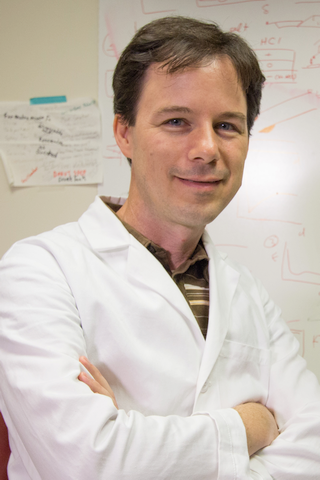
Todd Sulchek is an associate professor in Mechanical Engineering at Georgia Tech where he conducts fundamental and applied research in the field of biophysics. His research program focuses on the mechanical and adhesive properties of cell and biological systems and the development of microsystems to aid in their study. His research employs tools, including, MEMS, microfluidics, imaging, and patterning to understand or enable biological systems. His interests include cancer diagnostics, stem cell biomanufacturing, novel therapeutics, and ultracheap engineering tools. He is a member of the interdisciplinary Institute for Bioengineering and Bioscience. Dr. Sulchek also holds program faculty positions in Bioengineering and Biomedical Engineering and has a courtesy appointment in the School of Biology. He received his Ph.D. from Stanford in Applied Physics under Calvin Quate and received a bachelors in math and physics from Johns Hopkins. He was a postdoc and staff scientist at Lawrence Livermore National Lab. He joined Georgia Tech in 2008 as an Assistant Professor of Mechanical Engineering. He is a recipient of the NSF CAREER award, the BP Junior Faculty Teaching Excellence Award, the Lockheed Inspirational Young Faculty award, and the 2012 Petit Institute Above and Beyond Award. To date he has published 42 journal papers and has filed or been issued 7 patents. Prof. Sulchek is a strong supporter of undergraduate research, and he participates in a variety of undergraduate education activities including the Undergraduate Research Opportunities Program (UROP) and includes over 8 undergraduate authors in the past year.

Professor, Woodruff School of Mechanical Engineering
Appointments in Bioengineering, Biomedical Engineering, and Biology
Phone
404.385.1887
Office
Petit 2309
Additional Research

Biomedical Devices; bio-MEMS; biosensors; Drug Delivery; Advanced Characterization. Dr. Sulchek's research focuses primarily on the measurement and prediction of how multiple individual biological bonds produce a coordinated function within molecular and cellular systems. There are two complementary goals. The first is to understand the kinetics of multivalent pharmaceuticals during their targeting of disease markers; the second is to quantify the host cell signal transduction resulting from pathogen invasion. Several tools are developed and employed to accomplish these goals. The primary platform for study is the atomic force microscope (AFM), which controls the 3-D positioning of biologically functionalized micro- and nanoscale mechanical probes. Interactions between biological molecules are quantified in a technique called force spectroscopy. Membrane protein solubilized nanolipoprotein particles (NLPs) are also used to functionalize micro/nano-scale probes with relevant biological mediators. This scientific program requires the development of enabling instrumentation and techniques, which include the following: Advanced microscopy and MEMs; Nanomechanical linkers, which provide a convenient platform to control biomolecular interactions and study multivalent molecular kinetics; Biological mimetics, which provide a simple system to study cell membranes and pathogens. UltIMaTely, this work is used to optimize molecular drug targeting, improve chem/bio sensors, and develop more efficient pathogen countermeasures.

Google Scholar
https://scholar.google.com/citations?hl=en&user=J2TW91AAAAAJ&view_op=list_works&sortby=pubdate
ME Profile Page
Todd
Sulchek
Show Regular Profile

Christopher E. Carr

Christopher Carr

Christopher E. Carr is an engineer/scientist with training in aero/astro, electrical engineering, medical physics, and molecular biology. At Georgia Tech he is an Assistant Professor in the Daniel Guggenheim School of Aerospace Engineering with a secondary appointment in the School of Earth and Atmospheric Sciences. He is a member of the Space Systems Design Lab (SSDL) and runs the Planetary eXploration Lab (PXL).

Josiah Hester

Josiah Hester

Josiah Hester works broadly in computer engineering, with a special focus on wearable devices, edge computing, and cyber-physical systems. His Ph.D. work focused on energy harvesting and battery-free devices that failed intermittentently. He now focuses on sustainable approaches to computing, via designing health wearables, interactive devices, and large-scale sensing for conservation. 
   

David Myers, Ph.D.


David’s varied interests have fueled an unusual educational background that fuses engineering, microsystem design, biology, and clinical research. David received his PhD in mechanical engineering from the University of California at Berkeley, under the tutelage of one of the early microsystems pioneers, Albert P. Pisano, PhD. Driven by a desire to see new types of sensors in the clinic, David undertook a postdoctoral fellowship in biomedical and clinical research with Wilbur A. Lam, MD, PhD, in the Wallace H.

Seung-Joon Paik

Seung-Joon Paik

Seung-Joon Paik received his B.S. degree at the School of Electrical Engineering in 1999 and the M.S. and Ph.D. degrees at the Electrical Engineering and Computer Science from Seoul National University, Seoul, Korea, in 2001 and 2005, respectively. His doctorate research focused on the design, microfabrication and testing of silicon microneedles for neurophysiologic applications, including microfluidic channels and microelectrodes.

William Doolittle

William Alan Doolittle

During my research career I have observed “new” material systems develop and offer promise of wondrous device performance improvements over the current state of the art. Many of these promises have been kept, resulting in numerous new devices that could never have been dreamed of just a few short years ago. Other promises have not been fulfilled, due, in part, to a lack of understanding of the key limitations of these new material systems.

Ting Zhu

Ting Zhu

Zhu's research focuses on the modeling and simulation of mechanical behavior of materials at the nano- to macroscale. Some of the scientific questions he is working to answer include understanding how materials fail due to the combined mechanical and chemical effects, what are the atomistic mechanisms governing the brittle to ductile transition in crystals, why the introduction of nano-sized twins can significantly increase the rate sensitivity of nano-crystals, and how domain structures affect the reliability of ferroelectric ceramics and thin films.