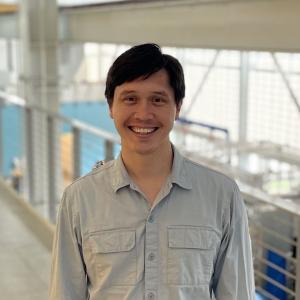
David S. Citrin

David S Citrin

Professor Citrin earned a B.A. from Williams College (1985) and a M.S. (1987) and a Ph.D. (1991) from the University of Illinois, all in physics, where his dissertation was on the optical properties of semiconductor quantum wires. Subsequently, he was a post-doctoral research fellow at the Max Planck Institute for Solid State Research, Stuttgart, Germany (1992-1993) and Center Fellow at the Center for Ultrafast Optical Science at the University of Michigan (1993-1995). Dr. Citrin was an assistant professor of physics and materials science at Washington State University (1995 to 2001).

Walter de Heer

Walter de Heer

Walter Alexander “Walt” de Heer is a Dutch physicist and nanoscience researcher known for discoveries in the electronic shell structure of metal clusters, magnetism in transition metal clusters, field emission and ballistic conduction in carbon nanotubes, and graphene-based electronics.

Mark Losego

Mark Losego

Mark D. Losego is an associate professor in the School of Materials Science and Engineering at Georgia Tech. The Losego research lab focuses on materials processing to develop novel organic-inorganic hybrid materials and interfaces for microelectronics, sustainable energy devices, national security technologies, and advanced textiles. The Losego Lab combines a unique set of solution and vapor phase processing methods to convert organic polymers into organic-inorganic hybrid materials, including developing the science to scale these processes for manufacturing.  Prof.

George White

George White

George will oversee activities designed to facilitate individual faculty members and teams of researchers in attracting extramural research funding, particularly opportunities with a focus or component involving external partnerships. This proactive and strategic role will allow George to assemble teams for creating collaborative research relationships with HBCUs and other MSIs, industry, government agencies, and other external organizations in order to respond to large-scale research opportunities.

William Hunt

William Hunt

Hunt grew up in the literary haven of Columbus, Mississippi, the boyhood home of Tennessee Williams, and received his B.S.E.E. from the University of Alabama in 1976. He worked for Harris Corporation for two years in the areas of acousto-optics and surface acoustic wave (SAW). He then entered the Massachusetts Institute of Technology where he earned his S.M.E.E.

Andrew Zangwill

Andrew Zangwill

Professor Zangwill earned a B.S. in Physics at Carnegie-Mellon University in 1976. His 1981 Ph.D. in Physics at the University of Pennsylvania introduced the time-dependent density functional method. 

He worked at Brookhaven National Laboratory and the Polytechnic Institute of Brooklyn from 1981-1985 before taking up his present position at the Georgia Institute of Technology. 

He was named a Fellow of the American Physical Society in 1997 for theoretical studies of epitaxial crystal growth. 

Phillip First


A primary goal of Professor First's research is to develop an understanding of solid-state systems at atomic length scales. The main experimental tools in this pursuit are scanning tunneling microscopy (STM) and related techniques such as ballistic electron emission microscopy (BEEM). These methods rely on the quantum-mechanical tunnel effect to obtain atomically-resolved maps of the electronic structure of surfaces, clusters, and buried layers.

Shannon Yee

Shannon Yee

Shannon Yee began as an Assistant Professor in the George W. Woodruff School of Mechanical Engineering in January 2014. He completed his Ph.D. at the University of California - Berkeley under the supervision of Prof. Arun Majumdar, Prof. Chris Dames, and Prof. Rachel Segalman. In 2010, he was named the first fellow to the U.S. Dept. of Energy 's Advanced Research Project Agency - Energy (ARPA-E) assisting to form the agency in its inaugural year. In 2008 he was awarded the prestigious Hertz Fellowship to support his graduate studies and research in energy.

Manos Tentzeris

Manos  Tentzeris

Manos Tentzeris was born and grew up in Piraeus, Greece. He graduated from Ionidios Model School of Piraeus in 1987 and he received the Diploma degree in Electrical Engineering and Computer Science (Magna Cum Laude) from the National Technical University in Athens, Greece, in 1992 and the M.S. and Ph.D. degrees in Electrical Engineering and Computer Science from the University of Michigan, Ann Arbor in 1993 and 1998.

Shyh-Chiang Shen

Shyh-Chiang Shen

Shyh-Chiang Shen received his Ph.D. degree in electrical engineering at the University of Illinois at Urbana-Champaign (UIUC) in 2001. He was a key contributor of high-cycle low-voltage radio-frequency (RF) microelectromechanical system (MEMS) switches and GaAs metal-semiconductor field effect transistors (MESFETs) millimeter-wave integrated circuits (MMICs) during his tenure at UIUC.