
Over the Rainbow and Into 15K: Alumni Help Bring Oz to Life at the Las Vegas Sphere
Apr 22, 2025 —

For anyone who has only seen the movie on television, The Wizard of Oz is an incredible movie theater experience. Its larger-than-life characters, vivid colors, and memorable soundtrack were made for the big screen.
Now, a Georgia Tech professor and several alumni are helping bring the 1939 classic Hollywood film to what will likely be its largest screen ever: the Las Vegas Sphere's 160,000-square-foot interior screen.
Ben Snedeker
Communications Manager
Georgia Tech College of Computing
albert.snedeker@cc.gatech.edu
Thesis on Human-Centered AI Earns Honors from International Computing Organization
Apr 17, 2025 —

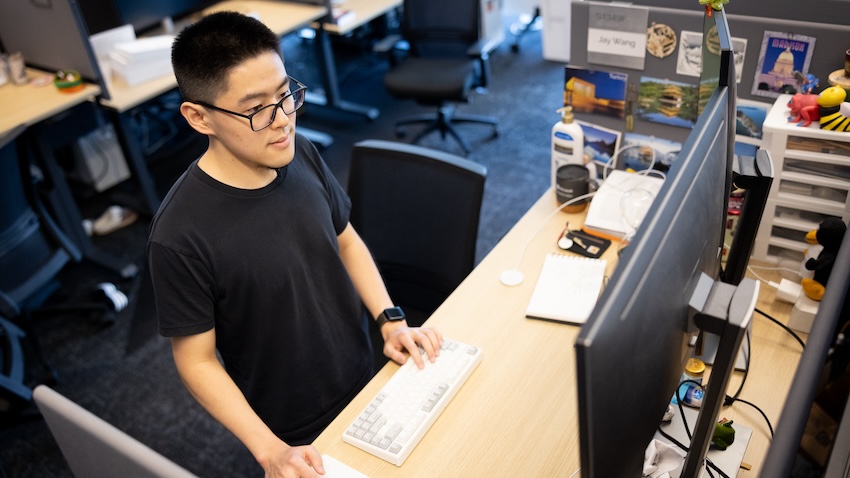
A Georgia Tech alum’s dissertation introduced ways to make artificial intelligence (AI) more accessible, interpretable, and accountable. Although it’s been a year since his doctoral defense, Zijie (Jay) Wang’s (Ph.D. ML-CSE 2024) work continues to resonate with researchers.
Wang is a recipient of the 2025 Outstanding Dissertation Award from the Association for Computing Machinery Special Interest Group on Computer-Human Interaction (ACM SIGCHI). The award recognizes Wang for his lifelong work on democratizing human-centered AI.
“Throughout my Ph.D. and industry internships, I observed a gap in existing research: there is a strong need for practical tools for applying human-centered approaches when designing AI systems,” said Wang, now a safety researcher at OpenAI.
“My work not only helps people understand AI and guide its behavior but also provides user-friendly tools that fit into existing workflows.”
[Related: Georgia Tech College of Computing Swarms to Yokohama, Japan, for CHI 2025]
Wang’s dissertation presented techniques in visual explanation and interactive guidance to align AI models with user knowledge and values. The work culminated from years of research, fellowship support, and internships.
Wang’s most influential projects formed the core of his dissertation. These included:
- CNN Explainer: an open-source tool developed for deep-learning beginners. Since its release in July 2020, more than 436,000 global visitors have used the tool.
- DiffusionDB: a first-of-its-kind large-scale dataset that lays a foundation to help people better understand generative AI. This work could lead to new research in detecting deepfakes and designing human-AI interaction tools to help people more easily use these models.
- GAM Changer: an interface that empowers users in healthcare, finance, or other domains to edit ML models to include knowledge and values specific to their domain, which improves reliability.
- GAM Coach: an interactive ML tool that could help people who have been rejected for a loan by automatically letting an applicant know what is needed for them to receive loan approval.
- Farsight: a tool that alerts developers when they write prompts in large language models that could be harmful and misused.
“I feel extremely honored and lucky to receive this award, and I am deeply grateful to many who have supported me along the way, including Polo, mentors, collaborators, and friends,” said Wang, who was advised by School of Computational Science and Engineering (CSE) Professor Polo Chau.
“This recognition also inspired me to continue striving to design and develop easy-to-use tools that help everyone to easily interact with AI systems.”
Like Wang, Chau advised Georgia Tech alumnus Fred Hohman (Ph.D. CSE 2020). Hohman won the ACM SIGCHI Outstanding Dissertation Award in 2022.
Chau’s group synthesizes machine learning (ML) and visualization techniques into scalable, interactive, and trustworthy tools. These tools increase understanding and interaction with large-scale data and ML models.
Chau is the associate director of corporate relations for the Machine Learning Center at Georgia Tech. Wang called the School of CSE his home unit while a student in the ML program under Chau.
Wang is one of five recipients of this year’s award to be presented at the 2025 Conference on Human Factors in Computing Systems (CHI 2025). The conference occurs April 25-May 1 in Yokohama, Japan.
SIGCHI is the world’s largest association of human-computer interaction professionals and practitioners. The group sponsors or co-sponsors 26 conferences, including CHI.
Wang’s outstanding dissertation award is the latest recognition of a career decorated with achievement.
Months after graduating from Georgia Tech, Forbes named Wang to its 30 Under 30 in Science for 2025 for his dissertation. Wang was one of 15 Yellow Jackets included in nine different 30 Under 30 lists and the only Georgia Tech-affiliated individual on the 30 Under 30 in Science list.
While a Georgia Tech student, Wang earned recognition from big names in business and technology. He received the Apple Scholars in AI/ML Ph.D. Fellowship in 2023 and was in the 2022 cohort of the J.P. Morgan AI Ph.D. Fellowships Program.
Along with the CHI award, Wang’s dissertation earned him awards this year at banquets across campus. The Georgia Tech chapter of Sigma Xi presented Wang with the Best Ph.D. Thesis Award. He also received the College of Computing’s Outstanding Dissertation Award.
“Georgia Tech attracts many great minds, and I’m glad that some, like Jay, chose to join our group,” Chau said. “It has been a joy to work alongside them and witness the many wonderful things they have accomplished, and with many more to come in their careers.”
Bryant Wine, Communications Officer
bryant.wine@cc.gatech.edu
New Approach for Easily Merging Data Models Brings Multi-Tasking AIs Closer to Reality
Apr 18, 2025 —

Georgia Tech researchers from the School of Interactive Computing have developed a novel method for merging AI data models. This approach makes creating systems that can adapt and multitask across different domains easier.
The innovation will help to advance self-driving vehicles, chat assistants, and other AI applications. It could lead to more versatile and efficient AI tools. Click to read the full story on the College of Computing website.
Josh Preston
Research Communications Manager
Georgia Tech College of Computing
josh.preston@cc.gatech.edu
Georgia Tech Leads Research Push for National Crane Safety
Apr 18, 2025 —

Cranes are common features in urban skylines. Because construction projects are constantly beginning and ending, the exact number of cranes in use globally is unknown. What is known, however, is that cranes have caused hundreds of deaths and catastrophic injuries. In the U.S. alone, dozens of deaths occur annually, and the construction industry loses billions of dollars.
“Crane usage is not well regulated or well measured. A lot of accidents are not reported or cataloged — and for those that are, there’s often not a proper investigation,” noted William Singhose, professor in Georgia Tech’s George W. Woodruff School of Mechanical Engineering and director of the Crane Safety Research Center.
The center includes researchers from Georgia Tech, the University of Washington, Utah State University, construction equipment suppliers, and industrial automation specialists. Together, they hope to bridge the gap between engineering curricula, practical applications, and legislation.
Read the full story on the George W. Woodruff School of Mechanical Engineering website.
Poetry Helped 20th Century Physicists Make the Quantum Leap
Apr 18, 2025 —

What do poetry and physics have in common? If your first answer is “the letter ‘P,’” you’re not alone. Georgia Tech Professor John Lyon, however, traces a much deeper connection between the two disciplines.
“Poetry was extremely important for the leading minds in quantum physics,” said Lyon, who is a professor of German and the Charles Smithgall Jr. Institute Chair of Georgia Tech’s School of Modern Languages. “Quantum physics is the science of the unseeable, the indescribable — and poetry is at least part of its language.”
According to Lyon, physicists like Max Planck, Werner Heisenberg, Albert Einstein, and others all had a strong background in the humanities, in literature and poetry. Erwin Schrödinger even published his own volume of poetry, Gedichte [Poems], in 1949.
But these early 20th century physicists weren’t just conversant in poetry — they viewed it as essential to their work.
“Neils Bohr said ‘When it comes to atoms, language can be used only as in poetry.’ He and others needed a way to understand and manipulate concepts that are too small to see and beyond the language of our everyday experiences,” said Lyon.
Because of its focus on building imagery and helping us make mental connections, says Lyon, poetry helped quantum physicists bridge the gap between existing language and their new ideas.
“Poetry might be one of the best ways to get at new concepts and thoughts, because it uses words in unusual ways and helps us see the world differently,” said Lyon.
With Apologies to Cats and Physicists
According to Lyon, one example of stretching language around a hard-to-grasp idea is Schrödinger’s Cat. This thought experiment loosely illustrates the concept of quantum superposition, in which opposing states can exist simultaneously.
Imagine a cat trapped in a box with a vial of poison that may or may not have broken open, killing the cat. Both outcomes are equally likely. You cannot see into the box, nor can you open it (yet). Is the cat alive or dead? From your perspective, it is both — at the same time.
What Schrödinger’s Cat may lack in detail or exactitude, says Lyon, it makes up for by making the impossible a concrete, graspable idea.
Unfortunately, there is no corresponding thought experiment to help us understand quantum entanglement. (Scientists at CalTech gave it a try, comparing entangled particles to twins separated at birth.) When two particles become entangled, a change in one is simultaneously reflected in the other, even if they are separated by great distances.
And while poetry and quantum physics may seem to be at either ends of the galaxy, Lyon says themes of superposition, paradox, and entanglement resonate across both.
“Ludwig Wittgenstein said, ‘the limits of my language are the limits of my world,’” said Lyon. “By pushing the boundaries of language, poetry pushes the boundaries of thought.”
Stephanie N. Kadel
Ivan Allen College of Liberal Arts
Georgia Tech’s Pascal Van Hentenryck Strengthens Ties With Panama’s AI Infrastructure
Apr 17, 2025 —

In early February, Pascal Van Hentenryck, professor and chair of the School of Industrial and Systems Engineering at Georgia Tech, as well as director of the NSF AI4OPT Institute and Tech AI, visited the Georgia Tech Panama Logistics Innovation and Research Center, with the aim of fostering collaboration between Georgia Tech and Panama’s academic and tech communities. His visit was part of Georgia Tech Panama’s Breakfast & Learn series and served as a strategic introduction between Georgia Tech’s leading minds in artificial intelligence (AI) and key players in Panama’s innovation ecosystem.
Bridging Academia and Industry
Van Hentenryck’s agenda included two sessions tailored to different audiences. The first, held in collaboration with Ciudad del Saber Foundation and the Panamanian Chamber of Technology, brought together entrepreneurs, tech sector leaders, and innovation advocates to discuss global trends in artificial intelligence. He highlighted the critical role AI will play in shaping future industries, underscoring how Georgia Tech can be a vital partner in accelerating Panama’s adoption of emerging technologies.
The second session, hosted at the Georgia Tech Panama Center, was an invitation-only gathering for professors and researchers specializing in AI and engineering disciplines. Van Hentenryck shared research insights, real-world applications of AI across various fields, and ideas for strengthening academic-industry collaboration.
Cultivating Strategic Relationships
While the visit was not part of a formal initiative, it marked a significant step toward deeper engagement. Van Hentenryck forged connections with technology entrepreneurs, university faculty, and representatives from the Secretaría Nacional de Ciencia, Tecnología e Innovación, Panama’s national science and innovation authority. These conversations opened the door to potential future partnerships and collaborative projects.
“This visit gave us the opportunity to connect Panama’s academic and private sectors,” said Van Hentenryck. “We see great potential for long-term collaboration that supports the country’s innovation goals.”
Looking Ahead
The Georgia Tech Panama Center anticipates that this exchange will lead to joint research, capacity-building, and the co-development of initiatives to strengthen AI and emerging technologies in Panama. The visit reflects Georgia Tech’s ongoing commitment to supporting global innovation through knowledge sharing and strategic partnerships.
Liquid Cooling Tech Developed at Georgia Tech Patented, Company Raising Capital
Apr 16, 2025 —

What’s the hottest thing in electronics and high-performance computing? In a word, it’s “cool.”
To be more precise, it’s a liquid cooling system developed at Georgia Tech for electronics aimed at solving a long-standing problem: overheating.
Developed by Daniel Lorenzini, a 2019 Tech graduate who earned his Ph.D. in mechanical engineering, the cooling system uses microfluidic channels — tiny, intricate pathways for liquids — that are embedded within the chip packaging.
He worked with VentureLab, a Tech program in the Office of Commercialization, to spin his research into a startup company, EMCOOL, headquartered in Norcross.
“Our solution directly addresses the heat at the source of the silicon chip and therefore makes it faster,” Lorenzini said. “Our design has our system sitting directly on the silicon chips that generate the most heat. Using the fluids in the micro-pin fins, it carries the heat that’s produced away from the chip.”
That cooling solution is directly integrated into the electronic components, making it significantly more efficient than conventional cooling methods, because it enhances the heat dissipation process.
The result is a much lower risk of overheating and reduced power consumption, he said.
Lorenzini, who researched and refined the technology in the lab of Yogendra Joshi at the George W. Woodruff School of Mechanical Engineering, was awarded a patent for the technology in September 2024.
Now, EMCOOL, which has five empoloyees, is actively pursuing venture capital funding to scale its technology and address the escalating thermal management challenges posed by AI processors in modern data centers.
The system uses a cooling block with tiny, pin-like fins on one side and a special thermal interface material on the other. There's also a junction attached to the block, with ports for the fluid to flow in and out. The cooling fluid moves through the micro-pin fins and helps to carry away the heat.
Since the ports are designed to match the shape of the fins, it ensures that the fluid flows efficiently and the heat is dissipated as effectively as possible at chip-scale.
As electronic devices — from high-performance personal computers to data centers used for artificial intelligence processing — become more powerful, they generate more heat. This excess heat can damage components or cause the device to underperform.
Traditional cooling methods, which include fans or heat sinks, often struggle to keep pace with the increasing demands of the newer model electronics. Lorenzini’s microfluidic system addresses the challenge of overheating with his patented, more effective, compact, and integrated cooling solution.
With the guidance of Jonathan Goldman, director of Quadrant-i in Tech’s Office of Commercialization, Lorenzini secured grant funding through the National Science Foundation and the Georgia Research Alliance to further the research and build design prototypes.
“We immediately had the sense there was commercial potential here,” Goldman said. “Thermal management, or getting rid of heat, is a ubiquitous problem in the computer industry, so when we saw what Daniel was doing, we immediately began to engage with him to understand what the commercial potential was.”
Indeed, the initial focus for the technology was the $159 billion global electronic gaming market. Gamers need a lot of computing power, which generates a lot of heat, causing lag.
But beyond gaming systems, the company, which manufactures custom cooling blocks and kits at its Norcross facility, is eyeing more sectors, which also suffer from overheating, Goldman said.
The technology addresses similar overheating electronics challenges in high-performance computing, telecommunications, and energy systems.
“This work propels us forward in pushing the boundaries of what traditional cooling technologies can achieve because by harnessing the power of microfluidics, EMCOOL's systems offer a compact and energy-efficient way to manage heat,” Goldman said. “This has the potential to revolutionize industries reliant on high-performance computing, where heat management is a constant challenge.”
Péralte C. Paul
peralte@gatech.edu
404.316.1210
Georgia Tech, UC San Francisco Collaborate to Assess Pork, Poultry Worker Safety
Apr 16, 2025 —

Hilarie Warren is SHES' OSHA Training Institute Education Center manager.
ATLANTA and SAN FRANCISCO — When University of California San Francisco (UCSF) officials were contracted by the U.S. Department of Agriculture (USDA) to conduct research on line speeds at pork and poultry processing facilities, they knew exactly who to ask for additional support: researchers from the Safety, Health, and Environmental Services (SHES) division at Georgia Tech.
A program housed in Tech’s Enterprise Innovation Institute, SHES offers occupational safety, health, and environmental (OSHA) consulting and training services to manufacturers across the country and has worked extensively examining food-processing workers’ exposure to chemicals.
UCSF needed a partner with specific scientific expertise regarding employee exposure to a chemical used to limit bacterial growth during pork processing. SHES’ prior working relationship with UCSF also proved beneficial. In 2021, SHES industrial hygienist Brandon Philpot was the primary investigator (PI) for a collaborative project with a group from the UC system to develop safety training for workers fabricating engineered stone countertops.
“UC San Francisco’s School of Medicine was so impressed with our team's work, they came back to us for this much larger project,” said Jenny Houlroyd, Ph.D., manager of occupational health services at SHES. “We're trying to build meaningful relationships and leverage expertise across institutions.”
Study Parameters
The study was initiated when the USDA’s Food Safety and Inspection Service division contracted with third-party experts to investigate whether increases in poultry and swine evisceration line speeds affected worker safety.
A secondary aspect of the study looked at the potential for an increase in worker exposure to peracetic acid (a food-safe chemical applied to surfaces in certain food-processing applications) when processing line speeds are increased.
“The study’s designers believed that ergonomics was the driving factor in worker safety, but they were unsure if by slaughtering and processing more animals per day, workers were also applying more peracetic acid,” said Houlroyd. “This is what the SHES team was asked to measure.”
In addition to tapping Georgia Tech’s expertise in industrial hygiene, UCSF brought in several other schools in the University of California system, primarily UC Berkeley, to assist with research.
Scope of SHES’ Role
“Our work with UC started in July 2024 and was completed in January 2025,” said Houlroyd, who served as the project’s PI and UC liaison.
Conducting the field research were SHES industrial hygienists Philpot, Sean Castillo, and Bob Hendry, as well as SHES OSHA Training Institute Education Center manager Hilarie Warren. The group traveled to six pork processing plants across the U.S. over 11 weeks.
Although the preferred method for industrial hygiene and worker exposure is to chart direct exposure to the workers themselves, the study did not allow employees to wear chemical monitors on the processing line for safety reasons.
“Our on-site sampling included putting on a variety of wearable monitors on ourselves,” Hendry said. “We’d then go to the various work areas in the plant where peracetic acid was used, stand next to the workers, and take readings.”
Each SHES team member upheld consistent sampling standards, but they were stationed at different sites. As a result, Castillo said, “It was up to us to use professional judgment to evaluate where the areas of concern were. We had to make sure we were very organized so that if I was at one site one week and Bob came out the next week, we could replicate our data almost one-to-one.”
Importance of Worker Interviews
The USDA study received Institutional Review Board (IRB) approval, which is needed if researchers interact with human subjects. Houlroyd noted that because the USDA study was considered formal research, IRB approval was necessary.
Although conducting worker interviews was not a requirement of their participation, the SHES team set up a special room where they interviewed employees on ergonomic issues and musculoskeletal disorders.
“We were able to take the load off from our collaborators and, in doing so, speed up their process so that they could finish their research earlier,” said Castillo.
Philpot stressed the importance of worker interviews to the study. “The process was good for collecting background information on what the employees were going through, day in and day out, to see if there’s anything that we could do to help their situation.”
By putting workers at ease, he and his teammates were able to gain their trust and listen to their concerns. “They could actually see that we cared about what's going on,” Philpot said.
According to Houlroyd, “One of the reasons the UC group loved Brandon and Sean and Bob so much is that we've had so much experience doing interviews, we were quick to jump into that role and help them. Our team knows that there is dignity in all labor, so we approach workers with respect. We meet the workers where they are, and we speak to them not as an academic, but human to human.”
Study Results
Acting Secretary of Labor Julie Su reported that the USDA study found that faster line speeds did result in an increased risk of injuries, but that this risk “could be mitigated with other controls, specifically having more workers on the line and having effective ergonomic plans.”
The results of the peracetic acid research conducted by SHES, however, were inconclusive. “Was there more exposure at the faster line speed?” asked Houlroyd. “We found one plant where it was true, but it wasn't consistently true at all the plants, so it was determined that there should be more research.”
Regardless, she welcomed the chance to strengthen collaborative ties with the UC system and celebrated the meticulous and compassionate work conducted by SHES.
“I am so grateful for this team for traveling to remote locations in our country and spending 11 weeks in slaughterhouses,” said Houlroyd. “I had no doubt that we could do it, and we did it well.”
Eve Tolpa
etolpa3@gatech.edu
Space Traffic and Trash: Policy Experts Work Toward a Sustainable Final Frontier
Apr 14, 2025 —

Debris presents not only a physical hazard but also a complex issue for satellite operators trying to navigate these invisible threats. (Credit: Adobe Stock)
In 1957, the Soviet Union launched Sputnik. Several months later, the U.S. sent Explorer I into space. With two small objects, the space race began.
As of March 2025, more than 11,000 satellites are orbiting Earth. According to some estimates, there could be as many as 60,000 by 2030.
“In the Space Age, space activity was overtly geopolitical, and that’s never really gone away,” said Mariel Borowitz, associate professor in the Sam Nunn School of International Affairs and director of the recently launched Center for Space Policy and International Relations. “But the major shift now is the rapid rise of commercial activity and the number of actors in space.”
Space traffic is global by nature — satellites cross over myriad countries while orbiting. Thanks to the Outer Space Treaty, every country has the right to access space. More actors in space, though, mean more trash and more potential collisions.
Borowitz and her colleagues in the Nunn School analyze and help develop policies on protecting space so it remains safe and usable in the future. In other words, they’re doing everything they can to make sure things don’t blow up.
Taking Out the (Space) Trash
Thomas González Roberts, a postdoctoral fellow in the Nunn School, has a research portfolio that unites his background in astrodynamics with space governance. One area he specializes in is space debris and its impact on the sustainability of space operations.
"We define space debris as objects in Earth orbit that are no longer actively being controlled," Roberts said. "A satellite that has run out of fuel, for example, becomes a piece of floating garbage.”
The issue, he notes, isn't just the large pieces of debris but also the many tiny fragments that go undetected.
"We can track objects the size of a softball, but anything smaller is more challenging to spot with current technology," he explained. "These small pieces can still destroy satellites because of their velocity, like a bullet can harm a human."
As such, debris presents not only a physical hazard but also a complex issue for satellite operators trying to navigate these invisible threats. Roberts also highlights the rising number of satellites in popular orbital regimes. Low Earth orbit (LEO) is the closest orbital regime to Earth. Beginning at the upper reaches of the Earth’s atmosphere, it hosts communication and observational satellites and is by far the most congested region of all.
"There are only a few spots in the near-Earth space environment where satellite operators want to be, effectively making these regions limited natural resources,” he said. “Without proper coordination, these valuable spaces will be overcrowded, making it harder to avoid collisions and creating more debris."
To address these issues, Roberts advocates for better international coordination and the development of more effective space policies. "How operators choose to control their satellites is a form of space policy," he noted. "We need transparent, collaborative policies that encourage more responsible space operations. When a satellite mission is completed, operators should clean up after themselves, ensuring the long-term viability of these orbital regions."
Space Situational Awareness
Space situational awareness (SSA) involves tracking objects in space, predicting their movements, and identifying potential collisions. If a potential collision is detected, the next step is determining whether to issue a warning. Currently, the U.S. military operates the most globally advanced SSA system, providing collision warnings free of charge to spacecraft operators worldwide. However, there is an ongoing effort to shift this mission to a civil agency, the Office of Space Commerce (OSC), because so much of space activity is now international and commercial.
In 2022, Borowitz testified before Congress on transitioning from a military to a civilian SSA system. A few months later, she was invited to join the OSC on a detail to help implement this transition. Currently, she spends half her time there as head of International SSA Engagement. Her work bridges the gap between research and government operations, ensuring that advances in academia inform policy and operations.
Borowitz and Brian Gunter, a professor in the Daniel Guggenheim School of Aerospace Engineering, launched a joint project tackling the complex issue of space traffic coordination, supported by a grant from NASA.
Their detailed simulation model — the Georgia Tech Virtual Environment for Space Traffic Analysis (VESTA) — incorporates real satellite data from military space situational awareness systems to test out possible space traffic coordination rules.
“One question we’re trying to answer is whether, when we see the possibility of a collision in space, we should have right-of-way rules,” Borowitz said. “We have them on the ground for cars, and we have them in the air and at sea. In space, we have no real concept of right of way.”
Through this approach, Borowitz and Gunter can test different traffic rules and collision scenarios over months and even years. Their model also assesses the impact of these rules on different countries and companies, and what might happen if some actors choose not to follow them.
“The results of these simulations are crucial for shaping international agreements; they provide concrete data on the potential costs and benefits of unilateral versus multilateral approaches to space governance,” Borowitz said. “This kind of research not only brings technical astrodynamics into policy discussions but also offers valuable insights for negotiating space traffic coordination at a global scale.”
By combining cutting-edge research with real-world policy work, Borowitz, Roberts, and their colleagues are helping ensure that space remains usable for everyone. With their work, the path to a safer space environment is becoming clearer.
Funding: The VESTA project is supported in part through NASA and in part through the Partnership for an Advanced Computing Environment (PACE) at the Georgia Institute of Technology.

Mariel Borowitz and Thomas González Roberts
Catherine Barzler, Senior Research Writer/Editor
Institute Communications
catherine.barzler@gatech.edu
Georgia Tech Researchers Pioneer Eco-Friendly Building Materials for Earth and Mars
Apr 11, 2025 — Atlanta, GA
Using eco-voxels to create a load bearing structure.
For centuries, innovations in structural materials have prioritized strength and durability — often at a steep environmental price. Today, the construction industry accounts for approximately 10% of global greenhouse gas emissions, with cement, steel, and concrete responsible for more than two-thirds of that total. As the world presses for a sustainable future, scientists are racing to reinvent the very foundations of our built environment.
Paradigm Shift in Construction
Now, researchers at Georgia Tech have developed a novel class of modular, reconfigurable, and sustainable building blocks — a new construction paradigm as well-suited for terrestrial homes as it is for extraterrestrial habitats. Their study, published in Matter, demonstrates that these innovative units, dubbed eco-voxels, can reduce carbon footprints by up to 40% compared to traditional construction materials. These units also maintain the structural performance needed for applications ranging from load-bearing walls to aircraft wings.
“We created sustainable structures using these eco-friendly building blocks, combining our knowledge of structural mechanics and mechanical design with industry-relevant manufacturing practices and environmental assessments,” said Christos Athanasiou, assistant professor at the Daniel Guggenheim School of Aerospace Engineering.
Housing Affordability Solutions
Their work offers a potential solution to the growing housing affordability crisis. As climate-driven disasters such as hurricanes, wildfires, and floods increase, homes are damaged at higher rates, and insurance costs are skyrocketing. This crisis is fueled by rising land prices and restrictive development regulations. Meanwhile, the growing demand for housing places an increasing strain on global resources and the environment. The modularity and circularity of the developed approach can effectively address these issues.
The New Building Blocks
Eco-voxels — short for eco-friendly voxels, the 3D equivalent of pixels — are made from polytrimethylene terephthalate (PTT). PTT is a partially bio-based polymer derived from corn sugar and reinforced with recycled carbon fibers from aerospace waste (scrap material lost during the manufacturing of aerospace components). Eco-voxels can be easily assembled into large, load-bearing structures and then disassembled and reconfigured, all without generating waste. Consequently, they offer a highly adaptable, sustainable approach to construction.
The team tested eco-voxels and found they can handle the pressure that buildings usually face. They also used computer simulations to show that changing the shape of eco-voxels makes them suitable for many different building needs.
The researchers compared the eco-voxel approach to other emerging construction methods like 3D-printed concrete and cross-laminated timber (CLT), finding that eco-voxels offer significant environmental advantages. While traditional and alternative materials are often heavy and carbon-intensive, the eco-voxel wall had the lowest carbon footprint: 30% lower than concrete and 20% lower than CLT.
These results highlight eco-voxels as a promising low-carbon, high-performance solution for sustainable and affordable construction, opening new possibilities for faster, more sustainable building solutions. In addition to residential uses, emergency shelters built with eco-voxels could be used for disaster-relief scenarios, where quick assembly, modularity, and minimal environmental impact are crucial.
“This study exemplifies how advances in structural mechanics, sustainable composite development, and sustainability analysis can yield transformative solutions when coupled. Eco-voxels — our modular, reconfigurable building blocks — provide a scalable, low-carbon alternative that redefines our approach to building in both terrestrial and extraterrestrial environments," said Athanasiou.
Building in Space
Beyond their terrestrial potential, eco-voxels can also offer a promising solution for off-world construction where traditional building methods are unfeasible. Their lightweight, rapid assembly — structures can be erected in less than an hour — and reliance on sustainable or locally sourced materials make them ideal candidates for future Martian or lunar shelters.
“The ability to build these structures quickly is a significant advantage for space construction,” said Athanasiou. “In space, we need lightweight units made from locally sourced materials.”
Perhaps most importantly, the researchers envision a future where the built environment not only minimizes harm but actively contributes to the preservation of planetary health.
This research was led by Georgia Tech, in collaboration with teams from the Massachusetts Institute of Technology, the University of Guelph in Ontario, Canada, and the National University of Singapore.
Monique Waddell