
Sholl Appointed to New Department of Energy Office
Mar 11, 2022 — Atlanta, GA

Professor Sholl is the former chair of Georgia Tech’s School of Chemical and Biomolecular Engineering, and he is a faculty member of the Renewable Bioproducts Institute.
David Sholl has been appointed as a senior portfolio advisor in the Department of Energy's new Office for Clean Energy Demonstrations (OCED). OCED has been allocated over $20B through the Infrastructure Investment and Jobs Act for large-scale demonstrations in clean hydrogen production, carbon capture, energy storage, and advanced nuclear reactors. In this half-time position, Professor Sholl will advise OCED's Portfolio Management group as they coordinate OCED's strategy for these demonstrations.
Professor Sholl is the former chair of Georgia Tech’s School of Chemical and Biomolecular Engineering, and he is a faculty member of the Renewable Bioproducts Institute.
More information about OCED is available here: https://www.aip.org/fyi/2022/doe-stands-clean-technology-demonstration-office#:~:text=The%20Department%20of%20Energy%20announced,Infrastructure%20Investment%20and%20Jobs%20Act.
Link to the Sholl Research Group.
Walter Rich
BioMADE Supports Georgia Tech Researchers to Strengthen American Competitiveness in the Bioindustrial Manufacturing Industry
Mar 03, 2022 — Atlanta, GA

BioMADE Supports Georgia Tech Researchers to Strengthen American Competitiveness in the Bioindustrial Manufacturing Industry.
BioMADE, a Manufacturing Innovation Institute sponsored by the U.S. Department of Defense, has recently funded a research project at Georgia Tech entitled ‘Stress Testing Supply Chains and their Ecosystems for Levels of Trust, Security, Resilience, Agility, and Competitiveness’. Headed by faculty members Chip White, Kevin Wang, and Ben Wang, this project will design, develop, and validate a simulation platform to stress test end-to-end bioindustrial manufacturing facilities and supply chains resiliency over multiple risks with the intent of strengthening American competitiveness and creating more robust and resilient supply chains.
Bioindustrial manufacturing uses living organisms such as bacteria, yeast, and algae, to make new products or replacements for current products that are more sustainable and environmentally friendly than current processes.
The simulation platform will be a customizable decision support system that will target disruptions that may be faced by supply chains in the biomanufacturing industry. Understanding the impact on performance of each disruption can lead to supply chain design and operations changes that will produce improved levels of supply chain performance when disruptions occur.
“Although this project is initially focused on supply chain productivity at the product or firm level, it is also intended to provide insight into how investments in the bioindustrial ecosystem can improve bioindustrial supply chain supply chain performance while ensuring the Nation’s public health, defense, and economic security,” said White.
Understanding how performance at the product- and firm-level throughout the industry contributes to industry ecosystem performance, and vice versa, will help to inform both future product- and firm-level supply chain design and the development of the Nation’s bioindustrial ecosystem.
Chip White holds the Schneider National Chair of Transportation and Logistics and is a professor in the Stewart School of Industrial and Systems Engineering. Kan Wang, Ph.D., is a senior research engineer in the Georgia Tech Manufacturing Institute (GTMI). Ben Wang is executive director of GTMI, holds the Gwaltney Chair in Manufacturing Systems and is a professor in both the Stewart School of Industrial and Systems Engineering and the School of Materials Science and Engineering.
Walter Rich
Atlanta Company Converts Hard-to-recycle Plastics into Fuel
Feb 22, 2022 — Atlanta, GA

Carsten Sievers is an associate professor in the School of Chemical and Biomolecular Engineering at the Georgia Institute of Technology.
ATLANTA — An Atlanta company is making the world a cleaner place with new technology.
Nexus Circular in southwest Atlanta has converted millions of pounds of landfill-bound plastics back into oil and wax to be used for new plastics production.
This is important because about 27 million tons of plastic went into landfills last year, according to the U.S. Environmental Protection Agency.
This potentially harmful garbage takes hundreds of years to break down.
Many residents place unrecyclable products into single-stream recycling bins, including plastic bags and food film, that are too expensive or complex to recycle, according to Cherokee County recycling manager Troy Brazie.
Brazie said about 20% of what he receives from customers at his facility ends up in a landfill.
“There is the thought process that well, it’s plastic so it’s going to be recycled because I’m putting it in recycling,” Brazie said.
That hard-to-recycle plastic is exactly what Nexus founder Jeff Gold wants. In his 120,000 square foot plant, he converts 50 tons of plastics to fuel a day.
That oil and wax are sold to partners including Shell and Chevron Philips to make new plastic.
Last year Nexus received a major investment from Cox Enterprises to get the operation up to scale.
“The amount of material (we’ve) diverted, almost 4 million pounds of plastic that would otherwise be going to the landfill, back into useful valuable products that they themselves are recycled circular processes,” Gold said.
Georgia Institute of Technology professor Carsten Sievers said Nexus is one of a handful of companies in the U.S. and Europe using this type of molecular recycling.
He said converting it back into the building blocks of new plastic is a vast improvement from sitting in a landfill.
Sievers said potentially dangerous plastic breaks down into our oceans and water supply.
“I think managing our environmental footprint is generally something we should all desire,” he said.
By Dave Huddleston, WSB-TV
Carsten Sievers is an associate professor and Thomas J. Pierce Jr. Faculty Fellow in the School of Chemical and Biomolecular Engineering at the Georgia Institute of Technology.
Walter Rich
IChemE Junior Sargent Medal
Feb 17, 2022 — Atlanta, GA

Fani Boukouvala, assistant professor in the School of Chemical and Biomolecular Engineering
Fani Boukouvala, assistant professor in the School of Chemical and Biomolecular Engineering and faculty member of the Renewable Bioproducts Institute, is the first recipient of the Institution of Chemical Engineers' Junior Sargent Medal, which honors an early-career individual who has made a significant recent contribution to research into computer-aided product and process engineering.
The award recognizes Boukouvala's development of novel computational tools for design and optimization of multi-scale, complex systems using both data-driven concepts and traditional chemical engineering fundamentals.
Walter Rich
Blair Brettmann Named 2021 Rising Star by American Chemical Society
Feb 16, 2022 — Atlanta, GA
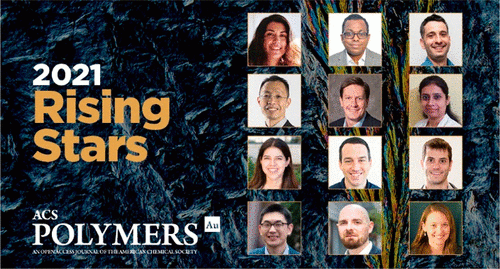
Blair Brettmann Named 2021 Rising Star by American Chemical Society
Blair Brettmann, assistant professor in the School of Chemical and Biomolecular Engineering (ChBE) and faculty member of the Renewable Bioproducts Institute (RBI) was recognized as a rising star in the February 9, 2022 special issue of ACS Polymers Au journal. The journal is published by the American Chemical Society (ACS), founded in 1876 and chartered by the U.S. Congress. They are one of the world’s largest scientific organizations with membership of over 151,000 in 140 countries.
The editors of ACS Polymers Au invited 13 outstanding early career polymer scientists who have been leading cutting-edge, novel, and impactful research in their independent laboratories to submit peer-reviewed manuscripts for a virtual special issue highlighting the 2021 Rising Stars in Polymers.
Brettmann received her B.S. in chemical engineering from the University of Texas at Austin in 2007 and her Ph.D. in chemical engineering from MIT in 2012 with Bernhardt Trout. Following her Ph.D., Brettmann was a senior research engineer at Saint-Gobain (2012–2014) and a postdoctoral researcher at the Institute for Molecular Engineering at the University of Chicago with Matt Tirrell (2014–2016). Her research focuses on linking molecular to micron-scale phenomena to polymer processing to enable rapid and science-driven formulation and product development. More information about Brettmann and her research can be found here: www.brettmannlab.gatech.edu.
Her article for the special issue is titled “Solvent effects on the elasticity of electrospinnable polymer solutions.” Article DOI: 10.1021/acspolymersau.1c00041.

Blair Brettmann, assistant professor in the School of Chemical and Biomolecular Engineering (ChBE) and faculty member of the Renewable Bioproducts Institute
Walter Rich
Agribusiness and Forest Product Innovations Among Projects Emphasized In NIFA Director Tour of Georgia Tech
Feb 15, 2022 — Atlanta, GA

In January, Georgia Tech hosted Carrie Castille, director of the National Institute of Food and Agriculture (NIFA), on campus to show Georgia Tech’s impact on food processing, agricultural, and forestry research.
NIFA, which operates within the U.S. Department of Agriculture, was created in 2008 to further enhance the nation’s agricultural research and education. The agency works to address the agricultural issues affecting people’s daily lives and the nation’s future by partnering with other federal agencies, universities, and nonprofits. NIFA funds research and educational initiatives in order ensure the long-term viability of agriculture in the United States.
Agriculture and forestry are serious business here in the state of Georgia. According to the University of Georgia’s Center for Agribusiness and Economic Development, Georgia’s forest industry accounts for a total economic contribution to the state of $17.7 billion and supports more than 73,300 jobs in Georgia. Agriculture contributes approximately $73.3 billion annually to Georgia's economy and ranks No. 1 in the U.S. for broilers, hatching eggs, and peanuts. One in seven Georgians works in agriculture, forestry, or related fields. While Georgia Tech is not a land-grant university, Georgia Tech researchers work alongside university partners across the state, merging engineering and technology expertise with partners in traditional agricultural sciences.
Castille and her staff met with researchers at Georgia Tech’s Renewable Bioproducts Institute (RBI) along with GTRI’s Agricultural Technology Research Program (ATRP). RBI creates a competitive edge and insight into the future of forest products. Their professional scientists and engineers work together to provide information and offer solutions required by a rapidly changing market. GTRI’s ATRP is a state-funded research program meant to help Georgia’s agriculture economy and poultry industry. ATRP drives transformational innovation, developing new methods and systems specifically designed for poultry, agribusiness, and food manufacturing applications. These innovations are created to maximize productivity and efficiency, advance safety and health, and minimize environmental impacts. Their goal is to transition technologies from concept to commercialization, as quickly and economically as possible.
Blair Meeks
wmeeks7@gatech.edu
Assistant Vice President External Communications
Researchers Discover Crystalline Zeolites in a Nanotubular Shape
Jan 27, 2022 — Atlanta, GA

Zeolites, which are crystalline porous materials, are very widely used in the production of chemicals, fuels, materials, and other products.
Zeolites, which are crystalline porous materials, are very widely used in the production of chemicals, fuels, materials, and other products. So far, zeolites have been made as 3D or 2D materials. This has changed with the recent discovery of crystalline zeolites in a nanotubular (1D) shape, by researchers at the Georgia Institute of Technology, Stockholm University, and Penn State University. The findings were published in the Jan. 6 issue of Science.
"A discovery like this is one of the most exciting parts of our research," said Sankar Nair, principal investigator and professor in the School of Chemical & Biomolecular Engineering at Georgia Tech. "We're increasingly used to doing research that has a pre-determined application at the end of it, so this is a reminder that fundamental discoveries in materials science are also exciting and important."
Zeolites have pores roughly the size of many types of molecules, and scientists and engineers have used the varied sizes, shapes, and connections of the pores to discriminate between molecules of different sizes, allowing for the production of chemicals suitable for plastic production, or for the separation of undesired molecules from desired ones, as examples.
The team was designing syntheses to assemble 2D zeolite materials. In an unexpected turn of events, some of the results indicated that a new type of assembly process was occurring. Indeed, one such case led to a novel 1D zeolite material that had a tube-like structure with perforated porous walls. This 1D material, termed a zeolitic nanotube, was unlike any zeolite ever synthesized or discovered in nature previously.
"Zeolite nanotubes could be used to make entirely new types of nanoscale components that can control transport of mass or heat or charge, not only down the length of the tube the pipe, but also in and out through the perforated walls," said Nair.
Resolving the detailed arrangement of the atoms in the zeolite nanotube was a challenging task, for which the Georgia Tech researchers teamed up with zeolite crystallography experts at Stockholm University and Penn State. They found that the nanotube walls had a unique arrangement of atoms that are not known in 3D or 2D zeolites. This same arrangement is also responsible for forcing the zeolite to form as a 1D tube rather than a 2D or 3D material.
"This is the first example of a new class of nanotubes, and its unique and well-defined structure provides exciting ideas and opportunities to design zeolite nanomaterials," said Tom Willhammar, co-investigator and researcher at Stockholm University. "Through further work, we hope that different zeolitic nanotubes could be obtained with variations in pore size, shape and chemistry."
Put plainly—a nanometer-scale tube made from a 1D material with regular, perforated holes on the sides is now available for exploration. In addition to this being a fundamental scientific discovery that could change the way we think about designing porous materials, the researchers see potential for many practical applications.
"The unique structural attributes of these materials will allow for an array of potential applications in membrane separations, catalysis, sensing, and in energy devices where mass or energy transport are crucial," said Christopher W. Jones, co-principal investigator and professor at Georgia Tech. "The materials may have unique mechanical properties, as well, finding applications in composite materials, as carbon nanotubes have done. At this stage, the sky is the limit, and we hope researchers will look for creative ways to deploy these materials for the benefit of humanity."
Walter Rich
Researchers Using $5.3 Million in DoE Funding to Reduce Energy, Water Consumption, and Emissions in Fiber Composite Products and Wallboard Manufacturing
Jan 25, 2022 — Atlanta, GA

Cyrus Aiden, Devesh Ranjan, and Srinivas Garimella
Two teams of researchers from the George W. Woodruff School of Mechanical Engineering have received Department of Energy funding to work with corporate partners to reduce the energy consumption and carbon emissions of energy intensive manufacturing processes.
Principal investigator Professor Cyrus Aidun, along with Eugene C. Gwaltney Jr Chair Devesh Ranjan, have received $3 million dollars in funding from the DoE for their work on advanced multiphase (MP) forming for enhanced efficiency of drying paper, tissue, board, nonwovens and other fiber composite products. The research is being conducted with Sandia National Lab and industry partners Kimberly-Clark and Solenis. In response to receiving the award, Professor Aidun said, "I am pleased that Department of Energy has recognized our research in multiphase forming to be a transformative technology that significantly reduces the need for fossil fuel energy and water consumption in a major manufacturing industry."
This industry is the third largest consumer of energy within the United States. The research team headed by Aidun is working to provide energy savings to the industry by bringing MP forming to large-scale commercial applications. The process of MP forming involves replacing a traditionally water-based carrier fluid with high-density (HD) foam within the manufacturing process of fiber-based materials. The reduction in water allows for an additional 30% reduction in the demand of evaporative drying, resulting in less energy consumption. In comparison to traditional methods of manufacturing, MP forming results in a 25% decrease in CO2 emissions. When fully integrated into a dedicated facility, the decrease in CO2 emissions could potentially reach 50%.
A large focus of Aidun’s research is on overcoming the barriers that are currently preventing MP forming from being used in commercial applications. Many of the complications stem from HD foam containing significantly different flow characteristics than water. Additional research into its behavior and how to manage it within commercial implementations is required. The focus of that research will be on achieving a deeper understanding of how fibers are suspended within HD foam and how to consistently orient the fibers for creating certain products.
Srinivas Garimella, the Hightower Chair in Engineering and Director of the Sustainable Thermal Systems Laboratory in the Woodruff School, received a $2.3 million grant from the Department of Energy for research on “Advanced Techniques for Energy Input Reduction in Gypsum Wallboard Drying.”
Garimella and the Georgia Tech Research Corporation are working with the largest wallboard manufacturer in the world, Saint-Gobain, to reduce energy, water consumption, and carbon emissions in the manufacture of gypsum board. Gypsum wallboard manufacturing is a $22.5 billion dollar industry, which involves significant energy use and carbon dioxide emissions, consuming 445 kWh of energy per ton of product while producing 80 kg/ton of CO2 emissions. According to Garimella, “This project has significant potential to disrupt an energy-intensive industry and can lead to energy savings of more than 2.1 × 10⁷ GJ annually.” The partnership between Garimella and Saint- Goblin is committed to reimagining the manufacturing process and reduce the industry’s carbon footprint.
In this three-year collaboration, the team will develop and implement microwave-based calcination and particle size optimization for the slurry to achieve the goals of reducing water and energy consumption in the production of gypsum wallboard. With the funding from this award, Garimella and his team have the potential to increase efficiency and hit their goal of a 50% reduction in energy consumption and CO2 emissions in the manufacture of gypsum wallboard.
Combined, the two projects have the potential to reshape resource intensive manufacturing processes and reduce the environmental impact of paper, tissue, board, nonwovens and gypsum board production in Georgia and around the world.
FUNDING: These projects are being funded by the Advanced Manufacturing Office of the DOE Office of Energy Efficiency and Renewable Energy, award numbers DE-EE0009394 and DE-EE0009396.
Walter Rich
Producing Active Pharmaceutical Ingredients from Lignin using Green Chemistry
Jan 11, 2022 — Atlanta, GA

Green Chemistry Journal (Header). Pictured: wood pulp is a major source for lignin.
Lignin, which is second to cellulose as the most abundant organic material on Earth, could be a source for the production of active pharmaceutical ingredients (APIs) using Green Chemistry production processes that reduce waste. APIs are the central part of any drug that produce the intended beneficial effect. (Other parts of the drug, called the excipient, aid in the delivery of the API medication to the targeted area of the human body).
Lignin, an abundant renewable material, can be converted to phenol and catechol, which can then be further converted into four important APIs: paracetamol (Tylenol®), acetyl salicylic acid (Aspirin®), amoxicillin (as sole API or as combination with potassium clavulanate (Augmentin®), and epinephrine (adrenaline, known also as trademark Adrenaline®).
A perspective paper by a team of Georgia Tech researchers focused on these important ingredients examines API production from renewable materials, in this case Lignin as the renewable material, and how Green Chemistry production could combine a low environmental footprint with high quality and economical manufacture of pharmaceuticals using Lignin.
Their paper, “Production of active pharmaceutical ingredients (APIs) from lignin-derived phenol and catechol,” was published in the October 7, 2021 issue of Green Chemistry.
The research team that wrote the paper include: Andreas Bommarius, professor of Chemical and Biomolecular Engineering at the Georgia Institute of Technology; Carsten Sievers, associate professor in the School of Chemical and Biomolecular Engineering at the Georgia Institute of Technology; Jimin Park, a Ph.D. student in the Georgia Tech School of Chemical and Biomolecular Engineering; Jason Kang, Siddarth Seemakurti, and Jasmine Ramirez, who are each pursuing a Bachelor of Science in the Georgia Tech School of Chemical and Biomolecular Engineering; Marta Hatzell, an associate professor in the Woodruff School of Mechanical Engineering at the Georgia Institute of Technology; and Megan Kelly, a graduate student at the University of Wisconsin. Park, Sievers, and Bommarius are affiliated with Georgia Tech’s Renewable Bioproducts Institute.
APIs are traditionally created by pharmaceutical companies and most of this production has shifted oversees where costs of production are lower than the USA and Europe. (As a result, rigorous guidelines and inspections have been put into place when these API ingredients are imported).
API production often suffers from unfavorable Green Chemistry metrics. Green Chemistry is a new way of thinking about how chemistry and chemical engineering (i.e. processes) are done. Benefits of applying Green Chemistry can include conserving energy, producing less hazardous substances, creating more sustainable processes, producing less waste, producing less pollution, using renewable feedstocks, designing systems holistically using life cycle thinking, etc.
With current supply chain disruptions, there has been renewed interest in reshoring drug production. New initiatives, such as the Food and Drug Administration’s (FDA) Emerging Technology Program, have tried to reduce barriers to advanced manufacturing techniques that can make domestic production more economically attractive. A collaboration between the FDA and the Biomedical Advanced Research and Development Authority (BARDA) is trying to develop mobile manufacturing platforms to produce APIs on demand near point of care. Furthermore, the European Commission has been proposing road maps to reduce dependence on outsourced products and secure Europe's supply chain.
Lignin, the second most prevalent component of plant biomass after cellulose, fills several criteria for a desirable fossil resource substitute through its abundance, renewability, and carbon neutrality. However, it is difficult to convert because it naturally occurs in a heterogeneous composite of cellulose, hemicellulose, and lignin from which it must first be liberated. In addition, lignin itself is complex, irregular, and highly oxygenated, and its purpose of providing rigidity in the plant cell wall contributes to its resistance to biomass conversion.
Despite these difficulties, much progress has been made on overcoming them through a focus on the fractionation of lignocellulose, depolymerization of lignin, and upgrading the resulting monomers into valuable products.
Walter Rich
Best Practices for Hybrid Meetings
Learn how to hold inclusive meetings with everyone, when your team is both on campus and remote.
Learn the flexibility Microsoft Teams offer for meeting participation where everyone can easily be seen and heard.
___________
This drop-in training session can be found in Microsoft Teams in the "Microsoft 365 Training" Team.