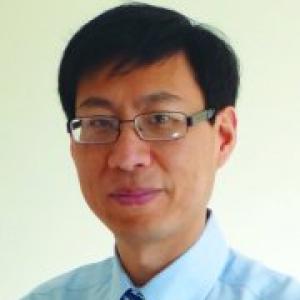
Frank Rosenzweig

Frank Rosenzweig

Frank Rosenzweig is a Professor in School of Biological Sciences. He holds Bachelors degrees in Comparative Literature and Zoology from University of Tennessee-Knoxville, and a PhD in Biology at University of Pennsylvania. He carried out postdoctoral studies at the University of Michigan. He was a professor at University of Idaho, University of Florida, and University of Montana before joining the Georgia Tech faculty in 2016. He served as the Director of the NASA Astrobiology Institute funded center “Reliving the Past” from 2015 to 2019.

Marvin Whiteley

Marvin Whiteley

Dr. Whiteley received his B.S. degree in Zoology in 1995 from the University of Texas at Austin and his Ph.D. in Microbiology from the University of Iowa in 2001. His doctoral research involved quorum sensing and biofilm formation in the bacterium Pseudomonas aeruginosa. Following a Postdoctoral Fellowship at Stanford University in 2002, Dr. Whiteley accepted a position as an assistant professor at the University of Oklahoma/Oklahoma Health Sciences Center. In 2006, Dr.

Peter Yunker

Peter Yunker

Dr. Yunker joined Georgia Tech’s School of Physics in 2014 after finishing his biophysics postdoc at Harvard University & New England Biolabs in 2014. Before that, he earned his Ph.D. in Physics from the University of Pennsylvania in 2012 after earning a B.S. in Physics from Texas A&M University in 2005. He has won the Burstein Prize and the Denenstein Award both from UPenn along with the Eric R. Immel Memorial award for Excellence in Teaching at GT. 

Peter’s interests are biophysics, soft matter, and golden retrievers.

Christine Heitsch

Christine Heitsch

Christine Heitsch is Professor of Mathematics at Georgia Tech, with courtesy appointments in Biological Sciences and Computational Science & Engineering as well as an affiliation with the Petit Institute for Bioengineering & Bioscience.

She is also Director of the new Southeast Center for Mathematics and Biology (SCMB), an NSF-Simons MathBioSys Research Center, and finishing her tenure directing the GT Interdisciplinary Mathematics Preparation and Career Training (IMPACT) Postdoctoral Program.

A. Fatih Sarioglu

A. Fatih Sarioglu

A. Fatih Sarioglu received the B.Sc. degree from Bilkent University, Ankara, Turkey in 2003, and the M.S. and Ph.D. degrees from Stanford University in 2005 and 2010, respectively, all in Electrical Engineering.

Kostas Konstantinidis

Kostas Konstantinidis

Dr. Kostas Konstantinidis joined the Georgia Institute of Technology as an Assistant Professor in November 2007. He received his BS in Agriculture Sciences from the Aristotle University of Thessaloniki (Greece) in 1999. He continued his studies at the Center for Microbial Ecology at Michigan State University (East Lansing, MI) under the supervision of Prof. James M. Tiedje, where he obtained a PhD in 2004.

Amit Reddi


Metalloproteins constitute one of the largest classes

Christoph Fahrni

Christoph Fahrni

Christoph Fahrni earned a master’s degree in chemistry from the Federal Institute of Technology (ETH, Switzerland) and a Ph.D. degree in chemistry from the University of Basel (Switzerland). After working as a postdoctoral fellow at Northwestern University (Evanston, IL), he joined the School of Chemistry and Biochemistry at the Georgia Institute of Technology in 1999.

Ronghu Wu

Ronghu Wu

Research in the Wu lab is mainly focused on mass spectrometry (MS)-based proteomics. They are developing innovative methods to globally identify and quantify proteins and their post-translational modifications (PTMs), including glycosylation and phosphorylation, and applying them for biomedical research. Protein PTMs plays essential roles in biological systems, and aberrant protein expression and modification are directly related to various human diseases, including cystic fibrosis, cancer and infectious diseases.

Facundo Fernandez

Facundo Fernandez

Facundo was born in Buenos Aires, Argentina. He received his MSc in Chemistry from the College of Exact and Natural Sciences, Buenos Aires University in 1995 and his PhD in Analytical Chemistry from the same University, in 1999.  In August 2000, he joined the research group of Prof. Richard N. Zare in the Department of Chemistry at Stanford University.  His work focused on several aspects of Hadamard transform time-of-flight mass spectrometry with an emphasis on coupling this technique to capillary-format separation methods.