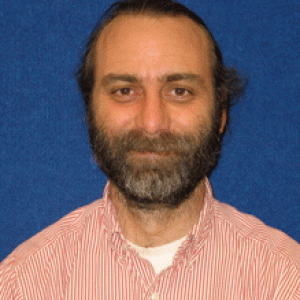
Rebecca Levit

Rebecca Levit

Dr. Levit came to Emory in 2007 after graduating from the University Of Pennsylvania School Of Medicine. She spent 7 years doing research and clinical training in cardiovascular disease. In 2014 she joined the faculty in the Division of Cardiology and is continuing her work on clinically translatable stem cell therapies for cardiovascular disease.

Michael Borich

Michael Borich

I am a rehabilitation neuroscientist keenly interested in the brain's capacity for change in response to rehabilitation after injury or in the context of disease. My work incorporates multimodal neuroimaging and neurostimulation approaches to investigate brain structure and function. The overarching aim of this work is to uncover the key neural substrates supporting motor control and motor learning to enable the design of optimal rehabilitation strategies to maximize recovery of function following neurologic injury.

John Oshinski

John Oshinski

Dr. Oshinski is known for his efforts at advancing the collaboration between Emory University and the Georgia Institute of Technology, as well as his dedication to advancing the technologies of MR imaging. He received his undergraduate degree from Kalamazoo College and BS, MS, and PhD from Georgia Institute of Technology. The underlying mission of his research is the application of engineering principles and technical problem-solving techniques to current clinical problems in the imaging, diagnosis, and treatment of cardiovascular disease.

Nicholas Boulis

Nicholas Boulis

Dr. Nicholas M. Boulis is a neurosurgeon in Atlanta, Georgia and is affiliated with multiple hospitals in the area, including Emory University Hospital Midtown and Grady Memorial Hospital. He received his medical degree from Harvard Medical School and has been in practice for more than 20 years.

Robert Gross

Robert Gross

Dr. Gross’s research interests include: restorative approaches (including cell and gene therapy) for Parkinson's disease and other neurodegenerative disorders; physiology of movement disorders (Parkinson's disease, tremor, dystonia); novel surgical techniques for epilepsy (e.g. deep brain stimulation, cell and gene therapy). In particular, he has been elucidating the role of axon guidance molecules in the development and reconstruction of the nigrostriatal pathway, which degenerates in P.D.

Edmund Waller

Edmund Waller

Dr. Waller specializes in bone marrow transplants for acute leukemia, myelodysplastic syndrome, myeloproliferative neoplasms, lymphoma, aplastic anemia, sickle cell disease and in the management of graft-versus-host disease.

William Brent Keeling

William Brent Keeling

Dr. Keeling earned his medical degree at the University of Louisville in 2001, did his general surgery residency at the University of South Florida School of Medicine from 2001-2008, and completed his cardiothoracic surgery fellowship at Emory in 2011. Dr. Keeling directs the cardiothoracic surgery program at Grady Memorial Hospital and provides clinical service at Emory University Hospital Midtown.

Younan Xia

Younan Xia

Xia is the Brock Family Chair and Georgia Research Alliance (GRA) Eminent Scholar in Nanomedicine in the Wallace H. Coulter Department of Biomedical Engineering at Georgia Institute of Technology and Emory University, with joint appointments in School of Chemistry and Biochemistry, and School of Chemical and Biomolecular Engineering. Professor Xia received his Ph.D. degree in Physical Chemistry from Harvard University (with Professor George M. Whitesides) in 1996, his M.S. degree in Inorganic Chemistry from University of Pennsylvania (with the late Professor Alan G.

Mark Styczynski

Mark Styczynski

Mark Styczynski is an Associate Professor in the School of Chemical & Biomolecular Engineering at the Georgia Institute of Technology (Georgia Tech), doing research at the interface of synthetic and systems biology as applied to metabolic systems. His synthetic biology work focuses on the development of low-cost, minimal-equipment biosensors for the diagnosis of nutritional deficiencies in the developing world. His systems biology work uses computational and experimental methods to characterize metabolic dynamics and regulation using metabolomics data.

Stephen Sprigle

Stephen Sprigle

Stephen Sprigle is a Professor at the Georgia Institute of Technology with appointments in Bioengineering, Industrial Design and the George W. Woodruff School of Mechanical Engineering.