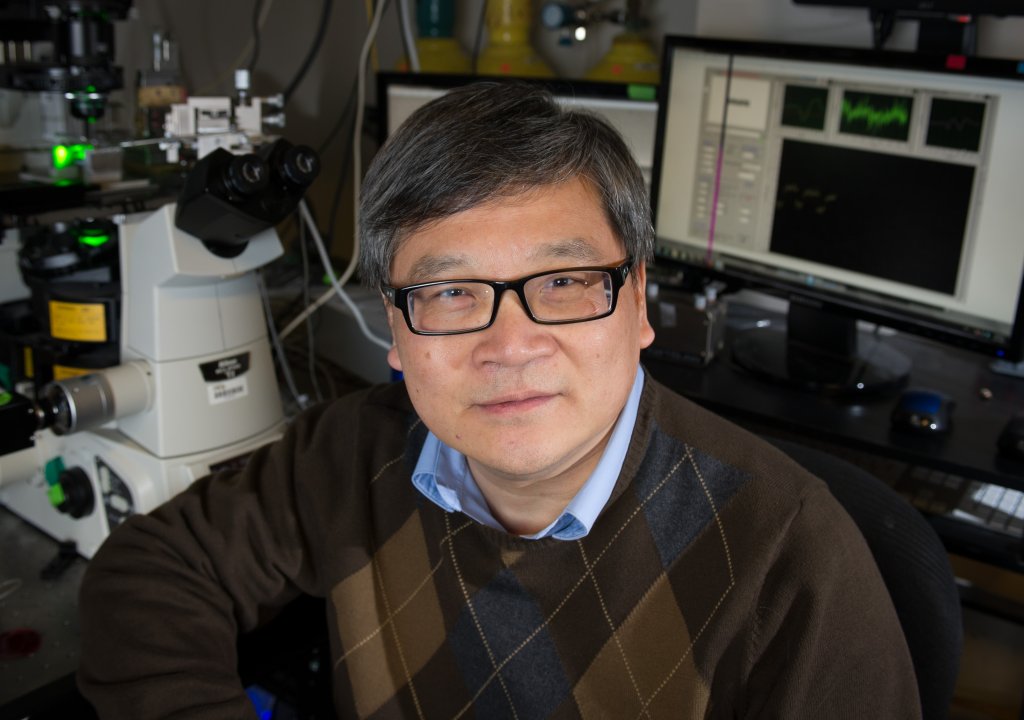
Cheng Zhu

Cheng Zhu
cheng.zhu@bme.gatech.edu
Cellular and Molecular Biomechanics Laboratory

Our interests lie in the adhesion and signaling molecules of the immune system as well as those involved in platelet adhesion and aggregation. We are primarily focused on early cell surface interaction kinetics and their primary signaling responses, as these are critical in determining how a cell will ultimately respond upon contact with another cell. The majority of our work ranges from single molecule interaction studies using atomic force microscopy, molecular dynamics simulations, or biomembrane force probe assays to single cell studies using micropipette adhesions assays, fluorescence imaging techniques, or real-time confocal microscopy. These assays focus on the mechanics and kinetics of receptor-ligand binding and their downstream signaling effects within cells. T cell receptors, selectins, integrins, and their respective ligands are some of the cell surface molecules currently under investigation in our lab. Understanding the initial interaction between molecules such as these and their subsequent early signaling processes is crucial to elucidating the response mechanisms of these physiological systems. Ultimately, our research strives to help better understand the mechanisms within these systems for possible medical applications in autoimmunity, allergy, transplant rejection, and thrombotic disorders. 

Regents' Professor, Coulter Department of Biomedical Engineering
J. Erskine Love Jr. Endowed Chair, Coulter Department of Biomedical Engineering
Executive Director, International Programs, Coulter Department of Biomedical Engineering
Phone
404.894.3269
Office
UAW 1210
Additional Research

BioinformaticsBiomechanicsCell biophysicsElectron MicroscopyMechanobiology

Google Scholar
https://scholar.google.com/citations?hl=en&user=_tPv2wEAAAAJ&view_op=list_works&sortby=pubdate
LinkedIn BME Profile Page
Cheng
Zhu
Show Regular Profile

Younan Xia

Younan Xia
younan.xia@bme.gatech.edu
ChBE Profile Page

Xia is the Brock Family Chair and Georgia Research Alliance (GRA) Eminent Scholar in Nanomedicine in the Wallace H. Coulter Department of Biomedical Engineering at Georgia Institute of Technology and Emory University, with joint appointments in School of Chemistry and Biochemistry, and School of Chemical and Biomolecular Engineering. Professor Xia received his Ph.D. degree in Physical Chemistry from Harvard University (with Professor George M. Whitesides) in 1996, his M.S. degree in Inorganic Chemistry from University of Pennsylvania (with the late Professor Alan G. MacDiarmid, a Nobel Laureate in Chemistry, 2000) in 1993, and his B.S. degree in Chemical Physics from the University of Science and Technology of China (USTC) in 1987. He came to the United States of America in 1991. Xia has received a number of prestigious awards, including the 2013 Nano Today Award, the ACS National Award in the Chemistry of Materials (2013), Fred Kavli Distinguished Lecture in Nanoscience at the MRS Spring Meeting (2013), AIMBE Fellow (2011), MRS Fellow (2009 ), NIH Director's Pioneer Award (2006), ACS Leo Hendrik Baekeland Award (2005), Camille Dreyfus Teacher Scholar (2002), David and Lucile Packard Fellowship in Science and Engineering (2000), Alfred P. Sloan Research Fellow (2000), NSF Early Career Development Award (2000), ACS Victor K. LaMer Award (1999), and Camille and Henry Dreyfus New Faculty Award (1997). Xia has been an Associate Editor of Nano Letters since 2002, and has served on the Advisory Boards of Particle & Particle Systems Characterization (2013-), Chemical Physics Letters (2013-), Chemistry: A European Journal (2013-), Chinese Journal of Chemistry (2013-), Angewandte Chemie International Edition (2011-), Advanced Healthcare Materials (2011-, inaugural chairman of the advisory board), Accounts of Chemical Research (2010-), Cancer Nanotechnology (2010-), Chemistry: An Asian Journal (2010-), Journal of Biomedical Optics (2010-), Nano Research (2009-), Science of Advanced Materials (2009-), Nano Today (2006-), Chemistry of Materials (2005-2007), Langmuir (2005-2010, 2013-2015), International Journal of Nanotechnology (2004-), and Advanced Functional Materials (2001-). He has also served as a Guest Editor of special issues for Advanced Materials (six times), Advanced Functional Materials (one time), MRS Bulletin (one time), and Accounts of Chemical Research (one time).

GRA Eminent Scholar in Nanomedicine, Wallace H. Coulter Department of Biomedical Engineering
Professor, Wallace H. Coulter Department of Biomedical Engineering
Brock Family Chair, Wallace H. Coulter Department of Biomedical Engineering
Professor, School of Chemistry and Biochemistry, and School of Chemical and Biomolecular Engineering
Phone
404.385.3209
Office
MSE 3100J
Additional Research
Catalysis; Nanomedicine; Bio-Inspired Materials; Tissue Engineering
Google Scholar
https://scholar.google.com/citations?hl=en&user=3gDWh4gAAAAJ&view_op=list_works&sortby=pubdate
Nanocages Lab
Younan
Xia
Show Regular Profile

Krishnendu Roy

Krishnendu Roy
krish.roy@gatech.edu
https://engineering.vanderbilt.edu/bio/krishnendu-roy

 In August 2023, Krishnendu Roy joined Vanderbilt University as the Bruce and Bridgitt Evans Dean of Engineering and a University Distinguished Professor in Biomedical Engineering, and Pathology, Microbiology, and Immunology, with a secondary appointment in Chemical and Biomolecular Engineering.

Previously, Roy served as Robert A. Milton Endowed Chair for the Coulter Department of Biomedical Engineering at Georgia Tech. He is also the former Director of the NSF Engineering Research Center (ERC) for Cell Manufacturing Technologies (CMaT), Center for ImmunoEngineering at Georgia Tech, and Marcus Center for Therapeutic Cell Characterization and Manufacturing. 

His overall research interests are in developing novel concepts for stem cell engineering as well as polymer controlled delivery of biological factors, especially for nucleic acid therapeutics (DNA, SiRNA and oligos) and immunoengineering. Currently, his group is involved in the following major areas of research; (a) Developing novel concepts to produce biodegradable surface functionalized micro-and nanoparticles for targeted and sustained delivery of nucleic acids, proteins, peptides and other immune modulators. In particular he is interested in developing multi-agent vaccine delivery systems for cancer and infectious diseases as well as immunotherapies for autoimmune diseases. (b) Creating spatio-temporally patterned polymer scaffolds for directed compartmental differentiation of stem cells into multiple lineages. (c) Engineering an artificial thymic niche for directed differentiation of stem cells into functional, antigen- specific T cells. (e) The development of novel nanoimprinting techniques to generate shape specific, environmentally triggered drug nanocarriers.

Faces of Research - Profile Article

Bruce and Bridgitt Evans Dean of Engineering at Vanderbilt University
University Distinguished Professor
Professor of Biomedical Engineering
Professor of Pathology, Microbiology and Immunology
Professor of Chemical and Biomolecular Engineering
Phone
404.385.6166
Additional Research
The overall goal of our research endeavor is the development of new biomaterial-based strategies for gene/drug delivery and stem cell engineering. Towards this, my laboratory focuses on three major directions: (a) design and development of novel delivery systems for nucleic-acid based immunotherapy and cancer chemotherapy (b) engineering complex microenvironments to study and manipulate stem cells and understand their behavior in biomimetic, three-dimensional conditions and (c) developing novel engineering tools and high throughput methods to generate functional T cells and Dendritic cells from stem cells.
Google Scholar
http://scholar.google.com/citations?user=c8qOg2YAAAAJ&hl=en
Roy Lab
Krishnendu
Roy
Show Regular Profile

Wilbur Lam

Wilbur Lam
wilbur.lam@bme.gatech.edu
BME Profile Page

Dr. Wilbur Lam received his B.A. from Rice University in 1995, his M.D. from the Baylor College of Medicine in 1999 and his Ph.D. from the University of California,San Francisco/University of California, Berkeley Joint Graduate Group in Bioengineering in 2008. He completed his Residency in Pediatrics from UCSF in 2002 and was a Postdoctoral Fellow at UC Berkeley from 2008-2010. Dr. Lam's research involves integrating microtechnology ,development, experimental hematology and oncology and clinical medicine. His interdisciplinary laboratory, comprising clinicians, engineers, and biologists, is dedicated to applying and developing micro/nanotechnologies to study, diagnose, and treat blood disorders, cancer, and childhood diseases. This unique "basement to bench to bedside" approach to biomedical research is enabled by our lab's dual locations at the Emory University School of Medicine and the Georgia Institute of Technology and our affiliations with the Children's Healthcare of Atlanta hospitals.

Professor, Wallace H. Coulter Department of Biomedical Engineering
Pediatric Hematologist/Oncologist, Children’s Healthcare of Atlanta
Professor of Pediatrics, Emory University School of Medicine
Phone
404.385.5081
Office
Marcus 3135
Additional Research

Cellular mechanics of hematologic processes and disease, microfluidics, microfabrication, BioMEMs, point-of-care diagnostics, pediatric medicine, hematology, oncology. Our interdisciplinary laboratory, comprising clinicians, engineers, and biologists, is dedicated to applying and developing micro/nanotechnologies to study, diagnose, and treat blood disorders, cancer, and childhood diseases. This unique "basement to bench to bedside" approach to biomedical research is enabled by our lab's dual locations at the Emory University School of Medicine and the Georgia Institute of Technology and our affiliations with the Children's Healthcare of Atlanta hospitals.

Google Scholar
https://scholar.google.com/citations?hl=en&user=-C3ZzToAAAAJ&view_op=list_works&sortby=pubdate
LinkedIn Lam Lab
Wilbur
Lam
A.
Show Regular Profile