
Flamingoes Use Their Feet and Mouths to Set Traps for Their Next Meal
May 20, 2025 —

A new study that better understands how a flamingo uses its mouth and stomp their feet while eating could lead to better water filtration systems.
The study found that the long-legged birds create mini tornadoes while eating upside down. Flamingoes do it by chomping their mandibles, bobbing their head up and down, and marching back and forth to push water into their mouth.
The bird is able to pick out its prey in the swirling vortices, even if the water is muddy or dirty.
Read the story and see a flamingo eating on the College of Engineering home page.
Jason Maderer
College of Engineering
maderer@gatech.edu
Army Vet Guides Student Team in Delivering Digital Solution for Military Operations
May 20, 2025 —

A CS Junior Design Capstone team created a new intake system for the U.S. Army to manage maintenance tasks. Photos by Jonathan Collins.
A team of Computing students has developed a digital intake system for the U.S. Army, which is set to be implemented as early as next month, transforming a time-consuming, paper-based process into an efficient, modern platform.
The project was part of Computer Science Junior Design Capstone Expo, where students collaborate in teams to build functional software solutions for real-world clients. For team members Jonathan Collins, Joel Cave, Srithan Nalluri, Mark Podrazhansky, and Caden Virant, that client was the U.S. Army. School of Computing Instruction Lecturer Aibek Musaev led their Junior Design section.
“The Army spends a significant amount of time maintaining, documenting, and repairing equipment that allows them to complete their mission,” said Collins, a U.S. Army veteran. “Our system essentially took the current maintenance process and converted it from an entirely paper-based process to a completely digital one.”
The team built a streamlined web application utilizing a set of modern tools that enhance data management, create a user-friendly interface, and ensure seamless operations. The new system improves accountability and visibility across Army maintenance operations by digitizing the intake and tracking processes. It eliminates the risk of lost paperwork and makes it easier for personnel to stay updated on equipment status and repair needs.
2nd Lt. Noah Parsons, the Army’s point of contact for the project, was impressed with both the product and the team’s professionalism.
“Georgia Tech students have completed the intake system to perfection,” Parsons said. “They performed exceptionally and professionally. I cannot stress how great of a job they have done for their class and for the Army as well. Our company intends to start using the intake system as early as next month.”
For Collins, who served four years in the Army before enrolling at Georgia Tech, the experience was meaningful.
“A large part of my role in the Army involved the very maintenance processes we’ve been working to improve,” he said. “I can’t even count how many hours my coworkers and I spent with the current system. Now, being able to use this new chapter of my life to make meaningful improvements feels incredibly rewarding.”
Collins also took the lead in communicating with the military client, helping the team navigate strict requirements and non-negotiable specifications.
With this system, the Army decided what they wanted, and the team was tasked with delivering exactly that with no variation.
The project taught the team critical lessons about ownership, communication, and collaboration under pressure.
“Communication with the client is the absolute most important thing,” Collins said. “You could have the best programmers in the world, but it won’t matter if you can’t deliver the product the client wants. Meeting often and getting consistent feedback was key.”
The Army plans to begin using the system as early as June, bringing the students’ work full circle and marking a meaningful contribution to real-world military operations.

The team's project digitized the Army's maintenance operations with a modern, user-friendly tool.
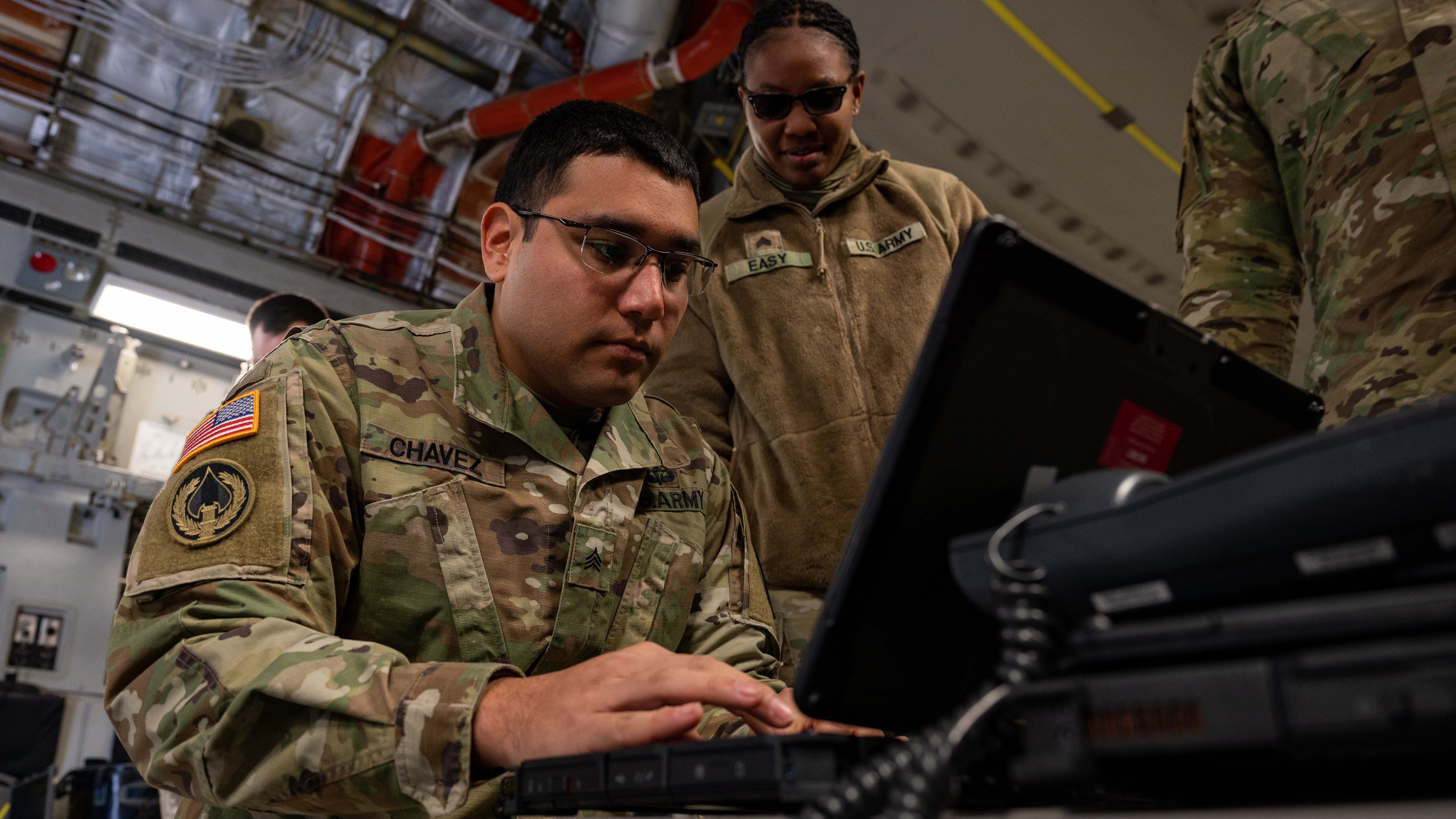
U.S. Army soldiers work on a mission. U.S. Air Force photo by Airman 1st Class Josey Blades/ DVIDS.
Peptides, Persistence, and Publication
May 20, 2025 —

"I'm passionate about this research because of its potential for worldwide impact," says Frooman.
When Marielle Frooman joined the McShan Lab, she brought a strong passion for chemistry, but no lab experience. Today, the fourth-year Georgia Tech biochemistry student is the first co-author of a groundbreaking malaria study published in Scientific Reports, a Nature Portfolio journal. Through extensive experimentation coupled with computer modeling, Frooman led a team of undergraduate and graduate researchers that uncovered eight peptides that can help the immune system recognize and fight the malaria parasite.
“Malaria kills over 500,000 annually with the mortality rate substantially higher in Africa,” says Frooman. “Our research explores how specific peptides bind to proteins that trigger immune responses.”
Frooman originally hoped the research would help her learn how to think like a scientist and gain basic lab knowledge.
She gained those skills and more, quickly becoming recognized as an exceptional researcher.
“Marielle is one of the most passionate and talented undergraduate researchers I have ever worked with,” says Andrew McShan, McShan Lab principal investigator and associate professor in the School of Chemistry and Biochemistry. “She is also a caring mentor and motivated future leader who wants to change the world. Her malaria research has the potential to provide real therapeutic outcomes, including better designs for vaccines and immunotherapy.”
From curiosity to contribution
Frooman’s journey into undergraduate research began with persistence. After a year and a half of searching for lab opportunities, she attended a School of Chemistry and Biochemistry research showcase. She approached several graduate students and professors with no success, until she met McShan.
“Our first meeting was so relaxed and friendly that I didn’t even realize Professor McShan was the principal investigator,” admits Frooman. “That’s how it all started.”
Once she officially joined the lab, Frooman contributed to every stage of the research, including designing experiments, performing computational and wet lab work, analyzing data, and writing and presenting the paper.
Lessons in resilience
The team faced several challenges.
“The research was delayed by failure after failure,” says Frooman. “But each setback taught us something valuable.”
The team’s biggest challenge involved trying to grow crystals of the peptide/HLA (protein) complexes to determine how they fit together. They spent two years attempting various methods, but nothing worked.
Guided by McShan, Frooman and the team then came up with the idea of using computational modeling to enable a deeper understanding of how the peptides and proteins interact at both biophysical and structural levels.
“Utilizing the computational modeling enabled us to see the best bindings and turned into a game-changing insight for our research, potentially leading to the design of more effective malaria treatments and vaccines,” explains Frooman.
She is quick to credit Georgia Tech and McShan for providing her with such a valuable learning experience.
“At many universities, undergraduates rarely do meaningful research, but at Tech, it’s a priority,” explains Frooman. “I’m extremely grateful for the opportunity to grow in such a supportive environment, and to learn from mentors like Professor McShan who lead by example and make time for every student.”
Her advice to other undergraduates entering research?
“Embrace your failures. They make the successes even more rewarding,” shares Frooman.
Outside the lab
On campus, Frooman is president of the Student Affiliates of the American Chemical Society and Cleanup Crew at GT, a member of Alpha Phi International Fraternity, and a campus tour guide who serves on their executive board.
She especially loves being a tour guide as it allows her to share her love of Georgia Tech and its people:
“Everyone is unapologetically themselves and fully invested in their major or interests. As someone who loves chemistry, I enjoy being surrounded by people who are just as dedicated to their passions.”
Frooman is a recipient of the Chance Family Scholarship, presented to two School of Chemistry and Biochemistry upperclassmen, recognizing their academic excellence, research contributions, and potential for career success in the field.
Recently, she shifted her research focus to organic synthetic chemistry and now works in the Gutekunst Lab. Her career goals include earning a Ph.D. in Chemistry with an emphasis on natural product synthesis, the lab-based creation of complex chemical compounds found in nature.
“I’ve seen what university labs can do,” says Frooman. “I hope to one day lead my own lab, advancing impactful research and mentoring the next generation of scientists.”
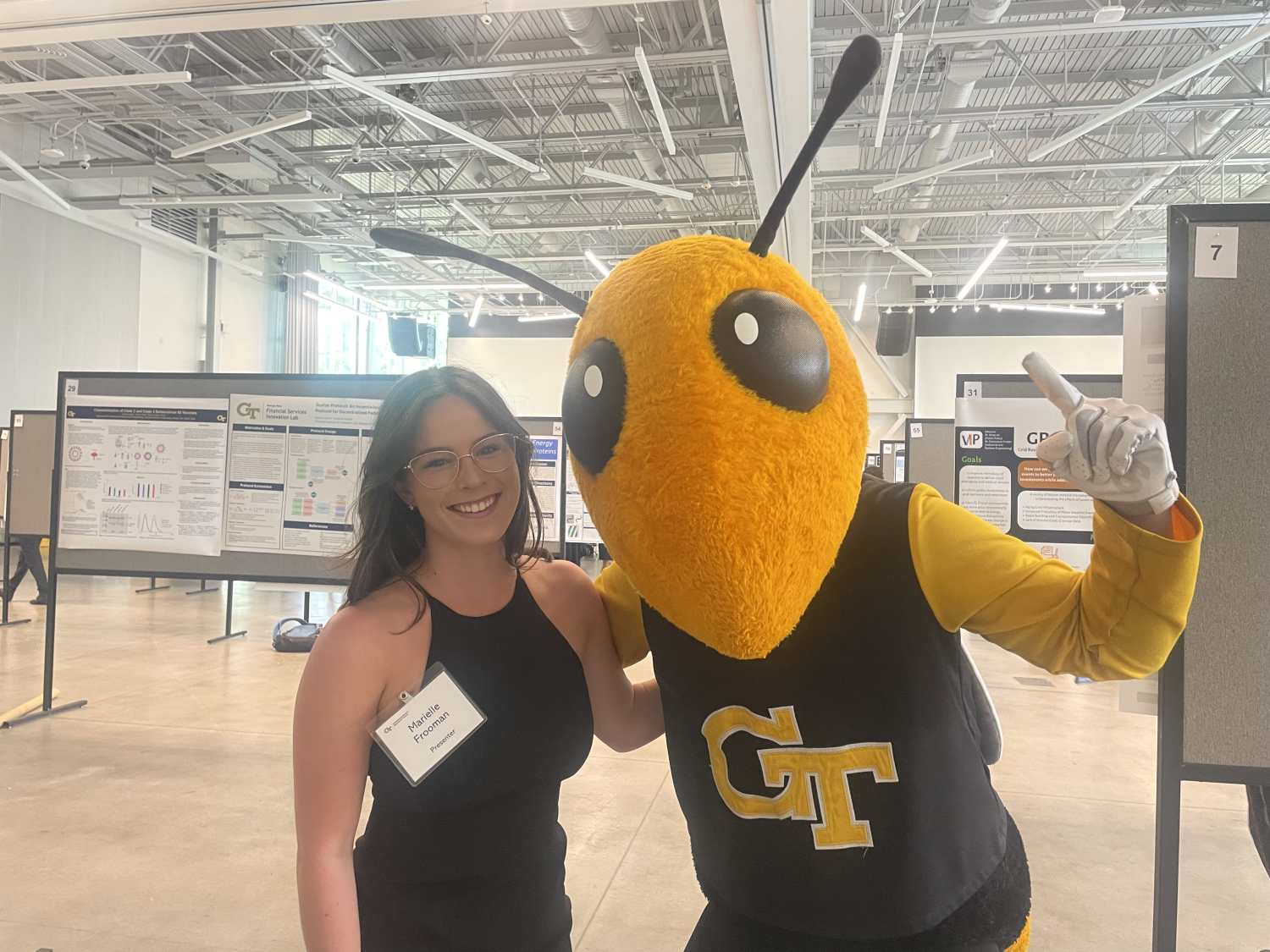
Frooman's Georgia Tech honors include the President’s Undergraduate Research Award and the Judith Priddy Award, given to a Panhellenic woman with demonstrated high scholarship and leadership.
Writer: Laura S. Smith
Painting a Target on Cancer to Make Therapy More Effective
May 19, 2025 —

The combination approach that Lena Gamboa, seated, Gabe Kwong, foreground, and Ali Zamat developed tags the tumors with a synthetic "flag" then uses specially engineered cells from the patient's own immune system to attack the cancer. They found their approach worked against hard-to-treat breast, brain, and colon cancers. it also turned the cancer into an immune system training ground, allowing the body to recognize and fight any tumors that regrow. (Photo: Candler Hobbs)
Biomedical engineers at Georgia Tech created a treatment that could one day unlock a universal strategy for treating some of the hardest-to-treat cancers — like those in the brain, breast, and colon — by teaching the immune system to see what it usually misses.
Their experimental approach worked against those kinds of cancers in lab tests and didn’t damage healthy tissues. Importantly, it also stopped cancer from returning.
While the therapy is still in early stages of development, it builds on well established, safe technologies, giving the treatment a clearer, quicker path to clinical trials and patient care.
Reported in May in the journal Nature Cancer, their technique is a one-two punch that flags tumor cells so they can be recognized and then eliminated by specially enhanced T cells from the patient’s own immune system.
Joshua Stewart
College of Engineering
Self-Regulating Soft Oscillators Enable Battery-Powered Motion in Soft Robots
May 12, 2025 —

Soft robots are known for their flexibility and adaptability, but most still rely on rigid electronic components for control and timing. A recent publication from researchers at Georgia Tech challenges that paradigm.
Noah Kohls, Ph.D. ME 2024, and Ellen Yi Chen Mazumdar, assistant professor in the George W. Woodruff School of Mechanical Engineering, recently published a new study featured on the cover of Advanced Materials Technologies. The paper describes the development of the first self-regulating soft electromagnetic oscillators. These actuators are also the first to operate using only a battery—no external microcontrollers, pumps, or logic circuits are required.
Read the full story on the George W. Woodruff School of Mechanical Engineering website.
George W. Woodruff School of Mechanical Engineering
Preparing to Study Venus’ Clouds
May 16, 2025 —

As Rocket Lab prepares to launch a mission to Venus next year, a multidisciplinary research team led by Georgia Tech braved an erupting volcano recently to test an instrument custom-built to explore Venus’ clouds and look for signs of organic chemistry. If successful, the 2026 launch will mark the first private spacecraft to reach Venus, and the first U.S. mission to study its sulfuric acid-filled clouds in nearly 40 years.
The instrument, the autofluorescence nephelometer (AFN) built by Droplet Measurement Technologies, will fire a laser beam out a window and use light scattering from individual particles to measure the size and composition of the planet’s aerosols, the tiny particles that make up the clouds. The AFN will only have about five minutes to collect data as the small probe falls through the clouds, and another 15 minutes to send data back to Earth before things get too extreme. The probe is not expected to reach the surface, where it is hot enough to melt lead, and the pressure is 90 times that of Earth’s surface.
Georgia Tech oversees all of the instrument’s field tests and modeling. The project, called VENUSIAN, is led by Christopher E. Carr, assistant professor in the Daniel Guggenheim School of Aerospace Engineering, with funding from NASA’s PSTAR program.
NASA also built a heat shield for Rocket Lab’s spacecraft and will provide navigation and communications support through the Deep Space Network.
“Is there life in the clouds of Venus? I don’t think so, but if it’s there, I want to find it,” says Carr, who admits that the more he studies Venus, the more interesting it becomes.
Collecting Volcanic Molecules
In March, his team tested the AFN in the field, flying it on a drone through Hawaii’s volcanic fog, a haze that forms because of volcanic emissions. The droplets are rich with sulfuric acid, similar to Venus’ atmosphere.
“We got some valuable data,” says Carr. “This was the first time for our whole team from different institutions to be together in one place.”
Collaborators from the Massachusetts Institute of Technology (MIT), the University of Colorado-Boulder, which managed and flew the drones, and Droplet Measurement Technologies joined the Georgia Tech contingent in Hawaii.
Sara Seager, professor of physics, professor of aeronautics and astronautics, and Class of 1941 Professor of Planetary Science at MIT, who serves as the science principal investigator for the Rocket Lab mission, emphasized the critical testing role Georgia Tech is playing ahead of the mission to Venus.
“Building the instrument is important, but what is also important is knowing how you’re going to interpret data when you get back. To understand that you need to use the instrument over and over again here on Earth. Professor Carr taking a lead on that from a science perspective is important,” says Seager, who will oversee two subsequent Morning Star Missions to Venus that the team envisions will culminate in an atmosphere sample return.
The Kilauea volcano, located in Hawaii Volcanoes National Park on the Big Island, began erupting as soon as the team started their first drone flight. The eruption grew more intense on the second day, giving the researchers a chance to run the AFN through its paces. While the flight test results are still preliminary, the team indicated that the instrument did detect volcanic ash and volcanic smog, which bodes well for the Venus mission.
“It was cool to see our instrument in action,” says Snigdha Nellutla, a research engineer and data modeler, who recently finished her master’s in aerospace engineering. She simulates the AFN’s output in different environmental conditions, both during the Hawaii field tests and on the actual mission to Venus.
In Search of a Carbon Cycle
“We’re seeking evidence of a carbon cycle in the Venus atmosphere,” she said. “Life as we know it on Earth is carbon-based. Carbon compounds are delivered to Venus from meteorites. Are they rapidly degraded or do they persist in some form?”
Billions of years ago, Venus may have had as much water as Earth — but at some point in its evolution, carbon dioxide in the planet's atmosphere triggered an intense runaway greenhouse effect. This sent temperatures soaring, causing the planet's water to evaporate, and the hydrogen part of the water (H2O) was lost to space.
In 2020, astronomers detected phosphine in Venus’ atmosphere. This gas, often associated with biological activity on Earth, could signal signs of life. While the presence of phosphine is now debated, a rash of recent discoveries suggests that organic chemistry in the clouds could be much more complex than previously considered.
While Venus’ extreme surface temperatures are well documented, the one exception is found in the middle cloud layers, which have habitable temperatures. By looking at individual particles within the Venus atmosphere, researchers hope to learn about other compounds that could exist, including organic molecules that could influence a carbon cycle. The Hawaii measurements will serve as an important baseline to compare against what will be gathered on Venus.
The Smoking Gun of Organics
The mission to Venus will also measure fluorescence, considered “a smoking gun” for possible organic materials, says Carr.
On Venus’ super-rotating atmosphere, clouds take four Earth days to travel around the planet, while the planet spins in the same direction approximately 50 times slower.
“The differences with Venus’s atmosphere compared with Earth have forced our whole team to look at how we approach astrobiology completely differently,” he explains. “When we think of finding signs of life, we follow the water, but Venus has no water; it’s sulfuric acid.”
To Carr, the importance of the mission is to better understand Venus’ chemistry, given that sulfuric acid and water have different properties, which can contribute to or limit the kind of chemistry that can occur.
“By understanding what might be possible, we can learn if different types of life might be possible. It also helps us know what to look for when we look for life,” he says. Even if there is no life in the clouds of Venus, there is likely to be interesting chemistry, based on extensive testing by members of the science team. This chemistry could be detected by the AFN as fluorescent aerosol particles.
VENUSIAN has enabled Georgia Tech aerospace engineering students to get a rare opportunity to test and model hardware that will fly in space.
Students Celebrate Teamwork, Space Aspirations
“As a first-year, I’ve had a variety of tasks, and that’s been fun for me as someone who is just starting to explore my career possibilities,” says Violet Oliver, who oversees the ground sampling tests. “This has been a really good introduction — getting my feet wet in what future space missions might look like and, more broadly, what the engineering test cycle looks like.”
“The biggest thing we learned was how to work together as a team,” adds Cassius Tunis, a senior in aerospace engineering. He managed the logistics, designed hardware to integrate the AFN and the drone, and served as the field study’s test engineer during the flights, where he communicated with the pilots and tracked their flight pattern.
“It’s been a goal of mine to work in the space industry since high school,” he said, crediting VENUSIAN with helping him pinpoint his career direction. “I see myself as the resident test engineer. Test engineering is a very operational, multidisciplinary field within aerospace. You get to wear a lot of different hats and interact with people of all different backgrounds.”
Carr indicated that the team will return to Hawaii later this year for final AFN field testing before the Venus mission.
Looking to the 2026 launch, Seager says, “I’m looking forward to a safe launch and getting exciting data back. It’s Venus’ moment to shine,” she added, calling Venus the “quiet, overlooked gem” to Mars and Earth.
Carr expressed admiration for Rocket Lab’s founder and CEO, Peter Beck, whose passion for the Venus mission is well documented.
“He exudes the true curiosity of a scientist and explorer. In Rocket Lab, we have a partner that is excited by discovery.”
News Contact: Laurie Haigh
Writer: Anne Wainscott-Sargent
AI Chatbots Aren’t Experts on Psych Med Reactions — Yet
May 14, 2025 —

The study was led by computer science Ph.D. student Mohit Chandra (pictured) and Munmun De Choudhury, J.Z. Liang Associate Professor in the School of Interactive Computing.
Asking artificial intelligence for advice can be tempting. Powered by large language models (LLMs), AI chatbots are available 24/7, are often free to use, and draw on troves of data to answer questions. Now, people with mental health conditions are asking AI for advice when experiencing potential side effects of psychiatric medicines — a decidedly higher-risk situation than asking it to summarize a report.
One question puzzling the AI research community is how AI performs when asked about mental health emergencies. Globally, including in the U.S., there is a significant gap in mental health treatment, with many individuals having limited to no access to mental healthcare. It’s no surprise that people have started turning to AI chatbots with urgent health-related questions.
Now, researchers at the Georgia Institute of Technology have developed a new framework to evaluate how well AI chatbots can detect potential adverse drug reactions in chat conversations, and how closely their advice aligns with human experts. The study was led by Munmun De Choudhury, J.Z. Liang Associate Professor in the School of Interactive Computing, and Mohit Chandra, a third-year computer science Ph.D. student. De Choudhury is also a faculty member in the Georgia Tech Institute for People and Technology.
“People use AI chatbots for anything and everything,” said Chandra, the study’s first author. “When people have limited access to healthcare providers, they are increasingly likely to turn to AI agents to make sense of what’s happening to them and what they can do to address their problem. We were curious how these tools would fare, given that mental health scenarios can be very subjective and nuanced.”
De Choudhury, Chandra, and their colleagues introduced their new framework at the 2025 Annual Conference of the Nations of the Americas Chapter of the Association for Computational Linguistics on April 29, 2025.
Putting AI to the Test
Going into their research, De Choudhury and Chandra wanted to answer two main questions: First, can AI chatbots accurately detect whether someone is having side effects or adverse reactions to medication? Second, if they can accurately detect these scenarios, can AI agents then recommend good strategies or action plans to mitigate or reduce harm?
The researchers collaborated with a team of psychiatrists and psychiatry students to establish clinically accurate answers from a human perspective and used those to analyze AI responses.
To build their dataset, they went to the internet’s public square, Reddit, where many have gone for years to ask questions about medication and side effects.
They evaluated nine LLMs, including general purpose models (such as GPT-4o and LLama-3.1), and specialized medical models trained on medical data. Using the evaluation criteria provided by the psychiatrists, they computed how precise the LLMs were in detecting adverse reactions and correctly categorizing the types of adverse reactions caused by psychiatric medications.
Additionally, they prompted LLMs to generate answers to queries posted on Reddit and compared the alignment of LLM answers with those provided by the clinicians over four criteria: (1) emotion and tone expressed, (2) answer readability, (3) proposed harm-reduction strategies, and (4) actionability of the proposed strategies.
The research team found that LLMs stumble when comprehending the nuances of an adverse drug reaction and distinguishing different types of side effects. They also discovered that while LLMs sounded like human psychiatrists in their tones and emotions — such as being helpful and polite — they had difficulty providing true, actionable advice aligned with the experts.
Better Bots, Better Outcomes
The team’s findings could help AI developers build safer, more effective chatbots. Chandra’s ultimate goals are to inform policymakers of the importance of accurate chatbots and help researchers and developers improve LLMs by making their advice more actionable and personalized.
Chandra notes that improving AI for psychiatric and mental health concerns would be particularly life-changing for communities that lack access to mental healthcare.
“When you look at populations with little or no access to mental healthcare, these models are incredible tools for people to use in their daily lives,” Chandra said. “They are always available, they can explain complex things in your native language, and they become a great option to go to for your queries.
“When the AI gives you incorrect information by mistake, it could have serious implications on real life,” Chandra added. “Studies like this are important, because they help reveal the shortcomings of LLMs and identify where we can improve.”
Citation: Lived Experience Not Found: LLMs Struggle to Align with Experts on Addressing Adverse Drug Reactions from Psychiatric Medication Use, (Chandra et al., NAACL 2025).
Funding: National Science Foundation (NSF), American Foundation for Suicide Prevention (AFSP), Microsoft Accelerate Foundation Models Research grant program. The findings, interpretations, and conclusions of this paper are those of the authors and do not represent the official views of NSF, AFSP, or Microsoft.
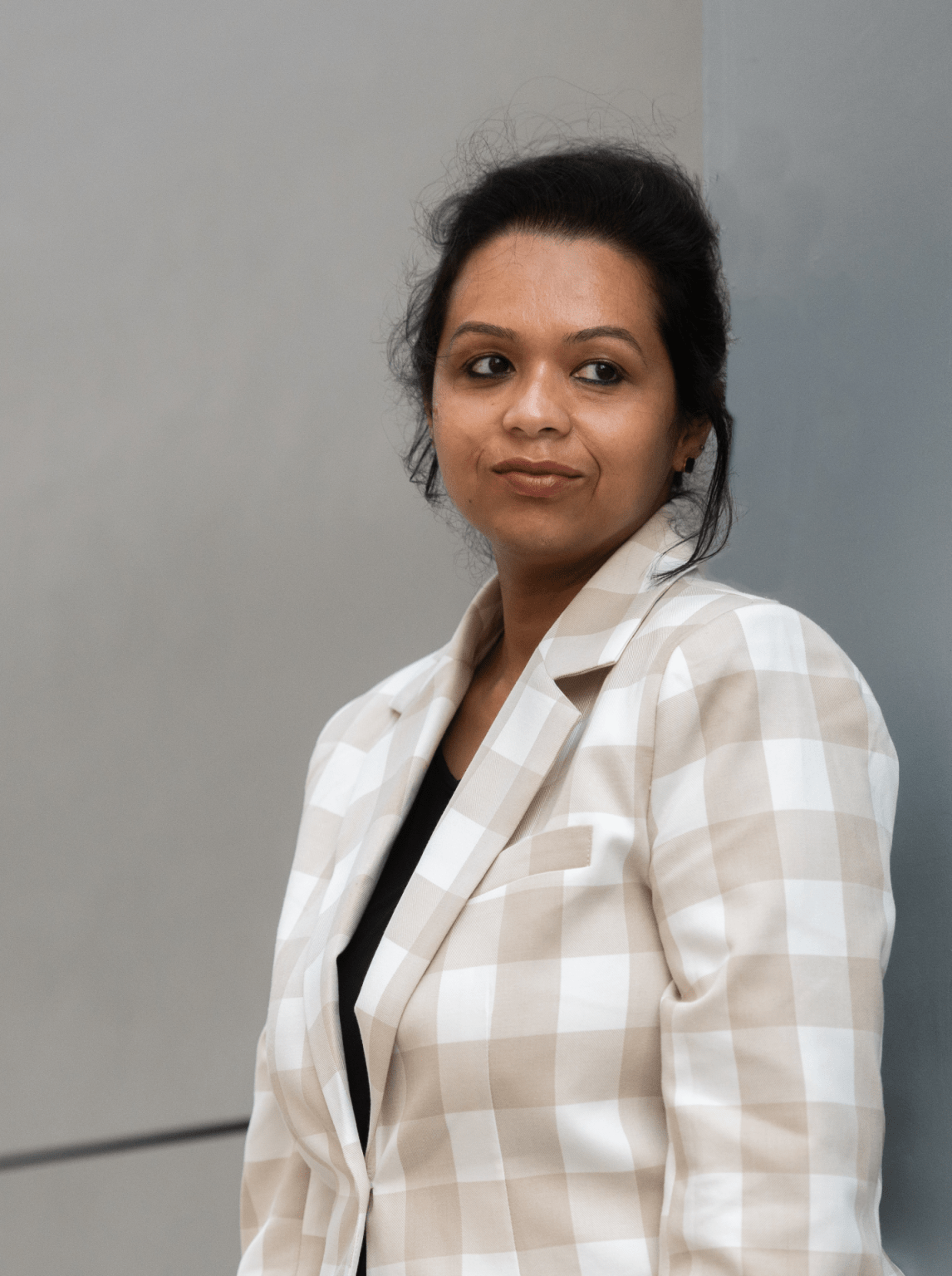
Munmun De Choudhury, J.Z. Liang Associate Professor in the School of Interactive Computing
Catherine Barzler, Senior Research Writer/Editor
Institute Communications
catherine.barzler@gatech.edu
Georgia Tech Celebrates 2025 Ph.D. Graduates in Cybersecurity and Privacy
May 14, 2025 —

The School of Cybersecurity and Privacy at Georgia Tech is proud to recognize the accomplishments of five doctoral students who finished their doctoral programs in Spring 2025. These scholars have advanced critical research in software security, cryptography, and privacy, collectively publishing 34 papers, most of which appear in top-tier venues.
Ammar Askar developed new tools for software security in multi-language systems, including a concolic execution engine powered by large language models. He highlighted DEFCON 2021, which he attended with the Systems Software and Security Lab (SSLab), as a favorite memory.
Zhengxian He persevered through the pandemic to lead a major project with an industry partner, achieving strong research outcomes. He will be joining Amazon and fondly remembers watching sunsets from the CODA building.
Stanislav Peceny focused on secure multiparty computation (MPC), designing high-performance cryptographic protocols that improve efficiency by up to 1000x. He’s known for his creativity in both research and life, naming avocado trees after famous mathematicians and enjoying research discussions on the CODA rooftop.
Qinge Xie impressed faculty with her adaptability across multiple domains. Her advisor praised her independence and technical range, noting her ability to pivot seamlessly between complex research challenges.
Yibin Yang contributed to the advancement of zero-knowledge proofs and MPC, building toolchains that are faster and more usable than existing systems. His work earned a Distinguished Paper Award at ACM CCS 2023, and he also served as an RSAC Security Scholar. Yang enjoyed teaching and engaging with younger students, especially through events like Math Kangaroo.
Faculty mentors included Regents’ Entrepreneur Mustaque Ahamad, Professors Taesoo Kim and Vladimir Kolesnikov, and Assistant Professor Frank Li, who played vital roles in guiding the graduates’ research journeys.
Learn more about the graduates and their mentors on the 2025 Ph.D. graduate microsite.
JP Popham, Communications Officer II
College of Computing | School of Cybersecurity and Privacy
Georgia Tech-Hosted Workshop Spurs Critical Mineral Production and Economic Development
May 12, 2025 — Atlanta, GA

Yuanzhi Tang, Georgia Tech Professor, and Strategic Energy Institute's initiative lead for Sustainable Resources providing an overview of the GEMs-3 initiative and the GRACE Engine at the workshop in Macon, GA
On April 29, nearly 70 attendees representing 36 organizations from industry, government, academia, and nonprofits gathered at the Middle Georgia Regional Commission for the third Georgia Partnerships for Essential Minerals (GEMs) Workshop, held jointly with the Growing Resilience for America’s Critical Mineral Economy (GRACE) Engine initiative. The workshop marked a pivotal step in the region’s critical mineral strategy, bringing together leaders across sectors to align priorities and accelerate ecosystem development.
Hosted by the Center for Critical Mineral Solutions and Strategic Energy Institute at Georgia Tech in partnership with the Middle Georgia Regional Commission, GEMs-3 highlighted the economic development potential of critical minerals through production and recycling. Critical Minerals such as rare earth elements, gallium, and graphite are materials essential for technologies ranging from electric vehicles, permanent magnets to national defense systems. Building on the industry-led conception of GEMs-1 and road mapping efforts at GEMs-2, this workshop focused on translating strategy into action, with particular emphasis on use-inspired innovation, commercialization, workforce development, community engagement, and strategic investment.
Keynote speaker Costas Simoglou, director of the Center of Innovation for Energy Technology at the Georgia Department of Economic Development, emphasized the state’s leadership in advanced energy manufacturing and innovation. Sessions highlighted ecosystem capabilities and insights from experts at Southern Company, Chemours, Ginn Technology Group, Savannah River National Laboratory, Georgia Research Alliance, Georgia Cleantech Innovation Hub, Georgia Artificial Intelligence in Manufacturing, Technical College System of Georgia, University of Georgia, Partnership for Innovation, the Supply Chain and Logistics Institute and the Advanced Battery Center.
Yuanzhi Tang, professor at Georgia Tech and director of the Center for Critical Mineral Solutions, shared an update on the GRACE Engine initiative, which aims to develop a co-located innovation ecosystem that integrates extraction, processing and advanced manufacturing across Georgia. “The GRACE vision is to move from potential to practice,” said Tang, “by building a regional supply chain that is resilient, sustainable, built for speed and benefits all stakeholders.”
Afternoon breakout discussions brought participants together into focused groups to explore commercialization models, community advisory board structures, and pilot program priorities. Participants emphasized the importance of fast-start strategies, shared economic development, and leveraging existing regional strengths and infrastructure.
As Georgia continues to lead in kaolin mining and advanced manufacturing, the GEMs-GRACE platform stands as a model for how states can turn mineral resources and waste streams into new engines of economic opportunity.
For more information, visit gems.research.gatech.edu.
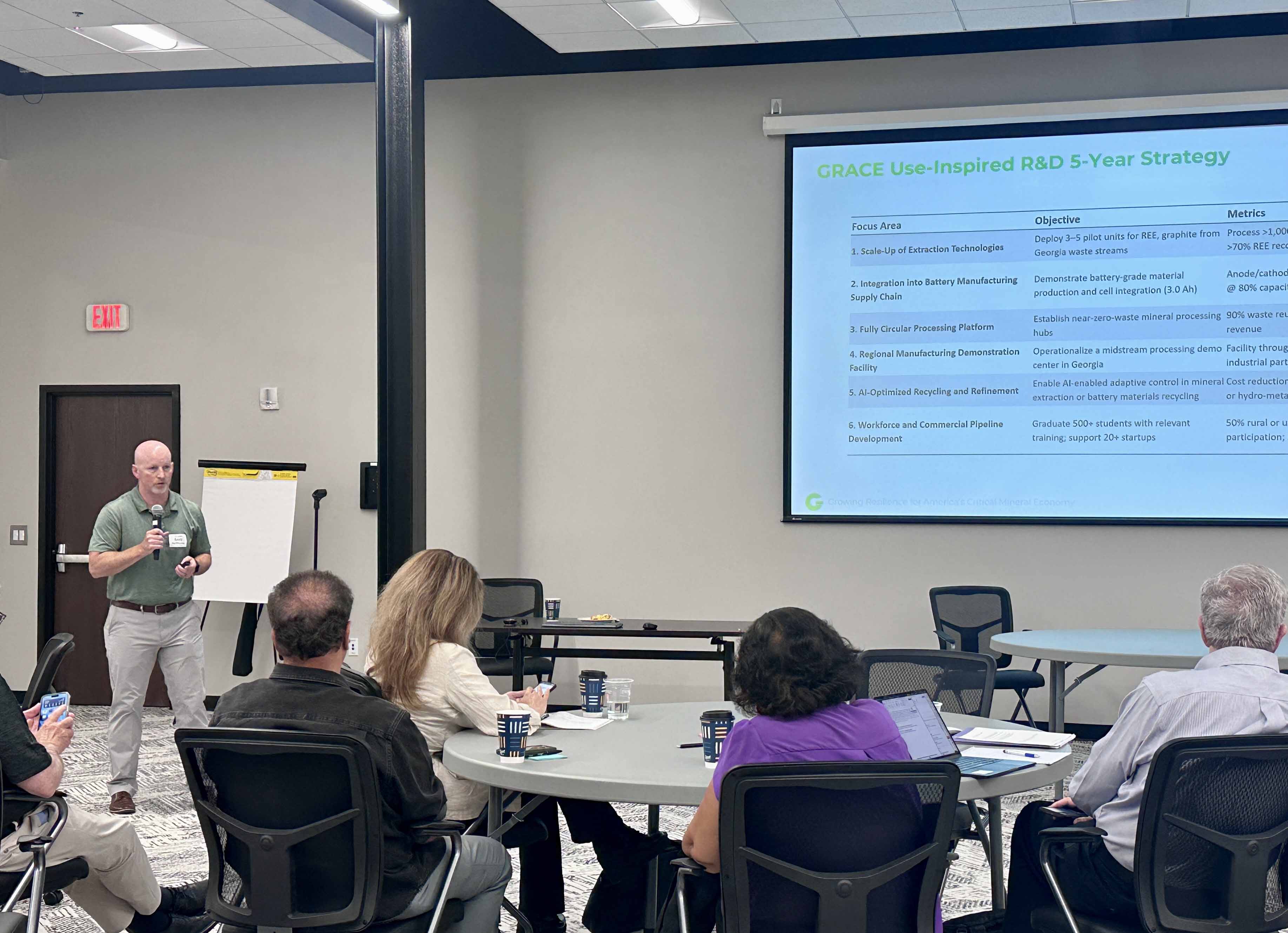
Scott McWhorter, Distinguishied External Fellow and Federal Funding Lead at the Strategic Energy Institute presenting during the GEMs-3 and GRACE Workshop
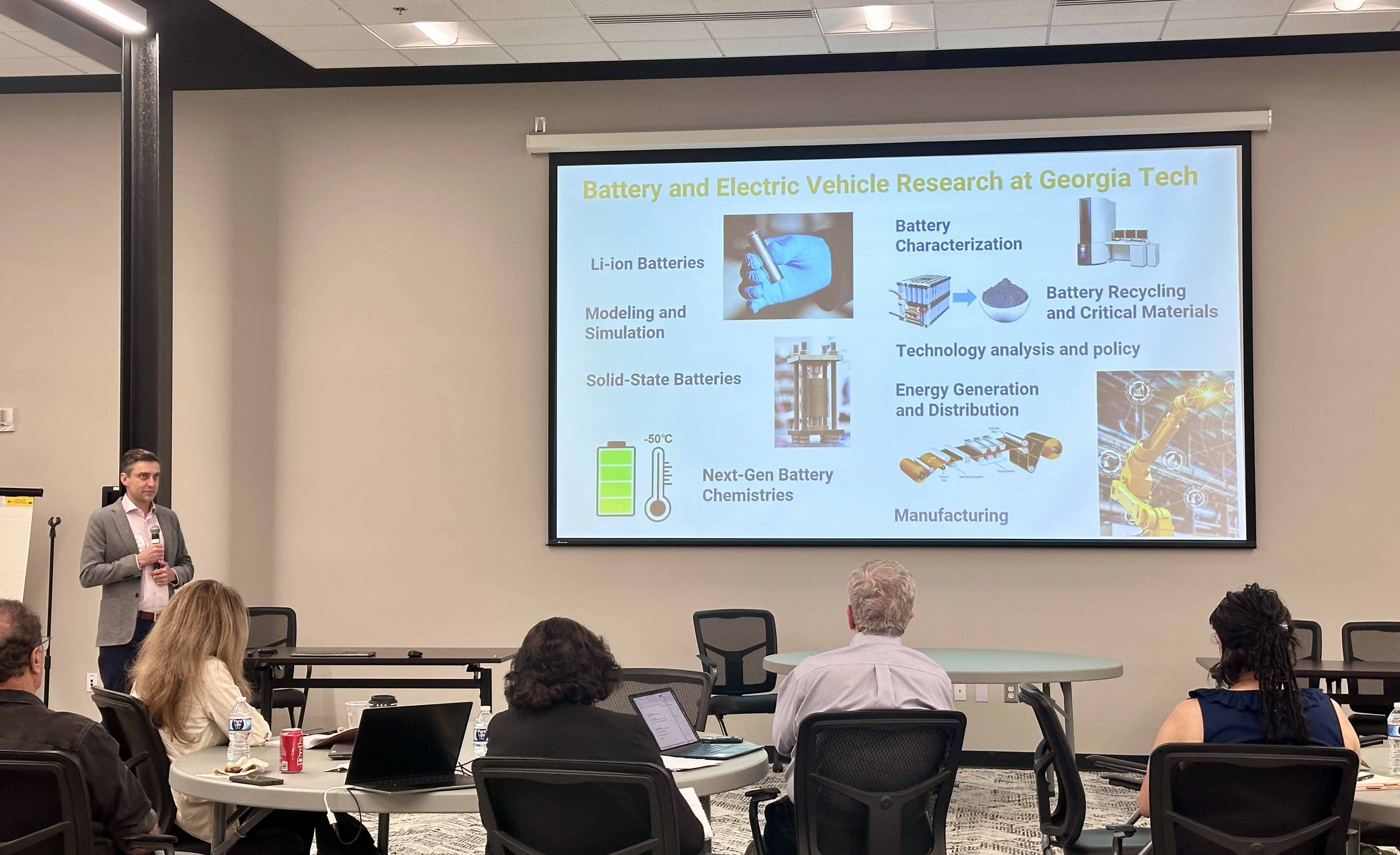
Matt McDowell, Professor at Georgia Tech at the GEMs-3 and GRACE Workshop
Written by: Yuanzhi Tang
Media Contact: Priya Devarajan | SEI Communications Program Manager
Georgia Tech Offers New Astrobiology Minor
May 08, 2025 —

Students from all majors are invited to register for the new Minor in Astrobiology at Georgia Tech. Welcoming its first enrolled students in Fall 2025, the minor is the latest degree offering from the College of Sciences and Georgia Tech Astrobiology Program.
Astrobio in focus
The Minor in Astrobiology will provide a broad, interdisciplinary introduction to the field of astrobiology while encouraging exploration beyond students’ primary fields of study.
The program will foster the development of well-rounded scientists and engineers who will graduate with confidence in their knowledge and ability to engage in cutting-edge endeavors across the astrobiology discipline.
The Minor in Astrobiology is open to all undergraduates at Georgia Tech. Students who enroll now and meet program requirements may graduate with the minor designation as early as the end of Fall 2025 term.
Enrolled students will learn about the physical and chemical conditions for development of a habitable planet; deeply understand Earth, space, and planetary science as well as the origin and evolution of life on Earth; and critically evaluate scientific issues related to astrobiology in media and popular culture.
Habitable Planet
The foundation of the new minor is the popular School of Earth and Atmospheric Sciences (EAS) course EAS 1601: Habitable Planet. Led by EAS Assistant Professor Frances Rivera-Hernández, the course enrolls up to 300 students a semester and expands options for study and career horizons.
"Students from a lot of different majors enjoy 1601 where they get a true sense for the broadness of astrobio — stars, galaxies, biology, life beyond Earth, and how we create technology and science to explore those places,” Rivera-Hernández explains.
Like the new minor, EAS 1601 is also open to all majors. The class is offered in person across fall and spring semesters, and also available online during the summer term.
“We’re purposely very flexible with that course and the overall minor,” adds EAS Jean “Chris” Purvis Professor Jennifer Glass. “Students use EAS 1601 as a launchpoint to pick their interests for their wider field of study and to hone career interests — whether that’s space, biology, and autonomous rovers; hunting for chemical signs of life beyond our planet; or becoming an entrepreneur.”
Over the past five years, students in the class frequently asked for formal degree offerings in astrobiology. Glass and fellow faculty partnered with then-graduate fellow Tyler Roche to explore the idea of a minor, leveraging Sutherland Dean's Chair funding in 2021 to officially launch the Georgia Tech Astrobiology Program in tandem with the Astrobiology Graduate Certificate Program, Astrobiology Fellows, and ExplOrigins young researcher group.
Astrobio and beyond
The Astrobiology Program is now supported by the new Georgia Tech Space Research Initiative and co-directed by Rivera-Hernández and EAS Assistant Professor Christopher E. Carr, who holds a primary appointment in the Daniel Guggenheim School of Aerospace Engineering.
Glass and Rivera-Hernández co-direct the Astrobiology Graduate Certificate Program, and co-direct the Astrobiology Minor with Nicholas Hud, Regents' Professor and Julius Brown Professor in the School of Chemistry and Biochemistry.
The team’s collaborative approach to interdisciplinary leadership mirrors unique opportunities ahead for students who are interested in exciting careers across the field of astrobiology and beyond.
“The minor is designed across three broad divisions of study,” Glass adds. “Whether you’re curious about ‘Foundations of Life,’ want to dive deep into ‘Earth, Space, and Other Worlds,’ or are exploring career ideas for ‘Astrobiology in a Wider World,’ we’ve built a solid home for you in Astrobio at Tech.”
The Minor in Astrobiology will be listed in the 2025-26 Catalog beginning May 12.
Jess Hunt-Ralston
Director of Communications
College of Sciences at Georgia Tech
(Story and Photos: Jess Hunt-Ralston)