The Physics of Heat Waves : Simple Models to Understand Temperature Variability in a Warming World

The School of Earth and Atmospheric Sciences Presents Dr. Lucas Vargas Zeppetello, Harvard University & University of California Berkeley 

The Physics of Heat Waves : Simple Models to Understand Temperature Variability in a Warming World

Student Team Wins Department of Energy EcoCAR Mobility Challenge

<p>Credit: Dept. of Energy</p>

Credit: Dept. of Energy

A team of Georgia Tech students and faculty members has won the U.S. Department of Energy’s (DOE) EcoCAR Mobility Challenge. The four-year competition tasked 11 universities with transforming a 2019 Chevrolet Blazer by adding advanced propulsion systems and automated vehicle technology. The goal was to improve the car’s energy efficiency while balancing emissions, safety, and consumer acceptability factors.

Originally a six-cylinder, the Georgia Tech team converted its Blazer to a four-cylinder hybrid vehicle with adaptive cruise control. Its vehicle-to infrastructure communication technology allows it to “talk” to stoplights and adjust its speed for optimization.

The team of approximately 60 graduate and undergraduate students represent six of the College of Engineering’s eight schools. The group also includes students from the College of Computing, Scheller College of Business, and Georgia State University.

Read the entire story on the College of Engineering website

 
News Contact

Jason Maderer
College of Engineering
maderer@gatech.edu

Georgia Tech Team Wins Solar Decathlon

<p>Group photo of the winning 2022 Solar Decathlon team.</p>

Group photo of the winning 2022 Solar Decathlon team.

The Georgia Tech student team, "English Avenue Yellow Jackets", is the 2022 Design Challenge Residential Division Grand Winner for the Department of Energy's Solar Decathlon. They also took home first place in the contest's new Retrofit Housing division. Their winning entry retrofitted a 102-year-old house in Atlanta's English Avenue neighborhood.

"The target was to retrofit an existing house to net zero," Aayushi Mody, the team lead said. "And, well, we exceeded the target by making it net positive. The house basically generates more energy than it utilizes." But, Mody explained, that's just the beginning.

In addition to a net positive retrofit, the English Avenue Yellow Jackets provided solutions for rainwater harvesting and graywater reuse, a financial model that included land trust subsidies, and an additional 60 years' worth of projected weather data that proved the house would stay net positive even in cases of extreme weather.

Full Story...

 
News Contact

Ann Hoevel, Director of Communications, College of Design

Marilyn Brown Tapped as First Woman to Receive Class of 1934 Distinguished Professor Award

Marilyn Brown is a world-leading expert on renewable energy and energy efficiency, a transformative intellectual thinker, and one of the founders of the field of energy and climate policy.

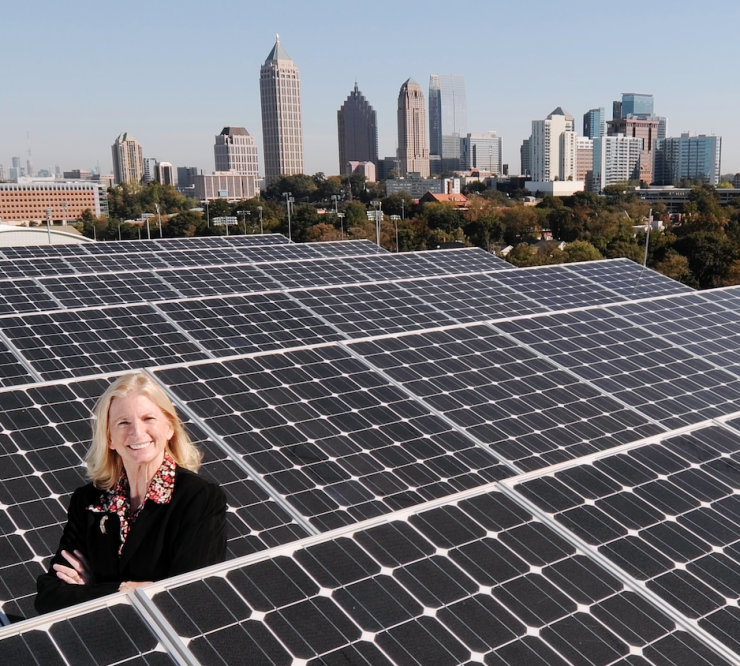
Marilyn Brown, Regents' and Brook Byers Professor of Sustainable Systems in the School of Public Policy, at the Clough Building rooftop solar panels.

Marilyn Brown is a world-leading expert on renewable energy and energy efficiency, a transformative intellectual thinker, and one of the founders of the field of energy and climate policy.

Her research has shaped energy policy in the U.S. and globally. Over the past two years, she has been tapped for several prestigious honors, including being elected to both the U.S. National Academy of Engineering and the National Academy of Sciences, and receiving the 2021 World Citizen Prize in Environmental Performance. Now, she is the first woman to receive the Georgia Tech Class of 1934 Distinguished Professor Award in the 38 years of its existence. It is the highest honor given to a Georgia Tech professor. The award is presented to a professor who has made significant, long-term contributions to teaching, research, and public service.

Brown is the Regents and Brook Byers Professor of Sustainable Systems in the School of Public Policy. She joined Georgia Tech after 22 years at Oak Ridge National Laboratory, where she directed several national climate change mitigation studies and became a leader in the analysis and interpretation of energy futures.

At Oak Ridge National Laboratory, she was the joint highest-ranking female manager. Brown was attracted to Georgia Tech after working with a high-level group of scientists from Oak Ridge, the Imperial College of London, and Georgia Tech on a project involving next-generation energy, including advanced broadband. “I really liked the people from Tech who I worked with on the project,” said Brown. “They had a can-do attitude. At other universities, they might say, ‘That can’t be done.’ The people from Georgia Tech said, ‘We’ll find a way.’” In 2006, she was encouraged to apply for the position of — and was chosen as — a full professor in the School of Public Policy in Georgia Tech’s Ivan Allen College of Liberal Arts.

Throughout her career, Brown has been known for her transdisciplinary, action-based research and linking behavior to policy. “I started my career in the physical sciences at Rutgers. “From the beginning, I brought sciences into my work and have been quantitative. It has given me the ability to span sciences and related fields,” said Brown. “I tell my students they have to be quantitative in math and the physical sciences to be effective in energy.”

The focus of her research has been on the clean energy transition — bridging engineering, social and behavioral sciences, and policy studies to advance the design, adoption, and diffusion of clean energy technologies and policies. She is particularly interested in energy disparities and work to strengthen energy infrastructure, especially in areas of financial need. “It is all about the diffusion of innovation to the benefit of all,” she said.

Drawdown Georgia

Brown also leads the research program Drawdown Georgia, which she helped to create with the inspiration and funding of the Ray C. Anderson Foundation. Georgia Tech alumnus Ray C. Anderson was founder and chair of Interface Inc., and a pioneer in sustainability.  

Drawdown Georgia was created and is being conducted in partnership with Emory University, the University of Georgia, and Georgia State University, as well as the Southface Institute, the Partnership for Southern Equity, and Greenlink Analytics.

Drawdown Georgia has identified a roadmap to significantly cut Georgia’s greenhouse gas emissions and achieve carbon neutrality. The Drawdown Georgia study, localized for Georgia’s urban and rural areas, was published in the Proceedings of the National Academy of Sciences in 2021. The plan identified technology and practices that could resonate with individuals, towns, and corporations throughout the state, including ways to bring more clean energy resources and technologies to rural Georgia and help people use limited resources more efficiently.

Through collaboration with the Scheller College of Business, 25 Georgia CEOs from throughout the state agreed to join Drawdown Georgia. The project includes a dashboard of emissions by Georgia’s 159 counties, tracked monthly. The next step will be to track implementation of the 20 solutions in the plan, measuring investments by counties, and the use of electric vehicles, rooftop solar systems, alternative transportation, recycling, composting, afforestation, and silvopasture — the integration of trees and livestock operations on the same land.

Sustainability as a Way of Life

When asked what she wishes people knew about sustainability, Brown said, “Sustainable technologies and behaviors are not costly. They can be good for your pocketbook. Consider the home refrigerator. Twenty-five years ago, it consumed 2,000 kilowatt hours a year. Today it requires less than 600 kWh, and they don’t cost any more than they used to. People just have to be smart about what they choose and pay attention to cradle-to-grave resource issues.”

Brown also lives her values. At her home, she grows vegetables and composts, has rooftop solar, a Tesla Powerwall battery, and uses heat pumps for water heating, air conditioning, and heat. Her family has an energy focus. Her husband, Frank Southworth, is an adjunct professor in the School of Civil and Environmental Engineering at Tech, and an accomplished transportation planner. Their daughter, Katie Southworth, is an attorney with Southface Energy Institute.

Working with Students

Brown created and co-leads the Climate and Energy Policy Lab in the School of Public Policy at Tech. She developed the Master of Sustainable Energy and Environmental Management degree. She has advised 19 Ph.D. students, many of whom have gone on to leading roles in government agencies, academia, and industry.

She is known as an excellent mentor, communicator, and educator, inside and outside of the classroom. She challenges students to expand their knowledge and excel in their project work while developing their confidence and leadership skills. She has been described as generous with her time in providing students with guidance on professional development. As she was one of very few women in her field when she began her career, she has been purposeful about mentoring women.

Background

Brown earned her Bachelor of Arts degree in political science from Rutgers University, and a Master of Regional Planning degree from the University of Massachusetts. She holds a Ph.D. from The Ohio State University in geography, with a minor in quantitative methods. Before joining Oak Ridge National Laboratory, she was an associate professor of geography at the University of Illinois, the first woman to earn tenure in geography there. Previously, she was a lecturer in the Department of Geography and Geology at Ohio Wesleyan University.

She has authored six books and more than 250 publications, and contributed to the United Nations 2007 Intergovernmental Panel on Climate Change (IPCC), a joint winner of the Nobel Peace Prize that year. Her work has had significant influence and visibility in the policy arena as evidenced by her impact on policies and programs, such as the Kyoto Protocol and the U.S. Department of Energy’s Weatherization Assistance Program, and briefings and testimonies before state legislative and regulatory bodies, committees of both the U.S. House of Representatives and Senate, and numerous international organizations.

Brown served two terms (2010-2017) as a presidential appointee and U.S. Senate-confirmed regulator on the board of directors of the Tennessee Valley Authority (TVA), the nation’s largest public power provider. At TVA, she contributed to reducing TVA’s CO2 emissions by 60% over a 15-year period. She also chaired for eight years the Nuclear Oversight Committee, which was responsible for bringing the most recent nuclear unit into commercial operation in the U.S., in 2016 at Watts Bar in Tennessee.

Reflecting her commitment to the role of demand-side management, Brown co-founded the Southeast Energy Efficiency Alliance (SEEA), chaired its board of directors for several years, hired its first executive director, and provided SEEA’s first office space at Georgia Tech.

Quotes from Colleagues and Former Students

“In her work, she conceptualizes the coevolution of technology and society, with an emphasis on the formation of a set of unsustainable systems for the provision of energy, food, mobility, water, and other areas — and the construction of new sustainable alternatives that may become the foundation for the formation of a new set of systems. However, rather than adhering to a narrow interpretation and application of geography and economics, her background, she uses sociotechnical insights to inform her research and sheds light on the complex processes of societal transformation needed for addressing the climate and biodiversity crises as well as steep inequalities. In short, she draws on science to make extremely compelling and insightful contributions to addressing contemporary challenges.”

Benjamin Sovacool
University Distinguished Professor of Business and Social Sciences – Aarhus University, Denmark
Professor of Energy Policy, Science Policy Research Unit – University of Sussex Business School, United Kingdom

“Dr. Brown’s contributions to the school and Institute extend beyond her own record to also include those of her students, who are excelling and driving important work both in and out of academia. Her students have founded startups in the explosive new climate tech field, lead energy and climate policy for major corporations like Google, work at multiple energy commissions at the state and federal level in regulatory staff roles, lead new areas of research in economics and policy in research centers across the world, and recently, one of her students was appointed as a deputy assistant secretary at the U.S. Department of Energy. I don’t believe that it is a coincidence that this group of exceptional people all happened to emerge from the same lab at Georgia Tech. Dr. Brown played a formative role in helping develop the attitudes and thought processes that have enabled her students’ success and grown the influence of Georgia Tech around the globe.”

Matt Cox
CEO and Founder, Greenlink Analytics

“Marilyn challenges students to reflect on what can be done to show impact and relevance. She challenges students and collaborators to identify gaps in research that need to be addressed to advance science and discovery. Marilyn has had an exemplary career in teaching, research, and service, and her impact is significantly amplified by the hundreds of students and collaborators she has developed into the current and future generation of research and policy leaders and mentors.”

Melissa V. Lapsa
Building Technologies Program Manager
Energy Science and Technology Directorate
Oak Ridge National Laboratory

“Marilyn led by example as a Clean Energy and Education Empowerment (C3E) ambassador who sought to inspire the next generation of clean energy practitioners and researchers. I have always been impressed by the way Marilyn brought her intellectual acumen, strong moral compass, and sound judgement to bear on the deliberations and decision making with the wide range of different stakeholders involved in C3E. Moreover, Marilyn always made it a point to recognize the work of women researchers in academia and national laboratories in terms of the impact and importance of their contributions.”

Ellen Morris
Director, University Partnerships
NREL (a national laboratory of the U.S. Department of Energy)

“The regularly scheduled Friday meetings of students and faculty at Dr. Brown’s direction were among the most innovative and rigorous discussions of clean energy policy and economic analysis anywhere.”

“Through both her body of work and numerous former students who work at or with the [Georgia Public Service Commission], she has a major indirect influence on the direction of utility regulation in this state and around the country.”

Benjamin H. Deitchman
Utility Analyst, Georgia Public Service Commission
Georgia Tech, Ph.D. in Public Policy, 2014

This story originally appeared in the Georgia Tech News Center.

Marilyn Brown, Regents' and Brook Byers Professor of Sustainable Systems<strong> </strong>in the School of Public Policy, at the Clough Building rooftop solar panels.
 
News Contact

Patti Futrell
Faculty Communications Program Manager

With Recent Funding, Sea Level Sensor Project in Savannah Moves into New Phase

<p>An aerial view of the Georgia Coast.</p>

An aerial view of the Georgia Coast.

The rising sea levels along Georgia’s Savannah coast and an uptick in more severe storms during hurricane season are bellwethers to looming ecological challenges stemming from climate change.

Ongoing research to study sea level rise led by Georgia Tech researchers, a coalition of universities, Savannah and Chatham County government leaders, and local community groups is creating what could be a national model for coastal regions across the country facing similar challenges.

Launched in 2018 with a Georgia Smart Communities Challenge Grant, the data collected from the sea level sensors is used to inform city and county planners and emergency responders on resource deployment following major weather events.

The project, in its fourth year, is now slated to receive $5 million from Congress. It is secured by U.S. Sens. Jon Ossoff and Raphael Warnock, and U.S. Rep. Earl L. “Buddy” Carter to expand the network of sensors — currently 50 are deployed off Chatham County’s coast — to blanket Georgia’s 11-county coastal region.

“With this new funding, we are recognizing a new phase of our project which has evolved,” said Kim Cobb, director of Georgia Tech’s Global Change Program and a professor who studies climate, oceanography, and weather in the School of Earth and Atmospheric Sciences.

Cobb and Russell J. Clark, senior research scientist in the School of Computer Science at Georgia Tech’s College of Computing, co-lead the project. Allen Hyde, assistant professor in the School of History and Sociology in Georgia Tech’s Ivan Allen College of Liberal Arts, leads a National Science Foundation project focused on youth disaster resilience as part of the effort.

The funding will support expansion of building out more hyperlocal flood forecasting models, resilience planning tools for underserved communities, and further development of a K-12 education curriculum, paid internships, and other workforce development programs.

Georgia Tech and its partners — which includes Savannah State University, the University of Georgia, and the University of South Carolina — is using these low-cost sensors to gain real-time data that over time will help inform the policies on infrastructure design and retrofitting, Cobb said. It will also further expand first responders and emergency planners’ ability to forecast extreme rainfall and storm surge events on a neighborhood-by-neighborhood specific basis.

“It's going to translate into a saved lives and saved infrastructure,” Cobb said.

A National Model
Hub researchers say the data being collected from the sensors and additional information gleaned from the sensor expansion has immediate applications in terms of flood disasters and hurricanes. Those findings over the long-term could also help frame the national dialogue and help inform policy as leaders in Washington shape it to tackle rising sea levels and climate change.

The award is part of a broader federal push, including a $12 billion funding package, to help Georgia and other states along the Eastern Seaboard, as well as the West and Gulf coasts, develop resiliency and flooding plans and protocols to mitigate damage from future floods.

Cobb said this new funding allows the Hub to further efforts in its research that further expands education and workforce development — particularly in underserved minority communities — as components of the broader strategy.

“Our project started out anchored on the sensors and trying to provide real-time data to emergency planners and emergency response responders, but it’s no longer just a small team of people who are interested in sensors or physical scientists, engineers and researchers on the science and technology side,” she said, explaining the research team of some 30 people also includes policy and planning experts, along with community advocates.

“We're trying to think about solutions in the context of history, geography, — the history of people, cultures, and economies down on the coast,” Cobb said. “There’s no waving a magic wand and making this all right, especially for the most vulnerable communities.”

Community Voice
In broad terms, the project touches flooding, infrastructure, property, and pollution. But this newer phase brings in aspects that go beyond scientific modeling of risk, said Dean Hardy, an assistant professor in the University of South Carolina’s Department of Geography.

It’s what he calls the “human dimension” phase.

“There are disaster plans, there's resiliency plans, and there's community level thinking. But what we need is systemic change,” said Hardy, whose research expertise is in geography and integrative conservation, which marries preservation and social and community goals with public policy.

“So, what I hope partially comes out of this is not just a bunch of scientific publications or better scientific understanding of these issues, but capacity-building with community organizations that leads to the capacity for self-determination.”

That acknowledgement is important to marginalized communities, said Dawud Shabaka, interim director of Harambee House, in Savannah. The organization, which is involved in the sensor project, promotes and advocates for civic engagement from the coastal city’s Black residents and youth.

Shabaka noted that the engagement component, particularly local high school and middle school students working on the sensors and coding, has allowed the participants to see themselves not only as budding scientists, but as future community leaders.

“When you’re dealing with or managing or mitigating an issue that’s affecting society, it’s got to involve research and dialogue with the community. This project is allowing us to recognize that the community themselves are the subject matter experts,” said Shabaka. “Having the students involved at an early age, benefits society as a whole and lets them know that the work they’re doing is having a much wider impact. This is the type of community engagement that needs to happen to make people feel like they’re worthwhile.”

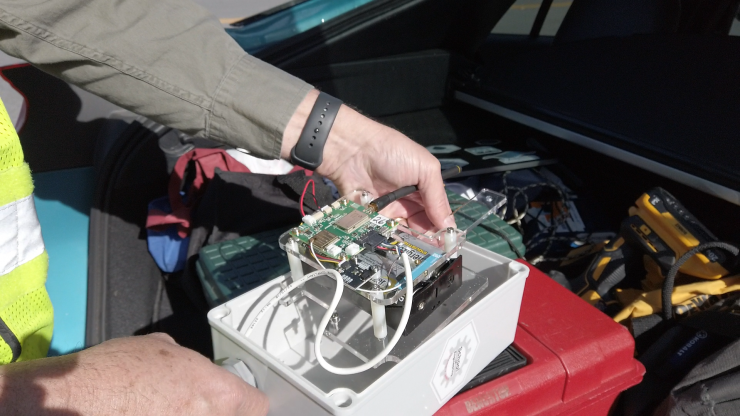
<p>A close-up view of the sensor being used to monitor sea levels off the Georgia Coast.</p>

A close-up view of the sensor being used to monitor sea levels off the Georgia Coast.

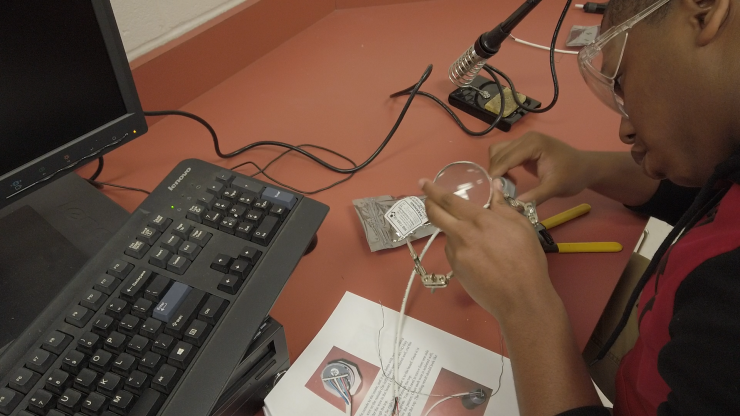
<p>Students from Savannah's Herschel V. Jenkins High School get hands-on experience in studying the sea level sensors, data analysis, and interpreting the results.</p>

Students from Savannah's Herschel V. Jenkins High School get hands-on experience in studying the sea level sensors, data analysis, and interpreting the results.

 
News Contact

Péralte C. Paul
peralte.paul@comm.gatech.edu
404.316.1210

9 Student Groups With Sustainable Missions

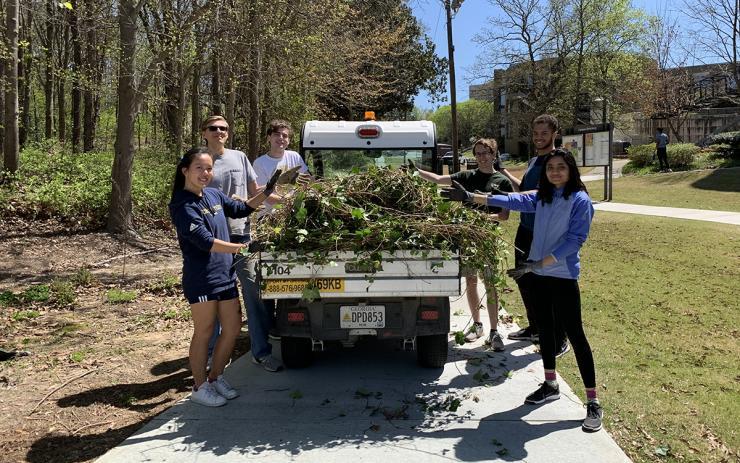
<p>Volunteers from Students Organizing for Sustainability remove ivy from an area near The Kendeda Building for Innovative Sustainable Design in April 2022.</p>

Volunteers from Students Organizing for Sustainability remove ivy from an area near The Kendeda Building for Innovative Sustainable Design in April 2022.

As Earth Day approaches, it’s a great time to look for new ways to get involved with sustainability efforts on campus. Tech students have a long history of being good stewards of the Earth’s resources and looking for ways to promote environmentally conscious practices.

Here are nine groups to look at if you want to get involved. To stay plugged in to all campus events, visit calendar.gatech.edu or engage.gatech.edu.

Students Organizing for Sustainability

This group has been active on campus for many years. One of its most visible initiatives is the Community Garden located on the Instructional Center Lawn. The group also hosts guest speakers and assists with invasive species removal on campus.

Association for Sustainable Investment

This group combines interest in sustainability and finance to promote investment in climate solutions and educate students about sustainable finance and fossil fuel divestment. The group hosts guest speakers, debates, and podcast discussions.

Trailblazers

The purpose of Trailblazers is to increase appreciation for the outdoors through trail adventure and exploration. The group coordinates trips that combine service, such as park cleanup or tree planting, with outdoor recreation. They also assist with on-campus projects such as invasive species removal. Trailblazers welcomes students, faculty, and staff to participate in its events.

Energy Club

The Energy Club’s premier event is its annual conference, which took place earlier this month. They also host weekly “energy chats” where an invited speaker will present on an area of their work in the energy landscape, focusing on topics that touch on technology, economics, and policy.

Solar Racing

Solar Racing designs and builds solar-powered race cars for track and cross-country competitions worldwide. The group recently built a vehicle that completed the American Solar Challenge last fall. Students of all experience levels and backgrounds are invited to participate and learn about solar vehicles — and have fun.

Engineers Without Borders (EWB)

The Tech student chapter, EWB-GT, is a chapter of EWB-USA, a nonprofit humanitarian organization. The goal of this group is to support community-driven development projects worldwide through partnerships that design and implement sustainable engineering projects. The Georgia Tech group has four ongoing projects in communities around the world.

IEEE PES

The IEEE Power and Energy Society is the oldest society of the Institute of Electrical and Electronics Engineers (IEEE), the world’s largest technical professional organization. IEEE PES at Georgia Tech is a student branch of the national organization. The group’s events are focused on the power and energy sectors and include group meetings, guest speakers, and networking opportunities.

Veggie Jackets

This group is designed for vegetarian and vegan students, offering many occasions to share meals together, including potlucks and other events. The group also hosts documentary viewings that focus on how eating habits can affect the Earth.

Effective Altruism

This group hopes to have its members maximize the positive impact they can have on the world and tackle some of the  greatest challenges, including extreme climate change, mitigating the next pandemic, and human-compatible AI. The group focuses on making professional connections to work that addresses these global challenges.

 
News Contact

Kristen Bailey

Institute Communications

Who’s Down for Earth Day?

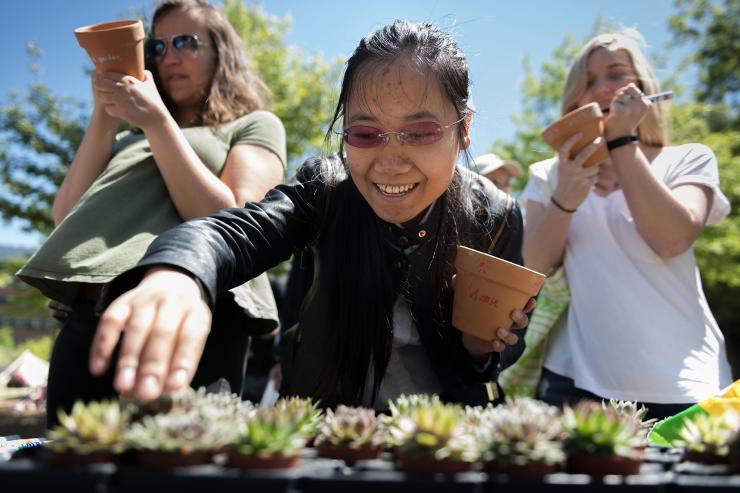
<p>Students select succulents at a 2018 Earth Day event. Photo by Allison Carter</p>

Students select succulents at a 2018 Earth Day event. Photo by Allison Carter

This year marks the 25th anniversary of celebrating Earth Day at Georgia Tech. A four-day schedule of events is planned for this campuswide program to celebrate nature, the preservation of our planet, and the Georgia Tech community’s contributions to campus sustainability. A few events are already collecting items or have opened registration — so get a head start on your Earth Day plans.

The keynote event on Monday, April 18, features Maria Cimilluca, vice president of Infrastructure and Sustainability, who will share the path forward for sustainability at Georgia Tech. The event will also feature the presentation of the Student Sustainability Champion Award. Register here.

If sustainable transportation is your thing, you can join a Group Bike Ride led by President Ángel Cabrera on Tuesday, April 19. The 4.75 mile ride requires registration and will begin in front of the Campus Recreation Center. 

If you are more tuned in to understanding campus waste streams, join the Student Government Association’s Sustainability Committee and the Office of Solid Waste Management and Recycling on Tuesday, April 19, to assist with conducting a waste audit of the Clough Undergraduate Learning Commons. You will see firsthand how recycling and composting services support Georgia Tech’s goals to achieve zero waste.

If understanding and protecting nature fits more with your passions, register for a bird walk led by a subject matter expert and learn about which birds prefer to make their homes on campus. In partnership with Georgia Audubon and The Kendeda Building for Innovative Sustainable Design, the walk begins at 9 a.m. on Wednesday, April 20.

The week rounds out with the Sustainability Fair, which showcases student groups and campus departments such as Tech Dining, Landscape Services, and Building Services, highlighting the ways campus operations support sustainable initiatives. The Urban HoneyBee Project and the Georgia Tech Global Change Program will offer opportunities to get involved and be a part of the climate solution. Table registration for the Fair closes Friday, so register for a spot to showcase your organization's work supporting campus sustainability.

The Hard to Recycle Materials Dropoff and the Clothing Swap will take place on the lower level of The Kendeda Building from 10 a.m. to 4 p.m. each day. Clothing can be donated for the swap at Housing locations through Monday, April 11.

Most importantly, the Earth Day planning committee would love your help. Volunteer to help make this 25th anniversary event a success.

 
News Contact

Cathy Brim
Institute Communications

Candidates Sought - BBISS Graduate Fellowship for Sustainability Research

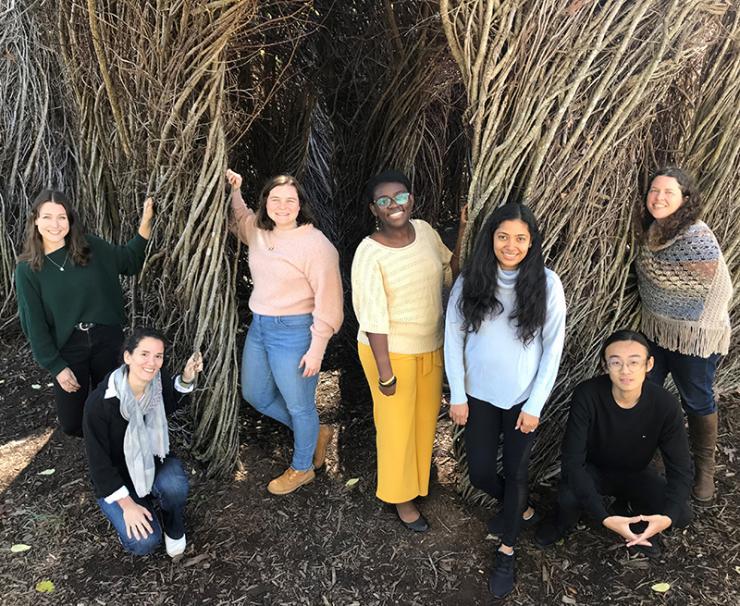
<p>Group photo of the first class of BBISS GRA Scholars in front of the EcoCommons Patrick Dougherty Sculpture installation. They are Katherine Duchesneau, Ioanna Maria Spyrou, Meaghan McSorley, Bettina Arkhurst, Udita Ringania, Yilun 'Elon' Zha, and Marjorie Hall.</p>

Group photo of the first class of BBISS GRA Scholars in front of the EcoCommons Patrick Dougherty Sculpture installation. They are Katherine Duchesneau, Ioanna Maria Spyrou, Meaghan McSorley, Bettina Arkhurst, Udita Ringania, Yilun 'Elon' Zha, and Marjorie Hall.

The Brook Byers Institute for Sustainable Systems (BBISS) Fellowship for Sustainability Research Program is recruiting PhD-seeking students of exceptional potential with a diversity of intellectual interests for our second class of fellows. With the support of a faculty advisory board, the fellows will work, study, and train as an interdisciplinary team on a program of research that aligns with the priorities of the BBISS and contributes to their personal development as future leaders in sustainability.

This fellowship pays a stipend, graduate student health benefits, and tuition remission for up to two full years. It is expected that 6 to 8 fellows will be selected for the program each academic year. The first class of 7 fellows was selected in Spring 2021 and began the program in Fall 2021.

To apply, students must be nominated by a faculty member from the Georgia Tech academic unit in which they are enrolled in the PhD program or to which they are applying for acceptance to the PhD program. The nominating faculty member will serve as the 
student’s faculty advisor, and commits to serving on the BBISS Graduate Fellowship Faculty Advisory Board. Nomination packets should be submitted by April 15, 2022.

Please help spread the word. Share this opportunity widely with faculty and students.

 
News Contact

Michael Chang, Deputy Director, BBISS

Georgia Tech Researchers Monitor Campus Biodiversity with Machine Learning

Since June, Lalith Polepeddi and Akhil Chavan have been using their skills in computer science and machine learning to help study biodiversity in Georgia Tech’s new EcoCommons.

Both research staff at the Georgia Tech Global Change Program, Polepeddi and Chavan teamed up to apply for a micro research grant from the Kendeda Living Building last summer. The grants empower research and innovation at a student, staff, and faculty level through small, accessible, amounts of seed funding.

Georgia Tech Researchers Monitor Campus Biodiversity with Machine Learning

Wildlife image captured by game camera.

Since June, Lalith Polepeddi and Akhil Chavan have been using their skills in computer science and machine learning to help study biodiversity in Georgia Tech’s new EcoCommons.

Both research staff at the Georgia Tech Global Change Program, Polepeddi and Chavan teamed up to apply for a micro research grant from the Kendeda Living Building last summer. The grants empower research and innovation at a student, staff, and faculty level through small, accessible, amounts of seed funding.