
IBB Seminar
Tanu Thote
Field Medical Lead
Theratechnologies
Georgia Tech Life Sciences Investor Forum
**Registration is by invitation only.
Investor Registration Portal
AGENDA
7:30 a.m. Check-in
7:40 a.m. Continental Breakfast | Networking
8:15 a.m. Welcome - Andrés García, Executive Director, IBB
Georgia CTSA - Lunch & Learn Series with Informatics Experts
REGISTER HERE for link to participate
Babak Mahmoudi
Associate Professor
Biomedical Informatics
Emory University School of Medicine
Tiny Fans on the Feet of Water Bugs Could Lead to Energy Efficient, Mini Robots
Aug 21, 2025 —
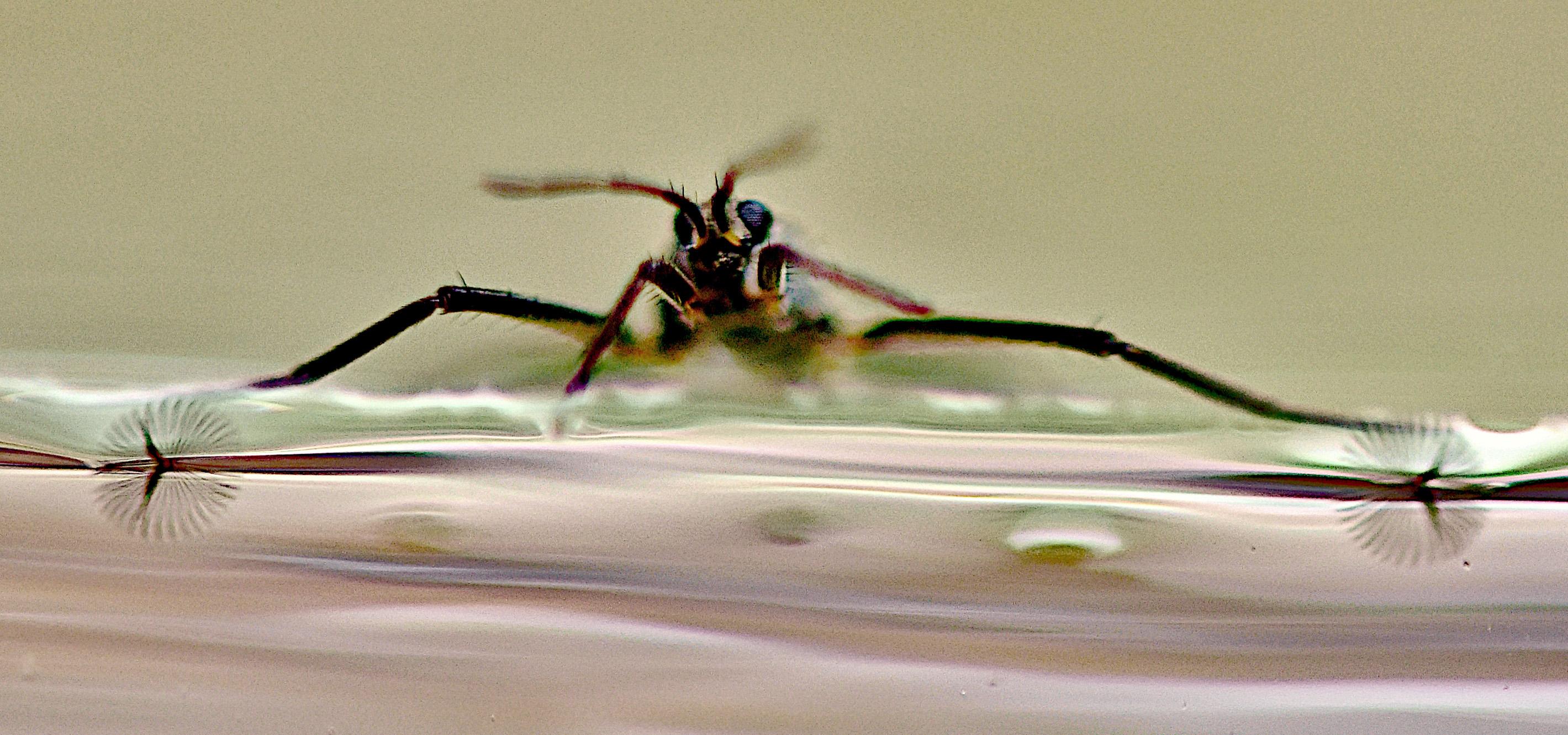
A new study explains how tiny water bugs use fan-like propellers to zip across streams at speeds up to 120 body lengths per second. The researchers then created a similar fan structure and used it to propel and maneuver an insect-sized robot.
The discovery offers new possibilities for designing small machines that could operate during floods or other challenging situations.
Instead of relying on their muscles, the insects about the size of a grain of rice use the water’s surface tension and elastic forces to morph the ribbon-shaped fans on the end of their legs to slice the water surface and change directions.
Once they understood the mechanism, the team built a self-deployable, one-milligram fan and installed it into an insect-sized robot capable of accelerating, braking, and maneuvering right and left.
The study is featured on the cover of the journal Science.
Read the entire story and see the robot in action on the College of Engineering website.
Jason Maderer
College of Engineering
maderer@gatech.edu
New NIH-Funded timsTOF HT Mass Spectrometer Boosts Proteomics Power in Georgia Tech IBB Core Facilities
Aug 21, 2025 —
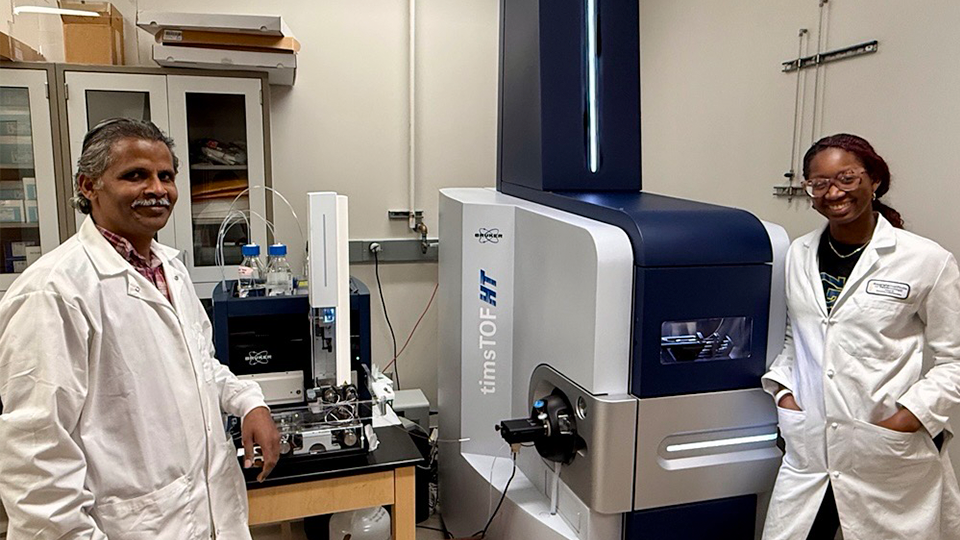
The Systems Mass Spectrometry Core (SyMS-C) at the Georgia Institute of Technology proudly announces the acquisition and installation of a cutting-edge Bruker timsTOF HT mass spectrometer integrated with a nanoElute2 liquid chromatography system. This transformative addition, funded by a prestigious S10 Shared Instrumentation Grant from the National Institutes of Health (NIH) and led by Matthew Torres, associate professor in the School of Biological Sciences, reinforces Georgia Tech’s leadership in pioneering proteomics research.
The timsTOF HT is a next-generation mass spectrometer that combines trapped ion mobility spectrometry (TIMS) with high-resolution quadrupole time-of-flight (qTOF) mass analysis to dramatically improve sensitivity, specificity, and throughput. Unlike traditional mass spectrometers, it uses dual TIMS funnels to separate ions by size-to-charge (rather than only mass-to-charge), enabling an added dimension of separation for complex biological samples. The system employs a method called PASEF (Parallel Accumulation–Serial Fragmentation), which synchronizes ion separation, isolation, and fragmentation to dramatically boost speed and depth of proteome coverage. TIMS also distinguishes between isobaric species—such as phosphopeptide positional isomers or structural isomers—that are indistinguishable by standard mass spectrometry alone. Because it stores and organizes ions rather than filtering them destructively, the timsTOF HT is especially well suited for sensitive and high-throughput omics applications, including plasma and tissue proteomics. As a result, it represents a transformative platform for biological discovery across a wide range of research areas.
Funded by the NIH S10 grant, this acquisition empowers the SyMS-C to support a wide range of research initiatives across Georgia Tech and its collaborative partners. The timsTOF HT’s advanced capabilities, including dia-PASEF® and prm-PASEF® acquisition modes, will accelerate discoveries in biomarker identification, single-cell proteomics, and multiomics applications, addressing critical challenges in understanding disease mechanisms and developing novel diagnostics and therapies.
“We are thrilled to integrate the Bruker timsTOF HT and nanoElute2 into our Systems Mass Spectrometry Core,” said Rakesh Singh, director of the proteomics services at SyMS-C. “This advanced platform will enable our researchers to push the boundaries of proteomics, providing deeper insights into cellular mechanisms and supporting transformative biomedical research. We are deeply grateful to the NIH for their support through the S10 grant, which makes this cutting-edge technology accessible to our scientific community.”
The installation of the timsTOF HT and nanoElute2 systems enhances the ability of SyMS-C to serve as a hub for interdisciplinary research, offering access to faculty, students, and external collaborators, including those within the Georgia Research Alliance and regional academic and clinical institutions. The core facility will provide technical expertise, consultation, and data analysis support to ensure researchers can fully leverage the system’s capabilities. The SyMS-C anticipates that the new instrumentation will drive high-impact research, contributing to breakthroughs in personalized medicine, cancer research, and neurodegenerative disease studies. For more information about the Systems Mass Spectrometry Core or to inquire about access to the Bruker timsTOF HT and nanoElute2 systems, please contact Rakesh Singh.
Georgia Tech, Shepherd Center Award Inaugural Seed Grants
Aug 21, 2025 —
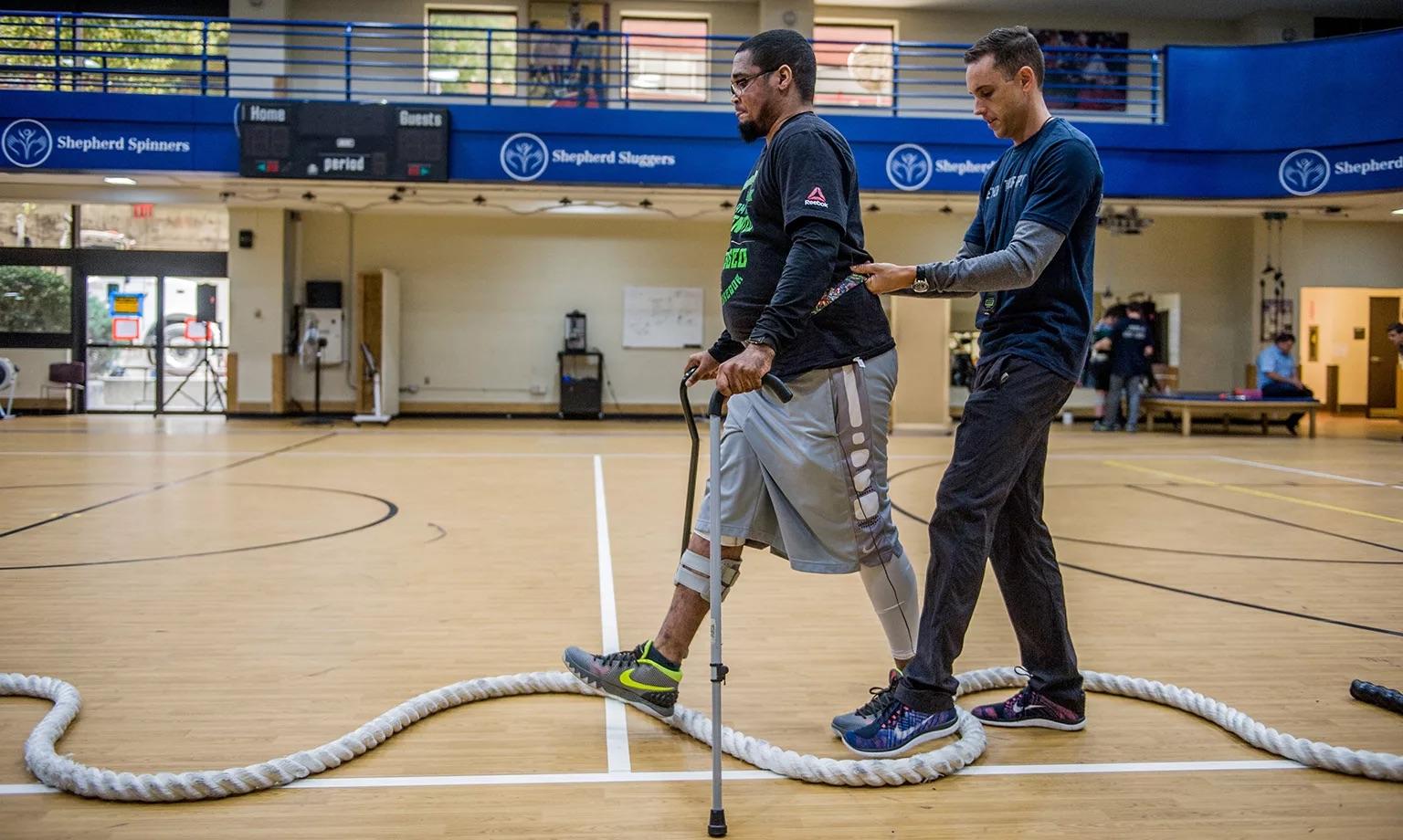
The seed grants will fund projects focused on enhancing wheelchair seating surfaces, supporting stroke patients as they transition home from rehabilitation, assessing lower limb exoskeleton technologies, and exploring the use of AI in remote rehab settings. Photo: Shepherd Center.
Georgia Tech and Shepherd Center recently awarded four seed grants totaling nearly $200,000 to researchers focusing on projects that will advance discoveries in neurorehabilitation, including acquired brain injury, spinal cord injury, multiple sclerosis, chronic pain, and other neurological conditions.
The Georgia Tech-Shepherd Center Seed Grant Program is part of an ongoing partnership between the two institutions that started in 2023 with the goal of advancing rehabilitative patient care and research.
“The seed grant program is intended to stimulate new interdisciplinary research collaborations by providing seed funding to obtain preliminary data or prototypes necessary for the submission of an external grant or industry opportunities,” says Deborah Backus, vice president of Research and Innovation at Shepherd Center. “As two leading research institutions, we know the potential for advancing rehabilitation therapies is even greater when we work together. We look forward to the solutions, treatments, and therapies that emerge from these initial seed grants.”
Experts from both institutions evaluated and scored seed grant applications based on the research’s innovation, approach, and potential for training opportunities, as well as its anticipated impact, prospects for commercial translation, and strategy for securing continued funding. This year, each awardee team received close to $50,000.
“We are very excited to launch this new seed grant program, which will spur ideas and propel research forward,” said Michelle LaPlaca, professor in the Coulter Department of Biomedical Engineering and the Georgia Tech lead of the Collaborative. “The complementary expertise of Georgia Tech and Shepherd Center researchers, combined with the motivation to find solutions for individuals with neurological injury and disability, is a winning formula for innovation.”
"Offering new hope for neurorehabilitation patients requires bringing together interdisciplinary researchers to explore new and creative ideas,” adds Chris Rozell, Julian T. Hightower Chaired professor in the School of Electrical and Computer Engineering and the inaugural executive director of the Institute of Neuroscience, Neurotechnology, and Society (INNS) at Georgia Tech. “I'm excited to see the talent at these world class institutions coming together to develop new solutions for these complex problems."
This year’s seed grants were awarded to the following projects:
- Proof of Concept Development of the Recovery Cushion – Stephen Sprigle, professor, School of Industrial Design and School of Mechanical Engineering, Georgia Tech; Jennifer Cowhig, research physical therapist, Shepherd Center.
- Paving a Smooth Path from Hospital to Home: A Feasibility Study of an Integrated Smart Transitional Home Lab to Support Stroke Rehabilitation Patients’ Transition to Home – John Morris, senior clinical research scientist, Shepherd Center; Hui Cai, professor in the School of Architecture, executive director of the SimTigrate Design Center, Georgia Tech.
- A Comparative Analysis of Lower-Limb Exoskeleton Technology for Non-Ambulatory Individuals with Spinal Cord Injury – Maegan Tucker, assistant professor, School of Electrical and Computer Engineering and School of Mechanical Engineering, Georgia Tech; Nicholas Evans (AP 2023), clinical research scientist, Shepherd Center.
- Improving Accessibility and Precision in Neurorehabilitation at the Point of Care with AI-Driven Remote Therapeutic Monitoring Solutions – Brad Willingham, clinical research scientist, director of Multiple Sclerosis Research, Shepherd Center; May Dongmei Wang, professor, Wallace H. Coulter Department of Biomedical Engineering, Georgia Tech.
Kerry Ludlam
Director of Communications
Shepherd Center
Audra Davidson
Research Communications Program Manager
Institute for Neuroscience, Neurotechnology, and Society
Georgia CTSA - K-Club
REGISTER Here for in-person (by September 5) or for Zoom link for virtual participation
IBB Postdoc Coffee Hour
Join us for coffee and treats to recognize your hard work and dedication to IBB research. Join the raffle 🎟️ for IBB branded items, mix and mingle with other postdocs, and take a well deserved break!
Thank you for being an important part of our bio-community!
Breakfast Club Seminar
Jennifer Singh
Associate Professor and Associate Chair
School of History and Sociology
Georgia Tech
Breakfast Club Seminar
Andrew McShan
Assistant Professor
School of Chemistry and Biochemistry
Georgia Tech